Alexandria's founded by Alexander

Alexandria's founded by Alexander the Great (by year BC): 334 Alexandria in Troia (Turkey) - 333 Alexandria at Issus/Alexandrette (Iskenderun, Turkey) - 332 Alexandria of Caria/by the Latmos (Alinda, Turkey) - 331 Alexandria Mygdoniae - 331 Alexandria (Egypt) - 330 Alexandria Ariana (Herat, Afghanistan) - 330 Alexandria of the Prophthasia/in Dragiana/Phrada (Farah, Afghanistan) - 330 Alexandria in Arachosia (Kandahar, Afghanistan) - 330 Alexandria in the Caucasus (Begram, Afghanistan) - 329 Alexandria of the Paropanisades (Ghazni, Afghanistan) - 329 Alexandria Eschate or Ultima (Khodjend, Tajikistan) - 329 Alexandria on the Oxus (Termez, Afghanistan) - 328 Alexandria in Margiana (Merv, Turkmenistan) - 326 Alexandria Nicaea (on the Hydaspes, India) - 326 Alexandria Bucephala (on the Hydaspes, India) - 325 Alexandria Sogdia - 325 Alexandria Oreitide - 325 Alexandria in Opiene / Alexandria on the Indus (confluence of Indus & Acesines, India) - 325 Alexandria Rambacia (Bela, Pakistan) - 325 Alexandria Xylinepolis (Patala, India) - 325 Alexandria in Carminia (Gulashkird, Iran) - 324 Alexandria-on-the-Tigris/Antiochia-in-Susiana/Charax (Spasinou Charax on the Tigris, Iraq) - ?Alexandria of Carmahle? (Kahnu)
Showing posts with label Amyntas-father-of-Philip-II). Show all posts

Monday, June 30, 2025

The case of Alexander of Lyncestis

The name Alexander is already very popular in the days of Alexander the Great and may lead to confusion. 

For a start, there was King Alexander of Epirus, Olympias brother and Alexander’s uncle. I usually refer to him as Alexandros to make the difference. He is the one who married Alexander’s sister Cleopatra in 336 BC, the day King Philip of Macedonia was assassinated. 

Then there is Alexander of Lyncestis, in Upper Macedonia, son of Aeropus and son-in-law of the general and later regent Antipater. He had two brothers, Heromenes and Arrhabaeus, who were soon accused of plotting the murder of Philip II and put to death. Brother Alexander is said to have been the first to proclaim Alexander of Macedonia as king and thus avoided punishment, for now at least. 

In Alexander’s campaign, the Lyncestian was soon appointed to command the Thracian detachment and later the Thessalian cavalry. However, two years later, Parmenion, who was spending the winter near Gordion, caught a messenger carrying a secret letter from the Persian King Darius for Alexander of Lyncestis. It revealed that Darius promised to pay him a thousand talents of gold to kill Alexander and would proclaim him King of Macedonia instead! Parmenion sent the messenger with a trusted escort to Alexander, where the man repeated the same story. 

This was an extremely serious matter that Alexander put before his assembled Companions in order to make the appropriate decision. It was agreed to send a trusted man, a brother of Craterus, to Parmenion. He would travel incognito, dressed as a local and accompanied by guides from Perge, and deliver his message verbally, as it was thought better not to write down anything on a matter of this importance. Alexander’s envoy reached Parmenion without being detected and reported the instructions he was carrying. Alexander of Lyncestis was arrested and put in chains. He was tried for plotting against his king and put in prison. Being the son-in-law of Antipater, acting as the king’s Regent in Macedonia, was an important factor in his favor. 

The Lyncestian was dragged around for about three years, when in 330 BC, in the wake of Philotas trial and execution for a similar plot, the Macedonians demanded that he should be tried and punished accordingly as well. When he was brought in from confinement to plead his case, he was faltering and nervous, and found no words to reply and defend himself. This was perceived as a guilty conscience, and the bystanders ran him through with their spears. 

It should be noted that Queen Eurydice I, Alexander’s paternal grandmother, was born in Lyncestis. She married King Amynthas III of Macedonia, the father of Philip II, in 390 BC to consolidate the relations between the two countries.

Friday, July 16, 2021

There is more to Aegae than the Royal Palace and the Great Tumulus

Driving from modern Vergina towards the Royal Palace of Aegae, we take little notice of the open fields to our left, where the necropolis of ancient Aegae is waiting to be fully excavated. The very area is uninspiring as it consists of a succession of more or less conic bumps in the landscape. These are, in fact, mounds covering the tombs dating as far back as 1000 BC. The cemetery remained in use until the 2nd century BC. 

Proceeding further south, we encounter the Rhomaios Tomb and the Tomb of Eurydice, Alexander’s grandmother, a few meters onward. Further north lies an undefined Public Building and the so-called Hellenistic House and the Sanctuary of the Mother of the Gods to the west

With its 8.50 meters, the Rhomaios Tomb is one of the longest tombs. It consists of two rooms, an antechamber, and the chamber proper. The antechamber measures 4.50 x 2.50 m and is 2.20 m high. A narrow band runs around the walls and is painted with flowers. The colors alternate on the deep blue background using combinations of red-blue, white-blue, yellow-blue successively, and again red-blue, etc. A marble door separates the antechamber from the main vaulted chamber, which is square (4.50x4.50 m) and 4.45 m high. Here too, a dark blue band decorates the walls, but it is plain blue this time. An impressive marble throne stands in the back of the tomb with a footstand and a kind of bed. The throne is remarkable because of its large size. It is decorated with small painted friezes in the lower part, and its armrests display sculpted sphinxes. 

This tomb has been totally robbed in antiquity, making dating very difficult. However, comparing its features and style to those of the nearby Palace, it has been possible to date it to the first half of the 3rd century BC. Last, but not least, it is essential to note that this tomb was never covered by a tumulus and that its location so close to the village is puzzling.
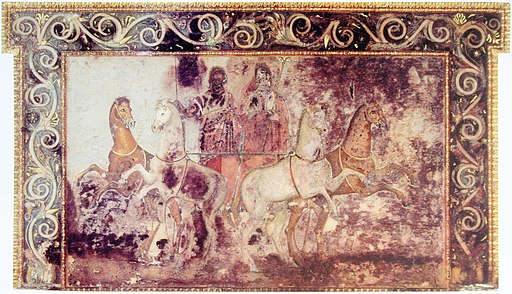
Hades and Persephone, Vergina
Unknown author, Public domain, via Wikimedia Commons

The Tomb of Eurydice is another large burial monument, which appears to be the earliest known Macedonian tomb. As expected, this gravesite has been plundered in antiquity. However, based on the shards left behind, it could be dated to around 340 BC. The dating, the wealth of the tomb, and the dedications found in the nearby  Temple of Eukleia led us to believe that this grave belonged to Queen Eurydicethe mother of Alexander’s father. The monument is 10.60 m long and nearly 8m wide. It is divided into an antechamber and the chamber proper, which measures 5.50x4.40 m with a 5.80-meter-high vault. The chamber's back wall displays an elegant but straightforward Ionic façade of a Macedonian tomb whose stucco and architectural details have been well-preserved. The trompe-l’oeil painting reveals a central door flanked by two stucco windows separated by two pairs of Ionic half-columns. The frieze of flowers and the cornice of the entablature are painted in vivid blue, red, and green. Like in the Rhomaios Tomb, we find a richly decorated throne two meters high. The back of the seat surprises with a superbly painted panel showing the Underworld, with the gods Pluto and Persephone, standing in full majesty on a quadriga drawn by two white and two brown horses. The throne itself is decorated with reliefs, gilded flowers and animals, and even with statuettes of korai. 

Other remarkable tombs in the area are the Tomb of the Bella Farm (first half of the 3rd century BC) with its delicate facade paintings, the tomb on the Bloukas field (c. 200 BC), and the cist grave of Palatitsa (c. 350 BC) – none of which are open to the public. 

The Temple of Eukleia is situated some 80 meters north of Aegae’s theater and close to the road leading to the Palace. Not much of this sanctuary survived, but it could be established that it had a small pronaos of 4x2.5 m and a square naos of 4x4 m. Archaeologists assume that the pronaos was an open space because the bases for statues were found in the two corners of the naos and possibly flanking a sacrificial table. It is striking that the temple faced north. Along the west side of the temple, three bases for statues were found at regular intervals. On the face of the southernmost base, a valuable inscription was found, reading ΕΥΡΙΔΙΚΑ ΣΙΡΡΑ ΕΥΛΛΕΙΑ, in other words, ”Eurydice, daughter of Sirra (erected this statue) to Eukleia.” The finesse of the letter curving has helped to date the inscription to the second half of the 4th century BC. These elements indicate that Queen Eurydice dedicated her statue to the goddess Eukleia, worshiped in this temple. It is assumed that the other bases carried similar offerings by members of the royal family. 

Roughly 400 meters east of the Temple of Eukleia are the remains of the Sanctuary of the Mother of the Gods. This archaic deity had a close relationship with the cult of Dionysus. By the early 6th century BC, the Mother of the Gods was linked with her Asian counterpart, Cybele. The goddess was worshiped with orgiastic dances and music. On votive reliefs and terracotta statuettes, she is depicted holding a large libation bowl in one hand and a large drum for the orgiastic dances in the other. Her head is crowned with a kind of fortress, referring to her role as goddess of cities and fortification walls.

Together with the information left by ancient writers, the remains of this Sanctuary reveal the importance of the cult. A large square building of 32x32 m has been unearthed in recent years. It contained separate rooms playing an essential role during initiation and worship. Various terracotta figures of the goddess, incense burners, vases, coins, loom weights, and all kinds of architectural relics from the earlier building from the 4th century BC have been found. The excavation showed that this sanctuary, destroyed by a severe fire around 150 BC, dates from Hellenistic times. 

A recent article in the Archaeology News Network mentions new studies of a large building complex close to the northwest gate of Aegae and the “queen’s burial cluster.” However, it is not clear whether this is close to the tombs mentioned above or the sanctuaries, but I suppose it is the case. 

The building complex from the 4th century BC has been associated with the worship of the royal family. It was built with stone from the nearby Mount Vermion and set up in successive square and rectangular rooms reaching 100 square meters. They are organized around a large courtyard. The space on the east side resembles a temple with a very large antechamber and two Doric columns on the courtyard side.

More exciting are the stamps carrying the Macedonian shield, which were also used on the coins by the Macedonian kings in Hellenistic times. Importantly, roof panels bearing the inscriptions AMYNTOΥ. This may refer to King Amyntas III, the husband of Eurydice and grandfather of AlexanderIn any case, it testifies of a close relationship with the Macedonian royal family. Other tiles are imprinted with ΠΕΛΛΗΣ, indicating that this particular sacred building must have belonged to Amyntas, who was given the status of hero. A similar cult is known to have existed in Pydna. Moreover, the presence of Eurydice in her nearby temple cannot be a coincidence. 

Despite the thorough looting by the Roman general Metellus in 148 BC, extensive renovations occurred under Philip V during the late 3rd/early 2nd century BC. For instance, the walls are covered with painted plaster. The favorite color was purple, with touches of green and ochre, and the scenes are divided with reliefs, not unlike those known from  Pompeii. The floors are inlaid with marble, as seen in the Palace of AegaeHowever, it could be established that the cracks and irregularities in the floor levels were due to catastrophic landslides in the 1st century AD. After a period of decline, the city of Aegae disappeared under the debris.

 It is clear that the cult of Alexander was kept alive and that the building complex was a way to confirm and legitimize his power and that of his successors.

Wednesday, April 6, 2016

Pausanias - Führer durch Olympia

Pausanias was born in Asia Minor in 110 AD and lived during the reign of Emperors Hadrian, Antoninus Piusand Marcus Aurelius, i.e., the heydays of the Roman Empire. He traveled extensively, and he is the author of the first travel guide ever!

His trips took him to Asia Minor and Greece, including Macedonia and probably Epirus, but also to Syria and Egypt, and even to Rome with the Latium region and Magna Graecia to the south. His travel experiences have been written down in ten books and cover the Greek regions of Attica, Argolis, Laconia, Messenia, Elis, Achaia, Arcadia, Boeotia, and Phocis. They are a first-hand testimony of what the world looked like in the second century AD.

The major part of his story is about Olympia, which takes about one-fifth of his entire work, a treasure trove for those who want to drift back in time.

Pausanias, Führer durch Olympia (translated by Ernst Meyer) is thus only a part of Pausanias’ travel guide. It so happened that I came across this German version many years ago. It may only be a pocketbook, but it does contain Pausanias’ story in full.

It is wonderful to walk with Pausanias through the streets of this famous city where the Olympic Games were held for twelve centuries (from 776 BC until 393 AD). He starts with the city’s origins and myths and soon goes straight to the Temple of Zeus, one of the Seven Wonders of the Ancient World. He describes the temple in detail: the roof, the pediment, the metopes, the grand statue of Zeus by Phidias, the votive offerings, and the altars. He then walks to the workshop of Phidias, the Temple of Heraand the Philippeon, built by Philip II and finished under Alexander III. At the Philippeon, he actually witnessed the statues of both Macedonian kings together with those of Amyntas and Eurydike, Philip’s parents, and of Olympias, his wife – all executed by Leochares in ivory and gold.

He spends time and effort to describe the unbelievably great number of Zeus statues all over Olympia, including one representing Alexander the Great as Zeus! Then follows a description of the statues erected for the winners at the Olympic Games. In between, he stops at a statue of Anaximenes, who not only wrote a history of the Greeks but also that of Philip II and his son Alexander. It is quite amazing to read that such a large number of these statues were made of bronze, silver, and even electron, and that many of them, besides the famous Zeus, were also chryselephantine sculptures with their hands and faces made of gold or ivory. This is beyond our imagination!

Next, he treats the many Treasury Houses, to end with the renowned Stadium and the adjacent Hippodrome.

Although this book dates from 1971, it contains a very pertinent list of annotations that are still very much up-to-date. To help us in picturing Olympia, there is a clear map locating the city’s main buildings. To complete the story, there is a useful Register of the buildings and memorials, as well as a list of all the Athletes and Artists treated in this book.

Sunday, December 7, 2014

The Philippeon at Olympia

After his victory at Chaironeia in 338 BC, King Philip of Macedonia ordered the construction of the Philippeon at Olympia. This temple took the shape of a tholos with 18 slender Ionic columns on the outside and nine half Corinthian ones on the inside. It was enhanced with five statues representing Philip himself, his parents (Eurydice and Amyntas), his wife, Olympias, and his son, Alexander. The architect was Leochares of Athens, who had also been working at the Mausoleum of Halicarnassus – a detail that cannot be lost to the attentive observer. For Philip, only the best was good enough, it seems! This temple stood inside the sacred temenos, an indication that it was dedicated to Zeus in thanks for his recent victory over Athens and Thebes, the ultimate goal to consolidate his power and that of his successors in all Greek cities. Besides, this was the place where the Olympic Games were held every four years, and this Philippeon would stand there for everyone to see!


What strikes me is the round shape of the temple, hence the name tholos, of course. You don’t find too many of those, and I’m wondering how far Philip’s idea is related to the Tholos of Delphi, dedicated to the goddess Athena, which he must have seen since it was built somewhere between 380 and 360 BC. From what I understand, Philip liked the pomp and splendor and didn’t mind spending his money lavishly to achieve such purposes. Building a Tholos in the very center of the sacred area of Olympia was something that couldn’t be overlooked, neither by his friends nor by his enemies. 

The Philippeon must have been quite something! There are rumors that the statues were made of ivory covered with gold leaf, but detailed research has revealed that this could not have been the case, so they must have been carved in heavy gilded stone. So far, Worthington’s remarks (Philip II of Macedonia).

Olympias’ presence here, however, has been a source for many discussions (women didn’t fit into the Greeks’ concept) despite her being the spouse of Philip and the mother of Alexander, the future heir to the throne. Ian Worthington reminds us here of the five small ivory heads that were found in the Vergina Tomb, thought to belong to King Philip, representing Philip, Alexander, Olympias, and two unknown portraits, that of a man and a woman, who might well be Eurydice and Amyntas. In this context, it is not so strange to see Olympias here after all. 


This temple was not finished yet at the time of Philip’s murder, and some skeptics claim that when Alexander completed this construction, he added the statue of his mother, Olympias. But then, archaeological investigations have clearly proven that the five pedestals were cut and placed at the same time. This means that Olympias was indeed included in Philip’s original plans. Olympias’ presence here at a time when Philip was planning his wedding with Eurydice, his seventh bride, does raise some questions, though. Why would he show a preference for Olympias among all his wives, were it not to show her as the mother of the pretender to the throne, Alexander? We must make an effort to look at this through the eyes of Philip’s days, when any form of recognition for a woman was unheard of. Philip, as we know, had no sympathy left for Olympias, certainly not at this time of his career, and he certainly couldn’t afford to push Olympias to the foreground when he just managed to unite Greece under his wings – he couldn’t risk losing face, could he? My own assumption is that Olympias was represented here just like Mausolos on top of his famous Mausoleum in Halicarnassus with his wife beside him. Leochares, previously working there, may add credibility to this theory. It’s logical, isn’t it? 

Another remarkable fact is that here at the Philippeon of Olympia, the city of the Temple of Zeus, one of the Seven Wonders of the World, Alexander is, beyond doubt, being presented as Philip’s legitimate heir, while there were and still are so many theories against Alexander being the successor of his father when he was murdered. Why are there so many discussions contesting Alexander’s evident succession to the throne of Macedonia? Should we ignore this proof at Olympia and take it as a trivial detail of no importance? The shortsighted critics and writers keep surprising me time and again whenever they have the need to push their own vision and theory forward! There is no proof for any of this. We can only speculate – that’s all. 

Well, so much for Philip II and Alexander III of Macedonia

Tuesday, December 6, 2011

Philip’s hegemony and his plans for Asia - Macedonia forged by Philip II - 14

Philip’s hegemony and his plans to cross over to Asia (337 BC)
Although at first sight, the Greeks could make their own decisions within the frame of the synedrion, it was definitely Philip as hegemon who was pulling the strings – he was the one who had all the power.


This was clearly illustrated at Olympia, where Philip commissioned the building of a splendid Philippeon, a large circular tholos counting 18 Ionic columns on the outside and nine Doric ones on the inside. A statue of Philip, slightly larger than life-size, would stand in the center, surrounded by his parents (Eurydice and Amyntas), his wife Olympias, and his son Alexander. The architect was Leochares of Athens, who had worked on the famous Mausoleum of Halicarnassus. This Philippeon was located in the sacred area and must have caught the eye of all the visitors by its sheer shape (the only round building in the sanctuary of Olympia) if not size. It may have looked like a thank-you to Zeus for his recent victory at Chaeronea, but it most certainly showed off Philip’s power and that of Macedonia.

A second meeting of the Synedrion was held that same spring in Corinth to officially elect Philip as hegemon. This is when he announced his plans to invade Asia as part of a pan-Hellenic plan to liberate the Greeks of Asia Minor from Persian rule and to punish the Persians for sacking Athens some one hundred and fifty years before. This is what he proclaimed, while we may wonder whether it was his dire need for money that instigated this decision. We know he made huge profits from his several gold and silver mines (more than 1,000 talents a year from Crenides alone), but vast amounts went into his army. His court in Pella cannot have come cheap, either with all the women and guest-friends. And then there were all the bribes he paid to influential statesmen and the many awards he lavishly granted for building temples, fortifications, etc. It’s interesting to read a comment made by Diodorus that “Philip used gold more than arms to enlarge his kingdom”, which tells a lot. We all remember that Alexander when he set out to Asia had no more than 70 talents in his treasury and that he had to borrow 600 talents on top of that – clear proof that Philip’s money was not there for the taking, although he somehow always had managed to use the income from one campaign to finance the next one.

Now, the reason why Philip went to Asia is another interesting question. There are several theories, as always, but the most likely is that Philip wanted to win the cities of Asia Minor over to Greece as the country needed agrarian land (it might even be a place where the Greeks could dispose of their unwanted or disreputable elements!). On the other hand, he had a golden opportunity to expand his own empire and acquire more wealth.