Alexandria's founded by Alexander

Alexandria's founded by Alexander the Great (by year BC): 334 Alexandria in Troia (Turkey) - 333 Alexandria at Issus/Alexandrette (Iskenderun, Turkey) - 332 Alexandria of Caria/by the Latmos (Alinda, Turkey) - 331 Alexandria Mygdoniae - 331 Alexandria (Egypt) - 330 Alexandria Ariana (Herat, Afghanistan) - 330 Alexandria of the Prophthasia/in Dragiana/Phrada (Farah, Afghanistan) - 330 Alexandria in Arachosia (Kandahar, Afghanistan) - 330 Alexandria in the Caucasus (Begram, Afghanistan) - 329 Alexandria of the Paropanisades (Ghazni, Afghanistan) - 329 Alexandria Eschate or Ultima (Khodjend, Tajikistan) - 329 Alexandria on the Oxus (Termez, Afghanistan) - 328 Alexandria in Margiana (Merv, Turkmenistan) - 326 Alexandria Nicaea (on the Hydaspes, India) - 326 Alexandria Bucephala (on the Hydaspes, India) - 325 Alexandria Sogdia - 325 Alexandria Oreitide - 325 Alexandria in Opiene / Alexandria on the Indus (confluence of Indus & Acesines, India) - 325 Alexandria Rambacia (Bela, Pakistan) - 325 Alexandria Xylinepolis (Patala, India) - 325 Alexandria in Carminia (Gulashkird, Iran) - 324 Alexandria-on-the-Tigris/Antiochia-in-Susiana/Charax (Spasinou Charax on the Tigris, Iraq) - ?Alexandria of Carmahle? (Kahnu)
Showing posts with label Hadrian. Show all posts

Thursday, November 20, 2025

The healing waters of Myra

Who would have expected to find healing waters in Myra?
 
As mentioned earlier, the excavations in Myra are hampered by modern Demre, which is built on top of the ancient city (see: Recent excavations in Myra and Andriake). As a result, expropriations are never easy, but this time, luck is on the side of archaeologists as a disaffected industrial zone has become available. The terrain is located about halfway between Demre and the ancient port of Andriake.

[Picture from tuerkei-antik]

The site made headlines with the discovery of a Nymphaeum from the 2nd century AD, built over a natural spring which is rich in magnesium, iron, sulfur, and phosphorus. This, by itself, is rare enough to make it stand out among the usual water monuments. It is believed to belong to a ‘healing water complex” comparable to a modern wellness center. The water source, constantly bubbling from underground, lies directly beneath this Nymphaeum and is connected to the nearby Baths, aqueducts, and water cisterns.
 
The monumental construction from the days of Emperor Hadrian shows three separate arched entrance gates, both on the east and west sides. It combines architectural elements carved into the bedrock and walls of cut stone.
 
The Nymphaeum functioned until the 7th century AD, i.e., when the harbor of Andriake silted up and fell into disuse.
 
The Turkish Ministry of Culture and Tourism has an ambitious vision to create a major attraction park where visitors will be able to swim in the healing waters while exploring the ruins. It reminds me of the pool at the bottom of Hierapolis, where we can swim among the crumbled remains of the Nymphaeum and its marble portico, possibly belonging to the Temple of Apollo. The plan should be completed by the end of 2026.

Thursday, November 13, 2025

Restoration of Hadrian’s Nymphaeum in Sagalassos

It is always a pleasure to return to Sagalassos where the first excavations started in 1989 by Professor Marc Waelkens from the Katholieke Universiteit Leuven in Belgium (see: Sagalassos in Alexander's campaign). 

Year after year, new buildings are being exposed while existing monuments undergo diligent restorations. The huge Antonine Nymphaeum is stealing the show after water started flowing black into the wide basin for the past fifteen years, reflecting the elegant statues that adorn this fountain. 

[Picture from Turkiye Today]

One level lower on the same hillside stands the Nymphaeum of Hadrian, discovered in 2002. It is hard to imagine that it has two levels of columns and statues of gods and prominent figures, just as the Antonine Nymphaeum. As yet, the water channels connected to the pool are visible between the six-meter-tall columns at ground level. The most striking elements are the reliefs of the Muses resting against the water basin. Archaeologists expect that water will flow again from the second level of the monument, as is the case at the Antonine Nymphaeum. They aim for this project to materialize within two years. 

Meanwhile, the steps in front of the fountain have been reinforced, and the scattered original stones have been put back into place. The fountain holds an inscription confirming that it was built between 129 and 132 AD in memory of Emperor Hadrian as commanded by Tiberius Claudius Piso.

Wednesday, November 5, 2025

Herodes Atticus, more than a name

Herodes Atticus is best known for his theater at the foot of Athens Acropolis. For most people, it is only a name to define this historic monument, forgetting who he was and what he achieved in life.

Herodes Atticus was born in Marathon, Greece, into a family of Athenian descent in 101 AD. He is known as an Athenian rhetorician and a Roman senator, spending time between Greece and Italy.
 
He was exceptionally wealthy and moved in the highest social circles. Emperor Hadrian, for instance, appointed him Prefect of the free cities in the Roman Province of Asia in 125 AD. A good year later, he was elected archon (high magistrate) of Athens. And in 140 AD, Emperor Antoninus Pius invited him to Rome to educate his adopted sons, the future Emperors Marcus Aurelius and Lucius Verus. As a Roman citizen, he was appointed Consul of Rome in 143 AD.
 
When he was 40 years old, he married Appia Annia Regilla, a 14-year-old aristocrat related to the family of Antoninus Pius wife.
 
Herodes Atticus was a philanthropic magnate and patron of many public works. What comes immediately to mind is the theater in Athens, which he financed in 161 AD to honor his wife, Regilla. Watching a Greek play performed within these walls or attending a popular or classical concert is a gratifying experience!

However, thousands and perhaps even millions of visitors have left their marks on the white marble construction. It calls for an extensive restoration and conservation process that is expected to take at least three years. During that time, the summer Athens Epidaurus Festival will be relocated elsewhere.
 
The overall deterioration consists of cracks in the Pentelic marble due to the variations in temperature and rainwater infiltration. Another problem is the plants that root in crevices and hold water. The theater had been destroyed in 267 AD and was in ruins until the 1950s, when the seating area and orchestra were restored. These repairs are now in dire need of improvement and require a comprehensive conservation plan.
 
The list of buildings Herodes Atticus funded is quite extensive. The ancient Panathenaic Stadium in Athens,  with a capacity of 50,000 seats, for instance, was one of his projects executed in 144 AD. Elsewhere in Greece, we owe him the Theater of Corinth, the Stadium of Delphi, the Baths of Thermopylae, and a splendid Nymphaeum in Olympia.
 
I was very surprised to read Herodes Atticusname and his wife’s in Olympia. The Nymphaeum stands at the entrance to the Stadium. The two-story-high back wall was filled with statues of Herodes Atticus and several Roman Emperors like Antoninus Pius, HadrianMarcus Aurelius, and their family members. 

Most statues have been moved to the Museum of Olympia. Among them, I noticed Athenais, one of Herodes Atticus’ daughters. She married Lucius Vibullius Rufus, and the couple had six children, but only three survived to adulthood. The eldest daughter, Elpinice, was born in 142 AD and died in 165 AD. The son, Atticus Bradua, was born in 145 AD and was the only child to survive his father. Herodes Atticus was heavily disappointed by his son and left him nothing after his death.
 
Also exhibited in Olympia’s Museum is a life-size bull, which carries an inscription left by Regilla reading: "Regilla, priestess of Demeter offers the water and appendices to Zeus." This brings history to life!
 
Outside Greece, aqueducts donated by Herodes Atticus can be found in Canusium, Puglia region in Italy, and in Alexandria Troas, Asia Minor. In my blog post of February 2024, I mentioned the Baths and Gymnasium of Alexandria Troas built by Herodes Atticus in 135 AD. They were surrounded by vaulted corridors with marble walls, and water was delivered thanks to the aqueducts on the northeast side of town. Most of the building remained intact until it was destroyed by the severe earthquake in the winter of 1809-1810.
 
At the National Archaeological Museum in Athens, I encountered a statue of Polydeukes, also Vibullius Polydeukion, the adopted son of Herodes Atticus, dated to circa 150 AD. Wikipedia, however, mentions the boy as his pupil and lover in a relation resembling that of Hadrian and Antinous. Polydeukes died around 173-174 AD. His loss greatly affected Atticus, who built a Heroon in his memory.
 
Herodes Atticus lived to be 76 years old in 177 AD. Regilla had died in 160 AD, after being brutally kicked in the abdomen while eight months pregnant.  Her brother accused Herodes Atticus of having ordered one of his freedmen to beat her to death. At the trial that ensued, Herodes Atticus was acquitted by Emperor Marcus Aurelius, his former tutor.
 
I’m sure we’ll look at the Theater of Herodes Atticus with different eyes next time we walk through Athens.

Friday, September 5, 2025

Serious excavation plans in Termessos

Back in 2018, I shared the news about the restoration of Termessos’ city walls and the clearing of the ancient road that connected the city to ancient Attaleia (modern Antalya). 

Presently, more serious excavation works are being planned in Termessos. For a start, a monumental tomb that once held several marble sarcophagi will be pieced together using the scattered and now numbered blocks lying around. Apparently, all the original stones have been listed. Unfortunately, the Hurriyet Daily News does not disclose its location. 

I found the choice the archaeologists made to start with the monumental tomb quite surprising, ignoring the more obvious remains of the Theatre, the Temple of Hadrian, the Temple of Artemis, the Bouleuterion, the Agora, and other recognizable constructions. 

Next excavations will, however, focus on the Gate of Hadrian, hopefully extending to the nearby Temple of Artemis from the 2nd century BC. Other necropolises, the aqueducts, and cisterns may also be included in this project. 

Until now, only the exceptional remains of the Tomb of Alcetas have been identified. This general, brother of Perdiccas, fought with Alexander in India, and died here in Termessos in 319 BC during the siege of the city in the War of the Diadochi. 

The beauty and challenge of Termessos is that its remains have been left mostly untouched and protected as part of the National Park of Güllük Dagi, with its rich diversity of fauna and flora.

Friday, April 4, 2025

A Roman bust retrieved in Soli Pompeiopolis (Mersin)

Excavations in Soli have been ongoing since 2015 (see: A two-month project to excavate the city of Soli), and each year, more remains of buildings, walls, and statues reach the news. 

[Picture from Hürriyet Daily News]

The most recent find appears to be the bust of a Roman Emperor or another high-placed nobleman. Based on the style of his curly full beard, he has been dated to the 2nd-3rd century AD. Emperor Hadrian, who visited Cilicia in 129-130 AD, seems to have initiated the beard fashion that had been abandoned after Alexander the Great. 

After Hadrian, Roman men were generally depicted with a beard, and many of the successive emperors followed suit. 

The bust was recovered near the colonnade street and may have belonged to one of the statues that stood on the plinth of one of these columns. 

The near life-size head has been transferred to the Museum in Mersin, which holds many of the recent finds.

Friday, June 14, 2024

Surprising city of Tripolis in Turkey

Tripolis can be found some 20 kilometers from the famous site of Pamukkale and the ancient city of HierapolisIts name meaning three cities is due to its location, i.e., at the crossroads of Phrygia, Lydia, and Caria, on the northern bank of the Meander River. From here, it was a convenient hub to reach Sardes, Philadelphia (modern Alaşehir), and Laodicea. 

Although Tripolis existed in Hellenistic times, it reached its peak in the 2nd century AD as testified by the remains we find here today. 

The city could be entered by two gates, the Gate of Hierapolis on the southern side and the Gate of Philadelphia at the western end.

Excavations have exposed a straight colonnaded street of ten meters wide and 450 meters long that runs east-west through the city. It was paved with travertine slabs. At the intersection of the main streets, a Nymphaeum was discovered. This Orpheus Fountain rested on a marble floor, and its walls were covered with onyx and white marble. The water came from a cistern east of the street. 

The colonnaded street is the most prominent element in Tripolis and is for now the main attraction. Pending further digs, several monuments from the 2nd century AD have been identified, such as two Agoras, one of which borders the northern side of the street, and two Baths, the Great Thermae near the western entrance to the city, and the Theater Thermae close to the theater. The theater is estimated to seat 8,000 people. Also, the Stadium could be located just outside the city walls and measures 256x66 meters. The Bouleuterion of 64x44 meters stands in the center of Tripolis, and only part of its walls are visible. 

[Orpheus Fountain from Turkish Archeo News]

It is remarkable, however, to discover an indoor bazaar in excellent condition since it remained buried for centuries. This structure is a unique example so far in the Mediterranean.
 

The fate of Tripolis was sealed after repeated earthquakes, the most severe one happening in 494 AD.  

A visit to Tripolis sounds rather inviting. The colonnaded street is very promising, but sadly little is known of the city’s role in history despite its early origin dating to the 4th millennium BC.

With a population of nearly 20,000 in the 2nd century AD, I assume an emperor like Hadrian would be mentioned as he stayed in nearby Hierapolis in 129 AD. This also applies to Caracalla in 215 AD. I would not be surprised if during Hellenistic times members of the Seleucid dynasty spent time in Tripolis. Apparently, nothing of the kind has transpired from the excavations yet. It is like visiting a skeleton without a soul …

Wednesday, February 21, 2024

The city of Alexandria Troas or Alexandria of the Troad

The name of Alexandria Troas has a most confusing name since it is generally thought that the city was founded by Alexander the Great, more so because of the king’s admiration for The Iliad in which Troy played such an important role. Nothing is further remote from the truth. 

[Votif relief of Psyche on a dromedary from Alexandria Troas, 
2nd century BC, Louvre Museum]

According to Strabo, the town of Sigeia was founded on this spot around 306 BC by Antigonus Monophthalmus. The name of Alexandria Troas was given to the city by Lysimachos in 301 BC, as a generous reference to Alexander. It was a double harbor in northwestern Asia Minor and the richest of the Troad and occupied a strategic position near the entrance of the Hellespont. It silted up over the centuries. 

In 188 BC, the Romans declared it a free and autonomous city that counted about 100,000 inhabitants. Emperor Augustus settled a colony of soldiers within its walls and renamed it Colonnia Alexandria Augusta Troas, in short, Troas. He lavishly embellished the city, as did the emperors Trajan and Hadrian a century later. 

Herodes Atticus, best known for his theater at the foot of the Acropolis in Athens, was appointed by Hadrian as prefect of the free cities of Asia in 125 AD, including Alexandria Troas. He may have built the aqueduct that carried water from Mount Ida, although other sources attribute the construction to Trajan. 

Alexandria Troas was surrounded by a 10-kilometer-long city wall, including fortified towers placed at regular intervals. Some parts are still visible today, together with remains of the Roman Baths and the Gymnasium, a Necropolis, a Nymphaeum, the Odeon, the Theater, and a recently discovered Stadium dating approximately from 100 BC. 

The Baths and the Gymnasium were built by Herodes Atticus in 135 AD. They were surrounded by vaulted corridors with marble walls, and water was delivered thanks to the aqueducts on the northeast side of town. The large Baths measured an impressive 123 x 84 meters. Most of the building remained intact until it was destroyed by the severe earthquake in the winter of 1809-1810. The whole project was greatly supported by Emperor Hadrian, as revealed in an inscription found in Hadrian’s Gymnasium in Athens mentioning the emperor as the sponsor of the city in 132 AD. Three more inscriptions unearthed at Alexandria Troas during excavations in 2006 confirm the emperor’s interest and the appreciation of the citizens. 

The Hellenistic theater stood at the highest point of the city, treating the spectators to a sweeping view over the city and the Aegean Sea with the island of Bozcaada.

Wednesday, February 14, 2024

The Periplus of the Euxine Sea by Arrian – Part 3

In this last part of the PeriplusArrian takes us from Dioscuras/Sebastopolis to Byzantium. 

He starts his story where he left off at the conclusion of part 1, i.e., in Sebastopolis (see: Tour of Colchis: From Trapezus to Sebastopolis). This section, the Cimmerian Bosporus, was not controlled directly by Rome but by a so-called client king. In Hadrian’s day, that was Cotys II, in full Tiberius Julius Cotys, who ruled from 123/4 AD until he died in 131/2 AD. His appointment was made for life, and his successor needed to be officially recognized by Rome. 

At the news of his death, Arrian decided that Hadrian would be interested in having the latest information about the Bosporan Kingdom since it supplied a great deal of wheat, clothing, wine, and slaves. His territory was also an important buffer zone with the warlike Alans living to the north. 

Arrian sailed along the mountainous coastline below the Caucasus to Pityus, some 65 kilometers away. These lands were occupied by the Zilchi, ruled by a certain Stachemphax, also recognized as a king by Hadrian. Follows a list of cities, harbors, and rivers, including the distances between them, from Crimea to the mouth of the Danube River. More familiar are the Greek cities on the south coast of Crimea, such as Panticapaeum (Kerch), Theodosia, Cercinitis, and Chersonesus (Kherson). Panticapaeum, which lies only 11 kilometers from the Tanais River (modern Don River) and flows into Maeotis Lake (Sea of Azov) was seen as the place where Europe ended and Asia started. 

Sailing further west, Arrian stops at the Greek city of Olbia at the mouth of today’s Dnieper River. Next, he heads for the harbor of Odessos, a trading post founded by the Greeks from Istria. From here, he continues to the wide delta of the Ister River (Danube), where he reaches the Island of Achilles or Leuke (possibly Snake Island in Ukraine). Legend has it that Thetis gave it to her son. The island was known for its Temple of Achilles, which held a wooden statue of the hero, as well as Greek and Latin inscriptions in honor of Achilles and his dear PatroclusArrian speaks of many offerings that were made, including sacrifices of animals. Those who sail by the island may “see” Achilles in their dreams or hallucinations. 

Proceeding further down the coast of the Black SeaArrian arrives at Tomis, a colony founded by the Greeks, where Emperor Augustus banished the poet Ovid. The next port was Callatis, established by the Carians, followed by Odessos (another harbor by that name), where he entered Thracia. 

Passing the eastern end of the Haemus Mountains (in central Bulgaria), Arrian reaches Miletus colony of Apollonia, which once held a colossal statue of the god Apollo. From here, he sailed to the not-so-good harbor of Salmydessus (roughly 150 km east of Hadrianopolis, modern Edirne), where Xenophon helped Seuthes II to become King of Thracia. 

By now, Arrian has landed on the Thracian side of the Bosporus. This area is reputed for the Cyanean Islands or Symplegades (also Clashing Rocks), a pair of rocks that clash together when a ship sails through. In Greek mythology, the rocks were defeated by Jason on his way to Colchis on board his ship, the Argo. 

Byzantium is Arrian’s final destination. He concludes by mentioning the local Temple of Zeus Ourios (who grants favorable winds), where Jason and the Argonauts erected an altar to the Twelve Olympian Gods on their return from Colchis. 

In our modern days of traveling by plane and high-speed trains, it is hard to imagine the pace in antiquity when people and armies moved on foot. Ships and barges were a comfortable alternative, although winds and currents were not always reliable. Travelers could never predict the duration of a trip or the time of arrival, but in those days, time was not so much of the essence as it is today. 

Though Arrian wrote his Periplus 130-131 AD, we don’t know how many months or weeks he actually spent at sea. Considering that the circumference of the Black Sea is over 4,000 kilometers, it may be safe to speculate that he spent most of those two years “on the road”. Quite an achievement!

[For the locations, please consult this map]

Tuesday, January 23, 2024

The Periplus of the Euxine Sea by Arrian – Part 2

The second part of the Periplus covers the section From the Thracian Bosporus to Trapezus. 

As mentioned earlier in About Arrian’s Periplus of the Euxine Sea, it could not be established whether this chapter reflects Arrian's personal experience or not. One theory is that he wrote it upon arrival in Trapezus after Hadrian appointed him governor of Cappadocia in 131 AD. 

We should also keep in mind that Arrian was a native of Bithynia, which bordered the south shores of the Black Sea over approximately one-third of its total length. Consequently, he knew the people and the geography of that area very well. As an admirer of Xenophon, he was familiar with the route followed by the Ten Thousand as they marched from Trapezus to Byzantium following the seashore.

[Bust of Xenophon, Carole Raddato (CC BY-NC-SA)]

Whatever the case, this section of the Periplus includes an impressive list of the harbors and rivers on the southern shore of the Black Sea among which are the cities of Herakleia-Pontus founded by the Megarians and the Boeotians at the mouth of the Lycus River; Tios, at the mouth of the Billaeus River and a colony of MiletusAmastris (modern Amasra) that had a harbor 17 kilometers from the River Parthenius; Sinope, another colony of Miletus and home of Diogenes; Amisus, an Athenian colony between the Halys and the Iris River deltas; and, finally, Cotyora, a colony of Sinope. 

Ever since the days of the Hittite Empire, which reached its height in the 14th century BC, the Halys River was the border between several kingdoms; first between Lydia and the Persian Empire, then between the Pontic Kingdom and the Kingdom of Cappadocia. By the 6th century BC, it separated Lydia from Media until King Croesus crossed the river to attack Cyrus the Great and was defeated. 

[From the Greek Reporter]

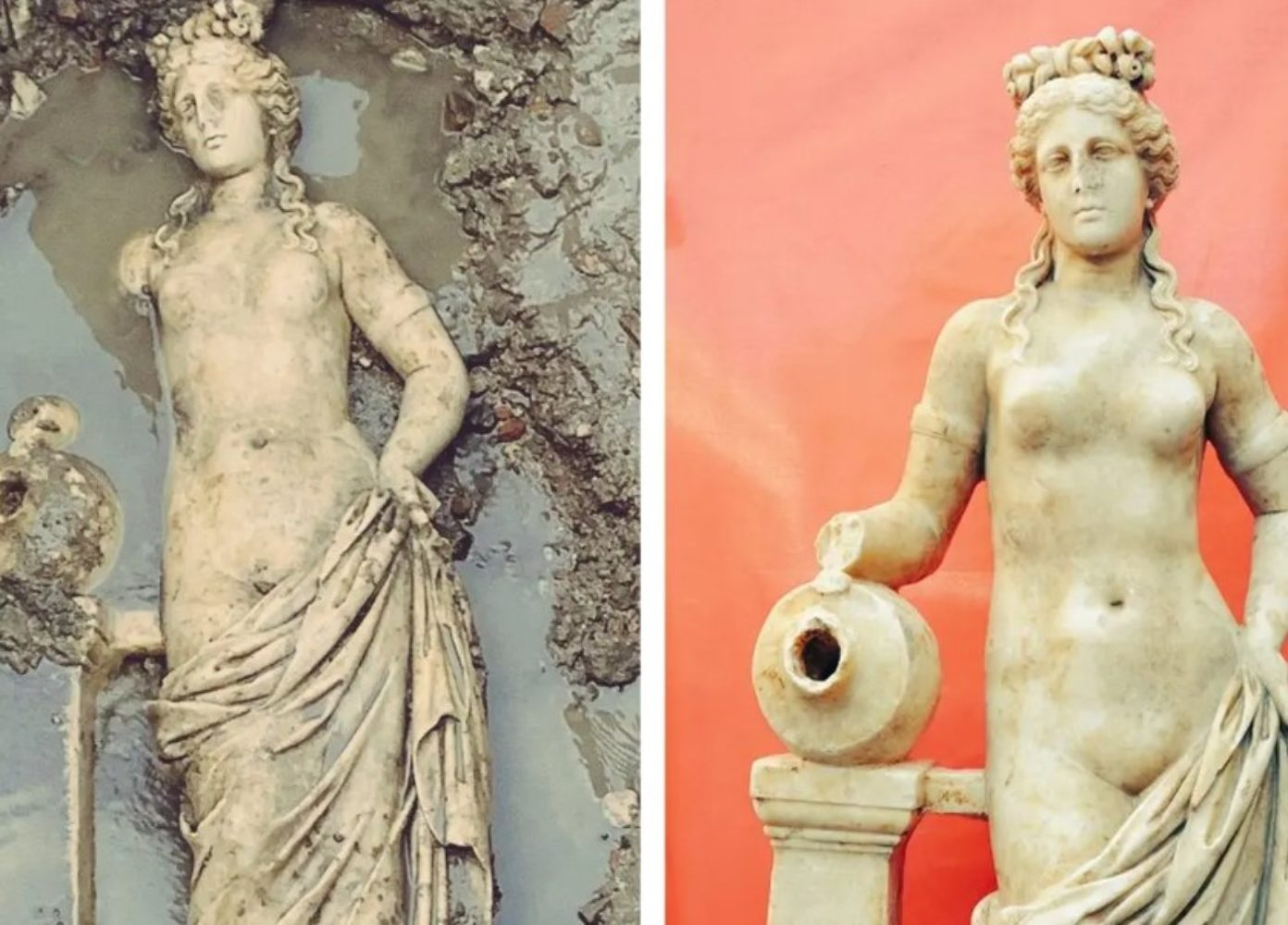
It is worth mentioning that a 1.50-meter-tall statue of Aphrodite has been discovered recently in ancient Amastris. It could be established that it is a Roman copy from between 180 and 200 AD that was inspired by Praxiteles school in the 4th century BC. The ancient city was named after Amastris, the niece of King Darius III, who married Dionysos, the tyrant of Herakleia-Pontus.

The map included in my post About Arrian’s Periplus of the Euxine Sea is most useful for locating all the cities, harbors, and rivers mentioned above. 

It should be said that while inspecting the Cappadocian frontier harbors in 123 AD, Emperor Hadrian had already visited part of the southern Euxine Sea, including Trapezus. With this in mind, Arrian now informed the emperor that Trapezus was building a new harbor, replacing the mooring where ships could only anchor in summer. 

It is quite amazing to see so much geography and history being exchanged. We tend to forget the many lines of communication that existed in antiquity, with traders, merchants, scholars, philosophers, astronomers, kings, and emperors traveling far and wide, by land and by sea.

[to be continued in Part 3]

Wednesday, January 17, 2024

The Periplus of the Euxine Sea by Arrian – Part 1

Arrian, to the Emperor Caesar Trajan Hadrian  Augustus, greetings. We came to Trapezus, a Greek city, as Xenophon says, founded on the sea, a colony of the Sinopeans; and gladly we looked down on the Euxine Sea from the very same spot as both Xenophon and you.

With these words, Arrian starts his letter to Hadrianintroducing the first part of his report, Tour of Colchis: From Trapezus to Sebastopolis. 

As mentioned in my previous blog, About Arrian’s Periplus of the Euxine SeaArrian started his journey in Trapezus. Here, he visited the sanctuary of Hermes, which was also devoted to Emperor HadrianArrian tells the emperor that his statue needs to be replaced with a better resemblance to the original. He also shared his critiques on the rough stone altars and the “incorrectly written” inscriptions. 

From TrapezusArrian sailed east to inspect the garrison of Hyssus. Here, he organized a display of javelin throwing and reminded the soldiers of Hadrian’s observations and address made in 128 AD at Lambaesis, Numidia (modern Algeria), which survived on a column found northwest of its parade ground. 

His next stop was at the temple of Athena in Athenae, where he was marooned for two days due to a violent storm of thunder and lightning, during which he lost one of his triremes. Arrian’s fleet consisted of liburnas, small galleys suitable for raiding and patrols, and large triremes. 

When it was safe to travel onwards, he anchored at the fortress of Apsarus (Gonio in modern Georgia). He inspected the weapons and provisions of the five cohorts and paid the 2,500 soldiers. Remains of this impressive Roman fortress are still standing on the left bank of the River Chorokhi, where it controlled the access to the hinterland. In 135 AD, Arrian established his headquarters in Apsarus when he led the Cappadocian legions against the invading Alans.

[Remains of the Apsarus Roman Fort, Carole Raddato (CC BY-NC-SA)]

At this point in his letters, Arrian provides a list of all the rivers between Trapezus and Phasis that flow into the Euxine Sea, adding the distances between them. 

These details are helpful to follow the governor as he moved on to Phasis (see: The many colonies of Miletus), some 67 kilometers further north at the mouth of the Phasis River. This was the most important river in Colchis. It arose in the Caucasus, and its water was unusually soft and sweet with a changeable light color. In Phasis, he dug a ditch to protect the harbor and the settlement that had developed around the stronghold. 

Arrian’s interest and respect for the history of Jason is tickled when the locals show him an iron anchor claiming it belonged to Jason’s ship, the Argo. However, he was skeptical as it looked too recent. It seems that even in ancient times, people liked to spread tales and myths! 

The last leg of this trip took Arrian to Dioscurias, another colony of Miletus, known to him as Sebastopolis. He is said to have visited the sick, which raises the question about their ailments. He also checked the city walls and the ditch to be sure they would resist any attack from the native Colchian tribes on the eastern coast. He provided a list of their rulers subject to Rome as established by Hadrian. They were Malassas of the Lazi, Rhezmegas of the Abasci, and Spadagas of the Sanigs. 

He further inspected Sebastopolis, including the grain supply vital to the army’s survival. He paid the soldiers and watched the cavalry in their exercises, leaping upon horses. 

From that harbor, the governor could see the highest peak of the Caucasus, the Strobilus, where, according to myth, Prometheus was bound and an eagle ate his liver that grew back overnight. The mountain was Mount Elbrus. 

This completed Arrian’s mission, and he returned to the naval base of Trapezus422 kilometers away.

[To be continued in Part 2]

Wednesday, January 3, 2024

About Arrian’s Periplus of the Euxine Sea

Beyond doubt, Arrian is best known for his Campaigns of Alexander the Great but as I mentioned in my earlier post, What do we know about Arrian of Nicomedia, he was a prolific writer. However, most of his works have now been lost. 

Such was the case for his Periplus of the Euxine Sea, the Circumnavigation of the Black Sea, an official military report Arrian wrote in Latin to Emperor Hadrian, who had inspected the area before him. Additionally, he composed a series of informal letters to Hadrian using Greek.

Although Arrian was a member of the Roman imperial administration, he also belonged to the Greek literary elite. As a native of still very Greek Bithynia in Asia Minor, Arrian grew up with this dual identity making him a true Graeco-Roman. Addressing his Greek account to the Philhellenic emperor underscores his friendly and personal relationship with Hadrian.

Arrian was very much inspired by Xenophon, a philosopher, and historian from the 4th century BC – hence his nickname of “Second Xenophon.” In fact, Arrian picked up Xenophon’s tracks on the Black Sea at Trapezus as he led his Ten Thousand according to his Anabasis.

Arrian’s Greek version of the Periplus with its valuable information about the Black Sea region luckily survived. It dates from 131 AD, one year after he had been appointed governor of Cappadocia.

In his days, Cappadocia was a Roman frontier with forts along the coast of the Black Sea. Arrian’s duty was to protect that line of defense and the routes into the hinterland up to the Parthian Empire further east. He was also responsible for the Pontic Fleet based in Trapezus (modern Trabzon) and for protecting the grain supply from Crimea. Besides those matters about his military and diplomatic mission, Arrian outlined the navigation routes and ports of the Black Sea and concentrated on economic activities and resources.

His Periplus covers a counter-clockwise voyage around the Black Sea, made in three separate trips. During his first journey, he sailed from Trapezus to Sebastopolis. His letters to Hadrian are bundled in chapters 1 to 11 and constitute the longest and most interesting part of his Greek Periplus.

His second expedition contained in chapters 12 to 17 took him from the Bosporus to Trapezus, and the third one is covered in chapters 18 to 25 traveling from Sebastopolis to Byzantium. These two voyages may well have been undertaken by different people as the narration is less personal and less fluent.

Much of the writing focuses on the rivers, landmarks, harbors, and cities, including the distances and other relevant information for sailors and travelers alike. It also includes information regarding the local population and the safe havens. True to himself, Arrian likes to insert local stories from Greek mythology such as Jason and the Argonauts and Prometheus, and often quotes Homer.

In short, a complete traveler’s guide that may still be helpful today!

[Continue reading in Part 1]