Alexandria's founded by Alexander

Alexandria's founded by Alexander the Great (by year BC): 334 Alexandria in Troia (Turkey) - 333 Alexandria at Issus/Alexandrette (Iskenderun, Turkey) - 332 Alexandria of Caria/by the Latmos (Alinda, Turkey) - 331 Alexandria Mygdoniae - 331 Alexandria (Egypt) - 330 Alexandria Ariana (Herat, Afghanistan) - 330 Alexandria of the Prophthasia/in Dragiana/Phrada (Farah, Afghanistan) - 330 Alexandria in Arachosia (Kandahar, Afghanistan) - 330 Alexandria in the Caucasus (Begram, Afghanistan) - 329 Alexandria of the Paropanisades (Ghazni, Afghanistan) - 329 Alexandria Eschate or Ultima (Khodjend, Tajikistan) - 329 Alexandria on the Oxus (Termez, Afghanistan) - 328 Alexandria in Margiana (Merv, Turkmenistan) - 326 Alexandria Nicaea (on the Hydaspes, India) - 326 Alexandria Bucephala (on the Hydaspes, India) - 325 Alexandria Sogdia - 325 Alexandria Oreitide - 325 Alexandria in Opiene / Alexandria on the Indus (confluence of Indus & Acesines, India) - 325 Alexandria Rambacia (Bela, Pakistan) - 325 Alexandria Xylinepolis (Patala, India) - 325 Alexandria in Carminia (Gulashkird, Iran) - 324 Alexandria-on-the-Tigris/Antiochia-in-Susiana/Charax (Spasinou Charax on the Tigris, Iraq) - ?Alexandria of Carmahle? (Kahnu)
Showing posts with label Persepolis. Show all posts

Thursday, June 18, 2026

Booty of war, a rare case

Speaking of the booty of war raises images of soldiers plundering palaces or the houses of the wealthy citizens in the territory they just conquered. In antiquity, the booty was the soldier’s pay or the common citizen’s way to take revenge on their lords for the suffering they had endured. 

Philip II, Alexander’s father, was the first to introduce a regular professional army and pay his soldiers for their services. Alexander followed suit, but old habits are hard to break, and his soldiers did not shy away from helping themselves to the enemies’ wealth when the opportunity arose. 

There were cases where Alexander forbade his troops from appropriating the treasures they found (see: Fire over Persepolis) and restrained his army from looting Babylon and Susa. But once they arrived in Persepolis, he let them loose to rampage the city, all but the palace. The Macedonians were unstoppable in their insatiable greed, storming through the houses and plundering the premises. The Persian wealth had rubbed off onto the common people, and it was said they possessed much silver and gold. Diodorus speaks of an “orgy of plunder”. Alexander’s proud army definitely was drunk with craving. The rampage became so outrageous that Alexander had to intervene in person.  

Today’s warfare is totally different from antiquity and can hardly be compared, but looting still exists. 

Let me, for instance, stop the time clock at WW2. Although it is hardly 80 years ago, it is difficult to separate looting from saving an artifact from bombed or burned buildings. If it happens to be a museum, we can speak of looting when the precious content is carried off as a trophy. However, it can be labeled as stolen when it is taken illegally out of the country of origin, although it may be retrieved for safekeeping. 

No matter the qualifier used, the object has been removed unknowingly from its established and documented environment. 

[Picture from Smithsonian Magazine]

Recently, an intriguing case made headlines. A Roman tombstone from the 2nd century AD was found in a garden in New Orleans, USA. The fine marble slab carried an inscription in Latin, reading: “To the Spirits of the Dead for Sextus Congenius Verus, soldier of the praetorian fleet Misenensis, from the tribe (natio) of the Bessi [i.e., a Thracian], (who) lived 42 years (and) served 22 in the military, on the [trireme] Asclepius. Atilius Carus and Vettius Longinus, his heirs, made (this) for him well deserving.” 

The tombstone was clearly out of place and out of its context. After further in-depth research, the New Orleans owners discovered that this artefact had been reported missing from the Archaeological Museum of Civitavecchia, near Rome, after it was bombed by Allied forces during WW2. In the process, the museum and its collection were destroyed. The museum reopened as late as 1970. 

The tombstone had been part of an ancient cemetery in Civitavecchia that contained some twenty graves of Roman soldiers. It had been discovered in the 1860s, and its Latin inscription had been carefully recorded in a catalogue from 1910 before the stone was moved to the local Archaeological Museum. This being established, and with the help of professionals, the American and Italian authorities are presently in the process of returning the stone to Civitavecchia

How exactly this tombstone ended up in New Orleans is another story. The previous owners of the house came forward when the media reported on this odd discovery. The lady of the house had received the plaque from her grandparents, who lived in Italy during WW2. Her grandmother was Italian, and her grandfather was from New Orleans

Our world is not perfect, as we are still debating whether the Parthenon friezes, now at the British Museum, should be returned to Athens. In antiquity, the strongest or the most powerful party simply took what they wanted. 

I developed the concept of looting in antiquity in an earlier post entitled, Wartime looting in antiquity. We have come a long way since then, yet not long enough.

Wednesday, May 13, 2026

Iran’s cultural heritage endangered

There should be a law to protect our cultural heritage from war. Well, yes, there is, but who is enforcing it?
 
After the barbaric destruction carried out for several years since 2014 by IS, the Islamic State, in countries like Syria, Iraq, and Libya, we are now seeing similar damage inflicted by our ‘civilized’ world on Iran. By the end of March 2026, 120 museums and heritage sites in Iran had been damaged, whether they were UNESCO World Heritage Sites or not.
 
I held my breath, fearing for sites like Susa, Hamadan, Persepolis, and Pasargadae, although there are no nearby towns or industrial plants to justify an attack. So far, I had not heard anything about bombing ancient sites in Iran until I came across this article, “Severed Spaces: Documenting Cultural Heritage at Risk in Iran,” published by The Ancient Near East Today (Neumann, K. 2026).
 
The article tells of destruction all over Iran, but I concentrated on the capital, Tehran, and on the world-renowned city of Isfahan. Yes, I am drifting away from Alexander, but after all, Iran remains part of his ambitious heritage!
 
The first picture after a panoramic view of Maidan Square in Isfahan is that of the shattered Hall of the Marble Throne in Golestan Palace, Tehran, whose unique mirror walls and ceilings I recognized immediately. 

Before

After [picture from ANEToday]

Mirrors with perfect reflection were invented by the Venetian artisans of Murano, who created clear glass backed with an amalgam of tin and mercury. They jealously kept their manufacturing secret until the 17th century. This is exactly when the Golestan Palace was built, using tiny hand-cut mirror mosaics to create geometric and floral patterns. A most expensive work of art, now lying in shatters all over the floor.

Inside Ali Qapu Palace
The gem of Isfahan is Maidan Square (Naqsh-e Jahan Square), measuring 160 x 560 meters, that
 
counts several unique buildings on the UNESCO World Heritage List that have been damaged by military strikes. 

They include the Royal Mosque, famous for its wonderful acoustics, and the Ali Qapu Palace, which occupies a commanding position in the middle of the long side of the square opposite the Lotfollah MosqueAll noteworthy buildings at the very heart of Isfahan.

Inside the Pavilion of 40 Columns
One block to the west lies the Chehel Sotou or Pavilion of 40 Columns, which has suffered damage from shockwaves as well.
 
Beyond the damage and destruction of buildings, there is the danger of looting once the walls of palaces, mosques, museums, and other public buildings have crumbled down. It is so easy to smuggle small(er) antiquities out of the city and out of the country over the roads of the black market. 

With the economic decline in a country at war, illegal trade is a simple way to survive. That is understandable, but it does not justify the means.

Friday, April 10, 2026

The story around Alexander’s copy of the Iliad

Throughout history, it transpires that Alexander liked to present himself as the new Achilles. His Companions jokingly said it was because he slept with Homer's Iliad under his pillow. 

Page from the Iliad found in Egypt, 
APM Amsterdam

This statement may be far-fetched, but Plutarch confirms that Alexander kept his copy of the Iliad in a jeweled casket. It was the king’s proud possession since the precious scrolls were given to him by his earlier teacher, Aristotle, who had commented on the script. 

Ironically, the luxurious box may have belonged to the Persian King Darius. After the Macedonians were victorious at the Battle of Issus, it fell into Alexander's hands, who considered it worthy to hold the scrolls of his beloved Iliad

What history does not provide is a detailed description of the box and what King Darius kept inside. 

It is everyone’s guess if the casket was made of wood and inlaid with precious stones, or perhaps made of gold with intricate decorations. 

As to its contents, it may well have held the translation of the ancient Persian Avesta, the sacred text of Zoroastrian belief written originally in Avestan, an old eastern Iranian language that dates back to 1400 BC. Zoroaster was the first to teach humanity the doctrines of Heaven and Hell, the Resurrection of the body, the Last Judgment, and Eternal Life. These principles spread among mankind to be picked up eventually by Judaism, Christianity, and Islam. The Avesta must have been key to Darius ideology, and these ancient texts were his most prized possession. 

Zoroastrian Temple of Fire, Yazd, Iran

Nothing more is heard about Darius Avesta. I find it hard to believe that Alexander would have discarded these texts. The wrath of the gods was something to reckon with. Besides, he always respected people’s beliefs, and there is no reason to simply dispose of the Avesta. There were enough men in his entourage who understood and spoke Persian to recognize the content. Our history mentions Leonnatus by name when he visits the Persian Queen Mother in Issus to reassure her that her son, King Darius, was still alive, although not victorious. Alexander may well have given the Avesta texts to Queen Sisygambis, why not? 

However, some tales take a life of their own. In the first centuries of the Abbasid Empire in Persia (750-1258), it was believed that Alexander had stolen all the Persian books, which had to be translated back from Greek into Arabic to make them available to the Persians once again, who by now had adopted the Arabic script.

While in the West, the ancient world collapsed with the Fall of Rome in 476 AD, the knowledge of antiquity survived in the Eastern Roman Empire. The Abbasid Caliphs largely contributed to preserving the knowledge of the ancient Greeks.  Their work, except poetry and history, was translated initially into Syriac and later into Arabic as spoken at their court. As a result, the well-known works on geometry, arithmetic, astronomy, and most of Aristotle’s oeuvre were saved.  Without the arduous efforts of their skilled translators, not even the Renaissance could have saved our Greek heritage. 

The Abbasid and Persian angle of perception of the facts was obviously different from ours, and led them to believe that Alexander had simply stolen the Persian books. Other sources argued that they were burned in Persepolis when Alexander set the Palace ablaze.

Tuesday, March 11, 2025

Equality of women and men in ancient Persia

The thought alone causes most people to frown their eyebrows and stare at me in utter disbelief. Who says this? 

Well, obviously not our Greek and later Roman historians for whom the Persians were the enemy. Persian sources, however, describe their women as enterprising, independent, and resolute. This has been widely researched by Robbert Bosschart in his book All Alexander’s Women on which I commented repeatedly (see: Persia’s historical memory of Alexander). An updated version, his 5th edition is now available on Amazon. 

His study, based on the in-depth research published by such experts as professors Amélie Kuhrt, Maria Brosius, Jozef Wiesehöfer, Wouter Henkelman, and others is concentrated on the clay tablets found at Persepolis (see: Fire over Persepolis) and saved by the fire as mentioned in his chapter Biographical/Geographical Notes: 

“An unintended consequence of these fires was the preservation of clay archive tablets, cooked and hardened. About a hundred Treasury Archive texts from Persepolis, recording royal payments in silver in 492-458 BC were made available between 1948 and 1965. Other texts, published in 1970, were written in Aramaic. This coincided with the biggest windfall: the discovery of over 8,000 texts, dated between 509 and 493 BC and found on tablets in the Persepolis Fortification Archive. They deal with the royal administration of food commodities. About 7,000 are written in the Elamite language of Susa, with some incrustations of Old Persian. Another thousand were written in Aramaic, but there is also one in Greek, one in Frygian, and a few in Neo-Babylonian.” 

He further underscores how and where women are mentioned performing tasks we would expect were those of men:

 … “the archive tablets routinely register travel rations of wine, beer and grain issued to royal women for extensive journeys throughout the empire on their own behalf. And … to commoner women ... For example, one tablet (… dated to 493 BC), registers a journey by a woman employee from Susa, Mizapirzaka, who has to carry a letter to Persepolis. The text adds that she carries a personal seal (…) that authorizes her to claim provisions at the waystations.” 

Until recently, the ruling opinion was that the Greeks doubted how women “could obtain and exercise power in the Achaemenid monarchy.  How could an empire be ‘well ruled’ if women were influential and even exercised power over the king himself?”

.. “with the publication, around 1970, of numerous tablet texts from the Persepolis Fortification site … Dr Maria Brosius identifies a particular category of women officials who carry the title of Arashara.  … specifically mentions four Arasharas by name: Dakma, Harbakka, Matmaba and Sadukka. Meat rations are rare, so the issuing of 4 complete sheep to each of these women supervisors confirms their important payment level. …

At least ten more tablets refer to the salary of Arasharas, showing that these highly qualified women were better paid than male personnel of lower professional rank. …

[Achaemenid, maybe Arashara statuette from Bosschart's book]
[Achaemenid, maybe Arashara statuette
from Bosschart's book]

750 measures of wine among 65 employees; three Arasharas receive 30 measures each, whereas a male scribe at the same workplace gets only 20. On another tablet we even see an Arashara being issued 50 measures. The sliding scale of payment in order of professional qualification (and not by gender distinction) … distributes wine rations: two men who are called ‘manual workers’ get 10 measures each; two other men who are “doorkeepers” by profession, get 20 measures each; and the Arashara is allotted 30 measures. The highest payment (in grain) of all the tablets in the archive also goes to an Arashara75 quarts per month…

… an exceptionally high number of Arasharas worked at the service of queen-mother Irdabama. The circa 7,000 archive texts that have been translated so far mention some 150 places in the region of Persepolis (and in a few cases, beyond) where royal ladies had storehouses or workshops. Usually the personnel working there was overseen by Arasharas.”

...

"The tablets show women in a wide range of occupations in Persepolis: woodworkers and stoneworkers, artisans, winemakers, furniture makers, treasury clerks, storekeepers, carriers, grain handlers. A tablet dated to 502 BC refers to ‘Indukka, mother of Tuku’, stating that she is “the chief of the merchants”. It registers the amount of tax she has paid -in silver- on “the business deal that she has managed”.


… “Irdabama regularly orders greater amounts of foodstuffs to be delivered at the palace from her own … storehouses … Irdabama has more personnel working at her various factories. On top, she can direct the royal treasury to make payments in silver” …

As Alexander traveled in the company of Queen-mother Sisygambis from Issus to Susa the equality of royals and commoners must have become apparent. His close company with Barsine undoubtedly confirmed and enhanced the role of women. Dr. Maria Brosius further writes:

“Persian queens were much more than consorts, or than queen-mothers supposedly ruling a palace harem. They had a huge influence in decisions about whom to promote, whom to punish, whom to execute, or whose life to spare. Sisygambis, queen-mother of Darius III, also wielded such power, even after her son had been replaced on the throne by Alexander the Great. He pointedly upheld her status as the most prominent woman in the empire, and treated her as if she were his own mother.” 

There is little doubt about the real meaning behind the mass-wedding in Susa as arranged by Alexander in 324 BC (see: Susa with its unique glazed brick walls). Lacking time and knowledge, he could not personally choose the brides-to-be for his Companions and close friends but Sisygambis could and did. The brides, many of them princesses in their own right, were selected with care, and probably well-prepared by Sisygambis for their new role as wife of one of Alexander’s marshals. Their independence would inevitably trickle down to their children and children’s children. What an ambitious vision! 

Alexander always led by example. His wedding with Stateira, the eldest daughter of King Darius III, and Parysatis, the youngest daughter of King Artaxerxes III was celebrated at the same time as that of 90 court members. Each of the newlywed couples received a dowry from the king and on this happy occasion, Alexander granted a gratuity to his Macedonians who had taken Asian wives during his campaigns. He paid out of his own pocket for the proper education of their children. 

The Susa celebration was Alexander’s first step towards uniting West and East, not limited to Greece and Persia but encompassing the entire then-known world. He laid the basis for one single world in which everybody was equal, East or West, man or woman. What we call today an emancipated woman existed for 2,500 years, not as a dream but a reality! So much time has been lost on the subject! 

Alexander was a visionary, but none of his generals or friends understood his vision. The one exception was Hephaistion, but he died shortly after the wedding, poisoned no doubt. As a result, Alexander’s plans were muffled and erased from history. 

When the king died one year later, his world died with him. Had Alexander lived long enough, we would all speak Greek. What’s more, for 2,500 years our world would have been one where men and women lived on the same foot, with the same rights and the same status. 

Friday, October 25, 2024

About decrees and multilingual inscriptions

In antiquity, news was carried by word of mouth, but legal matters and other important information were cut in stone and placed in a conspicuous spot for everyone to see. 

The majority of inscriptions are Decrees of which I can only mention a selection. 


At the Acropolis Museum, there is a stele with decrees for the construction of the temple and altar of Nike by Kallikrates, for the reorganization of the cult, and for the salary of the priestess of the goddess dated 427-424 BC (side A) and 424-423 BC (side B).


Also a stele with a series of Decrees by which the Athenians bestowed economic, commercial, and military privileges on their ally Methone in Pieria

It shows the goddess Athena shaking hands with perhaps Artemis, dated 430-423 BC.


Very broken but still readable is the Athenian Decree honoring Neapolis (modern Kavala) for its support in the war against Thasos and its constant commitment to her. 

In the upper right corner, we recognize the goddess Athena extending her hand towards another figure, probably the goddess Parthenos of Neapolis, dated from 410-409 BC.


A very elegant stele with a horse and an olive wreath carries an inscription in which the Athenians honored King Alcetas of Epirus for his help during their military expedition to Corcyra (modern Corfu) in 373-372 BC.


And finally, still at the Acropolis Museum, there is the long Decree of Chalkis on the island of Euboia in which the islanders were forced to swear loyalty to Athens after failing in their revolt of 446-445 BC. 

The people of Chalkis could punish their own citizens, except in cases that involved death, exile, or the loss of their rights as citizens, where the power of Athens prevailed.

The National Archaeological Museum in Athens has its own rich collection of Decrees. A good example is the honorary inscription from Piraeus dating from 347-346 BC. 

The stele honors the three sons of Leukon (depicted), king of the Cimmerian Bosporus, thanking them for services rendered to the people of Athens and allowing them to import grain free of duty.


A particular stele from 355-354BC was found near the Monument of Lysicrates in Athens

It honors Philiskos, son of Lykos of Sestos in the Thracian Hellespont as a public guest and benefactor of Athens. In 356 BC, Philiskos had warned the Athenians of the hostile presence of the fleet of Byzantium that threatened the city’s grain supply.


The Eleusis Museum, in turn, exhibits a decree providing for the construction of a footbridge across Lake Rheitoi on the Sacred Way from Athens to Eleusis, dated 421 BC.


Two fragments from an unidentified monument carry a Royal Decree of Alexander, which defines the limits of ‘land’, meaning the agricultural area that Philippi supervised. 
The (partial) inscription dates from 336-334 BC, just before Alexander started his campaign East. It is kept at the Museum of Philippi.


On a different level, there is a Decree sanctioning the people and city of Iasos for conspiring against King Mausolos of Caria

It is kept at the Louvre in Paris and dates to 370-350 BC. 


The Foundation Decree of Cyrene in North Africa is a covenant between the citizens of Cyrene in ca. 322 BC and those of their mother-state of Thera
The exact purpose is uncertain, but it is thought that the citizens of Thera, including the early settlers of 631 BC, were granted the same rights and freedoms as the Cyreneans, even though Cyrene was wealthier than Thera at the time.


Of another level is, for instance, the trilingual stele from Letoon in the Xanthos Valley found near the Temple of Apollo. It holds a public Decree authorizing the cult of the deities and establishing the provisions for its officers.
The Decree is written in Lycian, Greek, and Aramaic, which are not verbatim translations of each other. Each version contains information that is not translated into the two other tongues. The Aramaic text with 27 lines is the shortest, followed by Greek with 35 lines, and Lycian with 51 lines. Useless to point out that this stele helped to decipher the peculiar Lycian language. This unique document can be seen at the Fethiye Museum.

The story of this stele reminds us of the Rosetta Stone, which helped to decipher the Egyptian hieroglyphs and Demotic script using the Greek version carved on the same stone. The text is a Decree issued by King Ptolemy V of Egypt in 196 BC and was key to deciphering the hitherto unknown hieroglyphic signs. 

Trilingual inscriptions are not isolated cases. In ancient Persia, it was a common practice to leave inscriptions in three languages to make sure everyone in the vast empire would be notified: Elamite, Old Persian, and Babylonian. The best-known lines are carved on the cliff wall of Bisutun, where Darius I celebrates his victory over Gaumata and eight more pretenders to the throne in 518 BC, as represented above.

The trilingual inscriptions on the Palace walls of Pasargadae and Persepolis are mainly continuous reminders of the power of the King of Kings who ruled by the grace of Ahuramazda, repeating their title of Great King. These were defined in full by Cyrus the Great: Great King, King of Persia, King of Anshan, King of Media, King of Babylon, King of Sumer and Akkad, and King of the Four Corners of the World.

Perhaps the most remarkable panels are set in the spectacular landscape close to the fast-running mountain river and lovely waterfalls of Ganj Nameh, some five kilometers southwest of Hamadan. As is customary, each text starts by praising Ahuramazda and continues describing the lineage and deeds of Darius I on the left panel and his son Xerxes on the right. It reads: "The Great God [is] Ahuramazda, greatest of all the gods, who created the earth and the sky and the people; who made Xerxes king, and outstanding king as outstanding ruler among innumerable rulers; I [am] the great king Xerxes, king of kings, king of lands with numerous inhabitants, king of this vast kingdom with far-away territories, son of the Achaemenid monarch Darius." (see: The Bisutun relief of King Darius I).

I’d like to close with the impressive Monument of Opramoas in Rhodiapolis. He was a great benefactor who contributed lavishly to the reconstruction of most Lycian cities after the devastating earthquake of 141 AD. He must have been terribly wealthy, for it seems that every single Lycian city mentioned his name in thanks. The construction blocks of the Monument listing his good deeds were strewn over a wide area until, in 2016, archaeologists managed to sort them out and reconstruct the walls of his Monument (see: The Monument in honor of Opramoas of Rhodiapolis is taking shape).

Its text, the longest ever found in Lycia or perhaps even in all of Anatolia, contains 12 letters Opramoas exchanged with the Roman Emperors and Antoninus Pius in particular, 19 letters to the Roman Procurator, and 33 various documents related to the Lycian League. 

The reasons for leaving an inscription widely vary, and the list is endless. I stopped at a few of the most telling examples that caught my attention.

Sunday, October 13, 2024

A few words of praise for Oliver Stone’s vision of Alexander

Oliver Stone received loads of criticism for his Alexander movie, revisions, and comments as if he had it all wrong. Well, nobody from Alexander’s lifetime is still alive to contest what’s right or not. 

As said in my earlier blog post about Stone’s book Responses to Oliver Stone’s Alexander, it is so much easier to point out the shortcomings than to consider the author’s considerable merit. The critics seem to forget that Alexander’s life was far too complex, too active, too magnanimous, and too genial to be told in a movie of three hours for a public largely unacquainted with history or Alexander the Great. 

At the end of his book, Oliver Stone added a highly interesting chapter “Afterward”, an excellent explanation and justification for his vision of Alexander. I can only admire his stamina.  I saved this text from some link back in 2006 and had a fresh look at it today. It is striking to read how, nearly twenty years later, Stone’s approach to Alexander is still so close to the truth! 

His plea for humankind to understand Alexander is worthy of Demosthenes, the great Athenian orator. Here is an excerpt worth reading:

The response is in what Alexander did, and not his motives, which I suspect were something like most of ours: highly ambivalent, at times glorious, at times wretched. I sometimes feel professional historians, generally apart from the human give and take of the marketplace, expect too much from their leaders -- requiring them to act from abstract principles in a world harsh with chaos, greed and infighting. We can certainly say in Alexander’s defense that he kept the expedition marching eastward for 7 more years after Babylon, with a greatness of vision that could motivate a 120,000-man army. By leading from the front and sharing the burdens of his men, he showed himself above the comfort lines of materialism, and as a known foe of official corruption, he set high standards by punishing those found guilty of stealing, raping, plundering (including his school friend Eumenes). From all accounts written of Alexander, we see time and again, his great passion, pain, and self-torture in incidents such as the murder of Cleitus, the burning of Persepolis, the mutiny in India, the kissing of Bagoas in front of his men, and the bestowing of official acceptance on Asian men and womenfolk. There is no ancient ruler, outside of legend, that I have ever heard commit such potentially self-incriminating actions. This is, of course, one of the reasons his name continues to endure – who was ever remotely like him? ‘In the doing, always in the doing’, Alexander. 

Conquest is also a form of evolution. If Alexander had a smaller vision, he would’ve retreated long before to Babylon and consolidated his empire. He would’ve brought his mother, his sister and his entourage to the Persian Court. He would’ve made a stronger, more patient effort to combine Macedonian and Persian custom. This unification of cultures would’ve been the lifetime challenge for any emperor, and would’ve certainly changed the course of history. Why did he not? 

I see Alexander more as an explorer, like many others of such a nature, not quite knowing what’s going to come up on the horizon, yet boldly reaching for the new electrical charge of change. He stayed in motion until the end, and never returned to his Rome, London, Paris, Berlin, or Mongolia, as other conquerors have. He comes across in many ways as a man who was making it up as he went along -- from Babylon through Afghanistan, Pakistan, India, Bangladesh and back to Babylon -- where in the end, he remained unsatisfied, dreaming of his expedition to the West. I would call him not an imperialist as present fashion would have it, but rather a ‘proto-man’, an enlightened monarch naturally in search of one land, one world -- the unity, so to speak, of the womb. Given that Alexander might’ve had a longer lifetime to develop this experiment, his empire might’ve yielded perhaps six or seven centers -- such as Babylon, Alexandria, Athens, Carthage, Rome, South Spain, a world with nerve centers that supposes, to a surprising degree, the global world centers we have today – but with one world government, centered on enlightened monarchy, or, barring that, some form of governing body. 

In unconsciously pursuing this ‘one world’ concept, under the guise of a personal quest, the Alexander of the drama we created would have to be a man who believed he was the right force to bring the world into a greater sense of unification and prosperity, that he was a step in the evolutionary process. And given the cataclysms possible, I do think Alexander ruled extraordinarily well for 12 years over men, both noble and bestial, in a social fabric that not only maintained itself, but greatly expanded in terms of culture, scientific discovery, and economic progress. It’s so easy to dismiss this great effort, I think too easy, to declare it broken after 12 years of rule. But can we say it really broke apart? Even if dissolved in four parts, the basic communal energies remained in place, and his creation culminated shortly, within 150 years, in the burgeoning Roman Empire.

I cannot agree more!

Monday, September 16, 2024

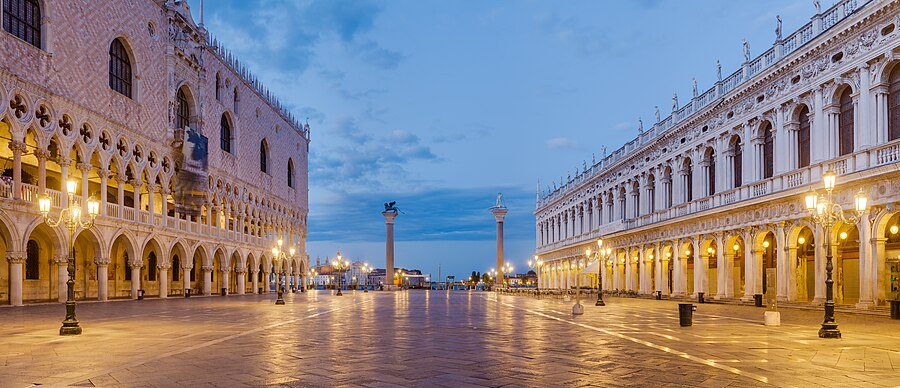
Alexander’s presence in Venice – Part 4, the Doge’s Palace

Who would check every detail of the Palace of the Doge in Venice, except the dedicated scholar? None of the millions of tourists has the patience or dedication to investigate, beyond the general overview. 

[San Marco Square, Doge's Palace on the left]

The Palace was built in the 12th century. The concept is atypical, displaying a smooth wall with a geometric pattern of white and pink stone, which rests upon two levels of colonnades. At ground level this is an arched white stone colonnade; on the first floor, it is a loggia enhanced with quatrefoil openings in white Istrian stone. The top of the Palace is crowned with white lace stonework merlons as seen in Persepolis and Central Asia. 

The capitals on top of the columns are all different and have many stories to tell. They serve not only as decorations but also as examples of historical, moral, and political teaching. We will recognize biblical scenes, Christian virtues, medieval symbolism, the Twelve Signs of the Zodiac, aspects of everyday life, and people of the world. 

[Doge’s Palace, south facade, Alexander the Great, ca. 1350 from Engramma]

It is in this last group that Alexander the Great pops up with the inscription ALEXANDER MACEDONIAE REX as one of the Kings of the World. He is to be found on top of the fifth column counting from the Ponte della Paglia. The picture from Engramma is not the best but is the only one available. It will have to do…