Alexandria's founded by Alexander

Alexandria's founded by Alexander the Great (by year BC): 334 Alexandria in Troia (Turkey) - 333 Alexandria at Issus/Alexandrette (Iskenderun, Turkey) - 332 Alexandria of Caria/by the Latmos (Alinda, Turkey) - 331 Alexandria Mygdoniae - 331 Alexandria (Egypt) - 330 Alexandria Ariana (Herat, Afghanistan) - 330 Alexandria of the Prophthasia/in Dragiana/Phrada (Farah, Afghanistan) - 330 Alexandria in Arachosia (Kandahar, Afghanistan) - 330 Alexandria in the Caucasus (Begram, Afghanistan) - 329 Alexandria of the Paropanisades (Ghazni, Afghanistan) - 329 Alexandria Eschate or Ultima (Khodjend, Tajikistan) - 329 Alexandria on the Oxus (Termez, Afghanistan) - 328 Alexandria in Margiana (Merv, Turkmenistan) - 326 Alexandria Nicaea (on the Hydaspes, India) - 326 Alexandria Bucephala (on the Hydaspes, India) - 325 Alexandria Sogdia - 325 Alexandria Oreitide - 325 Alexandria in Opiene / Alexandria on the Indus (confluence of Indus & Acesines, India) - 325 Alexandria Rambacia (Bela, Pakistan) - 325 Alexandria Xylinepolis (Patala, India) - 325 Alexandria in Carminia (Gulashkird, Iran) - 324 Alexandria-on-the-Tigris/Antiochia-in-Susiana/Charax (Spasinou Charax on the Tigris, Iraq) - ?Alexandria of Carmahle? (Kahnu)
Showing posts with label Xenophon. Show all posts

Wednesday, February 14, 2024

The Periplus of the Euxine Sea by Arrian – Part 3

In this last part of the Periplus, Arrian takes us from Dioscuras/Sebastopolis to Byzantium. 

He starts his story where he left off at the conclusion of part 1, i.e., in Sebastopolis (see: Tour of Colchis: From Trapezus to Sebastopolis). This section, the Cimmerian Bosporus, was not controlled directly by Rome but by a so-called client king. In Hadrian’s day, that was Cotys II, in full Tiberius Julius Cotys, who ruled from 123/4 AD until he died in 131/2 AD. His appointment was made for life, and his successor needed to be officially recognized by Rome. 

At the news of his death, Arrian decided that Hadrian would be interested in having the latest information about the Bosporan Kingdom since it supplied a great deal of wheat, clothing, wine, and slaves. His territory was also an important buffer zone with the warlike Alans living to the north. 

Arrian sailed along the mountainous coastline below the Caucasus to Pityus, some 65 kilometers away. These lands were occupied by the Zilchi, ruled by a certain Stachemphax, also recognized as a king by Hadrian. Follows a list of cities, harbors, and rivers, including the distances between them, from Crimea to the mouth of the Danube River. More familiar are the Greek cities on the south coast of Crimea, such as Panticapaeum (Kerch), Theodosia, Cercinitis, and Chersonesus (Kherson). Panticapaeum, which lies only 11 kilometers from the Tanais River (modern Don River) and flows into Maeotis Lake (Sea of Azov) was seen as the place where Europe ended and Asia started. 

Sailing further west, Arrian stops at the Greek city of Olbia at the mouth of today’s Dnieper River. Next, he heads for the harbor of Odessos, a trading post founded by the Greeks from Istria. From here, he continues to the wide delta of the Ister River (Danube), where he reaches the Island of Achilles or Leuke (possibly Snake Island in Ukraine). Legend has it that Thetis gave it to her son. The island was known for its Temple of Achilles, which held a wooden statue of the hero, as well as Greek and Latin inscriptions in honor of Achilles and his dear Patroclus. Arrian speaks of many offerings that were made, including sacrifices of animals. Those who sail by the island may “see” Achilles in their dreams or hallucinations. 

Proceeding further down the coast of the Black Sea, Arrian arrives at Tomis, a colony founded by the Greeks, where Emperor Augustus banished the poet Ovid. The next port was Callatis, established by the Carians, followed by Odessos (another harbor by that name), where he entered Thracia. 

Passing the eastern end of the Haemus Mountains (in central Bulgaria), Arrian reaches Miletus’ colony of Apollonia, which once held a colossal statue of the god Apollo. From here, he sailed to the not-so-good harbor of Salmydessus (roughly 150 km east of Hadrianopolis, modern Edirne), where Xenophon helped Seuthes II to become King of Thracia. 

By now, Arrian has landed on the Thracian side of the Bosporus. This area is reputed for the Cyanean Islands or Symplegades (also Clashing Rocks), a pair of rocks that clash together when a ship sails through. In Greek mythology, the rocks were defeated by Jason on his way to Colchis on board his ship, the Argo. 

Byzantium is Arrian’s final destination. He concludes by mentioning the local Temple of Zeus Ourios (who grants favorable winds), where Jason and the Argonauts erected an altar to the Twelve Olympian Gods on their return from Colchis. 

In our modern days of traveling by plane and high-speed trains, it is hard to imagine the pace in antiquity when people and armies moved on foot. Ships and barges were a comfortable alternative, although winds and currents were not always reliable. Travelers could never predict the duration of a trip or the time of arrival, but in those days, time was not so much of the essence as it is today. 

Though Arrian wrote his Periplus 130-131 AD, we don’t know how many months or weeks he actually spent at sea. Considering that the circumference of the Black Sea is over 4,000 kilometers, it may be safe to speculate that he spent most of those two years “on the road”. Quite an achievement!

[For the locations, please consult this map]

Tuesday, January 23, 2024

The Periplus of the Euxine Sea by Arrian – Part 2

The second part of the Periplus covers the section From the Thracian Bosporus to Trapezus. 

As mentioned earlier in About Arrian’s Periplus of the Euxine Sea, it could not be established whether this chapter reflects Arrian's personal experience or not. One theory is that he wrote it upon arrival in Trapezus after Hadrian appointed him governor of Cappadocia in 131 AD. 

We should also keep in mind that Arrian was a native of Bithynia, which bordered the south shores of the Black Sea over approximately one-third of its total length. Consequently, he knew the people and the geography of that area very well. As an admirer of Xenophon, he was familiar with the route followed by the Ten Thousand as they marched from Trapezus to Byzantium following the seashore.

[Bust of Xenophon, Carole Raddato (CC BY-NC-SA)]

Whatever the case, this section of the Periplus includes an impressive list of the harbors and rivers on the southern shore of the Black Sea among which are the cities of Herakleia-Pontus founded by the Megarians and the Boeotians at the mouth of the Lycus River; Tios, at the mouth of the Billaeus River and a colony of Miletus; Amastris (modern Amasra) that had a harbor 17 kilometers from the River Parthenius; Sinope, another colony of Miletus and home of Diogenes; Amisus, an Athenian colony between the Halys and the Iris River deltas; and, finally, Cotyora, a colony of Sinope. 

Ever since the days of the Hittite Empire, which reached its height in the 14th century BC, the Halys River was the border between several kingdoms; first between Lydia and the Persian Empire, then between the Pontic Kingdom and the Kingdom of Cappadocia. By the 6th century BC, it separated Lydia from Media until King Croesus crossed the river to attack Cyrus the Great and was defeated. 

[From the Greek Reporter]

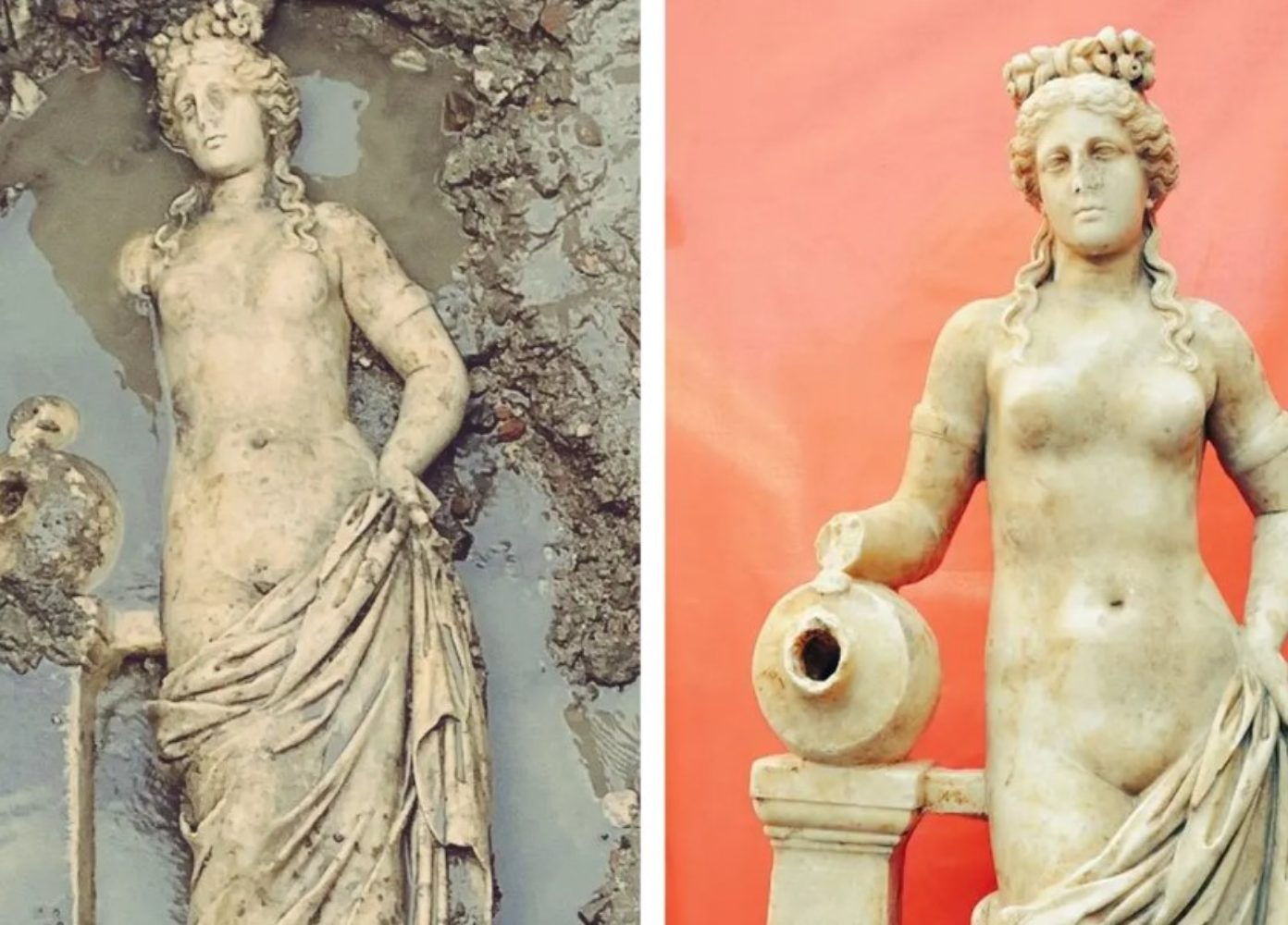
It is worth mentioning that a 1.50-meter-tall statue of Aphrodite has been discovered recently in ancient Amastris. It could be established that it is a Roman copy from between 180 and 200 AD that was inspired by Praxiteles’ school in the 4th century BC. The ancient city was named after Amastris, the niece of King Darius III, who married Dionysos, the tyrant of Herakleia-Pontus.

The map included in my post About Arrian’s Periplus of the Euxine Sea is most useful for locating all the cities, harbors, and rivers mentioned above. 

It should be said that while inspecting the Cappadocian frontier harbors in 123 AD, Emperor Hadrian had already visited part of the southern Euxine Sea, including Trapezus. With this in mind, Arrian now informed the emperor that Trapezus was building a new harbor, replacing the mooring where ships could only anchor in summer. 

It is quite amazing to see so much geography and history being exchanged. We tend to forget the many lines of communication that existed in antiquity, with traders, merchants, scholars, philosophers, astronomers, kings, and emperors traveling far and wide, by land and by sea.

[to be continued in Part 3]

Wednesday, January 17, 2024

The Periplus of the Euxine Sea by Arrian – Part 1

Arrian, to the Emperor Caesar Trajan Hadrian  Augustus, greetings. We came to Trapezus, a Greek city, as Xenophon says, founded on the sea, a colony of the Sinopeans; and gladly we looked down on the Euxine Sea from the very same spot as both Xenophon and you.

With these words, Arrian starts his letter to Hadrian, introducing the first part of his report, Tour of Colchis: From Trapezus to Sebastopolis. 

As mentioned in my previous blog, About Arrian’s Periplus of the Euxine Sea, Arrian started his journey in Trapezus. Here, he visited the sanctuary of Hermes, which was also devoted to Emperor Hadrian. Arrian tells the emperor that his statue needs to be replaced with a better resemblance to the original. He also shared his critiques on the rough stone altars and the “incorrectly written” inscriptions. 

From Trapezus, Arrian sailed east to inspect the garrison of Hyssus. Here, he organized a display of javelin throwing and reminded the soldiers of Hadrian’s observations and address made in 128 AD at Lambaesis, Numidia (modern Algeria), which survived on a column found northwest of its parade ground. 

His next stop was at the temple of Athena in Athenae, where he was marooned for two days due to a violent storm of thunder and lightning, during which he lost one of his triremes. Arrian’s fleet consisted of liburnas, small galleys suitable for raiding and patrols, and large triremes. 

When it was safe to travel onwards, he anchored at the fortress of Apsarus (Gonio in modern Georgia). He inspected the weapons and provisions of the five cohorts and paid the 2,500 soldiers. Remains of this impressive Roman fortress are still standing on the left bank of the River Chorokhi, where it controlled the access to the hinterland. In 135 AD, Arrian established his headquarters in Apsarus when he led the Cappadocian legions against the invading Alans.

[Remains of the Apsarus Roman Fort, Carole Raddato (CC BY-NC-SA)]

At this point in his letters, Arrian provides a list of all the rivers between Trapezus and Phasis that flow into the Euxine Sea, adding the distances between them. 

These details are helpful to follow the governor as he moved on to Phasis (see: The many colonies of Miletus), some 67 kilometers further north at the mouth of the Phasis River. This was the most important river in Colchis. It arose in the Caucasus, and its water was unusually soft and sweet with a changeable light color. In Phasis, he dug a ditch to protect the harbor and the settlement that had developed around the stronghold. 

Arrian’s interest and respect for the history of Jason is tickled when the locals show him an iron anchor claiming it belonged to Jason’s ship, the Argo. However, he was skeptical as it looked too recent. It seems that even in ancient times, people liked to spread tales and myths! 

The last leg of this trip took Arrian to Dioscurias, another colony of Miletus, known to him as Sebastopolis. He is said to have visited the sick, which raises the question about their ailments. He also checked the city walls and the ditch to be sure they would resist any attack from the native Colchian tribes on the eastern coast. He provided a list of their rulers subject to Rome as established by Hadrian. They were Malassas of the Lazi, Rhezmegas of the Abasci, and Spadagas of the Sanigs. 

He further inspected Sebastopolis, including the grain supply vital to the army’s survival. He paid the soldiers and watched the cavalry in their exercises, leaping upon horses. 

From that harbor, the governor could see the highest peak of the Caucasus, the Strobilus, where, according to myth, Prometheus was bound and an eagle ate his liver that grew back overnight. The mountain was Mount Elbrus. 

This completed Arrian’s mission, and he returned to the naval base of Trapezus, 422 kilometers away.

[To be continued in Part 2]

Wednesday, January 3, 2024

About Arrian’s Periplus of the Euxine Sea

Beyond doubt, Arrian is best known for his Campaigns of Alexander the Great but as I mentioned in my earlier post, What do we know about Arrian of Nicomedia, he was a prolific writer. However, most of his works have now been lost. 

Such was the case for his Periplus of the Euxine Sea, the Circumnavigation of the Black Sea, an official military report Arrian wrote in Latin to Emperor Hadrian, who had inspected the area before him. Additionally, he composed a series of informal letters to Hadrian using Greek.

Although Arrian was a member of the Roman imperial administration, he also belonged to the Greek literary elite. As a native of still very Greek Bithynia in Asia Minor, Arrian grew up with this dual identity making him a true Graeco-Roman. Addressing his Greek account to the Philhellenic emperor underscores his friendly and personal relationship with Hadrian.

Arrian was very much inspired by Xenophon, a philosopher, and historian from the 4th century BC – hence his nickname of “Second Xenophon.” In fact, Arrian picked up Xenophon’s tracks on the Black Sea at Trapezus as he led his Ten Thousand according to his Anabasis.

Arrian’s Greek version of the Periplus with its valuable information about the Black Sea region luckily survived. It dates from 131 AD, one year after he had been appointed governor of Cappadocia.

In his days, Cappadocia was a Roman frontier with forts along the coast of the Black Sea. Arrian’s duty was to protect that line of defense and the routes into the hinterland up to the Parthian Empire further east. He was also responsible for the Pontic Fleet based in Trapezus (modern Trabzon) and for protecting the grain supply from Crimea. Besides those matters about his military and diplomatic mission, Arrian outlined the navigation routes and ports of the Black Sea and concentrated on economic activities and resources.

His Periplus covers a counter-clockwise voyage around the Black Sea, made in three separate trips. During his first journey, he sailed from Trapezus to Sebastopolis. His letters to Hadrian are bundled in chapters 1 to 11 and constitute the longest and most interesting part of his Greek Periplus.

His second expedition contained in chapters 12 to 17 took him from the Bosporus to Trapezus, and the third one is covered in chapters 18 to 25 traveling from Sebastopolis to Byzantium. These two voyages may well have been undertaken by different people as the narration is less personal and less fluent.

Much of the writing focuses on the rivers, landmarks, harbors, and cities, including the distances and other relevant information for sailors and travelers alike. It also includes information regarding the local population and the safe havens. True to himself, Arrian likes to insert local stories from Greek mythology such as Jason and the Argonauts and Prometheus, and often quotes Homer.

In short, a complete traveler’s guide that may still be helpful today!

[Continue reading in Part 1]

Tuesday, October 11, 2022

Peritas, Alexander’s dog

Alexander had a dog named Peritas. So much is certain, but when it comes to defining the breed or race of this dog, we quickly find ourselves among legends and mysteries. 

The story goes that Alexander received the dog as a puppy. The name Peritas seems to mean January in the Macedonian language. The dog generally is defined as a Molossian, a breed of fierce fighters that no longer exists and could be closely related to the Mastiff. It was especially loved for its speed, strength, and bravery. Other sources tend to believe that Peritas was a greyhound that Alexander brought up himself. 

The Molossian dog would fit the image of the conquering Alexander perfectly. It is said that he was an enormous, powerful dog that could fight as hard as any soldier. He would not hesitate to attack lions or elephants. Virgil confirms his talents: “Never with [Molossians] on guard, need you fear for your stalls a midnight thief, or onslaught of wolves, or Iberian brigands at your back.”  

Either legend or truth, Peritas would have jumped to bite the lip of an elephant about to attack Alexander during the Battle of Gaugamela.  

Another story is being reported from India during Alexander’s battle with the Malians. The soldiers had been slow to follow their king, exposing him to the full force of the enemy’s assault. Alexander was hit by a poisonous arrow while scaling the city wall (see: About the Death of Alexander the Great). Apparently, Peritas held the enemy off until the Macedonians joined up with Alexander. Mortally wounded, the faithful dog crawled to Alexander, laid his head in his lap, and died.  

In a more elaborate version, Leonnatus sent the dog to Alexander. The obedient Peritas valiantly fought his way through the Malians till he reached his badly wounded master and defended him from the attacking enemy until the Macedonian troops arrived. The deadly injured Peritas crawled to Alexander, laid his head in his lap, and died.
 
We will probably never know what happened exactly, but a statue of Peritas was erected at the entrance to the city that bears his name.  He enjoyed the same honors as Alexander’s horse, Bucephalus. 

Based on the wide number of ancient dog tombstones, we can safely say that Greeks kept their pets as their trusted companions and protectors – not unlike what we do today.  

Alexander is no exception as a dog lover. He kept a vast number of dogs that accompanied him in hunting and in war or were simply keeping him company. Which one of them is Peritas remains a mystery. I personally picture Peritas as being a greyhound, meaning he was not the hero so honored in India.  

The Greeks have left us many tombstone inscriptions in which they openly grieved the loss of their faithful companion. They cried and mourned them as we still do nowadays. One particularly poignant tombstone reads, “You who pass on this path, if you happen to see this monument, laugh not, I pray, though it is a dog’s grave. Tears fell for me, and the dust was heaped above me by a master’s hand”. 

Homer
early on mentions Argos as the loyal friend of King Odysseus. The faithful dog recognizes his master when he returns home after twenty years. Odysseus, who wants initially to remain incognito, does not respond to his dog's affection, after which Argos lays back and dies.

Socrates took his philosophy so far as to attribute wisdom to dogs since they can distinguish their owner’s friends from their enemies. Diogenes (see: Alexander meeting Diogenes in Corinth) went as far as calling himself The Dog because "I flatter those who give me anything and bark at those who give me nothing." He had quite a sense of humor!  

Xenophon’s dog was called Impetus. He stated that a dog’s name was chosen with great care. Ancient Greeks were particularly fond of names that expressed power, courage, appearance, or speed.  In short, nothing new under the sun!

Monday, March 7, 2022

What do we know about Arrian of Nicomedia?

Although Arrian is quoted repeatedly by many historians, ancient and modern alike, we don’t know precisely when he was born or died. He lived during the reign of two great emperors, Trajan and Hadrian, when the Roman Empire experienced its most remarkable expansion.

He was a versatile man and prolific writer, but he was a historian most of all. How he found the time to pen down his many books besides pursuing a military career, holding public offices, and becoming a famous philosopher is commendable. 

Arrian, whose full name was Lucius Flavius Arrianus, was born in Nicomedia (modern Izmit, Turkey), a province of Bithynia ruled by Rome. Consequently, he was probably a Roman citizen. He grew up in an aristocratic family, was well-educated, and held the post of governor of Cappadocia from approximately 131 until 137 AD. Since the culture in Asia Minor was still very Greek, he grew up with this dual identity, making him a true Graeco-Roman. 

Arrian was the perfect person to write about Alexander the Great, having such a background. With his upbringing in Nicomedia, he realized that Alexander left behind so much Greek culture (he didn’t use the word Hellenistic!) He absorbed it all, even though he looked at it from a Roman perspective several centuries later. 

As a young man, c.108 AD, he moved to Nicopolis, Greece (earlier in Epirus), to stay with Epictetus. Epictetus considered philosophy a way of life, meaning that whatever happened was beyond our control, and we should accept events as they unfolded. His main philosophy was self-knowledge, similar to the Delphic maxim, know thyself. These wise words were visible in the pronaos of the Temple of Apollo in Delphi and were spread by Aeschylus, Socrates, and Plato. It is unknown whether Epictetus based his thoughts on this inscription, as no writings from his hand have survived. It was Arrian who wrote down Epictetus’ lectures in his Discourses of Epictetus and Enchiridion. 

The philosopher considerably influenced Arrian’s education and introduced him to important political people. The most notable figure probably was the later Emperor Hadrian – himself a pupil of Epictetus - whom he befriended in 126 AD. Hadrian appointed Arrian to the Roman Senate around 130 AD and promoted him to the governor of Cappadocia about a year later. During his governorate, he successfully stopped the invasion of the Alani in 135 AD. This was when Arrian documented his victory by writing his Ectaxis contra Alanos (Order of Battle against the Alans), which provides us with a unique insight into the Roman army in action that still bore “the stamp of Macedon.” Aware of the difference between the Macedonian and Roman phalanx, Arrian drew parallels between them. He underscored that the phalanx was not something of the past but still an active weapon in the contemporary military. His military career took him to many countries away from his native Bithynia, where he saw very different animals and plants from his familiar homeland. 

Arrian’s military career probably started earlier as he led an army to the Caspian Gates during Emperor Trajan's rule (98-117 AD). As governor of Cappadocia, Arrian commanded two Roman legions, which was when he wrote his Ars Tactica (The Tactical Arts). Experiencing the strategies and maneuvers firsthand, he described cavalry tactics and praised military innovations. In both Ectasis and Tactica, he mixed Greek and Roman military theories.

Arrian has a great interest in geography and a keen eye for details. Under Hadrian, he wrote the Periplus of the Euxine Sea (Sailing around the Black Sea) to inform the emperor about the region he considered exploring. Besides helpful information about ports, rivers, and cities, he included specific details about the viability and landscapes. In his Cynegeticus, which is an addition to Xenophon’s work, he stated, for instance, that Mysia (northwest Turkey), Dacia (mainly all of present Romania), Scythia, and Illyricum (the greater Balkans) had plains that were “adapted for riding.” 

Clearly, our historian started writing at a very young age. However, many of his works are lost or only survive fragmentarily, leaving us with titles alone. Besides the titles already mentioned above, he wrote:

- Biographies like Lives of Dion, Timoleon, and Tillorobus

- several volumes dedicated to his homeland, the Bithyniaca

- a history of the Parthians, the Parthica

- a history of the Alans, Historia Alanica

- an essay on maneuvers, On Infantry Exercises

- an essay about astronomy, On Nature, Composition, and Appearances of Comets

- And, most interestingly, a volume focusing on the events after the death of Alexander, The History of the Successors – sadly lost to humanity forever! Imagine the twists history could take if we had this book!

When or where exactly Arrian wrote his famous Anabasis or The History of the Wars and Conquests of Alexander the Great remains obscure. It is generally accepted as his most outstanding work, together with the Indica addendum about India. With these two books, Arrian is, to this day, our most precious and reliable source about Alexander. The historian could project his own military experiences and campaigns into his vision of Alexander. Arrian also had a profound fascination with Persia and Persian customs, which he lavishly shares in his Anabasis. 

Notably, he could rely on several sources, from first-rank witnesses to Alexander’s campaigns. These were generals and close Companions who had access to Alexander’s Royal Journal – men like Ptolemy, Nearchus, and Megasthenes. Another precious source was Eratosthenes, a librarian at the rich Library of Alexandria. Aristobulus also served under Alexander and later wrote a history of Alexander, including careful observations on geography, ethnography, and natural science. Aristobulus’ notes about which plants grew in specific regions of the lands Alexander conquered were vital because it gives us a glimpse of Alexander’s knowledge of plants and animals based on Aristotle’s lessons. 

It is still being determined what happened to Arrian at the end of his governorship in Cappadocia in 137 AD. Still enjoying the favors of Hadrian, he most probably became governor of Syria between 135 and 150 AD.

Towards the end of his life, he moved to Athens, where he became archon, probably in 145 or 146 AD. Other sources, however, state that Arrian retired to Nicomedia, where he was appointed priest to Demeter and Persephone. 

Arrian died some time during the reign of Marcus Aurelius, 121-180 AD, who was the last of the so-called good emperors. 

Witnessing how meticulous and objective Arrian proceeds in his Anabasis to describe Alexander’s campaigns, not only the sieges and the battlefields but also the geography and the nature and habits of the people, it is easy to realize how much information is lost in his other works.

Thursday, June 24, 2021

Greek philosophers Alexander knew

In April 2021, Mark Cartwright published an article in World History with a selection of twenty Greek philosophers. When I looked at the dates, I was amazed to discover that most of these men lived roughly one century before Alexander the Great was born. This means that the young prince and later king was familiar with their works and teaching, which covered many fields. 

Most prominent are Socrates  (c. 469-399 BC), Plato (427 - 348/347 BC), and Aristotle (384-322 BC), who are often mentioned in one breath as pre-Socratic philosophers. But there are many other great names like Pythagoras (c. 571 - c. 497 BC), who juggled with numbers, Democritus (c. 460- c. 370 BC), who wisely stated that nothing comes from nothing, Epicurus (341-270 BC), who focused on the pleasures of life, and the eccentric Diogenes (c. 404-323 BC), the hippy of antiquity. 

The knowledge of these thinkers had a significant influence on the world of antiquity (including Alexander) and still inspires us in modern times. Many of these philosophers never put any of their philosophy down in writing; if they did, their own letters seldom survived. In these cases, their teaching reached us through their pupils or followers. 

The philosophy of Socrates (c. 469-399 BC) was recorded by one of his pupils, Plato. He, in turn, taught Aristotle (384-322 BC), who became the tutor of young Alexander. Thanks to Alexander’s conquests, Greek knowledge and philosophy were spread throughout the ancient world. 

Another remarkable student of Socrates was Xenophon, a favorite author of Alexander, who recounted how he led a large group of Greek mercenaries back to Greece. These soldiers had been hired by Cyrus, who had died at the battle of Cunaxa (near Babylon) in September 401 BC (see: The Persian Expedition by Xenophon). The great merit of Socrates was that he inspired men to think for themselves – a relatively modern concept! Sadly, this great mind was sentenced to death and forced to drink poison after being accused of corrupting the youth of Athens. 

Plato (427-348/347 BC) penned down his philosophical works, which would eventually influence world culture. His thoughts greatly impacted the three monotheistic religions known: as Judaism, Christianity, and Islam. He was also the founder of the first university in the world named after him, Plato’s Academy in Athens. This happened after Socrates’ death and his own return from traveling to Egypt and Italy. Most of Plato’s works discussed the ideas expressed by Socrates, rightfully so or not. The philosopher was 80 years old when he died. His Academy may have lived on for almost 1,000 years until Emperor Justinian, a zealous new Christian believer, closed it to suppress paganism. 

Aristotle (384-322 BC) was a philosopher in his own right who made considerable contributions to logic, metaphysics, mathematics, ethics, politics, agriculture, medicine, biology, and botany. He has already been treated in previous blogs like Stagira, the Birthplace of Aristotle, and Aristotle’s 2,400th birthday with an appropriate celebration. 

Then there is Pythagoras (c. 571- c. 497 BC), best known for his famous Theorem stating that the square of the hypotenuse of a right triangle equals the sum of the squares of the two other sides. However, he was also the first to concentrate on the transmigration of souls, or, in other words, reincarnation. The details of Pythagoras’ life remain obscure, but apparently, he traveled to Babylon and Egypt. However, this Theorem may not have been his invention but copied from the Babylonians. Also, the idea of reincarnation may have been transmitted to him by the Egyptian priests. In antiquity, he was considered a mystic and not the mathematician we remember nowadays. In any case, he influenced the philosophy and thoughts of both Plato and Aristotle and many later philosophers far into our modern way of thinking. 

In turn, Democritus (c. 460-c. 370 BC) revolutionized the world as he claimed that the universe and everything in it was made of tiny undividable building blocks, which we call atoms. Although he may have written as many as 70 books, none of his work has survived. He touched on various topics like human origins, ethics, geography, astronomy, geometry, medicine, poetry, literature, and even farming. Aristotle, later on, cited parts of his works. Like Pythagoras, Democritus is thought to have spent time in Egypt to study mathematics and in Babylon, where he sought the company of the priests. He seems to have voyaged around the Mediterranean and further East to Persia and India. 

Next on the list is Epicurus (341–270 BC), who taught that “Pleasure is the principle and end to a happy life.” The modern adage may have been translated into “A laughter a day keeps the doctor away.” Epicurus was strongly influenced by Plato, Aristotle, and Democritus. From 307 BC onward, he lived in Athens, where he founded his school, The Garden. Here he welcomed both women and slaves, which clearly was not to the liking of the Athenians. Putting pleasure as his highest goal in life was often misunderstood. For Epicurus, pleasure should be seen as eating and drinking in moderation and leading a life of restful contemplation. He needed to “not spoil what you have desiring what you have not; remember that what you now have was once among the things you only hoped for.” He died from kidney stones at 71, but his school and philosophy would live long after this death. 

Last on this top list is Diogenes (c. 404-323 BC), who became famous for squatting in a barrel on the agora of Athens and living as a beggar from the gifts of his admirers. He was a contemporary of Alexander and died in the same year as the king. Legend has it that they met during Alexander’s visit to Corinth (see: Alexander meeting Diogenes in Corinth). This philosopher believed it was necessary to reject all that was unnecessary in life, not only one’s personal possessions but also one’s social status. The first part of this philosophy was widely accepted by Alexander, who did not care much for personal possessions! What must have shocked Diogenes' contemporaries is that he was very straightforward in his conversations and didn’t care for the rules of etiquette and good manners. Although Diogenes wished that his dead body would be thrown to the dogs, and despite his critics, he was buried with honor. 

There are, of course, many other great names such as Thales of Miletus (625-547 BC), one of the Seven Sages of ancient Greece (see: Miletus, more than a city), Parmenides, founder of the Eleatic School at the beginning of the 5th century (see: Magna Graecia, the forgotten Greek legacy) that was attended by Zeno of Elea (5th century BC) and Melissus of Samos (5th century BC) – maybe even by Xenophanes of Colophon (570-c. 478 BC) but that is not proven. 

Also listed in Mark Cartwright’s article are:

Anaximander of Miletus (c. 610-c. 545 BC), a friend of Thales wrote about astronomy as he apparently was the first to use the gnomon to determine solstices, time, seasons, and equinoxes. He also published a work on geography with the first map of the inhabited world (see: Miletus, more than a city). 

Anaximenes of Miletus was a younger contemporary and pupil of Anaximander. His theory was that the prime substance was pneuma, i.e., breath or air world (see: Miletus, more than a city) 

According to Plato, Antisthenes of Athens (c. 445-365 BC) was a follower of Socrates and may have witnessed his death. He was the founder of the Cynic School and wrote on subjects like physics, literature, and logic. 

Aristippus of Cyrene (c. 435-356 BC) founded the Cyrenaic School of Philosophy. He believed that pleasure and pursuing pleasure was the highest goal in life. That sounds rather odd coming from a pupil of Socrates. He died the year Alexander was born.

Heraclitus of Ephesus, an early Pre-Socratic philosopher who sought to identify the creation of the world (see: Sailing the Wine-Dark Sea. Why the Greeks Matter by Thomas Cahill) 

Protagoras of Abdera (c. 485-415 BC) also stood out. After all, he was the first philosopher to promote subjectivity because everything was relative to individual interpretation. In simple words, man is the measure of all things. He was the greatest among the Sophists, i.e., rhetoric, politics, and logic teachers who made a living as private tutors to the youth of the upper classes, especially in Athens. He taught them how to speak well – hence, our word sophisticated. Unlike Socrates, he was accused of impiety, which, in ancient Greece, meant he was executed. At age 71, Protagoras decided to flee from Athens before he was put on trial. Sadly, he drowned before he reached Sicily. 

Zeno of Citium on the island of Cyprus (336-265 BC). He was born in the year Alexander became king. By chance, he was exposed to the teachings of Socrates through the book, Memorabilia, written by Xenophon. Zeno’s study eventually led him to become a teacher himself as he founded a school on the porches (the Stoa) of Athens’ Agora. That’s how his school got its name, Stoic. Stoicism would become one of the most influential philosophies in the Roman world.

All in all, this is a substantial baggage the young King of Macedonia took with him to the East!