Back in 2018, I
shared the news about the restoration of Termessos’
city walls and the clearing of the ancient road that connected the city to
ancient Attaleia(modern Antalya).
Presently, more
serious excavation works are being planned in Termessos.
For a start, a monumental tomb that once held several marble sarcophagi will be
pieced together using the scattered and now numbered blocks lying around. Apparently,
all the original stones have been listed. Unfortunately, the Hurriyet
Daily News does not disclose its location.
I found the
choice the archaeologists made to start with the monumental tomb quite surprising,
ignoring the more obvious remains of the Theatre, the Temple of Hadrian, the Temple of Artemis, the
Bouleuterion, the Agora, and other recognizable constructions.
Next excavations
will, however, focus on the Gate of Hadrian,
hopefully extending to the nearby Temple
of Artemis from the 2nd
century BC. Other necropolises, the aqueducts, and cisterns may also be
included in this project.
Until now, only
the exceptional remains of the Tomb
of Alcetas have been identified.
This general, brother of Perdiccas,
fought with Alexander in India,
and died here in Termessos
in 319 BC during the siege of the city in the War of the Diadochi.
The beauty and challenge of Termessos
is that its remains have been left mostly untouched and protected as part of the
National Park
of Güllük Dagi, with
its rich diversity of fauna and flora.
Philipgave Cynanein marriage to Amyntas, who was the
legal successor to the throne of Macedonia after his father, King Perdiccas IIIof Macedonia, died in combat in 359 BC. As Amyntaswas only a child, Philip, Perdiccas' younger brother, became his
tutor and regent. Later that year, Philipwas elected king instead.
After Philip's murder in 336 BC, Amyntascould have taken his chances, but he did not, for whatever reason. The newly
elected King Alexander, however, did
not hesitate and had Amyntaskilled.
He could have suspected that Cynanewould manipulate her husband to gain power. Cynanewas left a widow, raising her daughter Adeaalone. Not for long, though.
When Alexander made
his way to Pelium in
335 BC, he faced a threatening revolt of the Illyrians, and Langaros, King of the Agrianes, came to
his rescue. In recognition of his assistance, Alexander invited Langarosto Pella,
offering his half-sister Cynane in marriage.
Before this wedding could materialize, Langarosfell ill and died (see: The
short-lived appearance of King Langaros).
Cynane stayed in Macedonia as Alexander
left for Asia. Having been raised by her
mother in the Illyrian tradition as a warrior, equal to any man, she now
instilled the same values in her daughter.
Upon Alexander’s death, Cynanesaw her chances, not for herself but for Adea. She mobilized her troops and led
her daughter and her army to Babylonto secure their future by arranging the marriage of Adeawith Alexander’s
successor.
As the daughter of Philip II and Alexander’s half-sister, Cynaneenjoyed the loyalty of the Macedonian army, despite General Perdiccas’ disagreement. The general tried to stop her in every
possible way and sent Alcetus, who
killed Cynanebefore she could speak.
This assassination did not sit well with the Macedonian army, who revolted and
demanded that Adea, Alexander’s niece, marry Alexander’s half-brother, the simple-minded
Arrhidaeus. Arrhidaeus, who was the only available bloodline, would rule as King Philip III, and Adeawould become Queen Eurydice II. She was the power behind Philip III, which was not to the liking of Queen Olympias. She had Philip III killed
in 317 BC and Eurydice II imprisoned
and forced her to commit suicide.
This long
introduction brings me to the tomb of Philip II and the adjacent tomb of a woman in Vergina. Since its
discovery in 1977 when Manolis
Andronicos attributed the tomb to Philip IIand the remains in the smaller room to his seventh and last wife, Cleopatra, many arguments have erupted, presenting different theories.
Recently, I
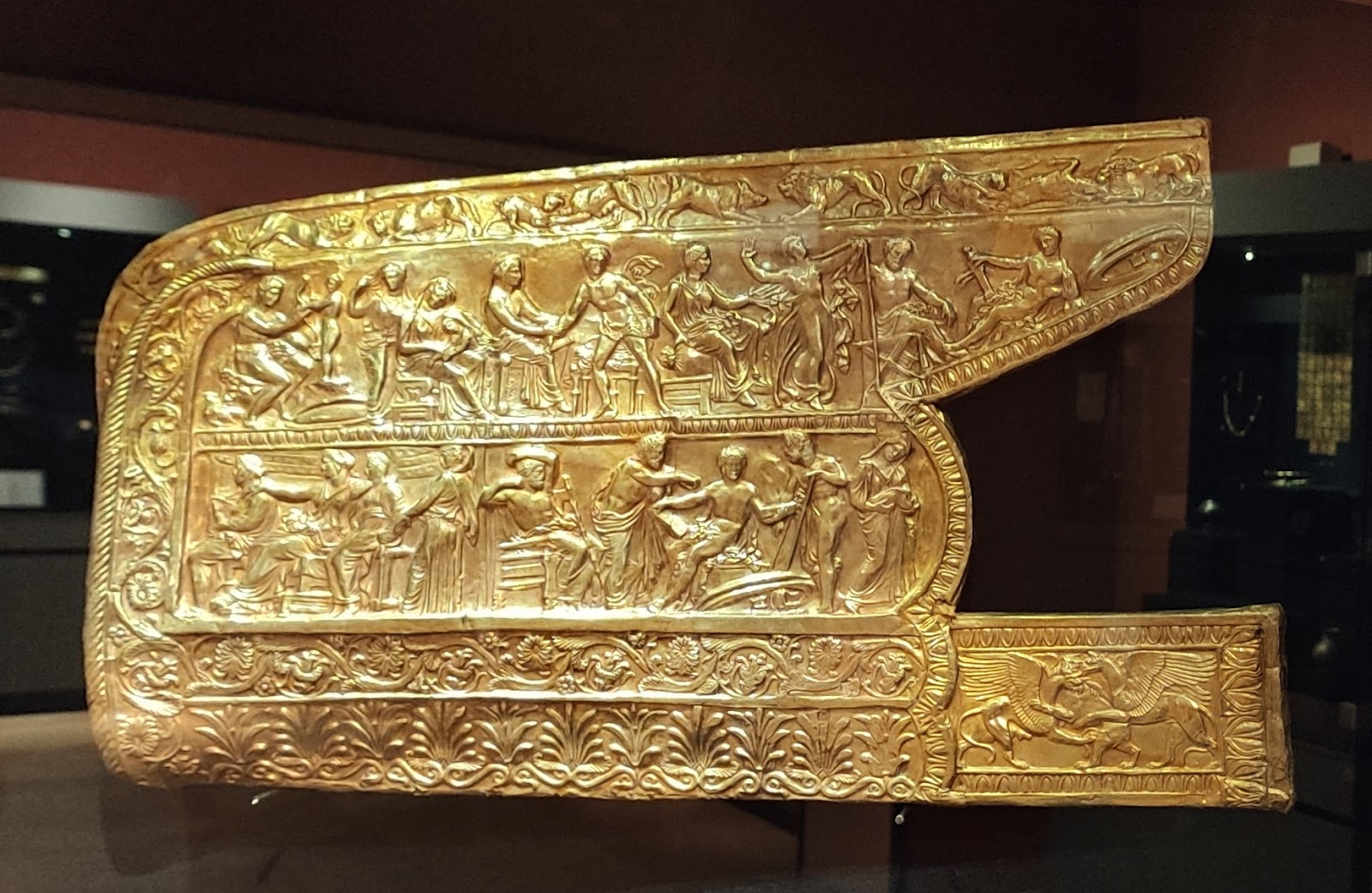
watched a presentation on the History Channel*, about the gold quiver or goritos found in this tomb. Scholars
agree that it is Scythian and not Macedonian, made between 900 and 200 BC.
Next, the question arose whether it had belonged to Philipor to the woman. If it was
the woman’s, who was she, and could she be a descendant of the fiercest
Scythian female warriors, the mythical Amazons?
The breakthrough
occurred when the female bones and pelvis from the smaller room were analyzed.
It is known that a woman’s pelvis changes during life, and it could be
determined that this example was between 30 and 35 years old.
Adea/Eurydicewas only 20
years old when she had to take her life. She is not a candidate to be interred in Vergina.
This conclusion automatically excludes earlier debates presenting Philip Arrhidaeusas the main occupant.
The only
remaining person obviously is Cynane,
Alexander’s half-sister, who was 34
years old when she was murdered on the orders of General Perdiccas.
It was also
established that the two chambers of the Vergina Tomb were not built at the
same time. Since Cynanedied 13 years
after her father, it is entirely plausible that her tomb was added next to her
father’s at a later date.
The program
concluded with an extra note regarding the Scythian goritos (that was worn around the waist). After examining the DNA
of the remains found in the Scythian kurgans, the scholars concluded that not
all warriors were men, as 1/3 of the burial sites were built for women.
Cynanemust have been
quite a character, raised as a warrior and a match to any man. No wonder the
Macedonian troops were horrified when she was murdered in cold blood. It is quite remarkable that she lived one year longer than Alexander. Whoever
arranged for her to be buried next to Philipwas well aware of her courage and battle spirit. Maybe her father had been
attracted to Audata for that same
reason, who knows?
*2023 Strangest Things on History
Channel
[Picture of Cynane's larnax and Facade of Philip's tomb are from Wikipedia; Goritos picture from this link Wikipedia]
“To the
strongest” are the last words Alexander
pronounced on his deathbed in Babylon
when pressed to name his successor.
His Companions
and generals were obviously panicking at the thought of being left behind so many
miles away from Macedonia
without their king to guide them. They desperately needed him.
Ever since he became
king in 336 BC Alexander had shown his commanders the way and led his
men by example. He certainly did not
expect to die at the age of 33 and not in his bed. How could he have foreseen
to be incapacitated and unable to be his own self?
The only person
who had always been at his side and enjoyed his full confidence had died the
previous year. Hephaistion had been
officially appointed as his Chiliarch, his second in command. The sudden death
of his dearest friend left him in total disarray and maddened by grief. He was
truly alone at a time when he had to make the hardest decision of his life and
elect a successor. “Who, Alexander? Tell us who!” are the words Oliver Stone
put in the mouth of Ptolemy. How
appropriate!
“To
the strongest” has often been understood as a weak and evasive statement, although, in
reality, Alexander’s last words are one final proof of his genius! Had he
not been so much afflicted by his illness and impaired by the high fever, he
would have found the strength to elaborate a solution to the Succession with
his close Companions. He would likely have appointed Perdiccas. Even so, Alexander’s decision may have lost its power two years onward, and
the commanders would have taken the matter into their own hands anyway.
Of
course, everyone around the king’s deathbed still hoped to be appointed and hear his
name called out. However, matters were not as straightforward as one might
think. On the one hand, he had to name an heir since, as King, he needed a
successor, and on the other hand, as commander in chief of his army, he had to
appoint a capable military leader.
At
this point, his most experienced generals were Craterus and Perdiccas.
Yet, Craterus was in Cilicia taking 10,000 veterans back to Macedonia with Alexander’s instructions
to replace Antipater as
Regent in Pella. Perdiccaswas
in Babylon and
took the king’s succession into his hands.
Roxanewas pregnant, but the
child had not been born yet, and there was no guarantee it would be a boy. Alexander had
never recognized Heracles,
his son by Barsine. In any case, Roxane’s son
and Heracleswere too young to rule, and the generals would
have to choose a Regent pending their coming of age. The next best option was
to push Arrhideusforward. He was Alexander’s simple-minded
half-brother and not capable of becoming the de facto ruler.
As a result, Perdiccaswas
elected Regent at the Partition of Babylon.
This
implied, however, that he would rule over Alexander’s Companions
and generals. Perdiccas’ success was short-lived, though, and in 321 BC
he was sidelined at Triparadeisus as the commanders decided
to divide the kingdom among themselves. When Perdiccasescorted Alexander’s remains
to be buried in Macedonia, Ptolemy hijacked the mummified body and took it to Egypt. In a desperate attempt to
recover his king’s remains, Perdiccasfailed totally to march
his men across the Nile. His losses were
so excessive that his soldiers revolted and killed him.
None
of the great men who fought alongside Alexander for almost
twelve years emerged as the strongest. They all had learned a lot, but none
could come close to Alexander’s charisma and exceptional genius.
Lysimachos was in Babylonat the time of Alexander’s death in 323 BC. Almost immediately, anarchy erupted
as the king had no successor. Every single one of his generals felt entitled to
succeed Alexander pending the coming of age of his yet unborn son.
The War of the Diadochi had begun and
would last for the next forty years or so. The generals took sides, changed
sides, and made peace treaties but coveted each other’s possessions soon after.
Their lust for power led them to conquer ever more land. They
eliminated each other systematically until around 280 BC; four contenders
remained: Ptolemyin Egypt, Seleucosin Asia, Antipater / Cassanderin Macedonia/Greece, and Lysimachosin Thrace.
Lysimachos’
origin is obscure, and the best guess is that he was born around 361 BC to
Thessalian parents living in Pella.
He was educated at the court of Philip and was probably one of his Bodyguards.
He was only a few years older than Alexander, and we can safely assume that he
joined the young prince in Mieza to
attend Aristotle’s
teaching with the other selected young men.
Historians hardly mention Lysimachosin Alexander’s early campaigns, although he was present throughout the king’s
conquests of Persia
as one of his trusted Bodyguards. This lack of information does not imply that Lysimachoswas not a valued element in Alexander’s organization. Many positions beyond
that of a general were of the utmost importance. Take, for instance, the
logistics of the entire enterprise, or the scouting parties to locate otherwise
hidden enemies or find the appropriate location for the following camping site,
or escorting Queen
Sisygambis and her retinue till their arrival at Susa,
and many other tasks.
Lysimachosjoined the ranks of the Companion Cavalry, maybe after several of Alexander’s
masterly reshuffling of the army according to his needs.
Except for him being mauled
by a lion in Syria, he was not
documented until 328 BC, when Alexander crossed the HydaspesRiver.
There is no further information.
Lysimachosparticipated in the siege of Sangala(see: The
siege of Sangala). Alexander lost less than one
hundred men in this fierce fight, but an excessive number of 1200 soldiers were wounded, including Lysimachos.
He was evidently present at
the Susa
Weddingin 324 BC, but we don’t know the name of his bride. Since she
is not mentioned when he moves to Thracia,
we may conclude that he left her behind after Alexander’s death, at which time
he became ruler of Thracia.
The position of Thracia was strategically crucial as the land
extended to the Black Sea and the Hellespont, both major links with Asia. Upon arrival, Lysimachosfaced the rebellious Thracian tribes fighting each other. Their most powerful
dynasty was the Seuthes. However, Lysimachoswas quickly able to establish his authority.
In 321 BC, to stabilize
his position further, he decided to marry Nicaea,
Antipater’s
daughter, after Perdiccashad refused her hand. This alliance secured his position vis-à-vis both Antipaterand Cassander.
The couple would have three children: one son, Agathocles, and two daughters.
In 315 BC, a revolt broke
out among the cities on the Black Sea. Antigonus Monophthalmus, who reigned over most of Asia Minor, saw an
opportunity to annex Thrace to his own territory and stirred up the local tribes against their king. Once
again, Lysimachosmanaged to suppress the revolt and consolidate his power. Peace was reached in
311 BC.
This revolt drew him into
the Succession Wars, and he sided with Cassander,
Ptolemy,
and Seleucosagainst Antigonus Monophthalmus. In 309 BC, to secure the Hellespont, he built a new city, Lysimachia,
in a commanding location on the Chersonese peninsula.
By 305 BC, all the
contestants in the Wars of the Diadochi adopted the
title of king and Lysimachosfollowed suit by assuming the royal title as well. He was now an equal player
in the succession game of the thrones.
In fact, with his
marriages, Lysimachoswas in line with the other Successors or contenders who still aimed at
re-establishing Alexander’s empire. Marriage was much cheaper than war to
conquer more land.
Arrian
does not mention what happened after Alexander’s death since the accounts of both Ptolemy and Aristobulus stopped at this
point. However, he adds a splendid eulogy to the greatness of Alexander. Diodorus follows the same
idea, stating that “He
accomplished greater deeds than any, not only of the kings who had lived before
him but also of those who were to come later down to our time.”
Only Curtius’ history continues
describing the mourning in the streets of Babylon by friend and foe, the earliest rivalry between the generals, and all kinds of
intrigues that followed the king’s death. He is the only one to mention that Alexander lay unattended
for seven days before his friends reentered the room. So much for a “friend,”
right? He reports how his body did not show any sign of decay despite the
Babylonian heat. As a result, the Egyptians and Chaldeans, "who were ordered” to
care for the body, hesitated to handle it. It is only after they prayed to their
gods for approval that “they emptied his body of entrails.” He goes on by
saying that the gold coffin was filled with perfumes, yet nothing about the
honey that covered Alexander’s
body as seen by those who paid their respects to him years later in Alexandria.
Several
questions arise after reading these accounts. Curtius, for instance, is the only one to tell
us about the widespread quarrel among the generals and troops alike (not yet about the matter of succession) and about
the decision to embalm Alexander’s
body. Plutarch
casually remarks that the body remained unattended for several days.
What transpires
is that nobody stayed at Alexander’s
bedside after he was declared dead. It is baffling and truly unacceptable
vis-à-vis the King of Macedonia, the King of Kings, to be left without a single
soul at his side to mourn him? Macedonia
must have had a set procedure for treating the deceased king. Persia
undoubtedly had a very ancient court protocol for such occasions! Yet, Alexander was left
alone and unattended. Incredible!
About a week
later, the king’s entourage seemed to remember that their king was dead and
required burial of some kind. According to Curtius, who appears the only source on this matter,
“Egyptians and Chaldeans were ordered to care for the body.” Nobody says who
issued such an order. The priests certainly would not act on their own to
handle the remains of the King of Kings, the most powerful man of the world!
Was there any discussion about the procedure and the choice of a funeral?
In Macedonia, a
king would be cremated on a fancy pyre, as was done for King Philip and even applied for Hephaistion. What did the
Persian tradition prescribe? I suppose a burial since the Tomb of Cyrus contained his bodily
remains, although we don’t know if the corpse had been embalmed or not. In
ancient Mesopotamia, everything indicates that
they buried the bodies in the earth since, according to their creation myth, Ea
(Enki) had created humans out of the earth's soil. So they naturally 'return'
the body to the earth once the person has died. However, in Alexander’s case, the
priests “emptied his body of entrails,” which indicates an Egyptian tradition.
How, then, was
it decided that Alexander
should be mummified? His body was originally to return to Macedonia. The
royal tradition was that their lineage would simply die if the king was not buried
in his homeland. At this stage, there were no known plans to bring the king’s
corpse to Egypt
at all. So, maybe it was decided to keep his body in good condition until it
reached Macedonia,
which actually meant years later.
The only people of authority present in Babylon were Alexander’s
generals, who seem, however, to have been more occupied with their own
importance in the wake of their king’s death than with the proper burial – or
any burial at all for that matter.
I cannot imagine
Perdiccas suggesting
mummification, or Nearchus,
or any other commander present, except maybe Ptolemy. At a very early stage, he had decided to
take Egypt
as his share. Not only that, but there were rumors that Ptolemy may have been an
illegitimate son of Philip,
making him Alexander’s
half-brother. This has never been established, but the relationship was a
public secret. At this stage, Ptolemy may have carried more weight than the other generals to suggest mummification.
He will, however, have been careful not to disclose his secret plan to take Alexander to Egypt. Who
knows?
Another
possibility is that the commanders were still fighting each other and had not
decided where to bury their king despite leaving him unattended for about a
week. The obvious place was Macedonia,
but Babylon as the
new capital of Alexander’s
Empire may have been another candidate. Pending a final decision, it was wise
to embalm the body to preserve it the best they could.
But who
performed the embalming on so short a notice? It is highly improbable that
priests could have been summoned so quickly from Egypt. Maybe Alexander had some Egyptian
doctors or priests in his entourage? That is not as far-fetched as it appears
because at the time of the moon eclipse, shortly before the Battle of Gaugamela,
when the army was wildly panicking, we know some Egyptian priests were present.
They had told Alexander
and his Macedonians that this was only an astronomical phenomenon - and hence,
nothing to be worried about. This shows that he had kept Egyptian priests with
him already then. These priests most certainly were familiar with the religious
embalming process and able to preserve Alexander’s body for the long journey home.
Craftsmen from
across the empire created an unsurpassed funerary golden catafalque. Alexander’s preserved body
was placed inside a gold sarcophagus inlaid with precious stones. It was
covered with a purple funerary pall embroidered with gold, on top of which lay
his armor and Trojan shield. After two years of careful and intense work, the
shrine was ready, and the funeral
cortege left Babylon forPella.
As we know, the
cortege never reached Macedonia
since Ptolemy seized the catafalque in Syria
and took it to Egypt.
As the city of Alexandria was not yet entirely
built, Alexander’s
sarcophagus was temporarily kept in Memphis.
We owe it to Ptolemy’s
son, Ptolemy II Philadelphus,
to give Alexander
his last resting place in his Alexandria.
In the following centuries, the tomb was visited by many Roman emperors till it
disappeared from history. That was between the mid-3rd century and the last
quarter of the 4th century AD.
About two years ago,
I posted a blog about the death of Alexander
based on the analysis made by Dr Katherine Hall, a Senior Lecturer at the
Dunedin School of Medicine and an academic of the University of Otago, New
Zealand. Her conclusion was that the king did not die from excessive drinking,
poisoning or any other disease, but from the neurological disorder called
Guillain-Barré Syndrome, in short GBS (see: Did
Alexander the Great die from an infection?)
It so happened
that a few days ago, I saw another article mentioning this diagnosis of
Guillain-Barré Syndrome. It was published by the New York Post in early 2019,
just like the one I commented on above. The title of their article Alexander
the Great was ‘buried alive’ after disease paralyzed him was true
propaganda to trigger the attention of the readers.
This Guillain-Barré Syndrome rang a bell
with me and I returned to my own blog to look at the many theories about Alexander’s death. In my previous
research, I found that gastroenteritis was presented as the main cause for GBS
and I had stopped there. This time, however, I started a new search. As a
result, I found that Healthline
as well as The
National Institute of Neurological Disorders and Strokes include a lung infection as a possible
cause of GBSalthough the gastroenteritis is
more widely quoted and admitted. This is very distracting because we are led to
overlook this lung infection that is mentioned so casually.
At this point, I recalled how Alexander had been fatally wounded during the
Malian attack and how he hovered for many days between life and death. An arrow,
three feet long, had hit him, piercing through his corselet deep into his chest
above his breast. It has not been established whether the barbed arrow had been
readily removed by Perdiccas, who cut
it out with this sword upon the king’s order, or if it was skillfully operated
by his physician. Alexander was
hemorrhaging and lost a lot of blood. Because
the arrow punctured the wall of his lung, the king was breathing air and blood
through the cut, meaning that he suffered excruciating pain at each and every draw
of breath. In time, his skin stuck to his lung, and according to some sources, the wound kept oozing a mixture of fluid and blood. History, afterwards,
remained silent about the health conditions of the king.
It is clear, however, that Alexander never entirely recovered from
this injury. His extensive march through the GedrosianDesert will not have done him any good, and the unhealthy conditions of the marshes surrounding Babylon were a fertile ground for
infection. This is precisely what I was thinking of when I read that GBS may
have been caused by a lung infection. His immune system had attacked his nervous
system, which led to gradually paralyzing his body, including the eyes but not his brain!Hence, the title of the article is that Alexander was buried alive.
The death of Alexander remains shrouded in many mysteries because so much has
been hushed and covered up. After the king was pronounced dead, we are flooded
with stories of the many conflicts among his generals about his succession, but
it appears nobody showed any concern for Alexander’s
body. None of the ancient authors, like Arrian,
Diodorus, orPlutarch, spent any
ink on what happened next; they all remained silent about it.
Only Curtius
tells us what happened afterwards: “when at last his friends had leisure to care for Alexander’s
lifeless body, those who had entered the room saw it corrupted by no decay, nor
even by the slightest discoloration. The vigor too which comes from the breath
of life had not yet left his face. And so the Egyptians and Chaldeans who were
ordered to care for the body after their manner, at first, as if he were still
breathing, did not dare to lay their hands upon him; then after praying that it
might be right and lawful for mortals to handle a god, they emptied the body of
entrails, the golden coffin was filled with perfumes, and the emblem of his
rank was placed upon the king’s head”.
This
could mean that Alexander was in a coma during those days of neglect or that he
was in a state of near-death. The medical knowledge of that time had no way to
diagnose this as we would today. However, it is comforting to hear that the priests
prayed that it might be right and lawful
for mortals to handle a god before they started the embalmment. I like to believe that their prayers
were answered.
Among modern historians, and as far as I know,
only Robin Lane Fox has put his
worries about Alexander’s health in
writing. He stated that the wound would hamper the king for the rest of his
life and that walking would be “an act of
extreme courage” – nothing less! Whenever possible, Alexander travelled by horse, chariot, or boat. So much for the
faithful reports of our historians!
In the end, it is my personal opinion
that this Guillain-Barré Syndrome is a very plausible cause for Alexander’s death and not his presumed drinking
bouts as advertised by ancient and modern historians alike.
Peshawar is the first city in Pakistan that Hephaistionand Perdiccasreached with about half the Macedonians as they proceeded east from the Khyber Pass to build a bridge over the IndusRiver. Alexander, with the other half of his troops, marched north along the Kunar/Chitral River to take the Aornos Rock (modern Pir Sar).
It is close to Peshawar that Pakistani archaeologists found the remains of iron workshops, dating them to the 2nd century BC, a period known as the Indo-Greek. They base their statement on tools retrieved from the site, like iron melting pots, molds, trowels, knives, and drills that were used to make bows and arrows, daggers, and swords. The archaeologists have also unearthed remains of furnaces and grinding stones, all leading to the labeling of the site as a blacksmith.
Excavations have also revealed coins from the Indo-Greek period, but without further details. It would have been interesting, however, to know, for instance, the name of the king(s) depicted on these coins in order to narrow down the time frame.
Anyway, it is great to gather every bit of information about the Indo-Greek period since so little is available due to the fact that this empire has not been subject to systematic excavations.
On their return
from Sogdiana (see: End
of Alexander’s Campaign in Central Asia), the Macedonians spent a
well-deserved rest of six months at Alexandria-in-the-Caucasus (Begram) in the
heart of the KabulValley. Here, Alexander worked hard to
reshuffle and reorganize his army.
His strategic
phalanx was dismantled since it no longer served its purpose after the Bactrian
guerilla wars. The mounted Lancers joined the Companion Cavalry together with
the skillful horsemen from Bactria
and Sogdiana, to which he added 2,000 horse-archers from Spitamenes’
nomads.
On another level,
the commanding posts needed to be redistributed after the execution of Philotasand Parmenionand the murder of Cleitos. Their
detachments were split between Ptolemy,
Hephaistion,
Perdiccas,
and Leonnatus. The Royal Shield Bearers were promoted to
the title of Silver Shields (Argyraspids), led by Seleucosand Nearchus, under the supreme
command of Neoptolemus. The Royal Squadron of Companions remained under
Alexander’s own command. These Cavalry Commanders and trusted squadron leaders enabled him to divide his army more freely between different locations
at any one time.
That winter of
327 BC, the entire army was on the march again, with their forces divided in two. Hephaistion and Perdiccas are sent ahead to
the Indus in order to prepare the crossing of
that river with half the Companions and all the mercenary cavalry. The timing
is well chosen to avoid the summer heat upon arrival in India. With the other half of the
troops, Alexander starts his march up the KunarValley into the SwatValley in modern Pakistan.
There is little
or no information about the expedition of Hephaistion
and Perdiccas as they head
east. It is clear that to reach the IndusRiver, they must cross the Hindu KushMountains again. The obvious route
this time leads over the KhyberPass. Even
today, the main road from KabultoPeshawar
runs over the same mountain pass.
The Khyber Pass is
situated at an elevation of 1070
meters and is 53 kilometers long. The passage varies between 3 and 137 meters in width, meaning that
the Macedonians had to cope with the inevitable bottlenecks. On top of that,
the Khyber Pass
is walled in by steep cliffs towering 200-300 meters above the
men’s heads.
It is not known
how long it took Hephaistion
and Perdiccas to get across the
pass, only that they marched to Peucelaotis
and hence to the Indus. Their instructions,
according to Arrian, were that they
had to take all the places they encountered, either by force or by agreement.
Peucelaotis, however, resisted. Hephaistion
besieged the town for thirty days, after which the defenders surrendered, maybe
simply because their governor, Astes,
was killed. The newly appointed governor was a certain Sangaeus who had deserted Astes some time before to join Taxiles.
This made the man trustworthy.
Eventually, Hephaistion
and Perdiccas reached the River
Indus at Ohind/Hund
(near modern Attock) in Punjab. Here, they built a fleet of thirty-oared galleys and a pontoon bridge of
linked boats spanning the river, which at this point is at least 400 to 500 meters wide. This
operation is not to be underestimated, for although the bridge was constructed
far upstream in the Punjab region, the river is fed by snow and glacial
meltwater from the Karakorum, the Hindu Kush, and the Himalaya Mountains, and its
annual flow is known to be two times faster than that of the Nile or three
times that of the Euphrates and the Tigris combined. Even in antiquity, historians tend to focus
solely on Alexander, but his generals
also excelled in their missions, which were multiplied from Sogdiana and Bactria
onwards. The War
of the Diadochi that broke out after Alexander’s death certainly proves – if a proof is needed – how capable
each and every one of his generals was. Well, they certainly had an excellent master! [The Black&White picture is taken by John Burke, 1879-1880]