Alexandria's founded by Alexander

Alexandria's founded by Alexander the Great (by year BC): 334 Alexandria in Troia (Turkey) - 333 Alexandria at Issus/Alexandrette (Iskenderun, Turkey) - 332 Alexandria of Caria/by the Latmos (Alinda, Turkey) - 331 Alexandria Mygdoniae - 331 Alexandria (Egypt) - 330 Alexandria Ariana (Herat, Afghanistan) - 330 Alexandria of the Prophthasia/in Dragiana/Phrada (Farah, Afghanistan) - 330 Alexandria in Arachosia (Kandahar, Afghanistan) - 330 Alexandria in the Caucasus (Begram, Afghanistan) - 329 Alexandria of the Paropanisades (Ghazni, Afghanistan) - 329 Alexandria Eschate or Ultima (Khodjend, Tajikistan) - 329 Alexandria on the Oxus (Termez, Afghanistan) - 328 Alexandria in Margiana (Merv, Turkmenistan) - 326 Alexandria Nicaea (on the Hydaspes, India) - 326 Alexandria Bucephala (on the Hydaspes, India) - 325 Alexandria Sogdia - 325 Alexandria Oreitide - 325 Alexandria in Opiene / Alexandria on the Indus (confluence of Indus & Acesines, India) - 325 Alexandria Rambacia (Bela, Pakistan) - 325 Alexandria Xylinepolis (Patala, India) - 325 Alexandria in Carminia (Gulashkird, Iran) - 324 Alexandria-on-the-Tigris/Antiochia-in-Susiana/Charax (Spasinou Charax on the Tigris, Iraq) - ?Alexandria of Carmahle? (Kahnu)
Showing posts with label Cothelas. Show all posts

Friday, March 25, 2022

Link to Philip’s presence in Bulgaria

Little is known about Philip’s conquest of the land of the Getae in his early campaigns to stabilize Macedonia after the death of his elder brother, King Perdiccas III, in 359 BC. 


Perdiccas was killed in a battle against the invading Illyrians, after which Macedonia faced several threats to the kingdom’s security. There was also the matter of succession to the throne since the dead king’s son, Amyntas, was still a youngster. The Athenians tried to interfere, pushing forward a certain Argaeus and the Thracians, Pausanias, who already marched towards the capital city of Pella. Given all these threats, the Macedonian Assembly unexpectedly proclaimed Philip as King, and the people swore their oath of allegiance to him. 

It was a lengthy and challenging assignment for the young Philip. The most urgent threat came from the Illyrians, who had just defeated his brother. He managed some treaties which may have included his marriage to Audata, King Bardylis granddaughter. 

He then turned towards the Paeonians, whom he corrupted with gifts and generous promises to reach a peace agreement. Athens with Argaeus was another serious problem, and Philip tricked them into believing he was giving up any claim on Amphipolis by withdrawing his Macedonian soldiers. The Athenians took the bait and eventually signed another peace treaty. 

Macedonia suffered from relentless attacks on all sides, but within a year, Philip managed to end the four major threats that had led to his accession to the throne. The lightning speed of his actions paid off. Although peace was never long-lived, Philip cleverly manipulated his opponents using diplomacy, deceit, bribery, and political marriages. 

In 342/341 BC (see: Macedonia forged by Philip II – part 11), Philip successfully dislodged the Thracians in the east, occupying the cities along the Hellespont - a very sensitive area as he needed to control this inland route. Later that year, he turned northwards against the people who lived between Thracia and the Danube Valley. Their King Cothelas was quick to surrender, giving his daughter, Meda, in marriage to Philip to become his sixth wife (see: The Many Wives of Philip II). 

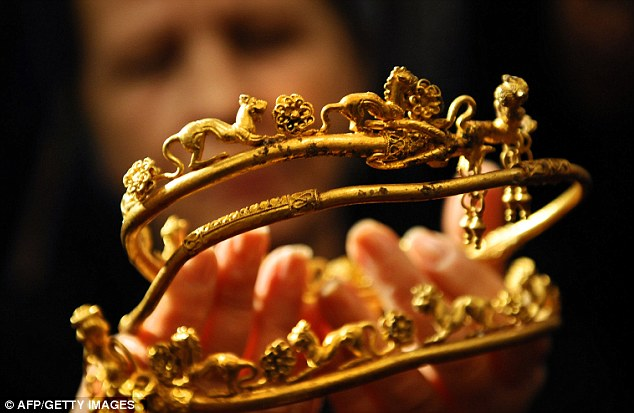
Recent excavations have located the tomb of Cothelas in northeastern Bulgaria, near the modern village of Sveshtari, roughly 400 km from the capital, Sofia. Although references to the Thracian king remain vague, the largest tomb in that burial complex may very well be his. Archaeologists have unearthed precious gold gifts, including 44 applications of female figures, 100 golden buttons, and a golden ring. The pièce de résistance is a tiara with animal motifs and a horse headpiece. Altogether, the site counts about 150 tombs all belonging to the Thracian tribe, the Getae. 

Let’s hope that further excavations will reveal more about these Thracians, of which much remains shrouded in mystery.

[Pictures from Daily Mail]
Tuesday, March 30, 2010

The many wives of Philip II of Macedonia

In antiquity, women had no say at all. They had absolutely no rights and were treated as common goods, to be sold or bought, negotiated, or given in marriage at will. I always have dreams of living in antiquity, but definitely not as a woman!

But here I am confronted with Philip II of Macedonia, the womanizer – or that is how history likes to present him. I’m still fascinated by Ian Worthington’s book, presently reading the chapter about Philip’s Marriages as Policy. It starts with Philip’s wedding plans with Eurydice, previously called Cleopatra. I didn’t know that Cleopatra's father and brother had died and that her guardian was Attalus (a Macedonian nobleman), who adopted the girl as his niece. She was thus an adoptive niece and not a true relative, although from pure Macedonian blood. And then there is the plausible fact that this marriage of Philip with Eurydice, for once, was not a political move, but one of true love – at least as far as Philip is concerned, of course.

The only source to mention all of Philip’s wives and the reason for the marriages is fragments from a biography written in the 3rd century BC by a certain Satyrus, a philosopher from Aristotle’s school, which was quoted much later by Athenaeus, a writer who lived in the 2nd century AD. According to Worthington, the list/sequence is not entirely correct, but generally speaking, all of Philip’s marriages can be tied to his wars, and Worthington feels this should be the correct order. The names and sequence given by Satyrus are as follows:

- a)Audata (2), an Illyrian, who gave him a daughter Cynane;

- b) Phila of Elimea (1), sister of Derdas and Machatas, meant to secure control over Amphaxitis;

- c) Nicesipolis (5) of Pherae (when he wanted to appropriate Thessaly), by whom he fathered a daughter Thessalonike; and

- d) Philinna of Larisa (3) (also while he wanted to appropriate Thessaly), who gave birth to Arrhidaeus;

- e) Olympias (4) served to acquire the kingdom of the Molossians (Epirus), the mother of Alexander;

- f) Cleopatra (7), sister of Hippostratus and niece of Attalus, with whom Philip had fallen in love and who bore him a daughter, Europa.

Yet, this list is missing Meda of the Getae tribe, wife number (6). The figure between parentheses corresponds to the chronology that Ian Worthington (see: Philip II of Macedonia) feels is correct based on Philip’s military campaigns.

After a good twenty years of ruling and fighting, Philip managed to bring peace and unity to Greece, and he is getting ready to cross to Asia. Worthington’s theory is that Philip wanted to have one or more successors to secure the Macedonian kingship before leaving. The simple-minded Arrhidaeus is of no use, and there is too much at stake to rely only on Alexander – even if he leaves him behind in Macedonia to look after his interests and to keep a close eye on the newly signed Corinthian League. So much could go wrong while he is away!


Aside from Olympias, little or nothing is known about the other wives. They supposedly all lived at the Royal Palace of Pella, probably each in their own quarters to avoid possible (and probable) conflicts and quarreling with one another. Nicesipolis seems to have died shortly after giving birth to her daughter, and as far as the other wives are concerned, your guess is as good as mine. Justin, however, tells us that Philip had many children, of whom some died in battle and others by accident or of natural causes, but, strangely, we have so little information about them – hardly a name. As to Philip’s marriage with Eurydice, who was much younger than he, Worthington assumes that the other women may no longer be able to produce a healthy heir, or were simply too old already. And yes, let’s not forget that Eurydice was a full-blood Macedonian! We all know how Alexander reacted to this wedding!

The story becomes even more interesting when I learn that Attalus, just to be closer to King Philip, decides to adopt Eurydice as his own daughter just before the wedding takes place. To have the King as father-in-law makes him much more important, doesn’t it?

When it came to marriages, they were a high-stakes game in those days! Not only was Attalus himself married to a daughter of Parmenion, but so was Coenus, another of Philip’s generals (Parmenion’s three sons, Nicanor, Philotas, and Hector, all fought later on in Alexander’s army). Attalus and Parmenion left together at the head of the shock troops that Philip sent to Asia ahead of his own planned invasion. All these events lead us to believe that Philip pulled the strings of an entire network, arranging intermarriages among his generals. In fact, it was a whole clique, of which Alexander was unfortunately excluded – to his greatest sorrow, I dare say. Although he obviously was recognized as the official heir to the Macedonian throne – probably so since he was fourteen and Aristotle was brought to Macedonia and certainly since he carried the seal of Macedonia at sixteen while his father was fighting on the eastern front; and again later on when he successfully led his cavalry against the Theban Sacred Band at Chaeronea – he had no place in Philip’s closest entourage of which he was excluded. This may have been reason enough for Olympias and Alexander to consider murdering Philip…?

A lot of stuff to think about! So much intrigue at the court! Enough for Louis XIV to find some inspiration here, and Henry VIII with his six wives could be looked at mildly, although Philip never divorced any of his wives or chopped their heads off. What an incredible mess!

As a side note, the huge and extravagant wedding party in Susa comes to my mind, which Alexander arranged in 324 BC for about one hundred of his generals and friends to marry girls from the widespread Persian aristocracy. The idea was not exactly a new one, was it?