Alexandria's founded by Alexander

Alexandria's founded by Alexander the Great (by year BC): 334 Alexandria in Troia (Turkey) - 333 Alexandria at Issus/Alexandrette (Iskenderun, Turkey) - 332 Alexandria of Caria/by the Latmos (Alinda, Turkey) - 331 Alexandria Mygdoniae - 331 Alexandria (Egypt) - 330 Alexandria Ariana (Herat, Afghanistan) - 330 Alexandria of the Prophthasia/in Dragiana/Phrada (Farah, Afghanistan) - 330 Alexandria in Arachosia (Kandahar, Afghanistan) - 330 Alexandria in the Caucasus (Begram, Afghanistan) - 329 Alexandria of the Paropanisades (Ghazni, Afghanistan) - 329 Alexandria Eschate or Ultima (Khodjend, Tajikistan) - 329 Alexandria on the Oxus (Termez, Afghanistan) - 328 Alexandria in Margiana (Merv, Turkmenistan) - 326 Alexandria Nicaea (on the Hydaspes, India) - 326 Alexandria Bucephala (on the Hydaspes, India) - 325 Alexandria Sogdia - 325 Alexandria Oreitide - 325 Alexandria in Opiene / Alexandria on the Indus (confluence of Indus & Acesines, India) - 325 Alexandria Rambacia (Bela, Pakistan) - 325 Alexandria Xylinepolis (Patala, India) - 325 Alexandria in Carminia (Gulashkird, Iran) - 324 Alexandria-on-the-Tigris/Antiochia-in-Susiana/Charax (Spasinou Charax on the Tigris, Iraq) - ?Alexandria of Carmahle? (Kahnu)
Showing posts with label Mausolos. Show all posts

Friday, October 25, 2024

About decrees and multilingual inscriptions

In antiquity, news was carried by word of mouth, but legal matters and other important information were cut in stone and placed in a conspicuous spot for everyone to see. 

The majority of inscriptions are Decrees of which I can only mention a selection. 


At the Acropolis Museum, there is a stele with decrees for the construction of the temple and altar of Nike by Kallikrates, for the reorganization of the cult, and for the salary of the priestess of the goddess dated 427-424 BC (side A) and 424-423 BC (side B).


Also a stele with a series of Decrees by which the Athenians bestowed economic, commercial, and military privileges on their ally Methone in Pieria. 

It shows the goddess Athena shaking hands with perhaps Artemis, dated 430-423 BC.


Very broken but still readable is the Athenian Decree honoring Neapolis (modern Kavala) for its support in the war against Thasos and its constant commitment to her. 

In the upper right corner, we recognize the goddess Athena extending her hand towards another figure, probably the goddess Parthenos of Neapolis, dated from 410-409 BC.


A very elegant stele with a horse and an olive wreath carries an inscription in which the Athenians honored King Alcetas of Epirus for his help during their military expedition to Corcyra (modern Corfu) in 373-372 BC.


And finally, still at the Acropolis Museum, there is the long Decree of Chalkis on the island of Euboia in which the islanders were forced to swear loyalty to Athens after failing in their revolt of 446-445 BC. 

The people of Chalkis could punish their own citizens, except in cases that involved death, exile, or the loss of their rights as citizens, where the power of Athens prevailed.

The National Archaeological Museum in Athens has its own rich collection of Decrees. A good example is the honorary inscription from Piraeus dating from 347-346 BC. 

The stele honors the three sons of Leukon (depicted), king of the Cimmerian Bosporus, thanking them for services rendered to the people of Athens and allowing them to import grain free of duty.


A particular stele from 355-354BC was found near the Monument of Lysicrates in Athens. 

It honors Philiskos, son of Lykos of Sestos in the Thracian Hellespont as a public guest and benefactor of Athens. In 356 BC, Philiskos had warned the Athenians of the hostile presence of the fleet of Byzantium that threatened the city’s grain supply.


The Eleusis Museum, in turn, exhibits a decree providing for the construction of a footbridge across Lake Rheitoi on the Sacred Way from Athens to Eleusis, dated 421 BC.


Two fragments from an unidentified monument carry a Royal Decree of Alexander, which defines the limits of ‘land’, meaning the agricultural area that Philippi supervised. 
The (partial) inscription dates from 336-334 BC, just before Alexander started his campaign East. It is kept at the Museum of Philippi.


On a different level, there is a Decree sanctioning the people and city of Iasos for conspiring against King Mausolos of Caria. 

It is kept at the Louvre in Paris and dates to 370-350 BC. 


The Foundation Decree of Cyrene in North Africa is a covenant between the citizens of Cyrene in ca. 322 BC and those of their mother-state of Thera. 
The exact purpose is uncertain, but it is thought that the citizens of Thera, including the early settlers of 631 BC, were granted the same rights and freedoms as the Cyreneans, even though Cyrene was wealthier than Thera at the time.


Of another level is, for instance, the trilingual stele from Letoon in the Xanthos Valley found near the Temple of Apollo. It holds a public Decree authorizing the cult of the deities and establishing the provisions for its officers.
The Decree is written in Lycian, Greek, and Aramaic, which are not verbatim translations of each other. Each version contains information that is not translated into the two other tongues. The Aramaic text with 27 lines is the shortest, followed by Greek with 35 lines, and Lycian with 51 lines. Useless to point out that this stele helped to decipher the peculiar Lycian language. This unique document can be seen at the Fethiye Museum.

The story of this stele reminds us of the Rosetta Stone, which helped to decipher the Egyptian hieroglyphs and Demotic script using the Greek version carved on the same stone. The text is a Decree issued by King Ptolemy V of Egypt in 196 BC and was key to deciphering the hitherto unknown hieroglyphic signs. 

Trilingual inscriptions are not isolated cases. In ancient Persia, it was a common practice to leave inscriptions in three languages to make sure everyone in the vast empire would be notified: Elamite, Old Persian, and Babylonian. The best-known lines are carved on the cliff wall of Bisutun, where Darius I celebrates his victory over Gaumata and eight more pretenders to the throne in 518 BC, as represented above.

The trilingual inscriptions on the Palace walls of Pasargadae and Persepolis are mainly continuous reminders of the power of the King of Kings who ruled by the grace of Ahuramazda, repeating their title of Great King. These were defined in full by Cyrus the Great: Great King, King of Persia, King of Anshan, King of Media, King of Babylon, King of Sumer and Akkad, and King of the Four Corners of the World.

Perhaps the most remarkable panels are set in the spectacular landscape close to the fast-running mountain river and lovely waterfalls of Ganj Nameh, some five kilometers southwest of Hamadan. As is customary, each text starts by praising Ahuramazda and continues describing the lineage and deeds of Darius I on the left panel and his son Xerxes on the right. It reads: "The Great God [is] Ahuramazda, greatest of all the gods, who created the earth and the sky and the people; who made Xerxes king, and outstanding king as outstanding ruler among innumerable rulers; I [am] the great king Xerxes, king of kings, king of lands with numerous inhabitants, king of this vast kingdom with far-away territories, son of the Achaemenid monarch Darius." (see: The Bisutun relief of King Darius I).

I’d like to close with the impressive Monument of Opramoas in Rhodiapolis. He was a great benefactor who contributed lavishly to the reconstruction of most Lycian cities after the devastating earthquake of 141 AD. He must have been terribly wealthy, for it seems that every single Lycian city mentioned his name in thanks. The construction blocks of the Monument listing his good deeds were strewn over a wide area until, in 2016, archaeologists managed to sort them out and reconstruct the walls of his Monument (see: The Monument in honor of Opramoas of Rhodiapolis is taking shape).

Its text, the longest ever found in Lycia or perhaps even in all of Anatolia, contains 12 letters Opramoas exchanged with the Roman Emperors and Antoninus Pius in particular, 19 letters to the Roman Procurator, and 33 various documents related to the Lycian League. 

The reasons for leaving an inscription widely vary, and the list is endless. I stopped at a few of the most telling examples that caught my attention.

Sunday, July 14, 2024

Not all Seven Wonders of the World are the same

We like to believe that the list of the Seven Wonders of the World in antiquity was well-established, but that is not entirely correct. 

In the 1st century BC, Diodorus mentions them by name: the Great Pyramid of Giza, the Hanging Gardens of Babylon, the statue of Zeus in Olympia, the Temple of Artemis in Ephesos, the Mausoleum of Halicarnassus, the Colossus of Rhodes, and the Lighthouse of Alexandria. This is the list we follow nowadays, but the importance of each monument has been subject to personal taste and appreciation of its time. 

Well before Diodorus, many writers had their opinions on the matter. The oldest known is, for instance, Herodotus who, in the 5th century BC does not mention the Hanging Gardens of Babylon but provides a very detailed description of the Walls of Babylon built with baked bricks cemented together with bitumen. The ramparts were 72 kilometers long, 10 meters thick, and 22 meters high! A striking feature is that the top of the wall was wide enough for two four-horse chariots to pass each other. The intermittent towers were 27 meters high. 

Callimachus of Cyrene, who lived in the 3rd century BC, chose to include the Ishtar Gate of Babylon – a marvel that has been reconstructed inside the Pergamon Museum in Berlin (see: A mental reconstruction of Alexander’s triumphal march into Babylon). 

Philo of Byzantium in 225 BC lists the Walls of Babylon, but not the Lighthouse of Alexandria, which had not been built yet. He said he had actually seen the Hanging Gardens but omitted to situate them in Babylon. Their existence remains questionable, and there still is an unconfirmed theory that these gardens were in Nineveh. They were described as vaulted terraces, raised one above another, and resting upon cube-shaped pillars. These were hollow and filled with earth to allow trees of the largest size to be planted. The pillars, the vaults, and the terraces were constructed of baked brick and bitumen. The Gardens were initiated by King Nebuchadnezzar II around 575 BC. Philo tells of the Statue of Zeus by Phidias in Olympia, the bronze Colossus of Rhodes featuring Helios (the Sun), and the Temple of Artemis in Ephesos. He further includes the Tomb of King Mausolos in Halicarnassus, and the Pyramids of the Giza plateau, not singling out the Great Pyramid. 

Antipater of Sidon, who lived in the 2nd/1st century BC writes that he laid eyes on the ‘walls of lofty Babylon on which is a road for chariots’, and the Hanging Gardens; the statue of Zeus in Olympia, the Colossus of the Sun in Rhodes, the huge achievement of the high pyramids in Giza, the vast tomb of Mausolos at Halicarnassus; and the Temple of Artemis in Ephesos saying ‘that [as] it mounted to the clouds those other marvels lost their brilliancy’. 

Strabo, in the 1st century BC, gives by far the most detailed description of the Seven Wonders. 

The Great Pyramid of Giza in Egypt, the oldest and only wonder that still exists, was erected around 2560 BC. It is the largest of the three Pyramids at Giza, which are all equally important, as stated by Philo of Byzantium. The proportions of the Great Pyramid are colossal. The original height from the base to the peak was about 147 meters. The length of each side at the base averaged around 230 meters. The theories about its construction and function are widespread and are by no means conclusive. 

The statue of Zeus in Olympia stood inside the Temple of Zeus. The large sitting Zeus was made of ivory and gold by Phidias in 436 BC. Although he was seated, Zeus stood 12.4 meters high, meaning that his head nearly touched the ceiling. Nothing much of the temple remains, but its impressive East and West pediments are exhibited in full glory at the local museum (see: Olympia, in the footsteps of Pausanias). 

The first Temple of Artemis in Ephesus goes back to the 7th century BC. After its destruction, it was completely rebuilt to an unheard scale of 115 x 55 meters, i.e., larger than the Parthenon in Athens. The Artemis venerated in this temple is represented with many breasts, and is clearly not of Greek origin but imported from the East (see: Alexander’s presence in Ephesus). Nothing remains today to prove its grandeur and glory.

The Mausoleum of Halicarnassus (see: Halicarnassus, capital of Caria) from about 350 BC was a rectangular monument measuring 40 x 30 meters, and about 45 meters high. It was decorated with scenes from Greek mythology, such as the battle of the Centaurs with the Lapiths and fighting Amazons, although scholars disagree on their precise position. It is certain, however, that the statues of King Mausolos and his wife/sister Artemesia riding in a four-horse chariot, now at the British Museum, stood at the very top of the Mausoleum. The tomb survived in pretty good condition for many years despite recurrent earthquakes, but the final blow happened in 1494 when the Knights of St John of Rhodes invaded the area and reused the stones of the Mausoleum to build their castle. Remnants are still visible to modern visitors on the walls of Bodrum Castle. 

The Colossus of Helios in Rhodes, the work of Chares of Lindos, was completed in 282 BC. It stood near the entrance of the harbor, although the exact location is unknown. The Colossus wore a crown of sun rays – hence its name, Colossus of Helios - and held up a torch. It was made of bronze and rested on a marble pedestal. With a height of 33 meters, it is considered the tallest bronze from antiquity. It was the shortest-lived ancient wonder that disappeared 60 years after its construction due to a severe earthquake. Its legend lives on, though. 

The Lighthouse or Pharos of Alexandria was the last wonder added to the list of seven, replacing the Walls of Babylon. It was conceived in three stages: a square stone base, an octagonal middle section, and a cylindrical shape at the top. Inside, a fire would guide the seafarers into the harbor of Alexandria. By day, they were led by the smoke, and at night by its bright light (see: Alexandria’s past futures). The Lighthouse stood over 100 meters tall, and its light could be seen 50-60 kilometers out at sea. Its construction was completed between 300 and 280 BC during the reigns of Ptolemy I Soter and his son, Ptolemy II Philadelphus.  

The ancient historians of Alexander the Great have spent very little ink on these Seven Wonders – or the texts simply have not reached us. The Temple of Ephesos, which was burnt down the night Alexander was born, was still under construction at the time of his visit. But the king must have witnessed the grand Mausoleum of Halicarnassus and the main features of Babylon, such as its Walls, the Ishtar Gate (which he used to enter the city), and the Gardens if they were indeed part of the Royal Palace. Strangely enough, Giza and its Pyramids are absent from all documents, as if they never existed!

Monday, August 31, 2020

Renewed display of the Carian Princess’ tomb in Halicarnassus

Bodrum Castle is the Underwater Archaeology Museum that holds the precious collection of the 3,500-years-old Uluburun shipwreck. Much less known are the separate buildings where the numismatic collection and the glasswork are exhibited. The eye-catcher, however, is the hall reserved for the Carian Princess.

Her tomb was found in 1989 with the skeleton still intact. She was lying with her arms crossed, surrounded by her grave goods that included a golden crown. Closer anthropological analysis revealed that she died when she was in her 40s and had at least one child. Based on the excellent condition of her teeth, it could be established that she enjoyed a good quality of life. The remains clearly belonged to a woman of high rank.

It was very tempting to attribute this tomb to Queen Ada, the youngest sister of King Mausolos. We will remember that after he died in 353 BC, it was his wife/sister Artemisia, who took over the rule of Caria. When she too died, the throne went to her younger brother, Idreus who had married his sister Ada. Idreus also died, and it was Ada’s turn to become Queen of Caria. But there was still another younger brother Pixodarus who hungered for power. He expelled the widowed Ada from Halicarnassus and she sought and found refuge in her stronghold of Alinda, further inland. Pixodarus aimed to befriend the Persians and ruled unofficially for a short while next to the Persian satrap Orontobates, who took over after Pixodarus’ death. This was the situation in Caria when Alexander the Great arrived at Halicarnassus in 334 BC.

Alexander besieged and eventually conquered Halicarnassus, and he generously handed Caria over to Queen Ada again. She ruled over her country till her death in 323 BC as she died in the same year as Alexander.

Further research about the lady in the sarcophagus has not been conclusive. It has been impossible to attribute the tomb to Queen Ada. That is the reason why it is safely called the Tomb of the Carian Princess.

The hall where these impressive remains are kept has now been refreshed and renewed according to the news published in the Hurriyet Daily News. What exactly has been changed in the setting or the presentation is unclear.

Thanks to facial reconstruction, this princess has been pieced together and until now she was meeting the visitor from the far end of the room. It was a very poignant encounter and I hope that she still gives that impression in the new setting. Said newspaper article does not include a picture of the renovated room but only states that with modern technology, visitors can download the photograph of the golden necklace and crown projected on the interactive screen via the QR Code.

Why can’t they share this picture on line, I wonder?

Tuesday, November 20, 2018

An update on the tomb of King Hecatomnos

Back in 2010, the discovery of the monumental sarcophagus belonging to King Hecatomnos made headlines due to illegal digging in the area of Milas, Mylasa in antiquity (see: Sensational archaeological find near Milas). 

Nothing much has been heard since as the standard procedure implies closer study, cleaning, restoration, and thorough analysis – that is till now. 

This find is important for two reasons. Firstly, Hecatomnos is the father of King Mausolos, who built the Mausoleum of Halicarnassus. Secondly, the tomb of Hecatomnos is found in Mylasa, which was the capital of Caria in his days. Besides, this tomb allows historians and archaeologists to establish a continuity in the architecture and art of Caria before the construction of Mausolos’ Mausoleum. Although he ruled (391 - 377 BC) as satrap over Caria loyal to the Persian king Artaxerxes II, Hecatomnos was fascinated by the Greek culture and respected the religious beliefs of his people. 

The mausoleum of King Hecatomnos was built not unlike the concept used a few years later by his son in Halicarnassus, his new capital of Caria. That does not really come as a surprise since one of the architects for both mausoleums built in the center of the respective capital cities was Piteos.

Unfortunately, the available information does not provide a clear image of the excavation site or the mausoleum itself. The crepidoma with seven steps is being mentioned as running around the entire perimeter of the mausoleum. Still, even the 3D reconstruction is not very helpful to get a comprehensive picture. 

Apparently, the mausoleum stood on top of the stairs of the crepidoma. The building gave access to an underground burial space where the impressive sarcophagus was discovered. It is being mentioned in the article by the Daily Sabagh that the treasure hunters damaged the gold leaf paintings and the sarcophagus paintings inside the tombs (plural?) and that the images on the murals are related to Hecatomnos. It would have been very enlightening to have some photograph or drawing of the layout to imagine what the site looks like. The article also mentions a well-preserved entrance gate and plans to create an open-air museum for visitors to access the tomb.

On the positive side, it may be noted that in 2014 a stela carrying the longest poem from the Classic era was discovered on the site (see: Precious stela with the longest poem from Classical Greece). In 2017, a gold crown surfaced in Scotland said to belong to Hecatomnos. It has been returned to Turkey.

[The picture of the tomb is from the Daily Sabagh. The 3D drawing can be found in an interesting article written by Anna Frascari. The picture of the gold crown is from Archaeology News Network]

Monday, October 16, 2017

Alinda, the refuge fortress of Queen Ada of Caria

From 545 BC onwards, Caria was part of the Persian Achaemenid Empire and as such was ruled by a satrap (governor). The most famous of them was Mausolus, who proclaimed Halicarnassus as his new capital – clearly a man with ambition and great visions. Mausolos married his sister Artemisia as was customary, and when he died childless in 353 BC, she continued ruling until her death. The power went to Artemisia’s younger brother, Idreus who had married his younger sister Ada. She ruled after her brother/husband died also. But there was still another younger brother, Pixodarus who hungered for the title of satrap and befriended the Persians. He expelled the widowed Ada from Halicarnassus and she sought and found refuge in her stronghold of Alinda, further inland.

Queen Ada managed to keep her independence in her fortress of Alinda but on Alexander’s approach in 334 BC, she decided to offer her surrender to the new conqueror and to adopt him as her own son – much to Alexander’s delight, no doubt. Alexander generously trusted Caria to Queen Ada who ruled over her country once again, except for the military affairs that were in the hands of a Macedonian garrison. She probably died in 323 BC, the same year as Alexander the Great.

Driving up to Alinda, it is quite clear that this is a very strategic location and the city’s defence walls running down into the fertile valley are there to prove it. The first constructions that welcome today’s visitor as he drives up from Karpuzulu are the remains of a Roman aqueduct with four arches still intact and a handful of scattered Carian sarcophagi. The heavily shattered and overgrown Roman theatre from the 2nd century BC lies on the other side of the hill, just above the impressive market building. This is probably the best testimony of Alinda’s importance and was three storeys high. The highest level touches the agora measuring 30x30 meters.

It seems Alinda, as capital of Caria died together with Queen Ada as it was the last stronghold of the Carians. However, the city did not lose its importance entirely for Antiochus III established a garrison there in the mid-3rd century BC but lost it to the Romans in the early 2nd century BC.

Saturday, April 1, 2017

Putting Halicarnassus on the (tourist) map

The Hurriyet Daily News recently published an article entitled “Mausoleum at Halicarnassus to be restituted” that made me raise my eyebrows. What did they mean by “restitute”? There certainly is no way to rebuild the Mausoleum since too many pieces have been lost over time.

On top of that, the rest of the article is pretty confusing, with plans and projects that are very vague. What transpires, however, is that the Bodrum Municipality wants to put the city on the map and most probably on the tourists’ map.

Of course, the Mausoleum of Halicarnassus is recognized as one of the Seven Wonders of the Ancient World and as I understand what the newspaper is trying to say, they intend to connect this monumental tomb built by King Mausolos in 353 BC to Bodrum harbor. I wonder how they can go about this, for it would mean the destruction of a good part of today’s residential area.

It is also odd to read that a team composed of a professional tour guide, an underwater archaeologist, an architect, a businessman, and a photographer had to be called to meet at the Bodrum Municipality in order to plan excavations to reveal more of Halicarnassus’ past. The projects that are discussed include more excavations of the eight-meter-long city wall and unearthing the 3,500-year-old hippodrome. The program also should tackle the restoration of the Jewish cemetery, the organization of a festival dedicated to Herodotus (International Herodotus Culture and Arts Festival), the illumination of the existing Myndos Gate, and last but not least, the collection of artifacts testifying of early Mycenaean occupation in the area (15th-12th century BC). By themselves, these are all excellent ideas, but it seems that is all there is, ideas tossed on the table without any strong argument to back them up or a plan to work them out.

Their intention to put Herodotus, the father of ancient history, who was born in Halicarnassus in the 5th century BC, in the floodlights may simply be an additional PR for Bodrum.

It will be interesting to see which part of these projects, if any, will ever materialize.

Monday, April 6, 2015

Priene, delightfully Greek

Unlike so many remains of Greek settlements, Priene has not been turned into a Roman city. What a delightful blessing!

Priene, like neighboring Miletus and Ephesos, was part of the Ionian League, regrouping twelve city-states that existed already before 1000 BC. Around 450 BC, the city was designed by the same architect as Miletus. His name was Hippodamus, after whom the well-known and most popular Hippodamian plan was named and used all over the Hellenistic world.

Priene was occupied in turns by Athens and Persia, but after the death of King Mausolus in 353 BC the city fell under Athenian rule. It is said that Alexander stayed here in 334 BC while besieging Miletus. It is in Priene that he received the embassy led by Glaucippus, a well-respected citizen of Miletus, who suggested leaving the harbor available to both Persians and Macedonians at will. This did not fit Alexander’s purpose; keeping an important port as Miletus open to the Persians was far too dangerous in his eyes. Alexander must have spent several months in Priene which had willingly surrendered to the Macedonian King for Miletus was a tough nut to crack (see: Miletus, Alexander’s first siege in Asia).

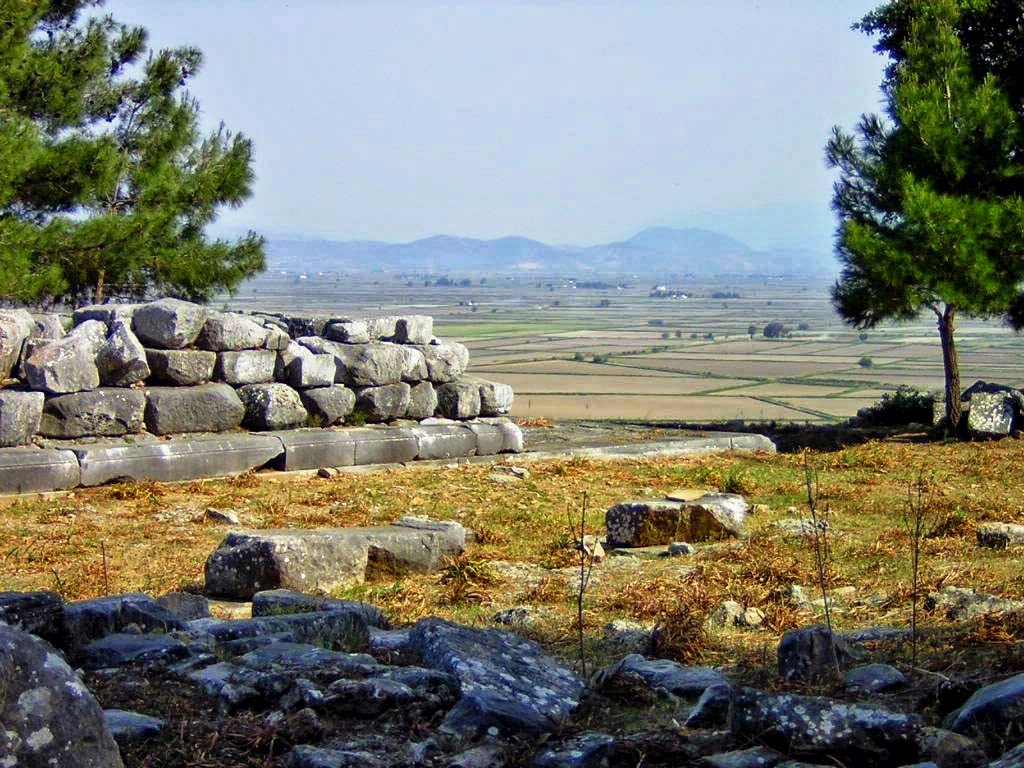
Priene occupies an impressive location and can be spotted from afar. It is nestled against Mycale Mountain, and the location somehow reminds me of Delphi. A steep and stepped road runs upwards to the city walls, two meters wide and six meters high. The spaced freestanding watchtowers are rather exceptional for this meant that they could easily be rebuilt in case of destruction. The rampart and the city gate are what the visitor sees first after a pretty strenuous climb – impressive!

The main road inevitably leads to the Hellenistic theater built at the same time as the city itself seating 5,000 visitors spread over 50 rows and resting against the gentle mountain slope. Five marble VIP seats around the orchestra are still in place and were not removed as usual during Roman modifications. Across from the theater lies the upper Gymnasium from the 4th century BC and several later Byzantine buildings.

Further down the street, one can hardly miss the Temple of Athena with its slender bluish-grey marble Ionian columns pointing to the sky that were reassembled thanks to the many drums lying around. Pytheos, who also was the architect of the famous Mausoleum of Halicarnassus, had just started building this temple when Alexander arrived. As a matter of course, the King immediately financed its construction, and a dedication to that effect, now at the British Museum in London, reads “King Alexander has dedicated this temple to Athena Polias”. How unique that this testimony survived the centuries for it makes Alexander’s presence almost palpable. The temple measured 19.55x37.20m and had eleven columns lengthwise and six for its width. An altar of Athena Polias including the relief of a Muse from the 2nd century BC has been unearthed and is now on display at the Pergamon Museum in Berlin.  Pytheos never finished the job and the temple was finally completed by Emperor Augustus who from then onward was worshiped here together with Athena.

In the next city block, we find the remains of a 116-meter-long Sacred Stoa, erected between 130-112 BC. The Stoa’s wooden roof was as so often supported by two rows of columns, Doric on the outside and Ionic on the inside, splitting the more than twelve-meter-wide promenade in two. This Stoa ran parallel with the 75-meter-long Agora that was reached by six steps since the square laid about 1.5 meters lower. One end of the Agora was reserved for the fish and meat market and the other end was occupied by a temple dedicated to Zeus or Asclepius.

Just behind the Sacred Stoa is the Bouleuterion, a square Council Hall seating 640 delegates and the best-preserved building in Priene. The auditorium is surrounded on three sides by rows of benches, 16 on the north side and 10 on either side. In the center of this Bouleuterion from the 2nd century BC, stands an altar decorated with wreaths and bullheads. The original columns supporting the protecting wooden roof are still in place. The adjacent Prytaneum where daily administrative operations were carried out is more difficult to find. The only indication is a stray column with an inscription since this was the Sacred Heart of the City that kept the eternal burning sacred fire.

The street running along the Agora ends at the western city gate and is lined with private houses. It is believed that Alexander lived in one of the houses on the left-hand side, probably because a statue of the conqueror was found there; yet there is no hard proof for this theory, however, tempting it sounds! The statue moreover dates from the 2nd century BC and can be seen at the Altes Museum in Berlin. The house itself, nicely sign-posted, is not different from its neighbors in the street, except maybe for the sacrificial table found in one of the smaller rooms. Moreover, this street is surprisingly Greek with the gutter running on the side of the pavement, very much unlike Roman roads.

During my very first visit, I had not looked into the geographical situation of Priene, and standing here high above the vast flat plain below, I instantly realized that this was an alluvial plain created by a river (in this case the Maeander). This means that in Alexander’s days, all the land below was sea and that in order to reach Miletus he had to make quite a detour, skirting the eastern foothills. Priene itself never had direct access to the sea, and its harbor was the nearby town of Naulochos. How strange to be reading history like this. The islands mentioned by ancient writers are now reduced to mere bumps in the landscape as pointed out by Peter Sommer during my next trip.

After Alexander’s victory over the Persians, Priene like all the other Ionian cities widely prospered. A small testimony of its wealth can be found at the Altes Museum in Berlin where we can admire some splendid statues of Dionysus, Aphrodite, and an unknown young man.

Of course, not much of the city dates from Alexander’s days but it definitely is Hellenistic and not “spoiled” by the Romans. This makes it quite a unique place to take in. So much history has been written in Priene and yet only a few tourists bother to stop here, while the city is so filled with past sounds of the Macedonian army and if you listen carefully, the soft breeze may still carry the name of Alexander.