Exploring the
rooms of an archaeological museum, one inevitably comes across a concentration
of gold and silver jewelry. Among them, the gold crowns with their quivering
leaves call for our attention.
The gold wreaths
and crowns originated in ancient times when leaves and flowers were commonly
used to mark festive occasions like processions or special dinners. Golden
crowns were the privilege reserved for honors on behalf of the community or as
funerary reverence.
Wreaths of
leaves were recognized as prizes for those victorious at competition games,
marking a moment of triumph for the athlete. The most famous event was the
Olympic Games, where the winner received a crown of olive leaves. Variants are
laurel, Apollo’s sacred tree, at Delphi,
dried celery at the Isthmian games, and green celery at the Nemean games.
However, they
were also appropriate on many other occasions. Those attending a Symposium
would wear wreaths made of roses, violets, or myrtle leaves. Such wreaths
appear clearly in Oliver Stone's movie Alexander in the wedding scene of King Philip.
They were also a
sign of exceptional merit and military conduct and were worn by orators and
priests as they performed their sacrifices. The Maenads and other followers of
Dionysus wore wreaths of ivy or vine leaves, and so did the Chorus in ancient
Greek theater.
The ritual of
crowning even extended to altars, statues, and temples. Wreaths were also part
of funerary practices as the deceased would be crowned; the urns containing
their ashes had a wreath, or the wreath was placed inside the tomb.
Many such
examples made in gold have reached us and found their way to the museums. For
instance, the crown of oak leaves and acorns discovered in the tomb of King Philip in Aegae and the silver
funerary urn from an unspecified Macedonian tomb are at the Museum of Vergina.
However, most of
the finds are on display at the Archaeological Museum of Thessaloniki (see: Exploring the Archaeological Museum of Thessaloniki). The wreaths come, for instance, from Cassandreia, Apollonia, Sedes, Aenea,
and the greater area around Thessaloniki and ancient Aegae. These precious
grave goods may be the legacy of Alexander’s
conquests and the wealth Macedonia
amassed in his wake.
It is a pure
pleasure to wander through the museum’s rich collections to find, for instance,
two myrtle wreaths, one splendidly executed with colored flowers, and another
funerary one with bronze gilt leaves and clay gilt fruit (Aenea) from 350-325
BC. Two olive crowns, one from Tomb A and another very elaborated one with the
knot of Heracles from Cassandreia (3rd century BC). The gold ivy wreath was found in Apollonia and dated
350-325 BC. The gold oak crown, very typical for the Macedonian court, was also
unearthed in Cassandreia and carried the fascinating knot of Heracles as well.
Although Athens holds far fewer examples, they may be kept in their reserves. The National
Archaeological Museum
exhibits a myrtle wreath with berries from the 4th century BC. The lesser-known
Benaki Museum
displays an oak leaves crown from the late 2nd/early 1st century BC found in Alexandria
and another crown with gold ivy and flowers from Macedonia, 1st century BC.
Eventually,
wreaths appeared on funerary monuments or were painted on their walls. In time,
a wreath might be carved on the tomb to mark the site.
It is noteworthy
that wreaths were sacred objects. It was a sacrilege to wear somebody else’s
crown without authorization. It was also forbidden to remove a wreath or
dispose of it if you were not supposed to touch it.
Crowns were not
a privilege of Greece.
Earlier Thracian gold wreaths were found in Bulgaria
and are now at the Museum
of Sofia.
A most striking
and uncommon crown surfaced at Tillya-Tepe in northern Afghanistan (see: Bactrian Gold, the Hidden Treasures
from the Museum
of Kabul).
The burial site belongs to some steppe people. It has been dated to the first
century AD revealing a true mixture of art from the steppes (possibly Scythian
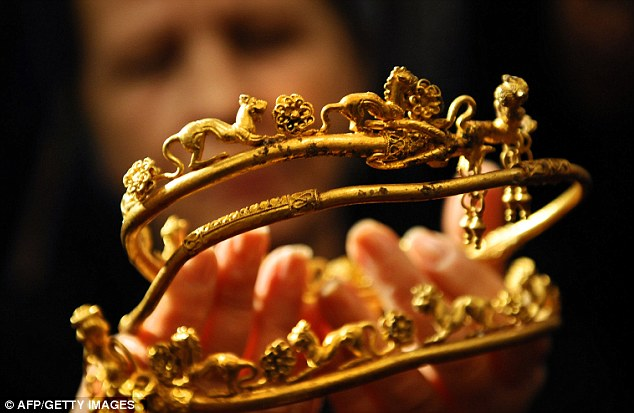
art), Greek, Indian, and Chinese art. The princess’ crown is a travel crown with
gold spangles and flowers. It can be taken apart as it consists of five
separate pieces mounted around a tiny stem holding flattened branches that fit
into the band of the crown itself. The spangles are gently shaking as people
walk by, so imagine this crown out in the open steppe where the wind can play
freely with every tiny detail! A true gem!
How many more
such treasures remain hidden, waiting for us to discover them?
[Picture from Oliver Stone's movie Alexander. The crown from Tillya Tepe is from the Australian]