Alexandria's founded by Alexander

Alexandria's founded by Alexander the Great (by year BC): 334 Alexandria in Troia (Turkey) - 333 Alexandria at Issus/Alexandrette (Iskenderun, Turkey) - 332 Alexandria of Caria/by the Latmos (Alinda, Turkey) - 331 Alexandria Mygdoniae - 331 Alexandria (Egypt) - 330 Alexandria Ariana (Herat, Afghanistan) - 330 Alexandria of the Prophthasia/in Dragiana/Phrada (Farah, Afghanistan) - 330 Alexandria in Arachosia (Kandahar, Afghanistan) - 330 Alexandria in the Caucasus (Begram, Afghanistan) - 329 Alexandria of the Paropanisades (Ghazni, Afghanistan) - 329 Alexandria Eschate or Ultima (Khodjend, Tajikistan) - 329 Alexandria on the Oxus (Termez, Afghanistan) - 328 Alexandria in Margiana (Merv, Turkmenistan) - 326 Alexandria Nicaea (on the Hydaspes, India) - 326 Alexandria Bucephala (on the Hydaspes, India) - 325 Alexandria Sogdia - 325 Alexandria Oreitide - 325 Alexandria in Opiene / Alexandria on the Indus (confluence of Indus & Acesines, India) - 325 Alexandria Rambacia (Bela, Pakistan) - 325 Alexandria Xylinepolis (Patala, India) - 325 Alexandria in Carminia (Gulashkird, Iran) - 324 Alexandria-on-the-Tigris/Antiochia-in-Susiana/Charax (Spasinou Charax on the Tigris, Iraq) - ?Alexandria of Carmahle? (Kahnu)
Showing posts with label Larissa. Show all posts

Thursday, May 26, 2016

A healthy mind in a healthy body – in early antiquity

The Oath of Hippocrates is still taken today by a physician-to-be, yet not everybody knows that this goes back to the very man who lived in the days of Pericles (5th century BC) and earned the recognition as Father of Western Medicine.

It seems probable that the Hippocratic Oath appeared only after Hippocrates’ death. This oath was actually a religious document established to make sure that a doctor operated within and for the community's values. The oath was sworn by Apollo, Hygeia, and Panacea, promising to respect their teacher, not to administer poison or abuse their patients; and, quite importantly, they swore to keep the confidentiality between doctor and patient – how modern that is! No wonder today’s Hippocratic Oath is formulated along the same line!
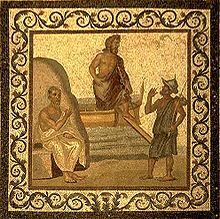
An image of Hippocrates on the floor of the Asclepieion of Kos, with Asklepius in the middle.

Hippocrates of Cos was probably born around 460 BC to become the most famous physician in antiquity, and his great merit is that he “untied” the link with the famous Greek god of healing, Asclepius. Sickness and health were no longer in the hands of the gods but were the result of our living habits, our nutrition, and our environment.

Nothing much has been documented about Hippocrates from his days, and all we have are patchy references written down at a later date. The oldest such document is from the 1st/2nd century AD by the Ephesian physician Soranus, who informs us that Hippocrates traveled extensively throughout his life and died in Larissa around 370 BC. He tells us that Hippocrates acquired his knowledge from his father and Herodicus of Selymbria, a gymnastic trainer. He frequented several sophists of his time, and Plato has it that Hippocrates worked for a fee (just like in our modern world) and basically treated the entire body of his patients. Other ancient sources seem to confirm that Hippocrates believed in a good diet and in exercises to keep the body healthy.

It has been documented, for instance, that he successfully fought the plague that ravaged Athens in 430 BC by lighting fires throughout the city. He also established that King Perdiccas II of Macedonia, a distant ancestor of Alexander the Great, was love-sick and did not suffer from any other obscure ailment.

Unfortunately, his many treatises, speeches, and letters on medicine have not survived, but they were still available at the Library of Alexandria during the reign of the Ptolemies. This Hippocratic Corpus, as it was called, was divided into four separate categories: the diagnosis, biology, treatment of the patient, and a piece of general advice for the doctors. It seems that at least sixty treatises existed, each one focusing on a specific subject: therapy, surgery, physiology, gynecology, the evolution of the disease, and the purging remedies, to name only a few. He even discussed the interaction of medicine with other subjects, like philosophy. Several ancient physicians are known to have written commentaries on his treatises, among which we can name Apollonius of Citium (1st century BC) and the famous Galen (2nd/3rd century AD).

At least we have inherited his school of medicine on the Greek island of Cos, better known as the Asclepion (rather paradoxically), of which important foundations can still be seen today. Hippocrates had three sons who all walked in his footsteps: Thessalus, Dracon, and Polybus.

How about Alexander’s medical knowledge? It is generally accepted that he received some teaching from Aristotle on the subject, but he may well have had direct access to Hippocrates’ treatises, as they were written only one hundred years earlier.

Monday, October 24, 2011

More wars and end of the Peace Treaty with Athens - Macedonia forged by Philip II - 10

More wars and end of the Peace Treaty with Athens (345-341 BC)

Yet the peace that had been so hard to reach was far from being achieved. The Thebans were unhappy to be left out; the Spartans complained about being isolated, and even the Thessalians resented the peace outcome, for they had expected more. Athens was not faring any better in 345 BC, for Demosthenes did all he could to sabotage the treaty, while Aeschines tried by all means to keep it alive.

Meanwhile, Philip was up north fighting some obscure war against what is now southern Albania, where he broke his collarbone. Details of these encounters are not known, but they led Philip to take the drastic and emphatic decision to submit the conquered peoples once and for all. The facts seem to be related only by Justin. Philip moved entire cities and tribes to areas he felt needed to be populated. Some people were settled right on his borders to serve as a buffer against his enemies, others were moved to the far frontiers of his kingdom, and yet others were used to repopulate some of his cities. His aim apparently was to create one cohesive kingdom with one people instead of the large numbers of tribes and clans spread all over his territories. Although this may be considered as being a useful tactical and political move, the victims of this move were far from content. According to Justin, the overall feeling was that of deep fear, "there was a silent, forlorn dejection, as men feared that even their tears might be taken to signify opposition” – a picture far from the loving and caring king we want to see. But in Philip’s eyes, this decision was a rational one as these new cities served as training grounds for the military where boys would be trained the Macedonian way. They would acquire experience defending the outposts, indirectly adding power to the king’s army. This was also the time when Philip ordered the swampy areas to be drained and turned into agricultural land. He had new roads built that could be used year-round and made sure of the rivers by building dikes. It is important to note that is was the army that undertook most of these projects, creating a kind of engineering corps that would be crucial in later years, especially in Alexander’s conquests east.

[picture graciously shared by Jim]
In the summer of 344 BC, Philip headed south towards Thessaly, which was still sulking over the peace treaty. He had heard enough complaints; he seized Larissa and Pherae and installed Macedonian garrisons in several places. He even went as far as to revive their old administrative system of tetrarchies, meaning that each of the original four tribes was again headed by a governor, appointed by the king, and answerable only to him. In this way, he remained firmly in control.

But then it was the Molossian ruler who created new problems for Macedonia and Philip invaded Epirus to settle the matter once and for all. It turned out to be a bloodless campaign; the Molossian king left for Athens (he had Athenian citizenship) and Philip put Alexander, his brother-in-law, on the throne – a wise move because this Alexander had spent time at Philip’s court and was Olympias’ brother. Macedonia’s southwestern border was now properly secured while the king acquired access to rich timberland and pastureland.

As was to be expected, Demosthenes had done his utmost to convince the Athenians that the peace treaty with Philip was worthless, using every opportunity and trick in the book to manipulate his audience and distort Philip’s words. By 342/341 BC, the famous peace treaty collapsed entirely.

Friday, September 2, 2011

Philip’s involvement in the Sacred Wars - Macedonia forged by Philip II - 5

Philip’s involvement in the Sacred Wars (355 BC)
But soon thereafter, another situation called for Philip’s full attention when, in 356 BC, the state of Phocis seized Delphi, the home of Apollo’s oracle. His involvement in this Sacred War could and would boost Macedonia’s power dramatically.

Now, the very name of Sacred War raises some questions with most of us, and we tend to associate or compare it with our Crusaders heading for the Holy Land in the Middle Ages. Yet, nothing is less true. Here it is all about the oracle site of Delphi, which the Greeks considered to be far too important for a single state or city to control. As a result, they created an association of states called the Amphictyonic League to protect them - the word “amphictyony” means as much as “those that dwell around or near”. This Amphictyonic League was very powerful and at some point even counted as many as 24 states. This League was led by a Council functioning as its executive arm. So, whenever the oracle was violated, the Amphictyonic Council would meet and declare a Sacred War against the offending state, calling to the other league members to defend the rights of the Delphian Apollo.

The Third Sacred War that lasted from 355 to 346 BC was the one in which Philip got involved, fighting over the occupation of Delphi by Phocis, roughly the territory locked between Thessaly and Attica, because the Phocians cultivated land on which the sacrificial animals of Delphi were kept. But there was also a matter of unpaid fines, not only by Phocis but by other states as well, which made matters worse.

This situation escalated when Phocis tried to take advantage of the hostile feelings between Thebes - then a formidable military power - on one side, and Athens and Sparta on the other; while taking sides with Athens, Phocis arrogantly invaded Delphi with a nice promise to protect its treasuries. A sensitive matter since this is the place where, besides the famous oracle, precious offerings and money from all over Greece were kept. All the states got involved one way or another, and in 355 BC, the Amphictyonic Council declared the Sacred War against Phocis.

Phocis stubbornly went on the warpath, bluntly seizing part of the temple’s treasury in order to hire mercenaries, some ten thousand of them. It is interesting to learn from Ian Worthington that a mercenary in those days was nothing like what we understand it to be today. And I quote: “Mercenaries formed a distinct group that was an accepted part of Greek society; they had their own identity as a group regardless of where they came from, and they played a political and economic role in relations between states. States and generals who provided or led mercenary armies for rulers and the like made political and trading contacts with them. The Greeks had no word for ‘mercenary’ as such, but instead used terms like epikouros, ‘fighter-alongside’, misthophoros, ‘wage-earner’ and xenos misthophoros, ‘foreign wage-earner’ (cfr Philip of Macedonia, Ian Worthington).” This army defeated the states of eastern Thessaly, splitting the territory in two. Facing this threatening situation, Larissa in eastern Thessaly turned to Philip for help. But Philip was busy laying siege to Methone, and when that was taken care of the next summer (354 BC), he went on to take four towns in eastern Thracia, which were key ports on Athens’ corn route from the Black Sea.


Yet Larissa’s call for help was something that Philip could not ignore, as Macedonia’s southern border could not be compromised. Besides, it was a convenient stepping stone for him to get more closely involved in the politics of Central Greece. Surprisingly and unexpectedly, Philips’ army was defeated by the Phocians – or should I say by the mercenaries they had hired. Antique sources tell us that Philip’s army had fallen into a trap set by Phocis and that the king had to leave behind a large number of dead and injured soldiers. Of the men still alive, many deserted him, and it was only with great difficulty that he instilled them enough courage and discipline to obey his orders in the retreat.

The outcome of this battle rattled like a thunderbolt through the streets of Eastern Thracia and Athens, followed by Illyria, Paeonia, and even Epirus who all welcomed a potential disintegration in Philip’s power. Eastern Thracia was the first to renew its alliance with Athens, which meant a serious blow to Philip’s arduous diplomatic maneuvers. Then Olynthus, in spite of its treaty of 357 BC with Philip, sought an alliance with Athens. The blow must have hit Philip very hard, making him realize how vulnerable Macedonia still was and how easily it could fall back into the chaos he found when he became king.

Tuesday, July 26, 2011

King Philip, one year later - Macedonia forged by Philip II - 3

King Philip, one year later (358 BC)

But, returning to 358 BC after one full year of kingship, Philip had to secure his border with the Paeonians again and trounced them. As a result, Paeonia became a sort of buffer zone between Macedonia and the tribes of the Danube to the north, which was the trade route up the Axios Valley and beyond. Philip’s army now numbered 10,000 infantry and 600 cavalry, no small achievement if you consider that only a year or two earlier, the Illyrians had defeated nearly the entire Macedonian army. He was confident about marching into Illyria and bluntly refused to accept old King Bardylis terms. Both armies met near today’s Lake Ochrid, maybe close to the town of Heraklea Lyncestis, and by the end of the day, the Macedonians had killed 7,000 Illyrian soldiers.


Philip seemed to have it all planned. He demanded that the Illyrians pull out of Upper Macedonia north to Lake Lychnitis, including the tribes of Orestis, which until now were controlled by the Molossian King of Epirus. This way, he had an open route into Epirus to the south and Orestis in the east. A surprising fact is that Parmenion, one of the Paeonian chieftains, was made a general soon after coming over to Philip’s side – an interesting background for this man who served both Philip and Alexander for many years. At this stage, Philip started training recruits from these newly conquered territories, the non-nobles as infantrymen and the nobles as cavalry. This practice stayed in place far into our 20th century!

This latest victory also meant that Macedonia virtually doubled in size, that the size of Philip’s army increased substantially in only one year, and that Upper and Lower Macedonia were united as never before. Philip, still married to the Illyrian princess Audata, found it wise to change her name to Eurydice to mask her origin. Their daughter Cynane later married Amyntas, the original heir to the Macedonian throne.

Let us switch our attention to the southern borders with Thessaly and two of its cities in particular, Pherae, with its harbor, Pagasae, controlling the coastal states, and Larissa, which controls the inland states. Strangely enough, both cities were bitter enemies. It so happened that Larissa turned to the king for an alliance against Pherae. Philip agreed, be it for his own reasons, i.e., to incorporate the expert Thessalian cavalry into his new army (estimated to be 3-6,000) and to consolidate Macedonia’s southern borders. This alliance was cemented by Philip’s (third) marriage to Philinna from Larissa. She was to bear him a son, Arrhidaeus, the following year.

After these events in 358-357 BC, Philip planned to include Epirus to consolidate his borders. Three large tribes dominated that country: the Thesprotians, the Chaonians, and the Molossians, who spoke a kind of Greek dialect and were the most powerful and prosperous. Since Epirus had also suffered from the Illyrians, a treaty with Philip was relatively easy, and it was sealed by his marriage to Princess Olympias, Philip’s fourth wife. So in 357 BC, Philip’s borders were mainly secure, but there were still two significant enemies to deal with: Athens and the Chalcidian League, who, luckily, were not on friendly terms with each other!

The Chalcidian League had a powerful army, counting 10,000 infantrymen and no less than 1,000 cavalry. We should remember that the Chalcidice owed its economic importance to the mines of the Crenides. The Athenians, meanwhile, had established settlements at Potidaea (on the neck of the Kassandra peninsula), close to Olynthus, and had captured Torone at the tip of the middle finger of the Chalcidice. And, of course, they still had an eye on Amphipolis, a most important crossing on the trading route with Thrace, including the rich mines of Crenides, the waterway to the Strymon River, and the Danube beyond. To send help to Amphipolis, Athens needed a nearby base for their fleet, and it eventually found one on the island of Thasos.

Philip’s attack on Amphipolis was quickly settled, and the city capitulated in the late summer of 357 BC. He also attacked Athens’ ally Pydna, which promptly fell to him. As a reminder, we should not forget that Philip was only 26 years old then.

Tensions between Philip and Athens ran high at this point, and both parties sought an alliance with Olynthus because of the forces it could muster. Olynthus apparently was blinded by Philip’s promises, and a treaty was made in the winter of 357-356 BC. Copies were set up in Delphi, at the Temple of Zeus in Olympia, in Dion, and at the Temple of Artemis in Olynthus. As a consequence, Philip besieged Potidaea and occupied the city.


He had no time to take a break, for now, the king of eastern Thracia besieged the strategic and precious city of Crenides. It was only about 40 miles east of Amphipolis, right above the port of Neapolis (today’s Kavala), a valuable naval base in the region. Philip immediately marched in and defeated the Thracian forces despite their sudden coalition with Illyria and Paeonia. Philip was determined to stay and to put his stamp on this place; he changed its name to Philippi. He fortified the city walls and towers and increased the output of silver coinage. The marshy plain was drained and cultivated, meaning another boost for the local economy.