Alexandria's founded by Alexander

Alexandria's founded by Alexander the Great (by year BC): 334 Alexandria in Troia (Turkey) - 333 Alexandria at Issus/Alexandrette (Iskenderun, Turkey) - 332 Alexandria of Caria/by the Latmos (Alinda, Turkey) - 331 Alexandria Mygdoniae - 331 Alexandria (Egypt) - 330 Alexandria Ariana (Herat, Afghanistan) - 330 Alexandria of the Prophthasia/in Dragiana/Phrada (Farah, Afghanistan) - 330 Alexandria in Arachosia (Kandahar, Afghanistan) - 330 Alexandria in the Caucasus (Begram, Afghanistan) - 329 Alexandria of the Paropanisades (Ghazni, Afghanistan) - 329 Alexandria Eschate or Ultima (Khodjend, Tajikistan) - 329 Alexandria on the Oxus (Termez, Afghanistan) - 328 Alexandria in Margiana (Merv, Turkmenistan) - 326 Alexandria Nicaea (on the Hydaspes, India) - 326 Alexandria Bucephala (on the Hydaspes, India) - 325 Alexandria Sogdia - 325 Alexandria Oreitide - 325 Alexandria in Opiene / Alexandria on the Indus (confluence of Indus & Acesines, India) - 325 Alexandria Rambacia (Bela, Pakistan) - 325 Alexandria Xylinepolis (Patala, India) - 325 Alexandria in Carminia (Gulashkird, Iran) - 324 Alexandria-on-the-Tigris/Antiochia-in-Susiana/Charax (Spasinou Charax on the Tigris, Iraq) - ?Alexandria of Carmahle? (Kahnu)
Showing posts with label Polyperchon. Show all posts

Thursday, April 14, 2022

How important was Barsine?

The question is actually double: How important was Barsine for Alexander? And how important was Barsine in the geopolitical world of her time? 

Authors from antiquity have not spent much ink on her, and she is only mentioned when she comes to the foreground, which isn’t often.  

Barsine was the daughter of Artabazus II, satrap of Hellespontine Phrygia in northwestern Turkey. Artabazus’ first wife was from Rhodes and was the sister of two capable generals, Mentor and Memnon. 

Artabazus revolted against the newly appointed Persian king, Artaxerxes III Ochus. Artaxerxes had ordered the dismantling of his mercenary army, which the satrap did not accept. Artabazus and his family (including Memnon) went into exile and found refuge at the court of Philip II in PellaBarsine, who was fluent in Greek, must have met the younger Alexander during their stay. We don’t know the nature of their encounters or conversations, but we may safely assume that Alexander inquired about life and customs in Persia. After all, he impressed the Persian envoys at a young age as he questioned them pending his father’s return to the Palace. 

Three years later, Artabazus reconciled with the Persian king, and he returned to Persia, taking Barsine and his family with him. That happened in 343 BC, about one year after Aristotle arrived on the scene to teach Prince Alexander. Over the years, the entire company probably met the philosopher along with other distinguished visitors to the Macedonian court. 

Barsine married her uncle Mentor, a Greek mercenary general in Persian service, while she still was young. Mentor died soon afterward, leaving her with a daughter. In those circumstances, Memnon took her as his wife that same year, 338 BC. He already had several sons from a previous marriage. We can safely assume that Barsine’s opinion in these matters didn’t count. What’s more, she became a second mother to her husband's (teenage?) sons. Just as MentorMemnon led an army of mercenaries for the Great King. Having a lovely wife familiar with the Greek language and culture, no doubt, added to his prestige. 

In 334 BC, when Alexander, now king of Macedonia, faced the Persian army at the Granicus RiverMemnon fought on the enemy’s side. Although the battle was lost, the general’s capabilities were recognized by Darius, and he was appointed as commander of the Persian fleet in the Aegean. This honor may be a questionable trust because, in exchange, Barsine had to stay at King Darius’ court with her father, Artabazus. 

A year later, during the siege of Lesbos Memnon fell ill and died. Barsine was widowed for a second time. 

Around that time, Alexander had reached Issus where he defeated Darius in November 333 BC. When Parmenion rode to Damascus to take hold of the Persian treasury, the baggage train, and the women of the aristocrats, he met Barsine and brought her to Alexander. 

Her relationship with Alexander lasted five or six years. I wonder whether she traveled with Darius’ mother, wife, and children, who had been taken in Issus. Alexander was constantly on the move, conquering the eastern Mediterranean and Egypt and marching to Babylon and Susa, where he finally installed the Persian Royal Family. Barsine stayed at Alexander’s side, and we can only guess which quarters she occupied when the army was on the road. 

During that time, Artabazus remained faithful to Darius until the Great King was murdered by Bessus, who then proclaimed himself the new king of PersiaArtabazus refused to submit to Bessus and left, taking his mercenaries with him. He joined Alexander, who rewarded him with the satrapy of Bactria. Here he was reunited with Barsine. 

She is mentioned again by ancient historians about 327 BC at the end of Alexander’s campaign in Sogdia. However, it is unclear in which order the events unfolded precisely. 

The fact is that Barsine became pregnant and gave birth to Heracles. Alexander never recognized his son, his first-born, although he must have loved him, giving him the name of his ancestors. Is it possible that Alexander resented Barsine for having Heracles without his consent? She and little Heracles stood in his way for his bigger plans, meaning to marry Princess Stateira as – probably – agreed with SisygambisBarsine must have known of those plans, so she had no excuse. 

It is, in any case, a strange coincidence that Alexander almost immediately married Roxane, the daughter of a local chieftain. This was not love at first sight, as most authors claim. It was a purely political move to end the three-year wars through Bactria and Sogdia. 

Artabazus requested to be relieved of his duties in Bactria because of his old age. Alexander accepted his resignation and Artabazus left for Pergamon taking Barsine and the little boy with him. Artabazus seems to have produced an elegant way to retire, and, at the same time, he created the best solution for Barsine since there was no longer a place for her at Alexander’s court. She had to say goodbye to the snow-topped mountains of the Hindu Kush after sharing so many miles with the Macedonian troops and her great love.

Barsine met Alexander again in 324 BC when she attended the mass wedding at Susa. Her daughter from Mentor married Nearchus. Two of her sisters were also given in marriage to Alexander’s companions, but the sources (Plutarch and Arrian) are at odds with each other about the names. 

Hardly a year later, Alexander died in Babylon. I wonder whether Barsine was still in nearby Susa, close enough to say her goodbyes to the man she once loved? If she returned to Pergamon after the wedding, she could never make it to Babylon in time. 

She and Heracles quietly spent the next decade in PergamonIn 310 BC, Cassander as king of Macedonia, summoned Alexander IV, Alexander’s 14-year-old legitimate son with Roxane, to Pella to be poisoned. 

The news traveled fast and eventually reached Pergamon, as poor Heracles was now at the center stage in the drama of the Succession War. Initially, general Polyperchon had been defending the cause of the now 17-year-old Heracles, but in 309 BC, he fell into Cassander’s vicious trap. Cassander made many great promises of money and power in exchange for eliminating Heracles. For one hundred talents, Polyperchon tricked Heracles into accepting an invitation for dinner and poisoned him. Barsine, who had traveled with her son, was murdered shortly afterward, although some sources pretend she was murdered simultaneously. Sadly, Heracles didn’t even receive a proper burial in the cemetery of his ancestors, and neither did Barsine. 

Now about my questions formulated at the beginning of my post. How important was Barsine for Alexander? Well, she was important enough to keep her at his side for about six years. All this time, she managed not to get pregnant. Barsine knew that Alexander dearly wanted and needed an heir during those years of intimacy. She also knew that his plan was to marry a Persian princess. Barsine spoiled this by wanting a child of her own. Alexander had his principles and stuck to them. Nobody, not even sweet and gentle Barsine, was allowed to interfere. His sudden marriage to Roxane may be seen as a statement toward Barsine. Historians say Alexander fell in love with Roxane because of her beauty. In my mind, her beauty may be a nice bonus, but it was not the main reason. 
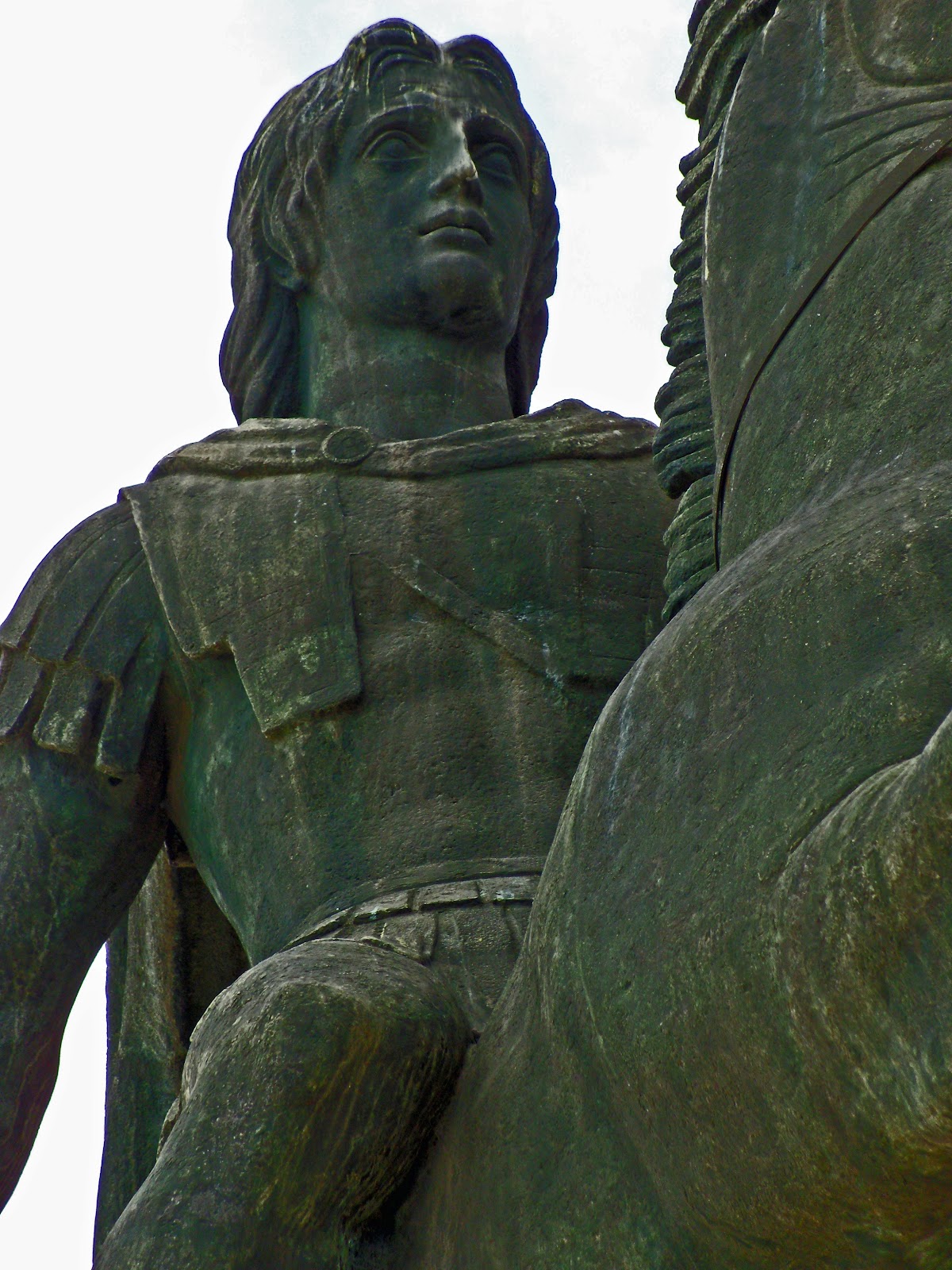

How important was Barsine in the geopolitical world of her time? Barsine was a beneficial source of information about the Persian court, Persian habits, and culture. After all, she had lived at least three years at the court of King Darius. Speaking Greek was an important asset to avoid misunderstandings. Alexander was an excellent judge of character, and having met Artabazus at Pella, he knew that he was a man of his word and could be trusted. Artabazus was loyal to Alexander. Having his daughter at the king’s side was a warranty that worked both ways. Barsine and her father contributed to Alexander’s larger plan. The birth of Heracles disturbed this goal – something Alexander never could or would accept. Barsine no longer fit his purpose in the new world he was building.

Sunday, November 14, 2021

Antipater and Alexander

Antipater first emerges from history at the side of Philip, when he became King of Macedonia after his brother Perdiccas died fighting the Illyrians. 

From what could be established, Antipater was a Macedonian nobleman, born circa 399 BC. In his younger years, he must have accompanied King Philip (see: Macedonia Forged by Philip) during his campaigns to impose and improve the power of Macedonia. We actively see him from 346 BC onwards, aged 57. 

When Philip ended the successive Sacred Wars in 346 BC (see: Philip’s campaigns east and the Fourth Sacred War – Macedonia forged by Philip II - 11), a delegation from Athens arrived in Pella to negotiate the peace terms. After the usual diplomacy, they reached an agreement. Philip, however, didn’t trust the Athenians and sent Antipater, Parmenion, and Eurylochus to Athens to repeat his terms of peace. This is where Antipater is mentioned by Arrian for the very first time. 

During the Battle of Chaironea in 338 BC, when Alexander commanded the left flank with his cavalry, facing the Sacred Band, he was probably assisted by both generals Parmenion and Antipater. To seal the ensuing Common Peace, i.e., the League of Corinth (see: High stakes at Corinth), with the Athenians, Philip sent an official embassy led by nobody less than Alexander in the company of Antipater and Alcimachus. They carried the ashes of those Athenians who had fallen during the battle. 

The above clearly shows how much Philip trusted Antipater. It is known that the king formed a clique with Parmenion, Antipater, and Attalus, who were also bound by several intermarriages. 

Antipater’s private life is little known except that he produced an impressive number of children. His recorded sons were Iollas, Cassander, Pleistarchus, Philip, Nicanor, Alexarchus, and Triparadeisus. His daughters Phila, Eurydice, and Nicaea all married generals in Alexander’s army. 

After Philip’s assassination in 336 BC, Antipater and Parmenion, still devoted to their king, supported Alexander to be elected as his heir. However, the neighboring Thracians and the Greek states in the south had doubts about accepting the rule of this young king and revolted. Alexander had no choice but to confirm his kingship from the onset and attacked the troublemakers both north and south. 

As soon as he had established Macedonian control, he turned his attention to his Asian campaign and left Pella in 334 BC. He made sure to leave half of his troops in the capable hands of his regent Antipater, who became Hegemon. Besides this heavy responsibility, which included handling the finances of the military and the navy, he was headmaster of the School of Pages. 

On top of his own army, Antipater had the power to summon the militia of the Greek city-states. He must have managed the situation with excellence because he gathered a large number of infantry and cavalry, despite Alexander’s constant demand for reinforcements. Antipater’s troops were needed when he had to face Sparta’s revolt in the Peloponnese. 

The first group of reinforcements was already mentioned in 332 BC while Alexander was in Memphis, and some 500 mercenaries and 500 Thracian cavalry joined his lines. From Arrian, we know Alexander sent the funds needed to enlist or hire such recruits. When the king was in Susa, he sent a certain Menes back to become the new governor of Syria, Phoenicia, and Cilicia. Menes received 3,000 talents in silver with instructions to transfer as much money as Antipater needed to cover his war expenses against Sparta. The general made good use of it because he emerged victorious in the decisive battle at Megalopolis, just north of Sparta. 

Antipater was, unfortunately, seriously criticized by Olympias, who liked to interfere in all matters. After several years, it must have become challenging for Alexander to make sense of either version of the facts. A mother’s love is mighty, and the image of the once-trusted commander was eventually blemished. Even if Alexander wanted to dismiss Antipater, he had nobody to replace him – not until a year before his death. Alexander decided to send Craterus to replace Antipater as the new regent in Macedonia. The regent-to-be was sent back home at the head of those veterans no longer fit for service. 

Alexander called (or summoned) Antipater to come to Babylon, but the old general ignored the order and sent his son Cassander instead. That is a bizarre decision because Cassander was not his favorite. Whether Cassander forced his father to accept to let him go or if it was by mutual agreement in case of the poison complot is true, we’ll never know. We will remember that Antipater’s son, Iollas, was Alexander’s cupbearer then. 

Alexander left no heir or successor when he died in 323 BC. As a result, each of his generals claimed a part of this empire. As a matter of fact, Antipater took control of Macedonia. This, however, did not mean peace as Antipater got involved in the Lamian War. The Aetolians, a tribe south of Thessaly, decided to help the Athenian general Leosthenes defeat Antipater. Leosthenes managed to corner Antipater, but luckily Craterus came to the old general's aid, and the Siege of Lamia was thus broken. The war proper ended a year later, in 322 BC, during the Battle of Crannon, when Leosthenes was killed. 

Antipater died in 319 BC at the blessed age of eighty. Upon his deathbed, he left his realm to Polyperchon and not Cassander. The arrogant Cassander deeply resented this, and Macedonia was the scene of bitter fights between Polyperchon and Cassander for the next decade. But that is another story altogether. 

It is quite astonishing to note how much Antipater accomplished in his later years. From the time of the Sacred Wars that ended in 346 BC until he died in 319 BC, he lived through some twenty-five turbulent years. In our modern world, this is the time for retirement. Amazing!

Sunday, May 3, 2020

The caltrop, a weapon to be reckoned with

A caltrop is a little-known gadget used over the centuries by many armies as an effective and unnerving weapon. Basically, it is made up of two or more sharp nails or metal contraptions arranged in such a way that one of the “legs” always points upward. In antiquity, it was an effective means to slow down enemy soldiers, their horses, and elephants. The upward nails would injure and impair the infantry soldier who stepped on them. The caltrop would also seriously hurt the feet of the unshod horses and the sensitive soles of the elephants’ feet.

It is not known who actually invented the caltrops or even who used them first. Caltrops are hardly mentioned in our historical records. In weaponry, it is clear that our attention goes to the protective outfit of the soldiers and to their apparent weapons like swords and lances, and the kind. 

The caltrops may have measured about 5 or 6 cm. They were easy to make, easy to transport, and easy to sew around.

The very first recorded use of the caltrop happened in Gaugamela, where the Persians had thrown plenty of so-called crow’s feet on the ground in front of the army. They must have caused Alexander some headaches. Firstly, to discover and locate these weapons, which were often partially hidden or entirely buried; secondly, to avoid them as the troops rushed forward to attack the Persians. In any case, he managed to bypass the trap as he cleared many of these crowfeet and otherwise safely maneuvered around the devices. His infantry, as well as his cavalry, successfully penetrated the enemy lines.

It is still to be determined whether the Greeks were familiar with the caltrops or saw them for the first time on the Battlefield of Gaugamela. Whatever the case, their effectiveness did not go unnoticed, as Alexander’s successors used them repeatedly in their later combats.

At the Battle of Gaza in 312 BC, Ptolemy and Seleucos threw these spiked caltrops in front of their lines to annihilate Demetrios’ elephants. The trick worked perfectly, and after shooting down the mahouts, the elephants were captured by the joint forces of Ptolemy and Seleucos.

A few years earlier, in 318 BC, caltrops or iron spikes were used to stop Polyperchon’s elephants at the siege of Megalopolis. In this case, they were driven in heavy wooden frames connected by chains and thrown in front of the elephants - spikes up. Eventually, Megalopolis did not accept the old general as the new Regent of Macedonia and chose to side with Cassander and Antigonus Monophthalmus. Unfortunately, the siege of Polyperchon failed.

The Romans, who learned a lot from Macedonian warfare, were also quick to implement the caltrop, although nothing is mentioned about Julius Caesar using them. He probably was the exception, for the Romans used the caltrops effectively in their war against the Parthians in 217 AD and again against the Sassanids in 637 AD. 

The caltrop was used throughout the Middle Ages, from Europe to North Africa and Asia - including China! The “fashion” did not die, and caltrops were again used during the Korean War. The principle of the caltrop is still effectively implemented today by the military and police to block vehicles.

Sunday, July 29, 2018

Thessaloniki continues writing history

Thessaloniki as such did not exist in Alexander’s days. The city was founded eight years after his death by Cassander, the eldest son of Antipater, Regent of Macedonia. Those were turbulent years and on his deathbed Antipater appointed Polyperchon as his successor instead of his own son, Cassander. That did not go down well with Cassander who simply murdered the old general. Well, we know that he mercilessly murdered all those who were in his way to the throne of Macedonia. Olympias, Alexander’s mother was assassinated in 316 BC. Roxane, his widow, and young Alexander IV, his legitimate heir to the throne, were poisoned upon his orders some six years later. About the same time, Heracles, Alexander’s son by his mistress Barsine was eliminated also.

The thirst for power clearly went to Cassander’s head and to legitimize his position inside the Argead Dynasty, he took Thessalonica , Alexander’s half-sister as his wife and self-proclaimed himself as king of Macedonia. As such he ruled from 305 till 297 BC and Thessalonica  gave him three sons, Philip, Antipater and Alexander. The city of Thessaloniki was named after her.


Because of its location, it soon became and still is one of the most populous and wealthy cities of Macedonia. When the Romans conquered Macedonia in 168 BC, it developed into an important hub on the Via Egnatia that connected Europe to Asia and prospered thanks to its spacious harbor. Consequently, it is not surprising that most of the remains of Thessaloniki  date from the heydays of the Roman Era.

Of course, there are testimonies left by the Ottomans who ruled from 1430 until 1912 when the city got involved in the Balkan War and gained its independence. The fire of 1917 devastated two third of Thessaloniki’s historic center, leaving 77,000 people homeless but exposing the Forum and its adjacent Odeon in return. Eventually, the city was rebuilt on a grand scale with little or no consideration for its antique legacy.

For the past ten years or so, Thessaloniki  is building a metro line through the city standing right on top of its antique levels, archaeologists have their work cut out. 

For these metro works, the underground of major streets has been exposed, especially parts of the ancient Via Egnatia and the Decumanus Maximus. Many stretches like the old commercial heart of the city have survived in amazingly good conditions.

In an ideal world, a metro station could be combined with an underground museum. This is a great idea as locals and tourists could enjoy a close up look at the glorious past of Thessaloniki  but skeptics declare that the two are not compatible as it is, for instance, impossible to move antique roads.

Smaller artifacts labeled as movable finds count 300,000 pieces, 50,000 of which are ancient coins. Plans are to exhibit at least part of these finds in two completed metro stations, probably Panepistimio and Papafi stations.

The metro should be completed by 2020 but repeated discussions about archaeological salvage and preservation regularly bring the works to a standstill. Besides, many local shopkeepers and residents are fed-up with the ongoing inconveniences and all they want is to be put out of their misery.

Tuesday, October 24, 2017

More illegal mosaics from Apamea

When I wrote my previous blog, The unique mosaic from Apamea, I was not aware that there was more of the kind to follow. There is a much larger mosaic estimated to cover at least 19 m2 that is also high on INTERPOL’s list of illegal digs at Apamea in Syria.

Besides the panel discussed previously showing the foundation of Apamea by Seleucos I with his son Antiochus I, there are three more panels coming from the same source. Because of their size and magnificence, this entire mosaic is assumed to belong to a large room from a wealthy Roman residence. The top one depicts the foundation of Pella (as Apamea was called previously) by the legendary Archippos. The bottom panels illustrate the construction of a fortification wall around the city that holds monumental public buildings.

Based on the clandestine photographs of this floor, it seems that the very lower part and half of the central zone are missing. What remains is, however, of the highest quality and has been compared to the paintings from the tomb of Agios Athanasios (see: The Macedonian Tomb of Agios Athanasios in Thessaloniki) – not without ground.


The top mosaic portraying the religious foundation of Pella shows five Macedonian cavalrymen with their horses, shields, and spears on the right-hand side and five figures making cult offerings in the left corner. Three of these men have been identified as their names are inscribed in Greek. We read Archippos as the legendary founder of the city sacrificing a bull, flanked by Antipater and his son Cassander – all richly dressed in their best tunic and cloak and wearing a diadem.

The central part of the mosaic depicts the key moment of the foundation of Apamea, where Seleucos holds the ktistes, an architectural measuring instrument symbolizing him as being the founder. Around a large table filled with silver and gold coins, we find once again Archippos and Antiochus I, together with Antipater and Cassander, and most importantly, Seleucos wife Apamewho contributed lavishly to the construction of the city. All these figures are dressed in the same sumptuous outfits as mentioned above.

I fail, however, to understand the presence of old Antipater in the company of his not-so-beloved son Cassander. We will remember that Antipater named Polyperchon as his successor and not Cassander, so why would he have dragged his son along to Pella/Apamea? And for what reason would they both be present in Pella/Apamea in the first place? The article published in Popular Archaeology seems to place the entire scene around 321-319 BC when Antipater was regent and Cassander was the commander of the Macedonian cavalry in Pella/Apamea. Still, I wonder what their contribution was to the foundation of Apamea. The Roman vision of history in the 4th century AD, some seven centuries after the facts, appears to be shrouded in mystery.


The background of this mosaic is, however, as exciting as the figures in the foreground, to say the least. We see huge defense walls encircling the city. Inside those walls, there is a large roofed temple with a high pediment supported by five columns. This temple is flanked by several other smaller and roofed buildings. Also recognizable is the large hippodrome or Roman circus, not unlike the one that has been unearthed in nearby Gerasa (which was founded about the same time) with a central spina delimited by little turrets. The figures on the left bottom part of that section are less obvious. They seem to be men working on the fortification wall, and a large ox is pulling something heavy.

The very bottom of the mosaic depicts a more idyllic suburban scene with, on the right-hand side, a lovely Roman Bath. Two distinct entrances can be seen, one probably leading to the cloakroom used by two women with small children and the other opening up above a ramp from which children are sliding down into the pool below. Very important, however, is the large noria (waterwheel) depicted on the left of this section. Until now, it was generally accepted that the oldest norias dated from the 5th century AD, but this picture confirms that they were used already one full century earlier! Norias are still standing along the Orontes River in Hama (see: Hama and its norias), where in the 5th century, some one hundred of them were still functioning. This makes you wonder how many of them were aligned along that same river here in Apamea!

All in all, these mosaic scenes are very revealing while, at the same time, they rise many new questions. It is not surprising to find them among the most valuable objects wanted by INTERPOL. It would be great if these masterpieces could be recovered someday, enabling professionals to examine them more closely.

Monday, May 11, 2015

What became of Alexander’s closest commanders after the War of the Diadochi?

Alexander was surrounded and supported by his highly skilled and efficient Bodyguards or Companions, who, after his death in 323 BC, had to take charge and rule his vast empire. They definitely were not prepared for this task, as Alexander obviously had not expected to die at such a young age.

The ensuing war that lasted for almost forty years and went into history as the War of the Diadochi was inevitable. Time and again, the commanders took sides and changed sides, made peace treaties, but coveted each other’s possessions soon after. Their lust for power and innate Greek competitiveness led them, at the head of their seasoned armies, to conquer ever more land. In the process, they eliminated each other systematically, till around 280 BC only four dynasties remained: the Ptolemies in Egypt, the Seleucids in Asia, the Lysimachids in Thrace, and the Antipatrids in Macedonia.

At the time of Alexander’s death, all his Bodyguards were in Babylon: Aristonous, Leonnatus, Lysimachos, Peithon, Perdiccas, Peucestas, and Ptolemy. Other powerful men were also present, like Seleucos, one of his principal commanders over the past seven years; Nearchus, his fleet admiral; and Eumenes, his secretary and archivist. However, Craterus was still in Cilicia on his way to Macedonia, and Antipater, as the Regent, was in Pella. Sooner or later, all these leaders got involved in the Succession War and died while defending their rights or in their increasing ambition to expand their territory.

"Diadochen1" by Captain_Blood - Own work. Licensed under CC BY-SA 3.0 via Wikimedia Commons 
Here is what became of them:

The first to die was Leonnatus, who relieved Antipater during the siege of Lamia in 322 BC and was killed by the Athenian enemy.

The next victim was Craterus in 321 BC, as his horse stumbled during a fierce confrontation with Eumenes on the borders of Cappadocia. He was trampled to death.

Perdiccas followed in 320 BC after failing to lead his troops safely across the Nile when he invaded Egypt held by Ptolemy. He was killed by his own officers.

Antipater died of old age in the late summer of 319 BC, nominating Polyperchon as his successor instead of his own son, Cassander.

Later that year (319 BC), the generals Arrhidaeus, Nicanor, and Cleitus were eliminated.

Eumenes, after desperate and repeated attempts to win the confidence of his troops, was killed by Antigonus Monophthalmus, the rising star in 317 BC. At the same time, Antigenes was burnt alive by Antigonus.

Under false pretexts, Peithon was summoned to Ecbatana by Antigonus some time later, where he was accused of treachery and executed.

Aristonous became the general of Olympias in her war against Cassander, but when the queen was taken prisoner in 316 BC, he was put to death by Cassander.

Nearchus disappeared from history around 300 BC, after he had joined Antigonus Monophthalmus and acted as adviser to his son, Demetrios Poliorcetes.

Lysimachus had the difficult task of ruling Thrace, which served as a buffer zone between east and west. He was killed in 281 BC after crossing the Hellespont into Lydia.

Peucestas had a less glamorous end to his career. He surrendered to Antigonus after acting as an unwilling ally of Eumenes and was kept as Antigonus close advisor and afterward for his son Demetrios Poliorcetes. The last time we heard from him was in 290 BC.

Ptolemy made a better choice with Egypt, which he ruled successfully, starting a dynasty that lasted three hundred years. Ptolemy I Soter died in his mid-eighties in 283 BC.

The same applies to Seleucos, who, after many fights on different sides, gained protection from Ptolemy and managed to establish himself as ruler of Alexander’s eastern provinces (311-302 BC). In his ambition to conquer Macedonia and Thrace as well, he was assassinated in 281 BC by Ptolemy Keraunos, son of Ptolemy I. He was the last of the great men who once rode by Alexander’s side to the end of the world.