Alexandria's founded by Alexander

Alexandria's founded by Alexander the Great (by year BC): 334 Alexandria in Troia (Turkey) - 333 Alexandria at Issus/Alexandrette (Iskenderun, Turkey) - 332 Alexandria of Caria/by the Latmos (Alinda, Turkey) - 331 Alexandria Mygdoniae - 331 Alexandria (Egypt) - 330 Alexandria Ariana (Herat, Afghanistan) - 330 Alexandria of the Prophthasia/in Dragiana/Phrada (Farah, Afghanistan) - 330 Alexandria in Arachosia (Kandahar, Afghanistan) - 330 Alexandria in the Caucasus (Begram, Afghanistan) - 329 Alexandria of the Paropanisades (Ghazni, Afghanistan) - 329 Alexandria Eschate or Ultima (Khodjend, Tajikistan) - 329 Alexandria on the Oxus (Termez, Afghanistan) - 328 Alexandria in Margiana (Merv, Turkmenistan) - 326 Alexandria Nicaea (on the Hydaspes, India) - 326 Alexandria Bucephala (on the Hydaspes, India) - 325 Alexandria Sogdia - 325 Alexandria Oreitide - 325 Alexandria in Opiene / Alexandria on the Indus (confluence of Indus & Acesines, India) - 325 Alexandria Rambacia (Bela, Pakistan) - 325 Alexandria Xylinepolis (Patala, India) - 325 Alexandria in Carminia (Gulashkird, Iran) - 324 Alexandria-on-the-Tigris/Antiochia-in-Susiana/Charax (Spasinou Charax on the Tigris, Iraq) - ?Alexandria of Carmahle? (Kahnu)
Showing posts with label Julius Cesar. Show all posts

Saturday, April 12, 2025

Sealing a sarcophagus with lead staples

Over the centuries, history has seen sarcophagi in all shapes and sizes, and one would think we know them all. 

Well, here is a surprise. In today’s city of Reims in northern France, archaeologists discovered a sarcophagus that had been sealed off with huge staples! 

[Picture from Artnet,  © Émilie Jouhet, Inrap]

Excavating the necropolis of Durocortorum, as Reims was known in the days of Caesar’s conquest of Gaul, and more precisely of the local Remi tribe. 

By 51 BC, the city reached its heyday when it was enriched with many Roman monuments including a Forum and several Bath Houses. Reims has also yielded a huge Roman building from the 2nd century AD including two nearly 20-meter-long Stoas. 

Outside the city wall, a vast necropolis was established. This surprised the archaeologists since the place was known as a swamp. 

However, the Roman engineers had managed to redirect the water to the Vesle River by building large ditches. The site so far revealed the remains of 20 burials. Among them was this unique, unopened sarcophagus from the 2nd century AD, fastened with strong lead staples! The rough limestone used suggests that the tomb was built with spolia recuperated from elsewhere. 

The sarcophagus contained the skeleton of a woman surrounded by her funerary gifts, such as two glass bottles, a jug, four oil lamps, an amber ring, a comb, and a mirror.

[Picture from Artnet,  © Émilie Jouhet, Inrap]

A further study of the woman’s remains is currently underway, including a DNA sample that will be compared with the 80 already existing ones. So far, some 5,000 tombs have been excavated in the Reims area. 

We are not often talking about the far-reaching impressions Caesar’s conquest left in Gaul, but this stapled sarcophagus seems to be one of a kind…!

Monday, March 3, 2025

The surprise of Myndos

Nowadays, Myndos is probably best-known for its underwater causeway running from the city’s harbor to Rabbit Island, which is guarding the mainland. It is a favorite with the tourists who happily walk across the bay when the sea level is only reaching to their knees. Otherwise, the site has very little to offer with cut stones and column drums strewn around. 

These ruins make it very difficult to imagine that Myndos was once a large prosperous city. In 377 BC, King Mausolos of Halicarnassus established Caria’s independence from Persia. He rebuilt the cities of Myndos and Syangela, and moved all other Carians to Halicarnassus, which he proclaimed his new capital (see: Halicarnassus, capital of Caria). 

Myndos, modern Gümüșlük, had a well-sheltered harbor, well-protected against the prevailing wind. The city had a two-mile-long fortification wall and its most vulnerable southeastern section was strengthened with towers. The green granite used for its construction is the same as the one known from the Mausoleum in Halicarnassus. The quarry providing these stones has been located in Koyunbaba, some three kilometers to the north. 

Otherwise, hardly anything else remains from ancient Myndos. Some rock-cut stairs and foundations of houses are found on the hillside, but the ruins that were present in the early 19th century have entirely disappeared. They are said to belong to a theater from the 4th century BC, a stadium with 7 columns, vaulted remains of a Bath, and a late Roman/early Byzantine basilica. 

Until the 1990s, there were more ancient stone blocks and bits of columns lying around in the village. Near a school, about 1.5 kilometers inland, some columns and Roman mosaics could be seen. Strangely, the nearby silver mines (hence the name Gümüșlük) are not mentioned in ancient sources. 

When Alexander besieged Halicarnassus in 334 BC, he speculated that Myndos would offer an easier approach. Some people in Myndos had actually suggested that they might open the city gates if he arrived under cover of darkness. Alexander took their word, but when he showed up at the gates there was no sign of surrender. Facing the betrayal, he ordered his Macedonians to attack without much result because he had not brought any rams, artillery or ladders. Myndos put up a vigorous resistance and soon was joined by Halicarnassus’ troops arriving by sea. Alexander was forced to withdraw and returned to besiege Halicarnassus. 

The capital of Caria was not taken so easily because the Persian commander Orontobates had the support of the Persian fleet. For the time being, Halicarnassus was no longer a real threat. Alexander moved on but left Ptolemy and Asander behind to finally take the city and to evict the remaining Persians. It was only a year later, in Soli, that Alexander received the long-awaited news that Halicarnassus had finally fallen!  At the same time, the town of Myndos came under Macedonian hands (see: A two-month-project to excavate the city of Soli). 

After the king’s death, Myndos was ruled by the Ptolemies from 308 until 275 BC. In 96 BC, it became independent and minted its own coins. Myndos was included in the Roman Province of Asia Minor in 133 BC. 

The harbor city was again in the news after the murder of Julius Caesar in 44 BC, after which Brutus and Cassius were expelled from Rome; they took their fleet to safety here at Myndos. By the end of 42 BC, the two murderers lost the battle against Marc Antony and Octavian in Philippi, and Myndos was given to Rhodes (see: Philippi, Macedonia’s gold and silver mines). Not for long though as the Rhodians treated Myndos harshly and unfairly and became independent again. However, it gradually lost its prosperity, although it may have survived till the 7th century AD. 

Myndos is often referred to as a Lelegian town, dating back to the Bronze Age. Except for its name, it has no connection with the classical city discussed in this article and both have a different history. The Lelegian site is nowadays called Old Myndos and lies a good three kilometers southeast of Gümüșlük.

Monday, September 30, 2024

Hoard of Roman coins found in Pantelleria

The small island of Pantelleria lies about one hundred kilometers southwest of Sicily, off the Tunisian coast, which is visible on a clear day. 

During recent excavations, archaeologists discovered 27 silver coins that had been deliberately hidden. They surfaced after severe rains had flooded the area. These silver denarii were minted between 94 and 74 BC. In those days, the island belonged to the Roman Republic and served as an important trading center in the Mediterranean. 

[Picture from All that's Interesting]

It is noteworthy that in the 1st century BC, the eastern Mediterranean, in particular, was plagued by repeated attacks from pirates. They even dared to kidnap young Julius Caesar in 78 BC and hold him for ransom. The story goes on to say that Caesar felt insulted because the pirates demanded only 20 talents for his liberation. He personally insisted they should raise the amount to 50 talents! Caesar was released after 38 days. The pirates swarmed as locusts over the towns and farms, plundering and burning them on the go. In 42 BC, in a large-scale operation, Pompey finally managed to abolish piracy. 

During these uncertain times, people buried their valuables and money, hoping to retrieve their possessions after the pirates left. It was not to be in the present case; the treasures were recovered only two thousand years later. 

A trove of over 100 coins was found during previous excavations, as well as marble busts of Caesar, Agrippina, and Emperor Titus.

Thursday, April 18, 2024

Reading the papyrus scrolls from Herculaneum

The Villa dei Papiri as reconstructed in Malibu, California, got its name from the huge amount of papyrus scrolls found inside the house’s Library in Herculaneum. 

Unlike Pompeii, Herculaneum did not burn after the eruption of Vesuvius in 79 AD but was buried under a meters-thick layer of pumice. That saved the Library of the Villa that once belonged to Julius Caesar’s father-in-law. The collection consists of more than 1800 papyrus scrolls and is considered the largest surviving library from Graeco-Roman antiquity. 

When the carbonized scrolls were discovered in the early 1800s, hopes were high to explore the long-lost literary works from antiquity. These scrolls were, however, very fragile and disintegrated as soon as they were touched. 

Attempts to open and unroll the rolls destroyed many of them, although some painstaking efforts by a monk revealed philosophical texts written in Greek. Three centuries later we are still trying to understand how to read the papyrus scrolls. 

In 2015, a process called micro-computed tomography (micro-CT) was developed to virtually unwrap fragile scrolls. It was used successfully to digitally recover a burned Hebrew scroll. 

Hopes ran high to apply the same technique for the papyri of Herculaneum. Unfortunately, they present another challenge as these texts are written in carbon ink, called “lamp black”. This type of ink is not detected by the micro-CT imaging system and the writing becomes ‘invisible’. More in-depth studies and new ‘learning machines’ eventually opened the path to reading four passages inside the unopened carbonized scrolls. 

In order to read entire scrolls, two key technical problems need to be solved. The first is to trace the papyrus surface inside the scan of the scroll, which is called segmentation. For the time being, this can only be done manually and costs a fortune. The other issue is the scanning, which is currently carried out using a particle accelerator in England. This involves a precious conservator-supervised transfer of the scrolls, two at a time, from Naples to England! 

The entire process requires much more fine-tuning and careful planning to finally set up a workable and above all affordable technique – as the entire organization is very expensive. With a little luck, it is expected that the scanning and reading of the 300 scrolls from Naples could be completed in two to three years. 

This will be a huge step forward to disclose the contents of hitherto unknown books and even new titles. So much history, literature, philosophy, and poetry that remained buried for two thousand years would finally be available! This is absolutely mind-blowing! 

Yet, there may be hundreds or even thousands of scrolls still buried in the Library of the Villa dei Papiri and, who knows, elsewhere among the ruins of Herculaneum! As we know, excavations are time-consuming and will depend on the funds made available to that effect. Only time will tell.

[Pictures from Vesuvius Challenge]

Monday, October 30, 2023

Rare testimonies from the Palace of Pergamon

Pergamon made a clear statement to take a leading position in the Hellenistic world in which the rulers attracted the best artists, architects, and philosophers. 

The Palace of Pergamon and its adjacent rooms must have been a sight for sore eyes considering the magnificence and action displayed on the famous Altar of Zeus, whose remains have been moved to the Pergamon Museum in Berlin. 

On most maps of Pergamon, we find five consecutive rooms initially labeled as Palaces in their own right. Recent studies have established that the so-called Palace V was the main building used for official purposes. The other “palaces” were rooms for the Royal family and the guests, storage rooms, and arsenals. 

The official rooms with their niches and patios would be filled with elegant statues, statuettes, vessels, and other decorative items created by the best artists from Hellenistic times commissioned by the Attalid kings (see: The Attalids, rulers of Pergamon). 

From the reign of Attalus I, 241 to 197 BC, the most striking examples are the statues of the Dying Gaul and the man and woman known as the Galatian Suicide. Both pieces were taken to Rome to adorn the Gardens of Caesar. Also at the instigation of Attalus I, a new architectural feature appeared, the Pergamene Capital (see: About Greek/Roman columns and capitals). There must be proof that at least bits of these capitals are left in situ but I have not found any. I discovered my first examples in North Africa and in particular in Leptis Magna, the city built by Septimius Severus in the 2nd century AD. 

The reigns of Eumenes II and Attalus II in the 2nd century BC left us with only a handful of artworks that survived the ravages of time. A rare treasure found in the dining room of Palace V with the Hephaistion mosaic is the dancer or light carrier lady. She is 1.20 meters tall and made of white translucent marble. Her right hand which has not survived is raised and her left hand reaches downwards towards her dress. This elegant beauty has been transferred to the Altes Museum of Berlin. Another lady dancer has apparently been moved to the Archaeological Museum of Izmir and the only available picture is on the site of Livius. 

More telling is the colorful mosaic of a parakeet now at the Pergamon Museum in Berlin (see: The beauty of Alexandrine mosaics) retrieved from one of the two dining rooms of the Palace. Here, another remarkable mosaic was discovered that carried the signature of the artist. His name is Hephaistion, which has nothing to do with Alexander’s friend who lived two centuries earlier. This artist very creatively wrote his name on a label that seemed to be stuck to the floor with sealing wax at its corners, except one corner which was already lifted up. The full inscription can be translated as "Hephaistion made it".
 

The balance of the finds in and around the Royal Palace is very meager considering the grandeur and wealth accumulated by the Attalid Kings of Pergamon (see: The Attalids, rulers of Pergamon). It is unclear whether these premises have been thoroughly excavated or if more work remains to be done. I like to believe the latest.

Wednesday, August 23, 2023

Roman soldiers in China

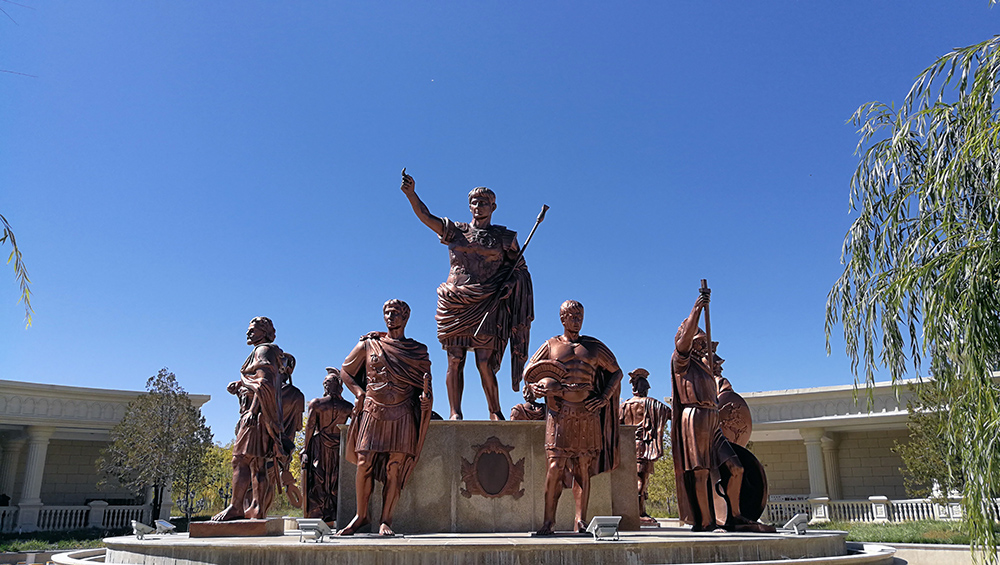
Entering China from the depression of Mongolia, the modern visitor is in for a remarkable surprise. High on top of a Corinthian column stand two bronze figures, a Chinese and a Roman soldier, greeting each other. Behind it, two rows of white columns line up in sharp contrast with the cloudless blue sky. 

A short distance away, a group of eleven, life-size Roman legionaries is immortalized in bronze. Behind it is the entrance gate to a Roman world in the style of Disneyland. The monument is a mixture of a Buddhist and a Roman temple with Ionic columns holding a pediment. A unique way to attract tourists to the Chinese frontier! What happened here? What triggered this staging? What is the truth behind this story? 

We must go back to 60 BC when Rome’s First Triumvirate was formed between Caesar, Pompey, and Crassus. Pompey is envious of Caesar’s successes in Gaul and recent friendship with Crassus. They were three very different men who came together to achieve their own goals. Once they agreed to their role in this new form of government, Caesar returned to Gaul, Pompey stayed in Rome, and Crassus went east.

Crassus was the richest man in Rome, but he was not a military man. Still, he sought glory on the battlefield similar to that of his co-rulers and decided to attack Asia Minor. His army was defeated by the Parthians and Crassus was killed at the Battle of Carrhae in 53 BC (see: Harran, better known under its Roman name Carrhae). Some 20,000 soldiers died on the battlefield and 4,000 returned to Syria. 

Yet 10,000 of his troops were taken prisoner by the Parthians (see: Who were the Parthians?) and sent to Margiana to man the frontier. In 36 BC, the Parthians forced the Roman prisoners to participate in the Battle of Zhizhi, Kazakhstan, against the Chinese. The victorious Chinese of the Western Han Dynasty were so impressed by the fighting skills of their opponents that they took them to the city of Liqian or Li-chien – maybe a transliteration of Alexandria or the Roman word Legion - in the region of Gansu in western China. 

A number of inscriptions discovered in the Kara-Kamar caves on the border between eastern Uzbekistan and Turkmenistan were written in Bactrian, Greek, Arabic, and Latin. The latter one was composed of three lines and was left by the Roman soldiers of the Pannonian Legio XV Apollinaris around the 2nd century AD (see: First contacts with China). A proof that the Romans had been there? 

It is a fact that about 50% of the population of Liqian has green and blue eyes and a Roman aquiline nose. This may be wishfully attributed to the Roman presence some 2,000 years ago. Another theory circulates that the Chinese mingled with people from Siberia. As so often, it is unclear where history and legend start or end.

[top and bottom pictures from That's Mags]

Tuesday, June 20, 2023

Another gold bust, this time from Switzerland

Some time ago, I wrote about a gold bust of Septimius Severus discovered in Plotinopolis, some 20 km north of Thracian Greece (see: A solid gold bust of Septimius Severus). 

I thought the find was pretty unique, but the Getty Villa just opened a special exhibition around a nearly life-size gold bust of Marcus Aurelius (see: the gold emperor of Aventicum published online in 2023). 

The bust is not made of solid gold like Septimius Severus’ but is hammered from a single sheet of gold. The gold bust was retrieved from an ancient sewage pipe in 1939. It was probably hidden there during a Germanic invasion in the 3rd century AD. 

Interestingly, the discovery was made at Aventicum, modern Avenches, in Switzerland. The Romans occupied Switzerland as they expanded their empire over the Alps. Julius Cesar defeated the local Helvetii tribe in 58 BC, and soon their land became a Roman Province. 

Aventicum, located between Lausanne and Berne, was built on the site of this Celtic settlement and prospered during the first three centuries AD. In its heyday, it counted as many as 20,000 people, who became Roman citizens assimilating Roman culture. 

The treasures of ancient Aventicum are kept in the Avenches Roman Museum, occupying a medieval tower from the 12th century near the amphitheater. 

This amphitheater from the early 2nd century AD could seat 16,000 spectators. It was partially built of stone, i.e., the walls, stairs, and central entrance, but the seating area was made of wood. When it fell into disuse in the 4th century, the building served as a stone quarry. 

The Roman vestiges counted more imposing monuments, including a theater, a temple where the bust was found, and the Thermal Baths of the Forum. Another striking feature is the Tornallaz, the only tower remaining from the initial 73 of the Roman city walls. This wall was 5.5 kilometers long and counted four gates. 

The gold bust of Marcus Aurelius was found under a temple situated at the center of a large courtyard framed with a Stoa on all sides. According to the available inscriptions, the temple was dedicated to Celtic gods as well as the ruling Roman emperor! 

The museum holds an impressive collection of artifacts such as mosaics and friezes, but also portrait sculptures recovered from the sanctuaries and the public monuments. 

A selection of artifacts, including the gold bust of Marcus Aurelius, is presently exhibited at the Getty Villa in Malibu, California till January 29, 2024. 

[Both pictures are taken from the Getty Villa exhibition link]

Wednesday, January 12, 2022

Speaking of the Mausoleum of Alexander

The massive circular tomb of Emperor Augustus in Rome has recently been opened to the public. This makes headline news to most people (including the Roman citizens) because the building was neglected and stood abandoned for the past 80 years. Finally, renovation works were completed, and the mausoleum has opened for visitors. 

The Mausoleum of the first Roman Emperor stands along the Tiber River just as the much better-known Castel Sant’Angelo, which initially was conceived as a mausoleum for the later Emperor Hadrian (ruled 117-138 AD) and his family. 

Working on the Tomb of Augustus, archaeologists were in for some surprises. They always thought that this mausoleum was cone-shaped, but their restoration revealed a cylindrical building. That is not surprising if we look at Hadrian’s Mausoleum, which also stands along the Tiber and is cylindrical. 

As Octavian returned home after his victory over Egypt, he proclaimed himself emperor and took the name Augustus. This was the proper time to start the construction of his tomb. With his title of Emperor came the megalomania of having the largest mausoleum ever with a diameter of about 87 meters! It seems that even today, this is a world record. The idea was that the emperors coming after him would also be buried in this tomb. So the ashes of Tiberius, Caligula, and Claudius were indeed interred in this necropolis. It must have made quite a statement with its shiny marble walls. Archaeologists suspect that an enormous statue of Augustus crowned the mausoleum. 

This type of construction was apparently not confined to Rome since other similar tombs existed in Algeria. The Royal Mausoleum of Mauretania in Tipaza may be the best-preserved example. It was built in 3 BC for King Juba II of Mauretania and Cleopatra Selene II, his wife. This queen was the daughter of Cleopatra VII and Marc Antony. She successfully ruled over Mauretania until she died in 6 BC. Her husband built this mausoleum for her, and based on its size, the idea probably was to also use it for future generations of royal families. King Juba died in 23 AD, and his remains joined those of his wife. 

The mausoleum appears not to be unique as the shape was known throughout Numidia. It may, however, also be inspired by Augustus’ tomb which was built some 25 years earlier. The circular stone construction with a diameter of 60 meters was initially topped with a cone or pyramid standing 40 meters tall. The walls were decorated around the outside perimeter with 60 Ionic columns, which have now lost their capitals. Inside there were two separate vaulted chambers. 

A recent article published on Academia by Michael Bengtsson, “Reconstruction of the Palace area in Alexandria,” sheds another light on the Mausoleum of Alexander, which was visited for centuries in Alexandria. The author has carefully reconstructed the Royal Palace of Alexandria, referring to the texts written by Zenobius, Strabo, Suetonius, and Lucan. 

Based on the striking resemblance between the Royal Mausoleum of Mauretania in Algeria and the Mausoleum of Augustus in Rome, Michael Bengtsson concluded that the tomb of Alexander served as a prototype for both. I think we may safely assume that the size of Alexander’s circular tomb must have surpassed all! 

In the case of the Algerian Mausoleum, we can be confident that Cleopatra Selene, born in Alexandria, thoroughly knew the Palace and the burial site of Alexander. As General Octavian, Augustus conquered Alexandria in 30 BC after winning the Battle of Actium against Marc Antony. He also visited the tomb of Alexander. And finally, Hadrian was in Alexandria in 130 BC. As a lover of all things Greek, he most certainly was full of admiration for Alexander and must have seen his tomb. He may well have been inspired to use the circular shape for his own Mausoleum.

Other Roman emperors who paid their respects to Alexander were Julius Caesar in 45 BC, Caligula, Septimius Severus early 3rd century AD, and Caracalla in the 3rd century AD. It is said that Septimius Severus closed Alexander’s tomb to the public when too many tourists flocked to see it! The crowds and tourists are of all times, it seems.

See also: Linking the Pantheon in Rome with ancient Mausoleums

[Top picture from World History Encyclopedia - Second picture from Atlas Obscura - Bottom picture from Michael Bengtsson]

Monday, August 30, 2021

Endless fuss over the tomb of Alexander the Great

As theories about the final resting place of Alexander the Great abound, it may be a good time to summarize what we know. 

After being embalmed in Babylon, Alexander’s mummified body was transported with due pomp to Pella, where he was born and where all Macedonian kings were traditionally buried. However, Ptolemy, now ruling over Egypt, decided to intercept the splendid coffin as it passed through Syria. He said that Alexander had wanted to be buried in Egypt, in his first city of Alexandria. 

At that time, Alexandria was still under construction, and the king’s mummy was temporarily deposited in Memphis, the hitherto capital of Egypt. Ptolemy eventually transferred Alexander’s remains to Alexandria. Ancient sources are almost silent about the size and location of this first tomb. 

Ptolemy IV Philopator built a grand mausoleum for Alexander around 215-214 BC, probably as imagined by his great-grandfather, Ptolemy I. This Philopator transferred Alexander’s mummy during a splendidly organized ceremony. With Philopator’s lineage of predecessors, Alexander was put to rest somewhere in the center of Alexandria, later called the Soma, i.e., within the Palace District. 

At some point, the mummy was protected by a glass surrounding it. That is how Augustus, the first Roman Emperor, saw it. His example was followed by at least Caesar (assassinated in 41 BC), Caligula (ruled 12-41 AD), Hadrian (ruled 117-138 AD), Septimius Severus (ruled 193-211 AD), and Caracalla (ruled 198-217 AD), who were all great admirers of Alexander. After 391 AD, when paganism was entirely outlawed, history lost track of the mummy after being on display for almost seven centuries. 

Strangely, no picture and no full description of Alexander’s last resting place has survived – not even of the Soma and/or Royal Palace. However, we do have coins and mosaics representing the Pharos built by Ptolemy I. One would logically assume that the Soma was far more important than the lighthouse. It remains everyone’s guess why we don’t have any description of the Soma and its location inside Alexandria? 

Northern Africa suffered severely from a devastating earthquake in 365 AD, causing the entire coastline to drop by four meters (see: Apollonia in Cyrenaica (eastern Libya) after Alexander). The consequences of the ensuing tsunami may not have flooded the Soma immediately, and it may have sunk slowly till it disappeared around 391 AD, as mentioned above. The tomb of Alexander obviously drowned together with the Palace of the Ptolemies. 

The big question is, what happened to the remains of Alexander, supposing they could be saved, either from the flooding or from unrest inside Egypt? Theories are endless. 

The analysis made by Andrew Chugg centered around the Mosque of Nabi Daniel, which would have hidden Alexander’s corpse in a sarcophagus way beneath the present street level. Chugg claims that these remains were taken to Venice in 828 AD as being those of St Mark. They are now in St Mark’s Cathedral (see: The Lost Tomb of Alexander the Great by Andrew Chugg). 

Greek archaeologist Liana Souvaltzi assumed that at some point, the king’s mummy was transferred to Siwah as Ptolemy fulfilled Alexander’s wish. The recorded visits of the Roman emperors to Alexandria, for instance, are merely ignored in her theory. Liana Souvaltzi started excavating the Temple of Amon-Ra in Siwah in 1989, but in 1995, the Greek and Egyptian governments suddenly blocked her permit. Today, she still fights to resume her excavations; however, without success. 

When the Kasta Hill tomb in Amphipolis was discovered a few years ago, one of the many supposed occupants was Alexander the Great (see: Amphipolis/Kasta Hill … here we go again!) Here is the list of possible candidates: 
Roxane, Alexander IV, the son of Alexander, Olympias, Cleopatra, sister of Alexander, Cassander (son of Antipater), Antigonus Monophthalmus, Hephaistion, Heracles (the illegitimate son of Alexander and Barsine), Polyandrion, Polyperchon, Philip-Arrhidaeus (half-brother of Alexander), Philip II (Alexander’s father, as many still doubt that he lies in the tumulus of Aegae).

The most recent theory here is that it was supposed to be the last resting place for Hephaistion. 

More news came from the Hellenic Institute for the Research of Alexandria Culture in 2017 (see: Magnificent Alexander statue found in Alexandria). They are working in the Shalallat Gardens area, where they claim to have located remains from the Royal Quarters of the Ptolemies. More exciting is the discovery of a unique marble statue of Alexander the Great in these gardens, fueling new theories about the king’s tomb once again.

Earlier this year, while discussing the presumed Tomb of Queen Olympias near Pydna (see: The tomb of Olympias found?), the leading Professor claimed that this tomb was similar to the one attributed to Alexander at Siwah.  

In the end, there have been many more theories, as I am not including those expressed in the widespread versions of the Alexander Romance (see: Le Roman d’Alexandre, traduit du grec par A Tallet-Bonvalot). None of them was satisfactory.