Alexandria's founded by Alexander

Alexandria's founded by Alexander the Great (by year BC): 334 Alexandria in Troia (Turkey) - 333 Alexandria at Issus/Alexandrette (Iskenderun, Turkey) - 332 Alexandria of Caria/by the Latmos (Alinda, Turkey) - 331 Alexandria Mygdoniae - 331 Alexandria (Egypt) - 330 Alexandria Ariana (Herat, Afghanistan) - 330 Alexandria of the Prophthasia/in Dragiana/Phrada (Farah, Afghanistan) - 330 Alexandria in Arachosia (Kandahar, Afghanistan) - 330 Alexandria in the Caucasus (Begram, Afghanistan) - 329 Alexandria of the Paropanisades (Ghazni, Afghanistan) - 329 Alexandria Eschate or Ultima (Khodjend, Tajikistan) - 329 Alexandria on the Oxus (Termez, Afghanistan) - 328 Alexandria in Margiana (Merv, Turkmenistan) - 326 Alexandria Nicaea (on the Hydaspes, India) - 326 Alexandria Bucephala (on the Hydaspes, India) - 325 Alexandria Sogdia - 325 Alexandria Oreitide - 325 Alexandria in Opiene / Alexandria on the Indus (confluence of Indus & Acesines, India) - 325 Alexandria Rambacia (Bela, Pakistan) - 325 Alexandria Xylinepolis (Patala, India) - 325 Alexandria in Carminia (Gulashkird, Iran) - 324 Alexandria-on-the-Tigris/Antiochia-in-Susiana/Charax (Spasinou Charax on the Tigris, Iraq) - ?Alexandria of Carmahle? (Kahnu)
Showing posts with label Taxila. Show all posts

Wednesday, May 31, 2023

Aristobulus, more than a biographer

Aristobulus of Cassandreia has been listed among the many biographers of Alexander the Great (see: Eyewitness accounts of Alexander’s life), but he was far more than that. He did not hold any military function in Alexander’s army. Consequently, not being involved allowed him to approach the events as an onlooker. 

He must have been a tough guy since he survived the hardships of Alexander’s campaigns, including the march through the Gedrosian Desert. He seems to have lived to be over ninety years old. 

When he was 83, he began writing his book about the exploits of Alexander from the early days of his kinship to his death. He was blessed with an excellent memory, being able to recall so many events, novelties, and details! Apparently, his book was finished at about the same time as Ptolemy and Cleitarchus published theirs, 285-283 BC. Unfortunately, most of his work is lost. We only have a few scraps together with his observations recorded and used later by Arrian and Strabo. 

We may assume that Aristobulus accounts were exact and reliable. He had a wide field of interest and investigated the land, the animals, the many peoples he encountered, the public buildings, and other construction works. Alexander’s military campaign was not his priority. 

He is best known as the engineer/ architect in charge of restoring Cyrus’ Tomb in Pasargadae, a serious responsibility that clearly shows how much Alexander trusted his capabilities. 

Aristobulus, however, was mainly a geographer. He spent much time analyzing and describing the fauna and flora he encountered, the rainfall and the Indian monsoon (whose arrival he recorded in Taxila), the rivers, and the different climates. He drew an in-depth comparison between India and Egypt, including their environment. He analyzed the river courses, placing them in a broader context as trade routes throughout Central Asia and Punjab. 

The Oxus (see: Crossing the Oxus River), for instance, was the longest river, he said, that was navigable and used to transport goods from India to the Caspian Sea. Another river that caught his attention was the Polytimetus (see: Alexander's march to Maracanda) in Sogdiana, which did not flow into another river or a sea, but petered out in the desert. 

On the other hand, fragments of Aristobulus’ text on plants have been preserved. He tells us how rice was cultivated in beds in the backwaters and that the plants were 1.75 meters tall. He said that since each plant had several ears, the harvests were plentiful, adding that the grains had to be hulled. 

The geographer also spent ink on the importance of Alexander’s visit to Siwah. Unlike fellow biographers of the king, Aristobulus detailed Alexander’s route. Ptolemy stated that Alexander headed directly for Memphis. Aristobulus, instead, wrote that the king left from Paraetonium and followed the Mediterranean for about 290 kilometers before turning south to Siwah. On the way back, Alexander founded the city of Alexandria. This implies that he returned over the same route as the one used on his outward journey. Again, this is the version of events as copied by Arrian.

We know very little about Aristobulus fascinating personality, but he is one of the rare authors who draws an overwhelmingly positive picture of Alexander. He depicts him as a righteous king, concerned about justice and not making hasty decisions. Another of his remarkable declarations is that Alexander was not a heavy drinker but liked to spend time with his companions, toying with his drink. That is a far cry from the many statements or hearsay statements depicting Alexander as a heavy drinker and even that the wine led to his premature death in Babylon! 

Aristobulus rightfully declares that Alexander was under the protection of the gods. Nowadays, we would say that he was born under a lucky star. Why not?

Saturday, July 16, 2022

Presence of the Greek gods in Asia after Alexander

Just imagine doing some excavations in the middle of the Ganges Valley to find hundreds of seals carrying the image of Greek gods and goddesses such as Athena, Apollo, Nike, and Herakles! 

[Agate intaglio from Phu Khao Thong (right), impression (left). H. 16 mm.
Photos: Brigitte Borell and Prachak Pongspanich] 

The discovery of the figure of Herakles, in particular, is very striking and recognizable as he is resting on a club and holding a lion skin. He appeared from excavations in the 1940s at Rajghat, close to the Varuna and Ganges Rivers confluence. The site was a well-established trade center in antiquity, with connections reaching westward to Taxila. Considering that the distance from the Indus Valley, where Alexander halted his march eastwards, to the Ganges is almost 1500 km, shows how far his Greek influence traveled after his death. 

The surprise discovery does not stop in India as pictures of the god Herakles were found as far away as southern Thailand, at the archaeological site of Phu Khao Thongis – meaning Golden Hill - on the Isthmus of Kra. The hill owes its name to the many gold finds resulting from legal and illegal diggings. 

This coastal trading post was linked to the maritime networks of the Indian Ocean and served as a hub for land crossings to the peninsula's east coast and the South China Sea The unearthed artifacts originate from China and South East Asia to the Mediterranean in the West. They can be dated to the last centuries BC and early AD. Typical among the finds are, on the one hand, a fragment of a Roman cameo and a Roman intaglio from the West, and on the other hand, fragments of bronze mirrors from China’s Han period (25-220 AD) from the East. 

The Herakles from Thailand is remarkable because its design does not originate in the Mediterranean. The young beardless Herakles has big eyes and a large nose – hardly the delicate, true-to-nature rendition of the Greeks! It is, however, the work of an experienced local craftsman and appears to have been made for a finger-ring. This kind of beardless Herakles may be tied to the days of Alexander the Great, who used it on his coins. The Graeco-Bactrian King Demetrius I, who ruled from c. 200 until 190 BC, continued the tradition in his eastern empire. 

The main concern for scholars is to note the difference between local work and imports from the Mediterranean. This is far from clear-cut, as craftsmen may have settled deeper into Asia, or local craftsmen may have mastered the techniques from those same settlers. 

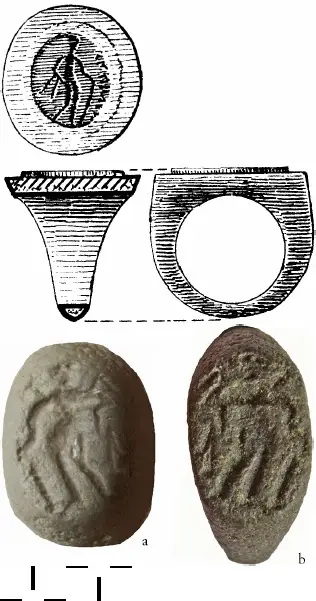
[TopGold ring with glass intaglio from Sirkap, Taxila. H. 22.1 mm
(from Marshall 1951: pl.197)
BottomBronze ring seal and impression (left) from Taxila H. 19 mm.
Taxila Museum, inv. 8797 (Photos: Courtesy of Aman ur Rahman)]

A good example is a ring found in a large hoard of jewelry at Sirkap near Taxila, buried there towards the end of the 1st century AD. Here, Herakles is presented as a slender and relatively thin figure – a far cry from the muscular male we would expect. However, it originated from a highly skilled school of gem-engraving.

The Herakles seal from Thailand resembles a garnet seal from the Northwest of the Indian subcontinent, possibly created there as well. It is now exhibited at the British Museum. It is noteworthy that it is closely related in type to two rings from Taxila. 

A similar meager Herakles appears on three other seals found in the Gandhara area in Afghanistan. Their style also suggests local production. 

These are only a few examples of the spreading of Hellenism and Hellenistic art further East, beyond Alexander's conquered lands. I like to believe that he would have been delighted with this outcome!

[Pictures are part of the article Herakles on an Intaglio Seal Found at Phu Khao Thong in the Upper Thai-Malay Peninsula by Brigitte Borell, published at Academia.edu]

Saturday, April 17, 2021

Dilemma at Pakistan’s National Museum: save it or trash it?

One example of many is the looting of some 395 rare artifacts that had been seized in 2012 as they were underway to Faisalabad, Pakistan. The experts claim that they belong to the Gandhara Civilization (see: Old Buddhist complex discovered in Pakistan) and may have originated from Taxila and Mehrgarh both in modern Pakistan. 

Looting and smuggling is of all times and happens everywhere – unfortunately! We praise ourselves when the police track down the culprits and their precious cargo in order to return it either to its initial finding place or to the nearby museum where, we assume, the unique artifacts will be taken care of. 

[Picture from Archaeology News Network]

Sadly, in the present case, such a straightforward assumption is far from reality as it involves the National Museum of Karachi. It has transpired recently that hundreds of artifacts and dozens of archaeological sites have been seriously neglected by the country’s authorities responsible for the preservation of antiquities. Among these objects are five sculptures of Buddha heads, three of them standing four feet tall and two about three feet. Instead of being carefully studied, cataloged and stored away, they have been found on top of a pile of garbage at said Museum of Karachi. 

This clearly illustrates the incompetence and carelessness of the government officials in place. Lying there in plain sight for many months, exposed to wind and weather, there is no excuse for such negligence! Antiquity robbers and looters are pointed with the finger and highly condemned, whereas government officials are able to get away with such a crime – because it is a crime! 

It has been reported by museum employees who want to remain anonymous that rare treasures from the Indus Valley and similar civilizations have also found their way to the museum’s dump site. The director, however, claims that a total 100,000 objects in stone, wood, metal and even paper are carefully checked and stored; adding that every single piece inside and outside the museum building has been carefully recorded. The museum’s most valuable piece is the statue of the King Priest from Mohenjo-daro, and which the Director says is safely stored away. It is rarely on display, although copies may be shown. 

Whatever is happening in Karachi remains obscure, to say the least, but there is no smoke without a fire and I find it extremely upsetting when our heritage is mistreated in such a manner!

Friday, April 2, 2021

The complex site of Taxila

Until now, I pictured Taxila as one big city, as it is in modern times. What threw me off was that ancient sources talked about the three ancient cities of Bhir, Sirkap, as well as Sirsukh instead of Taxila. Meanwhile, modern archaeology has established that Taxila is composed of 18 separate sites of great cultural value. This demanded a closer and more in-depth study of the matter. 

From the 6th century BC onward, the city of Taxila was known by the Persian Achaemenid kings, who turned it into an important hub on their Royal Road from Persepolis to Central Asia. For AlexanderTaxila was the first major city he encountered on this way into India. It was also the residence of King Taxiles, who came to meet him while he was still in Sogdiana. He had promised to join his forces to those of Alexander, but he died before they could meet. True to his father’s word, Omphis (also called Mophis or Ambhi) received Alexander in Taxila (see: Alexander crossing the Indus at Ohind). 

We will recall that Omphis had provided supplies to Hephaistion and the Macedonians as they were bridging the Indus River. When both kings met outside the city, Omphis handed his fifty-six elephants over to Alexander, together with an impressive herd of livestock, including 3,000 bulls dressed up for sacrifices. 

The site of Bhir is actually the place where this meeting took place in 326 BC since Omphis palace stood on top of a mound that carried that name. This same location was later occupied by Chandragupta Maurya (see: Was Chandragupta inspired by Alexander?) and his grandson, Asoka. As the latter introduced Buddhism in the Gandhara region, the first Buddhist monastery was erected at this very spot at some time in the 3rd century BC. By the 2nd century AD, this construction was replaced by the Dharmarajika Stupa, the remains of which are still visible. 

With Alexander, Greek knowledge and science reached Taxila. Here, philosophers and the like met and developed science, mathematics and astronomy. 

Sirkap emerged at a later date. After Alexander’s conquest, the eastern part of his empire was ruled by the Seleucid kings till about 250 BC. By then, power was taken over by the self-proclaimed King Diodotus I of Bactria, who laid the foundations of what became the Greco-Bactrian Empire. These Bactrian Greeks advanced into the Gandhara region and erected their well-planned city of Sirkap as part of Taxila. For the next five hundred years, Greek remained the lingua franca and the influence of Greek art and beliefs lived on (see: Unique Hellenistic heritage in Pakistan). 

This link is confirmed by the Greek philosopher Apollonius of Tyana (15-100 AD), who described Taxila as being rich with Greek-type of constructions. This happened in the 1st century AD, and it is generally accepted that he was talking about Sirkap.

As a result of the heavy traffic on the Silk Road that connected Central Asia to China, business flourished while the population mingled with the Scythians, the Parthians, and later the Kushans. Besides silk and other precious goods, Buddhism also spread steadily in the wake of Buddhist monks travelling to China, Korea, and Japan. It was under the Kushan emperors that a new form of art blossomed, blending classical Greek expression with local art forms. This became known as the Gandhara Art, which produced the most remarkable statues of Buddha and Bodhisattvas (see: Indo-Greek art or the influence of Hellenism on Buddhist art). 

One of the oldest Stupas is the so-called Round Stupa from the 1st century AD. The largest sanctuary is the Apsidal Temple, measuring 70x40 meters with a square nave and several rooms used by the Buddhist monks. It also presented a building in an apsidal shape – hence its name. It may have been decorated by a Greek artist, but the earthquake of 30 AD destroyed most of the building. 

Of particular interest is the Double-Headed Eagle Stupa, which displayed pilasters of Greek design with Corinthian columns. It has a strange combination of a Greek temple and a Hindu shrine. The ensemble is crowned with a double-headed eagle as originally found in Babylon. The theory is that the idea spread to Scythia and was introduced to the Punjab by the Saka rulers. 

The large Dharmarajika Stupa already mentioned in Bhir was situated not far from Sirkap. It was built with the sole purpose of housing relics of the Buddha and was surrounded by several monastic buildings. 

The most recent city is Sirsukh, which was founded by the Kushans after 80 AD. King Kanishka had decided to abandon Sirkap and to build his own new city in a typical Central Asian style. The city was surrounded by a strong fortification wall that was almost five kilometers long and more than six meters thick. Its particularity was that the face of these walls was covered with diaper or diamond-shaped masonry. Until now, the city proper could not be investigated properly because today it is buried deep underneath the low, richly irrigated land. Sirsukh was completely destroyed by the Huns, who invaded the Punjab around 500 AD.

Sunday, February 28, 2021

Where did Bucephalus die?

The question whether Alexander’s dear mount died on the Battle of the Hydaspes or at another location around that time has been discussed at length and obviously without any conclusive result.

Today, I have been wondering where Bucephalus actually died. It so happened that a friend of mine forwarded me an article about Bufliaz, a town on the foothill of the Peer Rattan Range in India that claims to be the place where Alexander’s horse died.

Bufliaz, according to the locals, is named after Bucephalus (Bunifales) to commemorate the death. The town is located 39 kilometers east of Poonch or Punch, roughly some 120 km northeast of Taxila. This sounds pretty odd because it is generally accepted that from Taxila, Alexander marched to the southeast to the banks of the Hydaspes, where his famous battle against Porus was fought.

Although Bucephalus may have died at Bufliaz, that does not exclude that a city in his honor could have been built on the banks of the Hydaspes near modern Mong (see: Locating Alexandria Nicaea and Alexandria Bucephala).

Opinions about the burial site of Alexander’s prized horse vary widely. Jona Lendering cites Jhelum, and G. Huntingford identifies a mound west of Jhelum as Alexandria Bucephala. Sir Aurel Stein tends to believe that Alexander went south from Taxila and crossed the Hydaspes near modern Behra. This town is close to Mong and could be the very site where the Battle of the Hydaspes took place. Michael Wood, although he agrees with Stein to identify Mong as ancient Alexandria Nicaea, suggests Garjak as Alexandria Bucephala. Garjak is said to have its own legend of a magical horse. Last but not least, Mansoor Behzad, a local historian, supports the idea that Bucephalus was buried in Jalalpur Sharif, which lies 75 km northeast of Bhera.

Clearly, the possibilities are endless, and in the end, we could only establish that Bucephalus died and was buried in that general area.

Saturday, January 11, 2020

Alexander caring for the wounded and the dead

Battlefields always revolve around numbers and tactical moves. The human aspect is generally left out, simply because it is an inevitable by-product of war. Modern warfare is far more clinical, and statistics of the number of dead and wounded are kept pretty accurately.

In antiquity, the situation was entirely different. A person’s life was of little value. Men died in battle, women died in childbirth, and if they managed to escape that fate, they could fall victim to raids from a neighboring town and finally die as slaves. Not the happiest prospect for any being, unless you belonged to the upper class of society. But still.

The Greeks considered that dying on the battlefield was an honorable death, but they were not ready to sacrifice their lives for that sole purpose.

When I watched Oliver Stone’s picture of the aftermath of the Battle of Gaugamela with hundreds and thousands of corpses spread over the battlefield, I remembered a similar shot of Atlanta in the movie Gone with the Wind. In both scenarios, I wondered about the smell of the decaying bodies of men and beasts, the puddles of blood and excrement, the buzzing of the flies, and the vultures uttering their guttural screams. There is nothing glorious left on a battlefield after the victory is claimed by one party.

Following Alexander on his major confrontations at the Granicus, at Issus, at Gaugamela, and on the Hydaspes, our sources from antiquity wind up producing the strangest figures when it comes to counting the dead. Numbers on either side have been distorted. They were either to make the losses on the enemy’s side much higher than they were or to reduce the casualties on Alexander’s side to a questionable minimum. It is impossible to verify any of the information that has reached us through Arrian, Plutarch, Diodorus, Curtiusor Justin, more so because it was penned down centuries after the facts.

As to the wounded, it seems they were not accounted for, or only in exceptional cases. Counting the dead on a battlefield did not equate to the ultimate number of casualties. Many of the wounded were bound to die afterward. 

Hygiene was a foreign word in antiquity, and if there was any basic knowledge, it was a far cry from our modern concept. We should remember, however, that Alexander had a great interest in medicine and learned from Aristotle everything he could. Healing illnesses with plants and specific concoctions was one aspect, but stitching the soldiers’ cuts back together and cleaning their wounds was another.

If we consider the many cases of trepanation that were successfully carried out since the Neolithic, we must admit that the knowledge available in antiquity is far beyond what we might think. PhilipAlexander’s father, lost an eye and survived the operation quite well. So did Antigonus Monophthalmus. Speaking of eyes, it is known that cataract surgeries were performed as early as 4,000 BC by the Egyptians. The list of medical wonders is probably endless, but the point I am trying to make is that the physicians in Alexander’s army were far more knowledgeable than we may believe. Cleanliness certainly was one of the main requirements. 

Early last century, for instance, it was essential to wash a bleeding wound with water and soap. This has been done for centuries and may well have been applied by the caretakers in antiquity. In my own youth, when a wound was infected, it was to be soaked repeatedly in hot water and soda crystals. The ancients may well have used something similar. The technique of cauterization was known long before the early trappers in the American West, and that knowledge was inherited from earlier generations. A hot knife, dagger, or even a sword would seal the wound and kill the bacteria at the same time.

It has been reported that Alexander visited the wounded after the battle. Going from one soldier to the next, he listened to their report, how they had been injured, acknowledged their courage, and showed them respect. I am sure that the king checked their wounds and how they were treated. The caretakers and physicians were watched closely by Alexander because he, himself, had considerable knowledge of healthcare and medicine. In the end, he gave his soldiers and the caretakers a huge boost in morale. There cannot have been a better medicine than that. In the end, this may well be the secret to justify the low rates of mortality among the Macedonian troops.

What about the wounded enemies, one might wonder? Well, I don’t think that the Macedonians were inclined to show much pity, if any, to their adversaries. They were not in for half measures, just as Alexander wasn’t. For them, the enemy had to be eliminated. I would doubt if any of the wounded were left behind with some breath in their lungs. 

When the enemy, however, asked to retrieve their dead to give them a proper burial, Alexander did not refuse. We’ll remember how he even sent the body of Darius III back to his mother to accomplish the funeral according to Persian customs. On an earlier occasion, at Issus, the king had also given the Queen Mother permission to bury the Persians from the battlefield. The recovery of wounded enemy soldiers is never mentioned.

The soldiers who died in Alexander’s service always received an appropriate burial with full honors. After the Battle of the Granicus, Alexander instructed Lysippos to create a bronze memorial for the 25 cavalrymen who had fallen on the battlefield. For several centuries, it stood in Dion, the sanctuary of Macedonia.

The list of lavish and expensive burials is a long one. I relied on Frank Holt’s account, as mentioned in his book “The Treasures of Alexander the Great”. For the soldiers as a group, there was a burial at Issus in 333 BC, Ecbatana in 330 BC, on the Polytimetus River in 329 BC, and Sangala in 326 BC. Personal and more elaborate funerals took place in honor of his generals/companions, Hector in Egypt in 331 BC, Nicanor in Alexandria Ariana in 330 BC, Philip and Erigyius in Sogdiana in 327 BC, Demaratus in 327 BC, and Coenus on the Hydaspes River in 326 BC. Also to be mentioned is the gymnosophist and sophist Calanus from Taxila, who immolated himself in Susa in 324 BC. Last but certainly not least was the expensive funeral pyre that Alexander had built for his dearest Hephaistion, who died in Ecbatana in 324 BC.

Clearly, nothing was too good for the dead.

[The picture of the battlefield is from Oliver Stone's movie Alexander]

Saturday, October 5, 2019

Heliodorus, Greek ambassador in India

It sounds rather strange to hear about an ambassador in antiquity. However, throughout his life, Alexander repeatedly met ambassadors from cities he would conquer or those who wanted to show their goodwill towards the conqueror. Yet, more often than not, they remain anonymous. One such exception, however, took place in India.

Chandragupta had entertained friendly relations with Seleucos, and the Greek Megasthenes had functioned as a capable ambassador. After Changragupta’s death, his son Bindusara came to the throne. This was six years after the death of Seleucos. Still, the friendly relations between the Seleucids and the Mauryan empire remained. Seleucos had been replaced by his son Antiochus, and Megasthenes was replaced by Deimachos as envoy to the Mauryan court (see: Transition between two great rulers, Chandragupta and Asoka).

Heliodorus, in the present case, is a Greek ambassador sent by the Indo-Greek King Antialcidas Nikephoros to the court of King Bhagabhadra, who ruled over north, east, and central India around 110 BC.

We have only scant information about the spreading of Hellenism in that part of the world, but it did happen. In the wake of Alexander and Seleucos, Hellenistic art, culture, and knowledge eventually took root in Central Asia, where the Bactrian kings proudly showed off their close ties.

In India, on the other hand, the influence of Hellenism was much slower since the Mauryan kingdom imposed itself shortly after Alexander’s short passage, eliminating all Greek influences in the area. (see: Indo-Greek art or the influence of Hellenism on Buddhist art).

But things changed in 185 BC with the fall of the Mauryas. The Graeco-Bactrian King Demetrius, son of Euthydemus, saw an opportunity to venture into IndiaHe invaded the country by 180 BC, setting the foundations for the Indo-Greek kingdom that lasted till 10 AD. This was when the influence of Hellenism appeared in India, and those rulers' coins carried inscriptions in Greek and Indian languages. Furthermore, art in the Indo-Greek kingdom reached an unequaled level blending Greek, Hindu, and Buddhist elements harmoniously together.

In this context, it is unsurprising to meet a person like Heliodorus, who lived in Taxila then. The fact that he was sent by Antialcidas Nikephoros places our envoy at an unusually high level. This king ruled from ca. 115 to 95 BC over western India, although other sources prefer to date his rule to ca. 130 to 120 BC and include eastern Punjab in his domain (supported by coin findings). Antialcidas had coins struck representing Zeus and Balram, an Indian god.

Interestingly, Antialcidas may have been a relative of a Bactrian king since Heliocles II, as well as Amyntas, Diomedes, and Hermaeus, struck coins with similar features.

The Hellenistic dynasties in India had a very open mind in true tradition with Alexander. It may not surprise us to hear that Heliodorus converted to Hinduism and erected a pillar confirming his role and position. Our ambassador was logically inspired by Asoka, whose columns were taller and more refined. The inscription on Heliodorus’ pillar in ancient Brahmi reads as follows:

This Garuda-pillar of Vãsudeva, the god of gods, was constructed here by Heliodora, the Bhãgavata, son of Diya, of Takhkhasilã, the Greek ambassador who came from the Great King Amtalikita to King Kãsîputra Bhãgabhadra, the Savior, prospering in (his) fourteenth regnal year. (These?) three steps to immortality, when correctly followed, lead to heaven: control, generosity, and attention(Translated by Richard Salomon)

Initially, the pillar was surmounted by a sculpture of Garuda, a divine eagle-like sun bird and the king of birds. How close can one get to the eagle who so often accompanied the images of Zeus? It is interesting to realize that Garuda was linked to Vishnu, the Hindu god who fights injustice and destroys evil and, as such, stood as the symbol of the king’s duty and power.

The “Khamb Baba” or Heliodorus Pillar still stands in Vidisha, some 60 kilometers northeast of Bhopal in India.

Excavations in the pillar area have also exposed the remains of a large temple from the 2nd century BC, measuring 30mx30m with exceptionally thick walls of 2.40m. An earlier elliptical temple from the 4th-3rd century BC has been located underneath this level. Apparently, this strange construction was destroyed by a flood in 200 BC, i.e., before the erection of the Heliodorus pillar.

[Picture of the pillar: By Regents Park - Own work, CCBY-SA 3.0]
[Picture of the inscription from Wikimedia]