Antipater first emerges from history at the side of Philip, when he became King of Macedonia
after his brother Perdiccas died
fighting the Illyrians.
From what could be established, Antipater was a Macedonian nobleman, born
circa 399 BC. In his younger years, he must have accompanied King Philip (see: Macedonia Forged by Philip) during his campaigns to
impose and improve the power of Macedonia.
We actively see him from 346 BC onwards, aged 57.
During the Battle of Chaironea
in 338 BC, when Alexander
commanded the left flank with his cavalry, facing the Sacred Band, he was
probably assisted by both generals Parmenion and Antipater. To seal the ensuing Common Peace, i.e., the League
of Corinth (see: High stakes at Corinth), with the Athenians, Philip sent an official embassy led by
nobody less than Alexander in
the company of Antipater and Alcimachus.
They carried the ashes of those Athenians who had fallen during the battle.
The above clearly shows how much Philip trusted Antipater. It is known that the king
formed a clique with Parmenion, Antipater,
and Attalus, who were also bound by several
intermarriages.
Antipater’s
private life is little known except that he produced an impressive number of children. His
recorded sons were Iollas, Cassander,
Pleistarchus, Philip, Nicanor, Alexarchus, and Triparadeisus. His daughters Phila, Eurydice, andNicaea
all married generals in Alexander’s
army.
After Philip’s
assassination in 336 BC, Antipater
and Parmenion, still devoted to
their king, supported Alexander
to be elected as his heir. However, the neighboring Thracians and the Greek
states in the south had doubts about accepting the rule of this young
king and revolted. Alexander
had no choice but to confirm his kingship from the onset and attacked
the troublemakers both north and south.
As soon as he had established Macedonian control, he
turned his attention to his Asian campaign and left Pella
in 334 BC. He made sure to leave half of his troops in the capable hands of his
regent Antipater, who became
Hegemon. Besides this heavy responsibility, which included handling the
finances of the military and the navy, he was headmaster of the School of Pages.
On top of his own army, Antipater had the power to summon the militia of the Greek
city-states. He must have managed the situation with excellence because he
gathered a large number of infantry and cavalry, despite Alexander’s constant demand for
reinforcements. Antipater’s
troops were needed when he had to face Sparta’s revolt in the Peloponnese.
The first group of reinforcements was already mentioned in
332 BC while Alexander was in Memphis,
and some 500 mercenaries and 500 Thracian cavalry joined his lines. From Arrian, we know Alexander sent the funds needed to enlist
or hire such recruits. When the king was in Susa, he sent a certain Menes back to become the new governor of Syria, Phoenicia, and Cilicia.
Menes received 3,000 talents in
silver with instructions to transfer as much money as Antipater needed to cover his war expenses against Sparta. The
general made good use of it because he emerged victorious in the decisive
battle at Megalopolis,
just north of Sparta.
Antipater was, unfortunately, seriously criticized by Olympias, who liked to interfere in all
matters. After several years, it must have become challenging for Alexander to make sense of either
version of the facts. A mother’s love is mighty, and the image of the
once-trusted commander was eventually blemished. Even if Alexander wanted to dismiss Antipater, he had nobody to replace him –
not until a year before his death. Alexander
decided to send Craterus to replace Antipater as the new regent in Macedonia. The regent-to-be was
sent back home at the head of those veterans no longer fit for service.
Alexander called (or summoned) Antipater
to come to Babylon, but
the old general ignored the order and sent his son Cassander instead. That is a bizarre decision because Cassander was not his favorite. Whether Cassander forced his father to accept to
let him go or if it was by mutual agreement in case of the poison complot is
true, we’ll never know. We will remember that Antipater’s son, Iollas, was Alexander’s cupbearer then.
Alexander left no heir or successor when he died in 323 BC. As a
result, each of hisgenerals
claimed a part of this empire. As a matter of fact, Antipater took control of Macedonia. This, however, did not
mean peace as Antipater got
involved in the Lamian War. The Aetolians, a tribe south of Thessaly, decided to help the Athenian general Leosthenes defeat Antipater. Leosthenes managed to corner Antipater, but luckily Craterus
came to the old general's aid, and the Siege of Lamia was thus broken. The war proper ended a year
later, in 322 BC, during the Battle of Crannon, when Leosthenes was killed.
Antipater died in 319 BC at the blessed age of eighty. Upon his
deathbed, he left his realm to Polyperchon and
not Cassander. The arrogant Cassander deeply resented this, and Macedonia was the scene of bitter
fights between Polyperchon and Cassander for the next decade. But that
is another story altogether.
It is quite astonishing to note how much Antipater accomplished in his later
years. From the time of the Sacred Wars that ended in 346 BC until he died in 319 BC, he lived through some twenty-five turbulent years. In our
modern world, this is the time for retirement. Amazing!
The island of Motya
(modern Mozia) off the
west coast of Sicily
holds several remarkable places of interest: the Villa Withaker with its
museum, the Phoenician or Punic cemetery, and the sanctuary of Khoton dedicated to the goddess Astarte.
Joseph Whitaker was an intellectual entrepreneur from Palermo
who excavated the island in the first two decades of the 20th century. He
organized his rich collection of ceramics, glass, coins, vases, jewelry,
terracotta artefacts, and mosaics in separate rooms of his estate. This display
shows how a private collector could present his precious finds to his friends
and guests. At the same time, it is a unique view of archaeology on Motya that yielded so many Punic
artifacts.
The museum's pride is the white marble statue of a charioteer that was
found buried in a shallow grave on the road to the sanctuary (see: Amazing charioteers).
Remarkably, this statue was made almost simultaneously as the bronze charioteer
of Delphi,
whose body was more static and elongated, probably to fit better inside his
chariot.
When visiting the Tophet, the Punic cemetery at the northern end of the
island, one can only be impressed by the many child graves. The remains were
either put inside a terracotta urn or buried in a rectangular box whose lids
are generally lost. A very moving confrontation! The nearby necropolis was used
from the end of the 8th century until the end of the 6th century BC.
At the seaside, one recognizes the two gate towers from the 5th century
BC. Here, we have to imagine the now inundated road that is connected to the
mainland. By low tide, carts with larger wheels could cross the isthmus, giving
the impression to walk on water. It has been dated to the 6th-5th century BC.
At the other end of the island, the artificial basin of Khoton has
been exposed, actually a sacred area that goes back to the 8th century BC. It
is here that a large temple facing the water was discovered. Inside this
temple, there were initially two upright steles and an obelisk. Viewing the
night sky at the winter equinox, the stones framed the constellation of Orion,
which corresponds to the Phoenician god Baal. During the spring equinox, the
temple's portal framed the same divinity, together with Venus, the Phoenician
Astarte. Terracotta remains of a female statue were unearthed inside the
temple. They belonged to the goddess Astarte, establishing that the temple was
dedicated to her.
Also known as Anahita, Innana, or Ishtar, Astarte embodies the qualities
of water, especially the fertilizing flow of water (see: The powerful goddess Anahita in Persia).
The pool in front of her temple clearly refers to these qualities. She is also
linked to the night sky, fertility, fecundity, and war. Besides Babylon,
her main centers of worship in and around the Mediterranean were Sidon, Tyre,
and Byblos,
as well as Malta and Sardinia. As mentioned in my post about Anahita in Persia, we
should remember that Alexander must
have been well-aware of the role Anahita played in the realm of the Persian
gods. Like so many other Greeks of his days, he may have assimilated her with
Aphrodite.
During the latest excavation campaign, a beautiful head of the goddess
Astarte was found. It was made of terracotta covered with a shiny layer of
white on her face, red for her curly hair, and gold for her divine diadem. It
could be dated to between 520 and 480 BC. The head was discovered inside a
round votive pit and a relief rosette that shows traces of gilding. The rosette
is one of the most widespread and popular symbols in the eastern Mediterranean and further inland, confirming the
Phoenician goddess's presence. Also, the mold of a dolphin with a large naive
eye was discovered.
The face of Astarte represents an astral goddess (based on the rosette)
and a marine goddess (based on the dolphin). She is the Lady of life, goddess
of fertility, love, and the sea and navigation, of fresh and seawater. The
terracotta is Greek, although made in Sicily
as was customarily done by the Phoenicians of Motya.
Recent archaeological investigations have shed new light on Motya as the oldest city in Sicily. This sacred area
of the Kothon is set
around a rectangular pool 52.5 m long. It was bordered by a circular temenos
measuring 118 m in diameter, encircling three larger temples. The Kothon was dedicated to Baal, the
main Phoenician god, lord of the sea, god of the storm and fertility, and to
his companion, the goddess Astarte who had her own little temple there.
Eventually, the mighty Astarte/Aphrodite of Motya survived as she merged with the goddesses of the
peoples who already lived here.
Once again, it makes me wonder how much Alexander knew about these western territories and their
beliefs. The fact is that we may never find the answer.
In 2019, seven
mass graves were discovered in Himera, exposing thousands of skeletons of
soldiers who fought in the city’s fierce battles of 480 and 409 BC against the
Carthaginians (see: The Battle of Himera, a major confrontation). Their bodies had been
neatly arranged with great respect in an orderly fashion. Another thirty burial
sites were reserved for the horses, which the experts related to the severe
clash of 480 BC (see: Mass
Graves discovered in Himera).
Thanks to modern
geochemical evidence, specialists were able to analyze the tooth enamel of 62
soldiers who fought in both battles. The tooth’s chemistry varies based on the
region of origin of the men. In the battle of 480 BC, it turned out that only
one-third of Himera’s
soldiers were locals. In the confrontation of 409 BC, three-quarters of them
were locals. This confirms Diodorus’
account that the Himerans received more outside help in their first
battle than in the second.
However, it
appears that this account is incomplete because the present geochemical
analysis reveals that the outside help was not Greek but came instead from
mercenaries hired for the occasion from territories outside the Greek
realm.
This discovery
sheds new light on history, as told by Diodorusand Herodotus. They apparently ignored the role of
foreign mercenaries in Himera to portray a more appealing true Greek intervention. We should remember that
Greeks generally considered it distasteful to hire foreign mercenaries, which
may be a good reason for our historians to bend their story to accommodate
their pride. Building the Temple
of Victory on the very
location of the battlefield truly confirms that sense of pride.
Another argument
for taking this decision may be the attempt to align the victory at Himera with other
Greek victories across the Mediterranean. It
transpires that from 480 BC onward, foreign mercenaries influenced the
ancient population in the western Mediterranean.
Food for thoughts!
Ancient sources
tell us that Alexander the
Greathad a thorough knowledge of medicine and ways to treat the
wounds and ailments of his troops (see: Alexander caring for the wounded and the dead).
It is great to
learn that one such remedy was the sea buckthorn, specifically the orange
berries this shrub produces. It is commonly present in cold-temperate regions
of Europe and Asia, from the coastal areas of the Netherlands
and the Baltic Sea to Afghanistan,
India, the Himalayan region,
and northern China.
In antiquity, it even grew in Greece.
The pretty
orange berries are full of vitamins and antioxidants, qualities that were
unknown to Alexander,
although he could take advantage of them. Besides, these fruits contained fatty
acids, which helped hair and nails to grow and were beneficial for the eyes. It
has been reported that after eating these berries, the king's horses had shinier hair,
gained in strength, and recovered more quickly from injuries and illnesses. Alexander most probably added these berries to his own diet and to that of his
troops, making them stronger and more vigorous.
The Latin name
for the sea buckthorn berries, Hippophae,
may well be based on Alexander’s
experiences with the horses as the particles hippos and phaos literally mean “shining horse.” This refers to
the radiant effect of the berries on his horses’ fur.
Alexander must have
learned about these berries from Aristotle
since Theophrastus,
one of his pupils developed the healing properties of sea buckthorn in his writings. The
interests of Theophrastus were, of
course, not limited to these berries and extended to biology, physics, ethics,
and even metaphysics (see: Theophrastus, philosopher and botanist).
Today, as the
sea buckthorn is made available as tea and juice or oil, we know that it even
boosts the immune system and increases our concentration. A sound immune
system, in particular, must have played an essential role in keeping Alexander’s troops in
excellent shape.
Aizanoi, regretfully, doesn’t make
headline news - yet. Several years ago, I watched a program on TRT TV that
showed many imposing monuments from Roman times at this site which was
otherwise unknown to me. After that, I haven’t heard anything about further excavations or remarkable finds until today. The massive entrance to the Temple of Zeus
has been re-erected, which rightfully makes it one of the best-preserved
temples in Anatolia.
As always, I like to put things in context. Looking at the map, Aizanoilies roughly 200 km south of Bursa, in the heart of ancient Phrygia.
The city occupies both sides of the KocaçayRiver (Penkalas). The
first settlements date back to 3000 BC, but what we see today are
roughly the remains of the Roman city from the 2nd century BC.
The Temple
of Zeus indeed commanded
the view, as it still does today, standing on its podium on top of a low hill. It
measured 33x37 meters, counted 15 x 8 columns, and was commissioned by Emperor Hadrian. Thanks to an
inscription on the architrave, the temple could be dated to the second quarter
of the 2nd century BC. The inscription also mentions M.
Apuleius as a benefactor of
the city.
The base of the podium of this temple is covered with vaults – an
unusual and unique occurrence in Roman Anatolia. Archaeologists concluded that
this was a double temple, with the one dedicated to Zeus beckoning us, and a
vaulted underground space where the cult of Cybele was practiced. This goddess
was worshipped under the name Metre Steunene in Aizanoi. However, more recent in-depth research has
revealed that this temple could not be devoted to both Zeus and Cybele. Consequently,
the underground space is thought to be a prophecy center or a mere storage
room. Whatever its purpose, it is an odd construction.
Opposite the temple are the remains of a small Bouleuterion, but its
history remains unknown. The same problem applies to the Heroon and the Agora
and surrounding Stoa because the remains were either reused on other structures
or disappeared under the modern houses.
Aizanoi counts remains of many monuments, among which a rare combined
theater-stadium complex linked together by a large stage building. Its
construction started shortly after 160 AD and was completed halfway through
the 3rd century AD. Several inscriptions have been found in the stadium and the
theater, and they confirm that the same M. Apuleius contributed substantially to building this complex.
The excavations done between 1970 and 2011 have exposed two public
Baths, a Gymnasium, a Macellum, five bridges, an ancient dam, a colonnaded
street, and a large necropolis.
One of the Baths stood between the theatre-stadium complex and the Temple of Zeus and included a Palaestra or
Gymnasium. With its recognizable frigidarium and caldarium, the Bath has been dated to
the end of the 2nd century AD. In the largest side room, a marble statue of
Hygeia was found. Also, the water and heating pipes are still in
situ. Despite its rich
marble décor, it has been recognized as a precursor of the Turkish-style Bath. The Palaestra is located at the northeast end of the Baths.
The second Turkish-style Bath
built a century later was found northeast of the city center. Here a beautiful
mosaic floor representing a satyr and a maenad has been exposed.
The circular Macellum of Aizanoiwas built simultaneously with the
first Bath and
was used as a food market. Here, a copy of the Price Edict of Diocletianfrom 301 AD
was found. The edict aimed to limit the severe inflation that followed the
debasement of the coinage initiated by Emperor Nero.
During recent excavations, remains of a colonnaded street have been
uncovered over a length of 450
meters. This street had its own Stoa, which could be
dated to ca. 400 AD. A pedestal carried a marble statue of a satyr dressed with
panther skin stands at the very end of the Stoa.
The Roman city of Aizanoioccupied both sides of the KocaçayRiver and was protected against the rise
of the water level by walls or dams made of large cut stones. Two of the five
bridges are still used today. They both have five arches, and one of them still
supports modern-day traffic. In between these two examples, we can recognize
the remains of a bridge with three arches that fell in disuse. Further north, a
low wooden bridge was used as a pedestrian crossing.
The main bridge displays an inscription on the pedestal of the railing
and tells us it was opened in September 157 AD. An illustrating relief shows
the sea voyage undertaken by M. Apuleius as he paid for the bridge’s construction. It may be
essential to mention that M. Apuleius represented Aizanoiin the Panhellion Union held in Athens from 153 to 157 AD. The new railing was installed
in 1990.
The large necropolis of Aizanoireflects the size of the city. It includes a wide
array of tombs, including door-shaped Phrygian tombs from the 2nd century AD. The
typical tomb doors, which often bore the name of the deceased or donor,
symbolized the passage to the other world. These tombstones usually showed
bulls, lions, or eagles for the men and baskets of wool or a mirror for the
women.
In one of the tombs, archaeologists made a remarkable discovery. They
found a “lykion,” a typical jar made to contain a precious salve to
treat eye dryness which frequently occurred to soldiers traversing large
stretches of dry lands or deserts (see: Eye cream from antiquity).
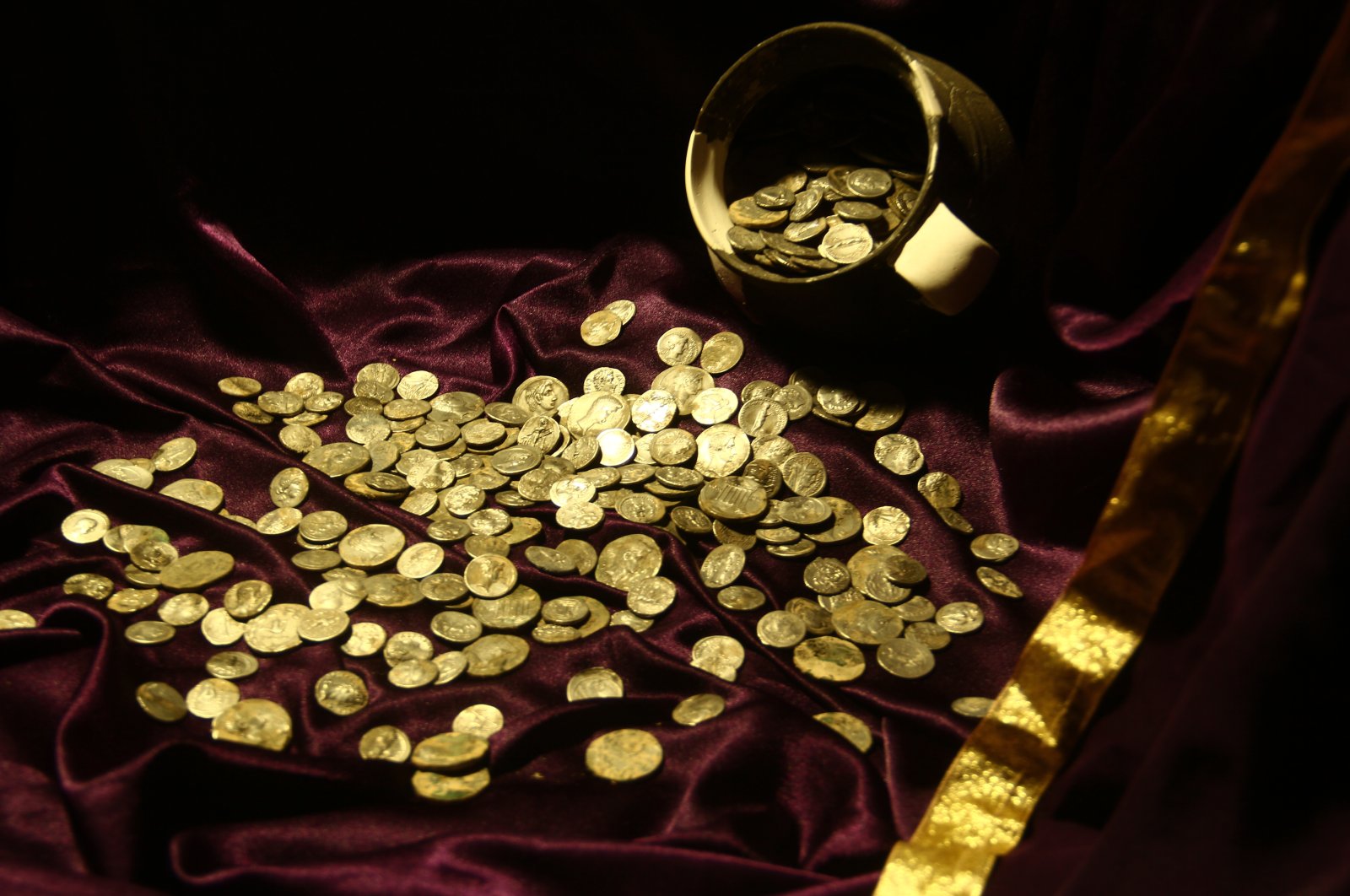
More recently, they unearthed a jug containing an exceptional hoard
of 651 silver coins from the days of Emperor Augustus. Remarkably, 439 coins were standard Roman silver
denarii, but 212 were cistophoruscoins typically from Pergamon. This is not surprising considering that Aizanoiwas ruled by Pergamon until the kingdom was bequeathed to the Romans
in 133 BC.
Aizanoistarted minting its first coins in the second and first
centuries BC. During the days of the Roman Empire,
the city grew wealthy thanks to the production of grain, wine, and wool. Aizanoifell into decline in Late Antiquity.
The story began
in 2017 when a Belgian art collector put several archaeological elements up for
sale. The European art catalog offered pieces belonging to a Daunian funerary
stele, which were noticed by a State Archaeology lab in Apulia, southeast Italy.
The stele
presented by the Belgian collector was missing its centerpiece. An official
from the restoration lab had noticed that the missing part was exhibited in the
museum’s collection. It represented a warrior on horseback and his shield.
This was indeed
the proverbial missing piece in the puzzle, which set in motion the complete
investigation. Soon, Italian authorities recovered nearly 800 separate
artifacts which the Belgian collector had gathered illegally. The pieces
included Daunian steles, red figure vases, black glazed Apulian ceramics,
amphorae and a great number of terracotta figurines. The artifacts have been
dated to the period between the 6th and the 3rd century
BC, and their value has been estimated to 11 million Euros.
Luckily, the
rare collection has been repatriated to Italy after all the legal appeals
of the collector were dismissed. That is an excellent result, of course,
although the items have all been taken out of their context and sadly we’ll
never know to which grave or tomb they once belonged.
Knowing where to go and what to see is very important in
any travel plan, but some surprises can turn out to be true gems.
It so happened that I could visit the recently excavated cemetery of Akanthoy, near Ierissos, North
Chalkidikis. The finds date roughly from the 7th-6th century BC,
i.e., before Alexander and thus
something he would have known.
According to Thucydides, the ancient city of Akanthos
was founded as a colony of Andros, or, if we
follow Plutarch, jointly by Andros
and Chalkis in the middle of the 7th century BC. It sat on top of a prehistoric
settlement. The city took the side of the Persians both in 499 BC (First
Persian War) and 480 BC (Second Persian War) and sided with the Athenians in
431 BC during the Peloponnesian War. With the expansion of Macedonia under Philipand Alexander, Akanthos
was incorporated into their kingdom. In 200 BC, the city was plundered by the
Romans and became a mere province.
The cemetery has been located underneath the modern city
of Ierissos. It has yielded more
than 14,000 findings confirming that the site was used all through the Roman
age. The best artifacts have, of course, been moved to the ArchaeologicalMuseum
of Polygyros.
One of the fascinating spots I happen to stumble upon by
chance is these lovingly cared-for tombs discovered in 2014, where everything
is kept in situ. I admire the
work of the archaeologists who managed to unearth these tombs from different
eras in superposed layers while leaving each one undisturbed by the excavation
of the others.
Jars of all sizes and shapes (varying with time)
alternate with small tombs, roofed or not. A few poignant small tombs still
contain the cremated remains with their original grave goods on top – little
earthen pots and jars that helped define the burial date. Also, skeletons of
what seem to be young children are surrounded by toy horses and miniature
vases. There also are many larger rectangular tombs in terracotta.
Outside, in front of an unmarked building, many larger
pots have been collected, some wrapped in protective plastic. They are all
waiting to be cataloged and studied together with smaller items filling
colorful crates. Archaeology requires a lot of patience!
The Scythians
are mentioned in different contexts throughout my blog, but they have never
been discussed as a people.
[Picture from World History Encyclopedia. A map illustrating the expansion of the warrior nomad Scythians between the 7th and 3rd century BC across Asia and Europe. (Simeon Netchev - CC BY-NC-SA)]
We have to go
back to Herodotus
in the 5th century BC, who mentions the Scythians for the first time. The author
concentrates on Ukraine,
although his description might well extend to the tribes in Central Asia. When talking about the Scythians, we refer to many different
tribes roaming the steppes north of the “civilized” world. Their habitat
stretched roughly from the Black Sea, the Caspian Sea (north of Persia) to Central Asia and the desert of Mongolia. At this far easterly end, the
Chinese protected themselves from Scythian invasions by building their famous
Great Wall.
Generally living
in small bands, they attacked the cities and towns situated south of their
extensive east-west frontier. After a more or less sudden devastating
incursion, they would withdraw with their booty into their vast nomadic
Eurasian steppe lands. Over the years, some tribes settled as farmers, but they
were not interested in founding cities of their own.
In Central Asia
and Persia,
the Scythians were called Sacae
as both tribes shared the same Indo-European language and lifestyle. These Sacae are called Skudat, which the Persians understood
as Sakâ. The
Greeks, in turn, used the name Skythes or Skythai. No wonder the Scythians show up so
often in history under a different disguise.
The Persians
suffered repeated attacks from the Scythians, who, even shortly, dominated the Medes
in the 7th century BC. They are also known to have played a significant role in
the Sack of Nineveh
in 612 BC.
As a result of Miletus’ colonization, the Kingdom of the Bosporusemerged (see: The Kingdom of the Bosporus). It reached its
peak between the 6th and the 3rd century BC. During that period, the new
settlers maintained strong cultural and trade relations with the Scythians.
Over the centuries, the kingdom with its capital of Panticapaeum became a
melting pot of civilizations as the Greeks mingled with neighboring Pontic Scythians.
An earlier blog,
A cast helmet from Central Asia, discussed a helmet found
near Maracanda,
in the tomb of a Sacae
leader. The technique of cast helmets was customary in China, which
proves that these nomadic Scythians lived far to the east. This particular
helmet dated from the 6th century BC and became obsolete afterward.
The Massagetai tribe living
near the Aral Sea was also Scythian. In 529
BC, Cyrus the Great
attacked this tribe, ruled by Queen
Tomyris. That happened after Cyrus’
negotiation to marry her failed. She bluntly refused to submit to him. As a
result, the king attacked her and her tribe, and she died on the battlefield.
The Scythians
also successfully withstood Darius the Great’s attack at the beginning of the 5th century BC. Later
that century, the Pontic
Scythians took possession of Thrace.
In the 5th
century BC, the OdrysianKingdom was founded – merely a union
of more than forty tribes that turned Thracia into a powerful state. The Odrysians and the Scythians had reached
peaceful relations through their inter-dynastic marriages, which led to
establishing the border of their lands at the DanubeRiver.
Both peoples mingled and were generally recognized as Scythians. Their
agreement, however, was not meant to last as, in the end, southern and central Thrace were divided among the Odrysian kings.
Eventually, Philip II
conquered their land in 340 BC. The Getae
ruled the northeast section.
Alexander attacked
these Getae after his pursuit of the Triballians to the banks of
the DanubeRiver in 335 BC. The Triballians had sought
refuge on an island. Instead of attacking them in that awkward position, Alexander decided to
isolate them and go after the Getae
on the other bank of the Danube. Hemanaged to ferry 4,000
infantrymen and 1,500 cavalry across the wide river by night. No wonder the Getae were in
shock when they woke up with this army on their land and fled to the hinterland
(see: Crossing the Danube River).
A noteworthy Odrysian Thracian is Sitalces. His true origins
remain relatively obscure, but apparently, he was a prince, maybe even the son
of King Cersobleptes
of the Odrysian Thracians.
He joined Alexander’s
army and proved to be a competent commander who led the Thracian javelin men on
more than one occasion. The Thracians appear again at the Battle of
Gaugamela. They were placed with the main body of the
Macedonian troops, under the command of Sitalces once again (see: Sitalces, commander of the Thracians).
Sitalces was also
one of the three generals who, on Alexander’s orders, executed Parmenionin Ecbatana
(see: The
Philotas Affair – Part II – His judgment and execution).
Back in Central Asia, we should mention the story of a Scythian
chief named Karthasis, who
offered one of his daughters – most probably one of those warlike Scythian
young women - in marriage to Alexander.
The King declined, but the story may well have triggered the tale of the
Amazons.
In 329 BC, Alexander marched north to Cyropolis, a city
founded by Cyrus the Great. But
Cyropolis was
situated about 10 km
away from the JaxartesRiver. Alexander felt that it
didn’t serve his purpose, i.e., to protect the country against the nomads
inhabiting the lands beyond the majestic river. He decided to build a city of
his own, Alexandria-Eschate
or Alexandria-the-Furthermost
(Ultima), right on the banks of the Jaxartes – the location of today’s Khodjend in Tajikistan.
Shortly after starting his project, a general revolt broke out, and the entire
area exploded into armed resistance, making it clear that the Macedonians were
not welcome. The Scythians on
the opposite shore of the Jaxartes
also grew furious. Consequently, Alexander
set the crossing of the river in motion. He conceived a flotilla of large rafts
made of stuffed leather tent covers, rigged together and covered with a sturdy
platform. These rafts could carry a heavy contingent of men and even horses. Besides, Alexander
equipped them with long-range catapults, a kind of machine the Scythians would
discover for the first time.
When the
Scythians recovered from their first shock and surprise, they played their
favorite maneuver by riding and attacking in circles. Alexander threw in a mixed
force of infantry and cavalry and successfully broke the circle, sending the
Scythians to retreat after being hunted down by Alexander for several miles into the desert
(see: Alexandria-Eschate
and Cyropolis).
The above gives
insight into the Scythians' link between Greece,
Persia, India, and China. It may somehow have laid the
foundation of the Silk Road as a vast trade network.
Although the Scythians
have no written records, they left us substantial archaeological evidence of
their high skills in metalwork. Monumental burial mounts across the Eurasian
steppe reveal high-quality jewelry, weapons, vessels, horse harnesses, belts,
and other decorative items, mostly made of gold.
Inevitably, some
of these Scythian tribes, such as the Pontic Scythians, settled as farmers, while others
kept roaming the vast steppes from Mongolia
to the Black Sea area. In the early Middle
Ages, the most westerly tribes blended in and mixed with the early Slavs.
One of the most
appealing sites of Paphos may well be the so-called “Tombs of the Kings,” although the name is very misleading. No king has
ever been buried in any of these underground tombs, but the place is impressive
all the same. I stumbled on this peculiar site quite by accident, surprised by
the name and location, hardly two kilometers from today’s town of Paphos.
The “Tombs of the Kings”
is an amalgam of underground tombs and burial chambers that create the feeling
of a small city – a city of the dead that is. It started to be used as early as
the 3rd century BC by Ptolemaic aristocrats and functioned till the 3rd century
AD. The burial practice continued into early Christianity when tombs became
chapels. Today it has been declared a World Heritage Site. The graves are
carved out of solid rock and show a definite Greek, if not Macedonian,
influence. The use of this style is not surprising since Cyprus was part
of Ptolemy’s heritage after Alexander the Great’s death. The
prosperous island (see: Focus on Paphos, Cyprus)
was subject to quarrels until the competitive Diadochi finally settled their
differences.
Some tombs appear like miniature houses with a central court
surrounded by Doric columns shading frescoed walls. Not all columns are fluted,
but the architraves and door lintels often are crowned with the typical frieze
of alternating triglyphs and metopes, including the regulae and guttae. In the courtyard and corridors walls, we find
niches meant to hold the remains of individual corpses. The space in between
the niches displays exciting reliefs. It is not difficult to mentally recreate
a lively picture of the costly grave goods and jewelry looted in ancient times.
Some of these villa-like constructions are rather elaborate, with arched
passageways and staircases running up and down. Originally most walls and tombs
were covered with stucco and enhanced with frescoes, of which many traces have
survived. It was customary to celebrate the anniversaries of the deceased loved
ones with a ceremonial meal, sharing the food with the dead. The custom was
common in antiquity, but here the practice creates a rather homely feeling.
One of the tombs has a large block left uncut in the middle of the
atrium, creating more niches. Archaeologists have counted 18 burial sites here,
all from Hellenistic times, and three of them were still intact. One of these
three contained the remains of a child buried in a terracotta pipe, while the
two other tombs revealed precious gifts like a gold myrtle wreath and a fine
amphora from Rhodes.
It is a highly unusual site and most definitely worth a visit!
Treasure hunters
are of all times, from the Assyrians and Egyptians to the Greek, Roman, or
Byzantine times. They don’t care about the tombs, the churches, or city remains
as their only concern is to find valuable artifacts, mostly gold objects. These
treasure hunters ignore that their finds are out of context forever.
Archaeologists arriving on the site after the robbery generally miss too many
pieces to recreate what is lost.
Turkish
authorities have assessed that curfews and lock downs to prevent the spread of
Covid have encouraged both professional and amateur looters to carry out
illegal digs all over the country.
Turkey is extremely rich in archaeological sites, many of which have not
been excavated yet. It is unfortunate to hear the Ministry of Culture and
Tourism confirm that during the past two years, some 3,365 illegal excavations
occurred. Of those, only 26 cases were caught red-handed.
It is hard to
imagine people able to move across the country unnoticed by local authorities.
As reported by an archaeologist, the looters used generators, hammer drills,
and other pieces of machinery. The noise made by such equipment is heard from
afar, especially in the countryside. Still, the treasure hunters could work
unnoticed by local authorities?
Monumental tombs
around the ancient site of Sardes
(see: Sardes, the capital
of ancient Lydia
and a key-city for Alexander’s Successors) have been destroyed
forever. Other examples of looting abound, from a thousand-year-old sarcophagus
from the Byzantine or Seljuk time to the destruction and robbing of Armenian
churches in search of gold mainly. It remains challenging to trace the
smuggling route of the artifacts abroad.
The pandemic has
caused the loss of human life all over the country, but nobody could expect
this surge of illegal hunters, causing another loss to the history of
humankind.