Alexandria's founded by Alexander

Alexandria's founded by Alexander the Great (by year BC): 334 Alexandria in Troia (Turkey) - 333 Alexandria at Issus/Alexandrette (Iskenderun, Turkey) - 332 Alexandria of Caria/by the Latmos (Alinda, Turkey) - 331 Alexandria Mygdoniae - 331 Alexandria (Egypt) - 330 Alexandria Ariana (Herat, Afghanistan) - 330 Alexandria of the Prophthasia/in Dragiana/Phrada (Farah, Afghanistan) - 330 Alexandria in Arachosia (Kandahar, Afghanistan) - 330 Alexandria in the Caucasus (Begram, Afghanistan) - 329 Alexandria of the Paropanisades (Ghazni, Afghanistan) - 329 Alexandria Eschate or Ultima (Khodjend, Tajikistan) - 329 Alexandria on the Oxus (Termez, Afghanistan) - 328 Alexandria in Margiana (Merv, Turkmenistan) - 326 Alexandria Nicaea (on the Hydaspes, India) - 326 Alexandria Bucephala (on the Hydaspes, India) - 325 Alexandria Sogdia - 325 Alexandria Oreitide - 325 Alexandria in Opiene / Alexandria on the Indus (confluence of Indus & Acesines, India) - 325 Alexandria Rambacia (Bela, Pakistan) - 325 Alexandria Xylinepolis (Patala, India) - 325 Alexandria in Carminia (Gulashkird, Iran) - 324 Alexandria-on-the-Tigris/Antiochia-in-Susiana/Charax (Spasinou Charax on the Tigris, Iraq) - ?Alexandria of Carmahle? (Kahnu)

Wednesday, April 27, 2022

How the principles of Pythagoras and Buddha met

As a result of his campaigns, Alexander created a true revolution in world culture. His influence often reached far beyond what we might imagine or hope for today. 

Take, for instance, vegetarianism, which has become popular in recent years and has been presented as a new aspect of our eating habits. It may be shocking to learn this very concept goes back to the days of Buddha and Pythagoras. 

The Greek philosopher lived in the late 6th century BC and is best known for his theorem and teaching that our soul is immortal. Buddha was an ascetic and religious teacher from the 6th-5th century BC. Both men could have met were it not that Pythagoras spent most of his life in Magna Graecia and Buddha in Nepal and India – two opposite poles of the then known world! 

Surprisingly, they both promoted a vegetarian diet, although for different reasons.

Pythagoras was a purist stating that we should avoid eating fish, fowl, and meat to live a healthy life. However, Buddha’s reason for abstaining from eating fish or meat is based on his concept of rebirth, i.e., reincarnation. 

We owe it to Alexander’s conquests that, eventually, both concepts met. The followers of Pythagoras added a more spiritual doctrine to their vegetarian meals. On the other hand, the adepts of Buddha would reinforce their diet ideas with the scientific foundation of Pythagoras. 

Over the centuries, these two concepts led many people to concentrate their diet on fruits and vegetables, which, in turn, spread the broader exchange of varieties from east and west.

Friday, April 22, 2022

Unanswered questions about the Alexander mosaic

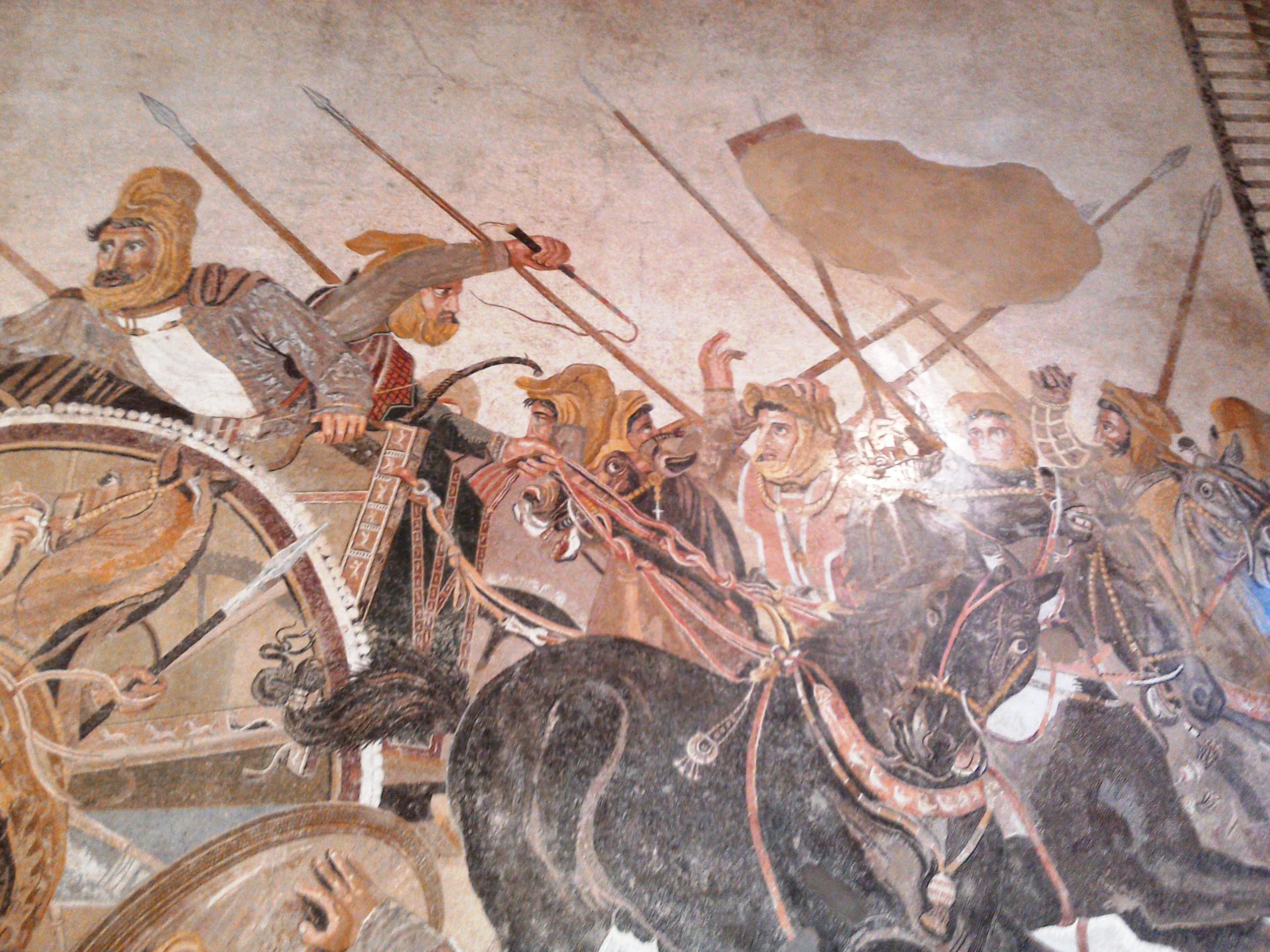
The Alexander mosaic is one of the most commonly used illustrations for Alexander the Great in articles, magazines, or books. 


Standing in front of this large work of art in Naples, Italy, made me realize that only a few pictures do the mosaic justice. Besides, it is pretty remarkable that Alexander has been almost isolated from the rest of the scene. In fact, Darius occupies the central position with his chariot and horses. With the crowd of Persian soldiers, it would have been more logical to call it the Darius mosaic. 

Anyway, much is happening in this battle scene, and attention is given to a significant number of details. I remember spending more than half an hour in front of this masterpiece, pacing back and forth, stepping back for a wider view, and zooming back into the minute details of the tiny tesserae. Their orientation and flow influence the perception of the figures to the point that I can almost “feel” the texture of the horse’s robe. 

I already described the impact the mosaic had on me in my earlier blog, The Alexander mosaic. Nevertheless, there are far more details than I could highlight in one go. I found a recent article by Nicola Murredu analyzing the scene from a different angle. 

The first detail I hadn’t noticed is that of the Persian soldier on the far right who is not carrying a spear like all his comrades but a standard. The picture in the standard is too damaged to be deciphered. However, I never saw standards in the Persian army’s outfit on the battlefield, although they must have existed. 

Halfway between this standard-bearer and Darius, one of the horses has not yet turned around with Darius’ chariot but continues riding to the left. I remember how I was puzzled by the cross attached to the horse’s harness. It reminded me of the Christian rosary, but the cross doesn’t fit time-wise. Murredu presents an explanation that ties the cross to the god Marduk, the ancient Mesopotamian creator of life and generator of life. Marduk was no longer part of the Persian religion, now devoted to Ahura Mazda. However, this image could indicate that some soldiers still adhered to the Babylonian cult as it existed before Cyrus the Great. 

The last detail that raised questions in my mind is about the Greek meander motif that borders Darius’ cloak. Why is a Greek motive appearing on a Persian garment (left of the wheel)? Murredu mentions the Greek swastika motif (another way to describe the design) on a Persian bridle. He rightfully ties the swastika to India, where it originated. Persia might have taken over the swastika from them. However, the Greeks already used it frequently during the Early Archaic period. The swastika may have entered Persia from India or from Greece – who knows? 

Nicola Murredu is tackling other issues like, for instance, the Gorgon on Alexander’s outfit. It may be too far sought, but those who would be interested could read the article for themselves on The Gorgon and the Cross: Rereading the Alexander Mosaic and the House of the Faun at Pompeii.

Thursday, April 14, 2022

How important was Barsine?

The question is actually double: How important was Barsine for Alexander? And how important was Barsine in the geopolitical world of her time? 

Authors from antiquity have not spent much ink on her, and she is only mentioned when she comes to the foreground, which isn’t often.  

Barsine was the daughter of Artabazus II, satrap of Hellespontine Phrygia in northwestern Turkey. Artabazus’ first wife was from Rhodes and was the sister of two capable generals, Mentor and Memnon. 

Artabazus revolted against the newly appointed Persian king, Artaxerxes III Ochus. Artaxerxes had ordered the dismantling of his mercenary army, which the satrap did not accept. Artabazus and his family (including Memnon) went into exile and found refuge at the court of Philip II in PellaBarsine, who was fluent in Greek, must have met the younger Alexander during their stay. We don’t know the nature of their encounters or conversations, but we may safely assume that Alexander inquired about life and customs in Persia. After all, he impressed the Persian envoys at a young age as he questioned them pending his father’s return to the Palace. 

Three years later, Artabazus reconciled with the Persian king, and he returned to Persia, taking Barsine and his family with him. That happened in 343 BC, about one year after Aristotle arrived on the scene to teach Prince Alexander. Over the years, the entire company probably met the philosopher along with other distinguished visitors to the Macedonian court. 

Barsine married her uncle Mentor, a Greek mercenary general in Persian service, while she still was young. Mentor died soon afterward, leaving her with a daughter. In those circumstances, Memnon took her as his wife that same year, 338 BC. He already had several sons from a previous marriage. We can safely assume that Barsine’s opinion in these matters didn’t count. What’s more, she became a second mother to her husband's (teenage?) sons. Just as MentorMemnon led an army of mercenaries for the Great King. Having a lovely wife familiar with the Greek language and culture, no doubt, added to his prestige. 

In 334 BC, when Alexander, now king of Macedonia, faced the Persian army at the Granicus RiverMemnon fought on the enemy’s side. Although the battle was lost, the general’s capabilities were recognized by Darius, and he was appointed as commander of the Persian fleet in the Aegean. This honor may be a questionable trust because, in exchange, Barsine had to stay at King Darius’ court with her father, Artabazus. 

A year later, during the siege of Lesbos Memnon fell ill and died. Barsine was widowed for a second time. 

Around that time, Alexander had reached Issus where he defeated Darius in November 333 BC. When Parmenion rode to Damascus to take hold of the Persian treasury, the baggage train, and the women of the aristocrats, he met Barsine and brought her to Alexander. 

Her relationship with Alexander lasted five or six years. I wonder whether she traveled with Darius’ mother, wife, and children, who had been taken in Issus. Alexander was constantly on the move, conquering the eastern Mediterranean and Egypt and marching to Babylon and Susa, where he finally installed the Persian Royal Family. Barsine stayed at Alexander’s side, and we can only guess which quarters she occupied when the army was on the road. 

During that time, Artabazus remained faithful to Darius until the Great King was murdered by Bessus, who then proclaimed himself the new king of PersiaArtabazus refused to submit to Bessus and left, taking his mercenaries with him. He joined Alexander, who rewarded him with the satrapy of Bactria. Here he was reunited with Barsine. 

She is mentioned again by ancient historians about 327 BC at the end of Alexander’s campaign in Sogdia. However, it is unclear in which order the events unfolded precisely. 

The fact is that Barsine became pregnant and gave birth to Heracles. Alexander never recognized his son, his first-born, although he must have loved him, giving him the name of his ancestors. Is it possible that Alexander resented Barsine for having Heracles without his consent? She and little Heracles stood in his way for his bigger plans, meaning to marry Princess Stateira as – probably – agreed with SisygambisBarsine must have known of those plans, so she had no excuse. 

It is, in any case, a strange coincidence that Alexander almost immediately married Roxane, the daughter of a local chieftain. This was not love at first sight, as most authors claim. It was a purely political move to end the three-year wars through Bactria and Sogdia. 

Artabazus requested to be relieved of his duties in Bactria because of his old age. Alexander accepted his resignation and Artabazus left for Pergamon taking Barsine and the little boy with him. Artabazus seems to have produced an elegant way to retire, and, at the same time, he created the best solution for Barsine since there was no longer a place for her at Alexander’s court. She had to say goodbye to the snow-topped mountains of the Hindu Kush after sharing so many miles with the Macedonian troops and her great love.

Barsine met Alexander again in 324 BC when she attended the mass wedding at Susa. Her daughter from Mentor married Nearchus. Two of her sisters were also given in marriage to Alexander’s companions, but the sources (Plutarch and Arrian) are at odds with each other about the names. 

Hardly a year later, Alexander died in Babylon. I wonder whether Barsine was still in nearby Susa, close enough to say her goodbyes to the man she once loved? If she returned to Pergamon after the wedding, she could never make it to Babylon in time. 

She and Heracles quietly spent the next decade in PergamonIn 310 BC, Cassander as king of Macedonia, summoned Alexander IV, Alexander’s 14-year-old legitimate son with Roxane, to Pella to be poisoned. 

The news traveled fast and eventually reached Pergamon, as poor Heracles was now at the center stage in the drama of the Succession War. Initially, general Polyperchon had been defending the cause of the now 17-year-old Heracles, but in 309 BC, he fell into Cassander’s vicious trap. Cassander made many great promises of money and power in exchange for eliminating Heracles. For one hundred talents, Polyperchon tricked Heracles into accepting an invitation for dinner and poisoned him. Barsine, who had traveled with her son, was murdered shortly afterward, although some sources pretend she was murdered simultaneously. Sadly, Heracles didn’t even receive a proper burial in the cemetery of his ancestors, and neither did Barsine. 

Now about my questions formulated at the beginning of my post. How important was Barsine for Alexander? Well, she was important enough to keep her at his side for about six years. All this time, she managed not to get pregnant. Barsine knew that Alexander dearly wanted and needed an heir during those years of intimacy. She also knew that his plan was to marry a Persian princess. Barsine spoiled this by wanting a child of her own. Alexander had his principles and stuck to them. Nobody, not even sweet and gentle Barsine, was allowed to interfere. His sudden marriage to Roxane may be seen as a statement toward Barsine. Historians say Alexander fell in love with Roxane because of her beauty. In my mind, her beauty may be a nice bonus, but it was not the main reason. 

How important was Barsine in the geopolitical world of her time? Barsine was a beneficial source of information about the Persian court, Persian habits, and culture. After all, she had lived at least three years at the court of King Darius. Speaking Greek was an important asset to avoid misunderstandings. Alexander was an excellent judge of character, and having met Artabazus at Pella, he knew that he was a man of his word and could be trusted. Artabazus was loyal to Alexander. Having his daughter at the king’s side was a warranty that worked both ways. Barsine and her father contributed to Alexander’s larger plan. The birth of Heracles disturbed this goal – something Alexander never could or would accept. Barsine no longer fit his purpose in the new world he was building.

Sunday, April 10, 2022

Fascinating Persepolis

For those who are in California or expect to travel there soon, it seems very worthwhile to visit the new exhibition at the Getty Villa Museum in Malibu. 

Persia: Ancient Iran and the Classical World will run from 6 April until 8 August 2022.

The video Persepolis Reimagined provides an excellent introduction to the exhibition and the rich historical role of Persepolis, the prestigious capital of the Persian Empire. 

This exhibition is centered on the shared art, religion, myth, and culture in the Old World. We often forget that peoples in antiquity were very much connected. Persia, for instance, had a significant influence on Greek culture, especially after Alexander the Great conquered the Achaemenid Empire. Also, through Roman times. These exchanges were not unilateral, as the Greek and Hellenistic dynasties profited from the Persians' knowledge, art, and culture. 

The Getty provides complete information in their article, Inside the Glorious Art – and Fierce Rivalry – of Ancient Persia, Greece, and Rome.

Wednesday, April 6, 2022

True or False?

While writing my blog about Persian dining (see: Dining the Persian way), I found a statement that Alexander used saffron to care for his hair. 

Alexander clearly took great care of his body health, and daily bathing has repeatedly been mentioned by our historians. However, I never came across any reference to the use of saffron for his hair. Too much vanity to match his character, maybe? 

The article mentioning saffron was published by the Greek Reporter and reads as follows: Moreover, Alexander himself carefully kept stocks of saffron — but not for culinary use, rather for cosmetic use: in fact, the young Macedonian king used the pistils of the flower Crocus sativus as a conditioner and as a care for his hair, characterized by its strikingly golden color and a splendid tone. 

The same article further mentions that the army carried a provision of saffron as the primary means to exchange goods among the Macedonians. 

True or false, these bits of information remain hard to check and believe, although not impossible. 

On the other hand, I gladly believe that Alexander’s army introduced saffron to the West. The precious spice spread further through the later Hellenistic Indo-Greek kingdom, the Yavana Kingdom. Over the last two centuries BC, that realm generally covered part of modern Afghanistan, Pakistan, and the northwest of India. 

Saffron became deeply rooted in Indian cooking, and growing the plant became so popular that the country ranks fourth among the largest producers worldwide. Interestingly, one of the most refined types of saffron comes from the Kashmir area. This type is recognizable by its dark color and delicate aroma.

Saturday, April 2, 2022

Dining the Persian way

What disturbs me most is not your lack of respect for my judgment, it’s your contempt for a world far older than ours!Alexander pronounced these words in Oliver Stone’s movie, casually placed in the king’s upcoming wedding with Roxane. It is just a detail, but one that resonates much further than we may see at first glance. 

For the Greeks and the Macedonians, the Persians were Barbarians. They certainly could not imagine their refined culture, splendid cities and monuments, and accoutrements. As a great admirer of Cyrus, the very founder of the Achaemenid dynasty, Alexander clearly understood that Persia was much older than Greece and consequently had built up a richer civilization. 

Oliver Stone rightfully illustrated the grandeur and richness of the Persian Empire in Babylon when he orchestrated Alexander’s triumphal entrance march! This was the first major city the Macedonians saw with their own eyes, leaving them in total awe. The pomp and circumstance of Persepolis and Susa added to their astonishment and wonder. 

Although Alexander and his companions were familiar with the palaces of Aegae and Pella, these edifices could in no way compete with anything in Persia. Athens was a gem of its own right, with the shining Parthenon finished a good hundred years before. In contrast, Persian history, refinement, protocol, and wealth testified to their cultural superiority. It must have been a real shock to most of the army. Even Alexander and his close companions were not prepared to deal with this immeasurable and boundless wealth. 

Our thoughts automatically drift to the gold and the luxurious furnishing and ornamentation of the palaces. Still, we hardly would think of food, the oriental way to serve it and savor it. In the Greek Symposia, an all-male gathering, food was secondary to the meeting proper. The banquet started with a meal, and the wine continued to be served till the end of the occasion. More importantly, the host would regulate the wine intake since it was cut with the amount of water he determined for the entire duration. 

On the other hand, the Persians drank their wine straight, and sumptuous occasions called for much drinking. The long duration and the overall glamour contributed to creating extraordinarily refined and elegant events. The wide choice of savory, sweet foods like dates, for example, was a luxury unknown to many Greeks. 

Dining was an occasion to display Persian magnificence and sumptuousness, not only in their setting but also in the dishes themselves. The diners’ behavior, however, was far from elegant. Since the flow of the wine was not overseen by a host or similar master of ceremony, the Persians often became violent and not seldom harassed the king’s women who attended the meal. In this light, it is not surprising that the Greeks saw them as Barbarians! 

In both cultures, fish and meat were widely present on the menu. The main difference was that the Greeks generally roasted their meat and fish, whereas the Persians preferred simmered, slowly cooked meals. They enriched their marinades with exotic fruits and spices imported from as far as India, including saffron. Bread, rice, and eggplant, delicate sauces further enhanced the dishes. After the main dish, there was plenty of room for sweets and fruits as part of the following dishes offered. A marriage of foods occurred during the lifetime of Alexander and lasted for centuries entering today’s flavors and gastronomic influences in the world, particularly in the Mediterranean. 

It is said that in its heyday, the Persian Empire was the leader in refined gastronomy. Arrian casually mentioned the regiments of cooks attached to the Persian king’s services when Parmenion took Damascus. The Persian baggage train with noblemen's wives was camping there pending the outcome of the Battle of Issus (not expecting their defeat). 

Even today, it is hard to imagine the refined cooking and presentation of the meals marking special occasions such as the mass wedding in Susa. Cooks must have been busy day and night preparing an array of meats, fish, vegetables, and fruits for thousands of guests (9.000 according to our sources!). The logistics to cart the meat, fish, fruits, and vegetables to the palace grounds are achievements on their own. 

At that time, Alexander’s army was no longer all Macedonian but integrated with peoples from Persia, Central Asia, and India. The food habits in the camp had changed accordingly. In a way, Alexander conquered land and people with their specific cultures, including a wide variety of their diets. In his wake and thanks to the later Roman Empire, the Spiced Road was born with tentacles far beyond the lands touched by Alexander. 

Modern visitors to Greece, Turkey, and the Middle East experience these exotic tastes and other flavors when served a typical local meal. We accept them as a matter of course, but the issue was entirely different for those living 2,500 years ago. Most people never left their hometown unless to war with the neighboring settlement. Persia, which was much larger than today’s Iran, was at the other end of the world as far as they were concerned. To them, the world appeared from an entirely different perspective. 

The Greek-Italian chef Giorgio Pintzas Monzani wrote several pertinent articles on this subject in the Greek Reporter, which inspired me to write the present post.

[Top and second picture from Asia Food]

Tuesday, March 29, 2022

Bringing the Doryphoros home

Thanks to the many copies the Romans made of original Greek sculptures, the initial artist of most works can be traced back. It is the case of the unique marble Doryphoros by Polycleitus, created in bronze around 440 BC. The bronze original was a little larger than life-size. 

[Picture from the Archaeology News Network]

The best-preserved copy of a Doryphoros or Spear Bearer was retrieved from the volcanic ashes of Vesuvius in the buried city of Stabiae on the Gulf of Naples. The Roman copy was created between 27 BC and 68 AD, shortly before the eruption of 79 AD. It was looted in the 1970s and ended up in Minneapolis' Institute of Arts

Investigations led to the reconstruction of the trail, followed by this important artifact after being stolen from Castellammare. This occurred between the end of 1975 and the beginning of 1976. 

The looters sold the statue to an antique dealer in Basel, Switzerland. From there, it made its way to the USA and hence to Germany. It was exhibited at the Glyptothek of the Antikenmuseum in Munich for several years, labeled as "Doryphoros aus Stabia." When identified by the Italia investigators in 1984, it was seized by the Naples Public Prosecutor. However, a year later, it was released and disappeared again to be sold in 1985 to the MIA in Minneapolis.  

It makes one wonder how it is still possible to drag around illegal antiquities without being detected, especially in the present case of a full-sized statue! 

The mayor of Stabia is asking to bring the Doryphoros back home to the Archaeological Museum Libero D'Orsi. The Italian authorities introduced a new official request to Minneapolis to return the Doryphoros to Italy. A close-up study followed to establish that this was indeed Stabia's stolen statue, which initially had a damaged arm, a missing finger, and a missing right foot. 

The Doryphoros stands out because of the perfection of its proportions, as Polycleitus is the first artist to establish the absolutely balanced and harmonious dimensions of the human body in his sculptures. He described its mathematical proportions in a lost treatise, the Canon of Polycleitus. His attitude was called contrapposto, in which the body's weight rested on one leg, and the other leg relaxed. Apparently, the sculptor has created 1500 works, none of which have survived. 

Polycleitus' search for perfection fits entirely with the typical mentality of the Greeks in his time, in which artists, intellectuals, and statesmen strived for excellence. This idea lived on long afterward since it was still practiced by Alexander and his contemporaries

With Phidias and PraxitelesPolycleitus is considered one of the most important sculptors of the Classical Greek era. So significant was his influence that later artists like Skopas and Lysippos (Alexander's personal sculptor) worked using the same references.

[Bottom picture from Positano News]

Friday, March 25, 2022

Link to Philip’s presence in Bulgaria

Little is known about Philip’s conquest of the land of the Getae in his early campaigns to stabilize Macedonia after the death of his elder brother, King Perdiccas III, in 359 BC. 


Perdiccas was killed in a battle against the invading Illyrians, after which Macedonia faced several threats to the kingdom’s security. There was also the matter of succession to the throne since the dead king’s son, Amyntas, was still a youngster. The Athenians tried to interfere, pushing forward a certain Argaeus and the Thracians, Pausanias, who already marched towards the capital city of Pella. Given all these threats, the Macedonian Assembly unexpectedly proclaimed Philip as King, and the people swore their oath of allegiance to him. 

It was a lengthy and challenging assignment for the young Philip. The most urgent threat came from the Illyrians, who had just defeated his brother. He managed some treaties which may have included his marriage to Audata, King Bardylis granddaughter. 

He then turned towards the Paeonians, whom he corrupted with gifts and generous promises to reach a peace agreement. Athens with Argaeus was another serious problem, and Philip tricked them into believing he was giving up any claim on Amphipolis by withdrawing his Macedonian soldiers. The Athenians took the bait and eventually signed another peace treaty. 

Macedonia suffered from relentless attacks on all sides, but within a year, Philip managed to end the four major threats that had led to his accession to the throne. The lightning speed of his actions paid off. Although peace was never long-lived, Philip cleverly manipulated his opponents using diplomacy, deceit, bribery, and political marriages. 

In 342/341 BC (see: Macedonia forged by Philip II – part 11), Philip successfully dislodged the Thracians in the east, occupying the cities along the Hellespont - a very sensitive area as he needed to control this inland route. Later that year, he turned northwards against the people who lived between Thracia and the Danube Valley. Their King Cothelas was quick to surrender, giving his daughter, Meda, in marriage to Philip to become his sixth wife (see: The Many Wives of Philip II). 

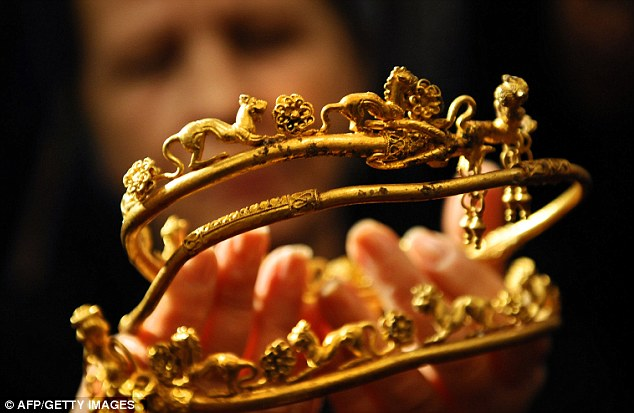
Recent excavations have located the tomb of Cothelas in northeastern Bulgaria, near the modern village of Sveshtari, roughly 400 km from the capital, Sofia. Although references to the Thracian king remain vague, the largest tomb in that burial complex may very well be his. Archaeologists have unearthed precious gold gifts, including 44 applications of female figures, 100 golden buttons, and a golden ring. The pièce de résistance is a tiara with animal motifs and a horse headpiece. Altogether, the site counts about 150 tombs all belonging to the Thracian tribe, the Getae. 

Let’s hope that further excavations will reveal more about these Thracians, of which much remains shrouded in mystery.

[Pictures from Daily Mail]

Monday, March 21, 2022

An example of the heavy traffic in the Mediterranean

Recent underwater explorations of the Bay of Fethiye, ancient Telmessus, led to discovering a heap of amphorae of the Rhodian type. 

[Picture from Daily Sabag]

The shipwreck was found at a depth of 28 meters and only 20 meters from the shore. The remains of amphorae indicated the place of the wreck that occurred in the 3rd century AD. This dating was based on the shape of the amphorae whose spur-handles are typical for the last type produced in Rhodes. It has been labeled as the latest example from the Roman era. 

At that time, Rhodes was a major harbor and entertained intense trade relations with other cities around the Mediterranean and Asia Minor in particular. 

It has been estimated that this merchant ship, of which nothing remains, was between 20 and 30 meters long, and it probably sank during a storm. 

It is known that storms are the primary cause for ships to run aground. So far, approximately 40 shipwrecks from antiquity have been identified in the Turkish waters.

Wednesday, March 16, 2022

More antiquities in blasting color

Since the first-ever exhibition of ancient statues reworked to their ancient polychromy in 2003 (see: Ancient Greece in full Technicolor), the concept of looking at colored versions has become more familiar. Many 3D and other reconstructions of temples and monuments have been published in its wake. 


It is almost unbelievable that the idea of looking at white marble or stone temples has been anchored in our minds for so long. That is not entirely surprising as some early archaeologists used to scrub their finds clean to remove the dirt, including any possible trace of color. Earlier archaeologists of the 1800s, like Sir Charles Fellows, have repeatedly exposed tombs and smaller temples with explicit paint remains, either in their decoration or in the inscriptions' letters. 

I remember strolling through the site of Arykanda, for instance (see: Visiting the site), and staring at the stately tombs in its necropolis, which Charles Fellows described with many traces of paint. I stared and stared but saw nothing except in my imagination. 

The statues' bright colors are shocking at first because they are so strong (see: Greek statues in blasting colors). Besides, some parts may have been gilded and have in-laid eyes as first appearing in bronze statues. Modern technologies using ultraviolet and infrared light reveal any faint remains of color. 


In my earlier blogs mentioned above, I mainly concentrated on marble statues and missed to stress the exceptional beauty of reconstructed bronze statues. Striking examples are the two Riace bronzes hauled from the sea in 1972. After they were cleaned, many details became visible. Their mouths appeared to be made from copper, as were their eyelashes and nipples. Warrior A showed silver teeth. And, of course, both statues had kept their eyes inlaid with stone. 

They are very striking and charming in their bright colors, but the detail of the head I found by chance is even more revealing! Although this was common good in the temples and houses in antiquity, these pictures look spectacular because we only have isolated examples.

[Pictures from Atlas Obscura]