Alexandria's founded by Alexander

Alexandria's founded by Alexander the Great (by year BC): 334 Alexandria in Troia (Turkey) - 333 Alexandria at Issus/Alexandrette (Iskenderun, Turkey) - 332 Alexandria of Caria/by the Latmos (Alinda, Turkey) - 331 Alexandria Mygdoniae - 331 Alexandria (Egypt) - 330 Alexandria Ariana (Herat, Afghanistan) - 330 Alexandria of the Prophthasia/in Dragiana/Phrada (Farah, Afghanistan) - 330 Alexandria in Arachosia (Kandahar, Afghanistan) - 330 Alexandria in the Caucasus (Begram, Afghanistan) - 329 Alexandria of the Paropanisades (Ghazni, Afghanistan) - 329 Alexandria Eschate or Ultima (Khodjend, Tajikistan) - 329 Alexandria on the Oxus (Termez, Afghanistan) - 328 Alexandria in Margiana (Merv, Turkmenistan) - 326 Alexandria Nicaea (on the Hydaspes, India) - 326 Alexandria Bucephala (on the Hydaspes, India) - 325 Alexandria Sogdia - 325 Alexandria Oreitide - 325 Alexandria in Opiene / Alexandria on the Indus (confluence of Indus & Acesines, India) - 325 Alexandria Rambacia (Bela, Pakistan) - 325 Alexandria Xylinepolis (Patala, India) - 325 Alexandria in Carminia (Gulashkird, Iran) - 324 Alexandria-on-the-Tigris/Antiochia-in-Susiana/Charax (Spasinou Charax on the Tigris, Iraq) - ?Alexandria of Carmahle? (Kahnu)

Monday, July 4, 2022

Let's play chess and relive the Battle of Issus

If I were a rich man, ... surely I would buy this chess game. It is a pure pleasure for the eye and handling each and every piece of the game would bring me closer to Alexander at his Battle of Issus!

*

*          *


The Battle of Issus Chess Set

Photo by M.S. Rau

It's a unique piece and is wonderful, it would be a dream to have it... even less valuable workmanship and material to make it more affordable to many but is wonderful!

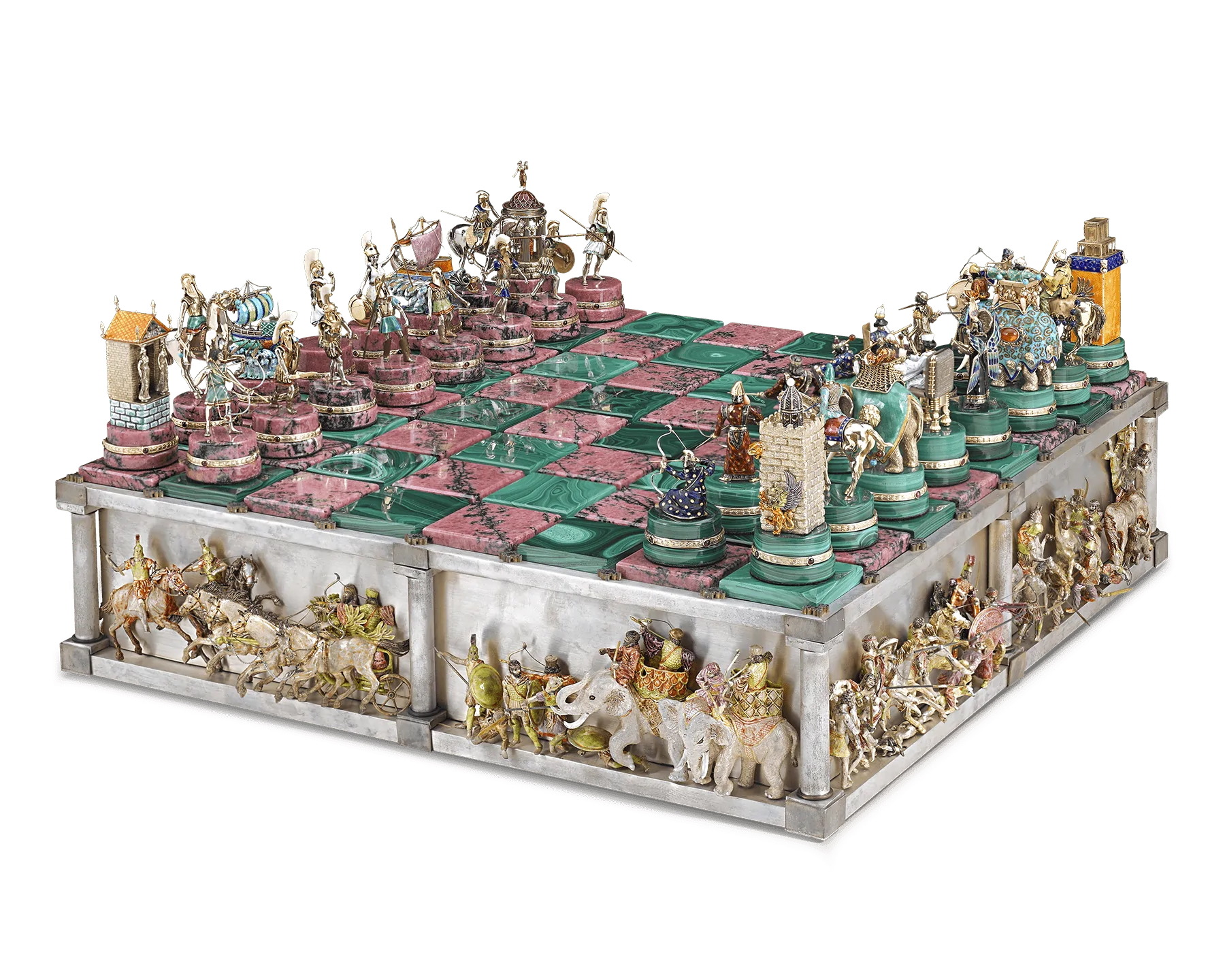
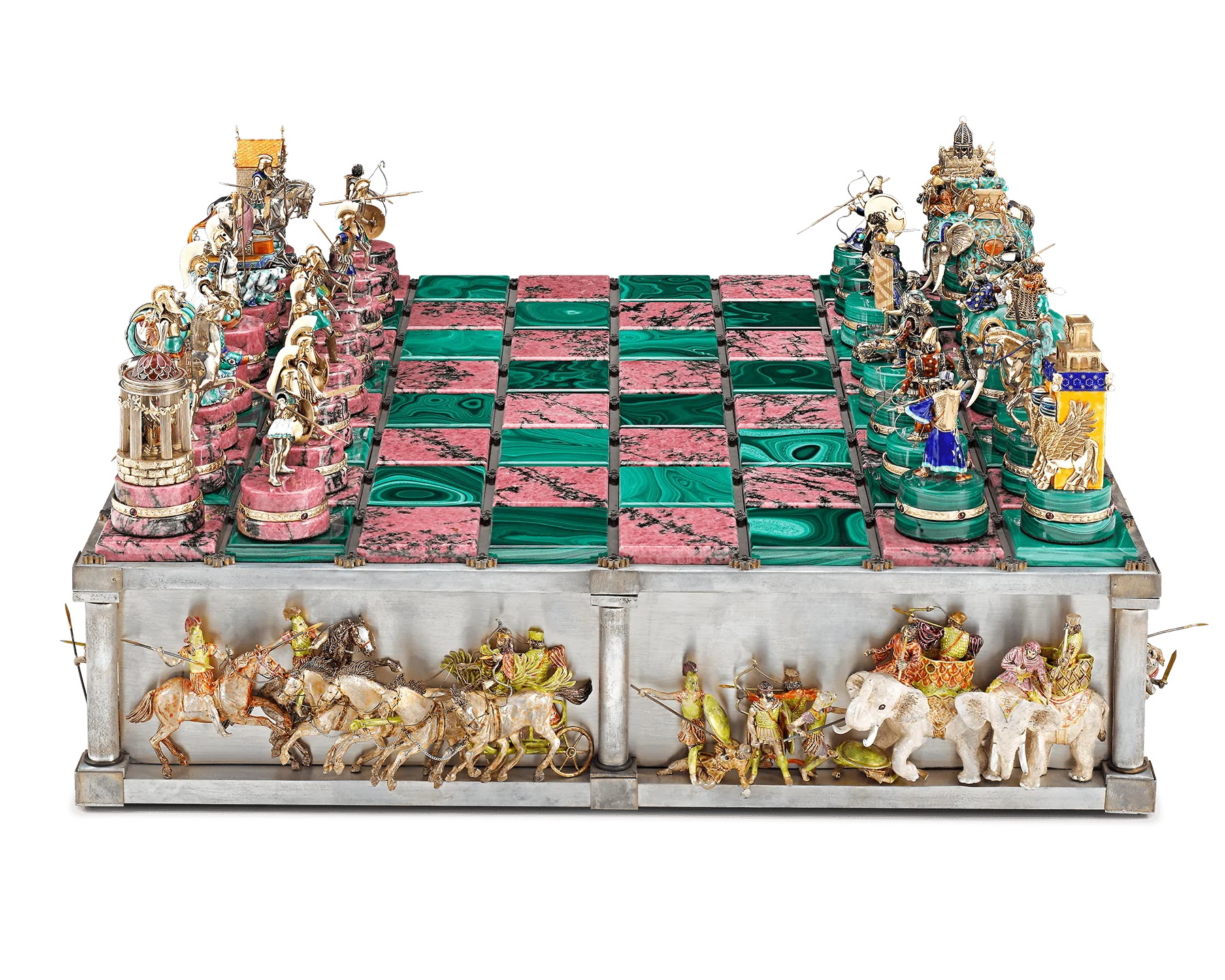
Lavishly decorated and large in size, this extraordinary chess set is the only one of its kind and is perhaps the best ever made. Crafted by the hand of a master jeweler, the exquisite quality of its manufacture is showcased in each and every detail. Every 14k gold game piece is different, encrusted with semiprecious stones and brightly hued enamel, and each is endowed with mechanical movement. This ancient game of war truly comes to life on the breathtaking board, which is itself a spectacular sight to behold.

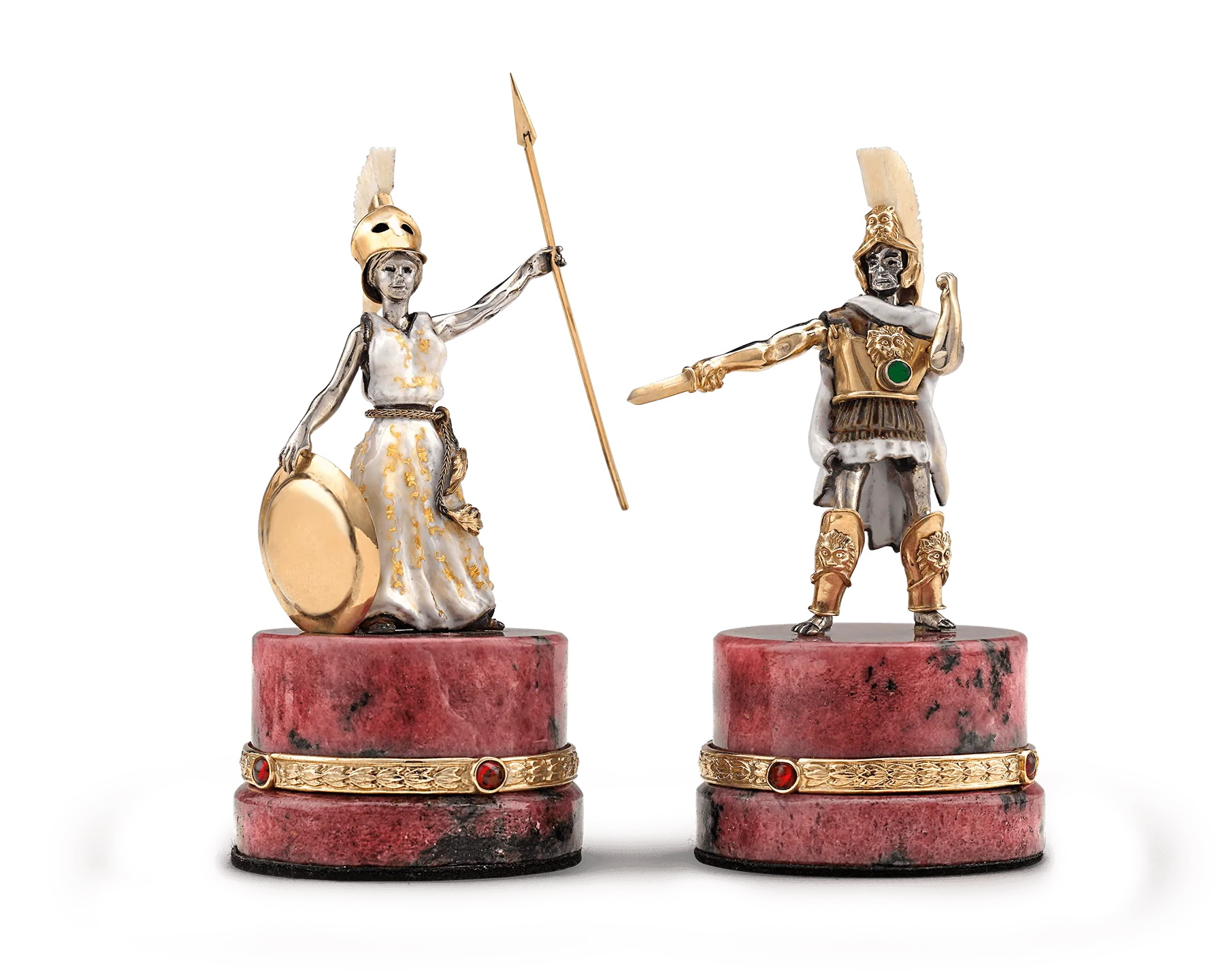
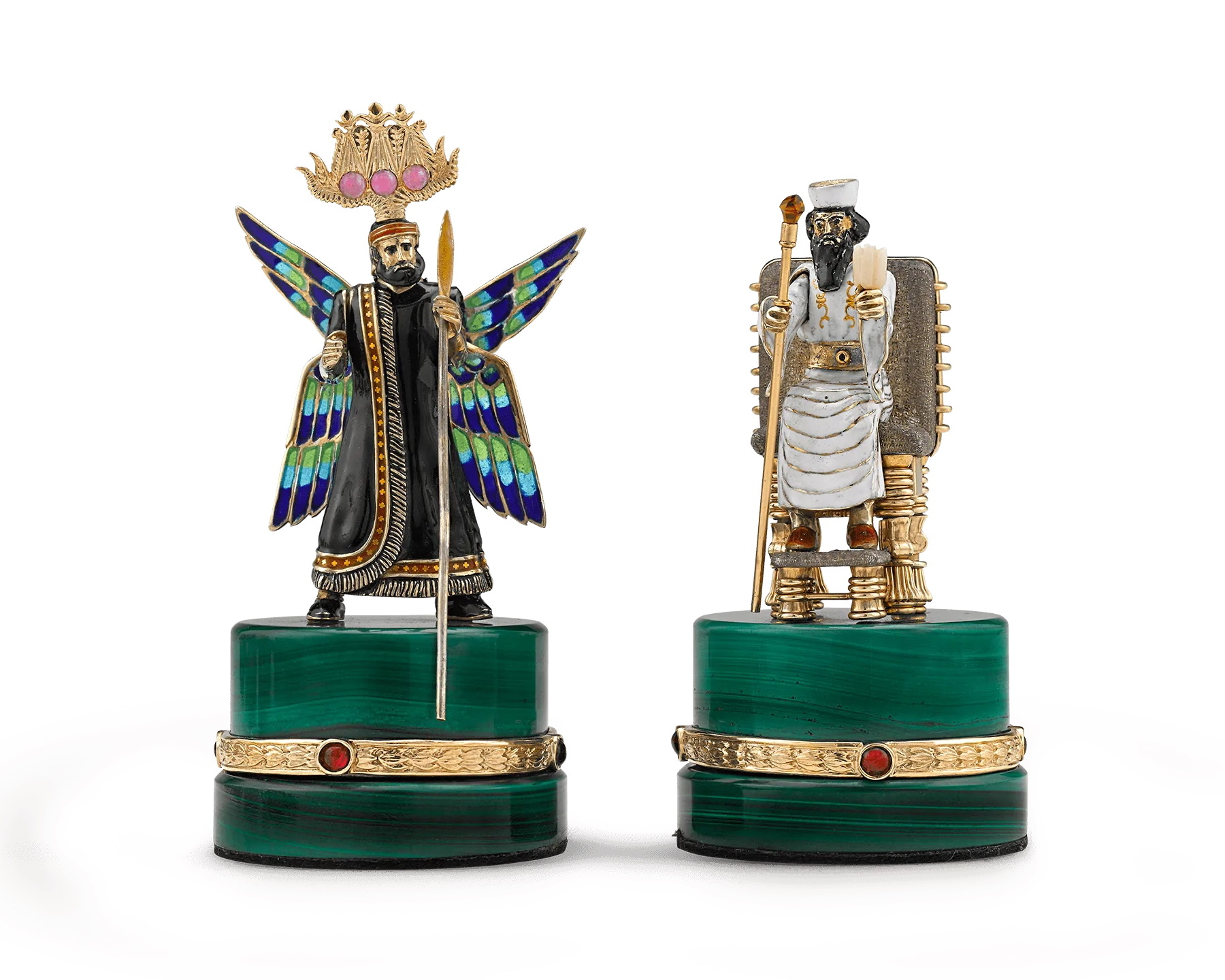
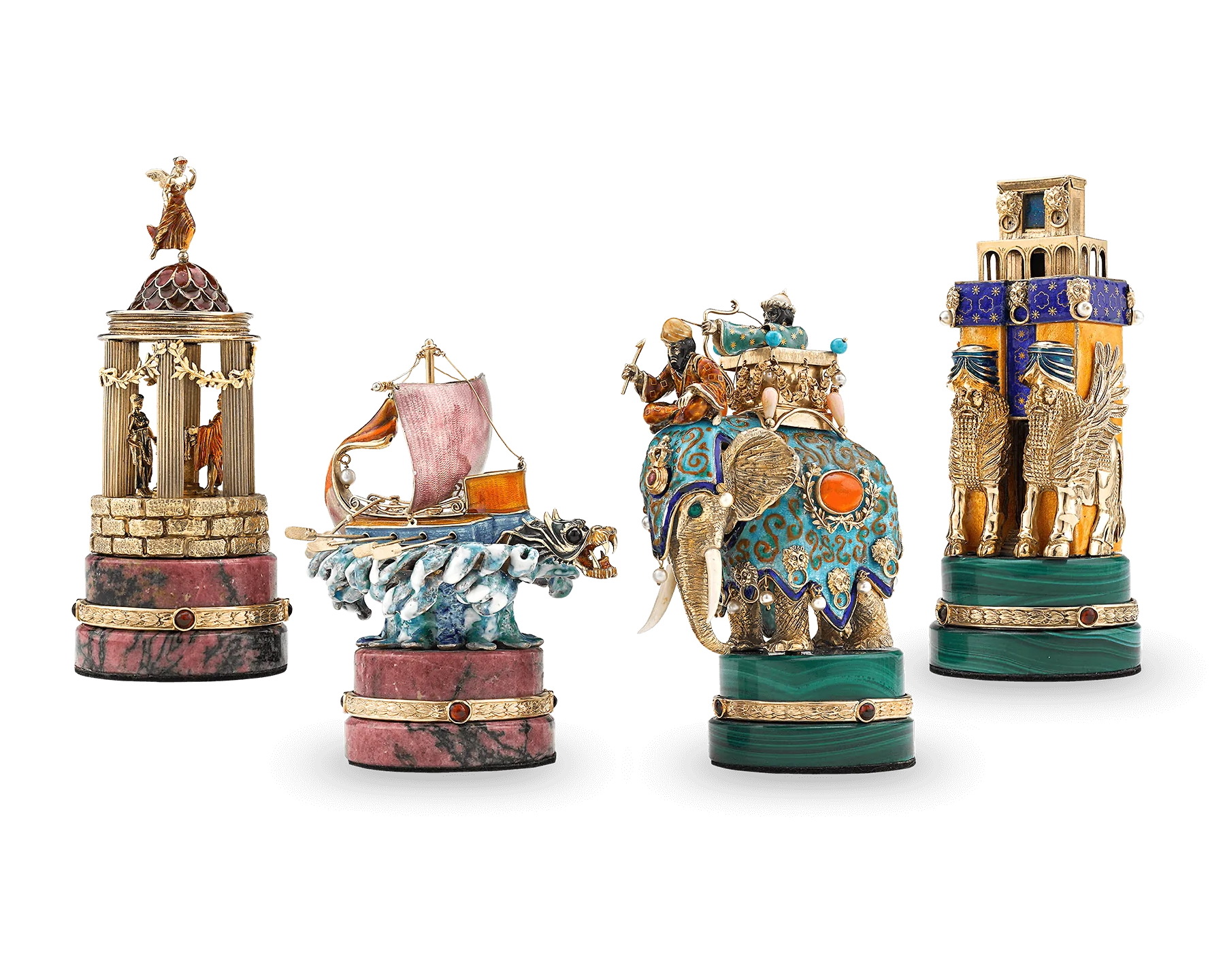
The ancient Battle of Issus is the subject of the set and an apt reference to the military-like strategy of the game. What was one of the most important battles of the ancient world is beautifully retold here through pieces representing gods and goddesses, ancient structures, and creatures of both Greek and Persian origin. Alexander the Great and King Darius III take their places on the board as kings. At Alexander's side is Queen Athena, the Greek goddess of war and wisdom, while the winged Persian god of war stands as Darius' queen piece. Warships sailing over waves and massive elephants covered in elaborate trappings take the place of bishops, while the castles have been transformed into the columned temples of ancient Greece and the impressive Persepolis. Horsemen and footmen face off as well, each with their own sword, javelin or bow.

Photo by M.S. Rau
Photo by M.S. Rau
Photo by M.S. Rau

Not a single detail has been overlooked, from the laces of the soldiers' boots to the tiny feathered arrows in their quivers. Yet, even the spectacular aesthetic design of the pieces is surpassed by their mechanical complexity. Each figure stands on a solid pink rhodonite or green malachite base that, when twisted, triggers a different movement in each individual piece. Through this simple movement, the ships row their oars, Alexander lowers his sword, archers tense their bows and horses shake their manes — the extraordinary pieces, so rich in appearance, truly come alive.

Photo by M.S. Rau

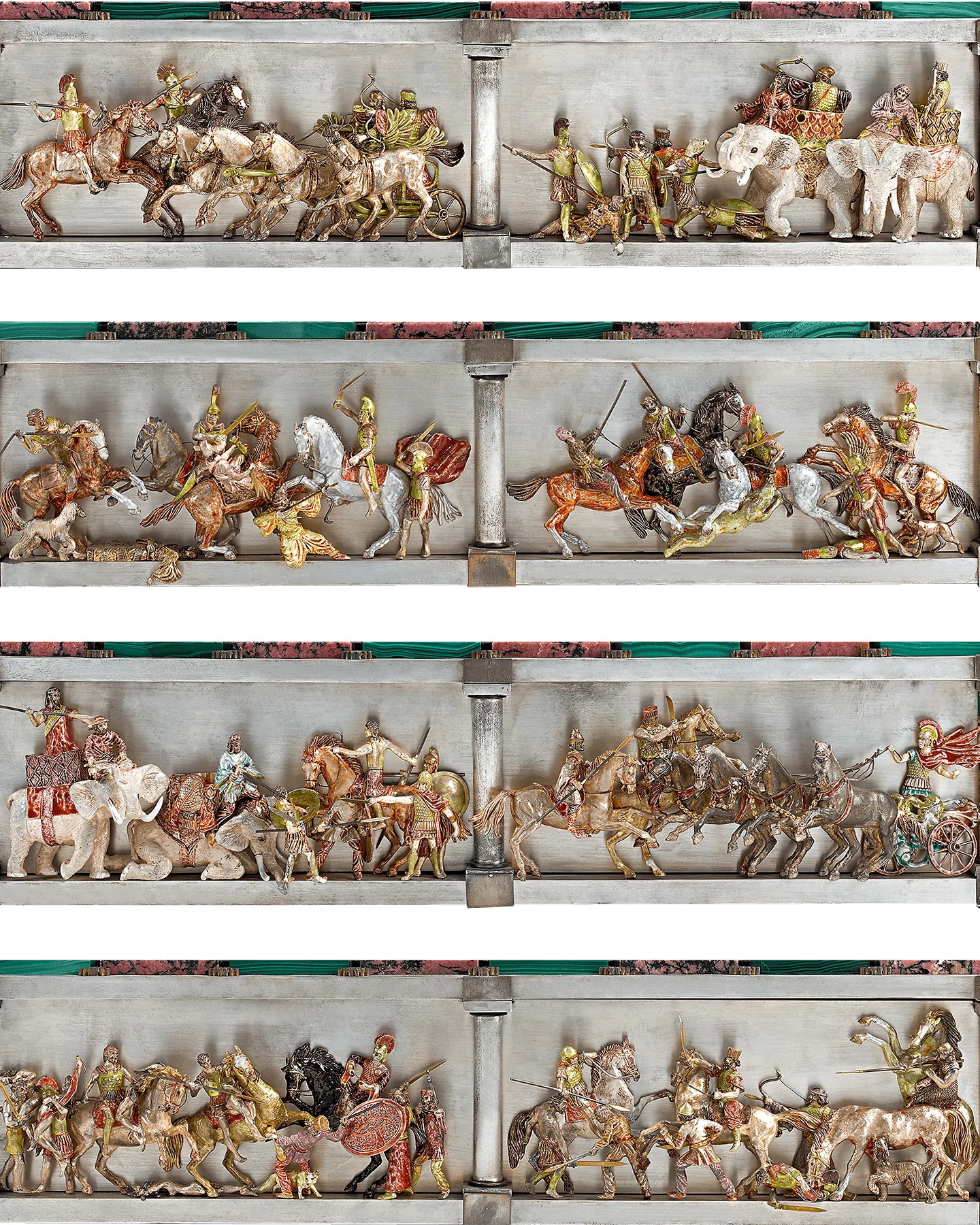
The chess table is as remarkable as the chess pieces. The squares of the board are crafted of pink rhodonite and green malachite to match the bases of each piece and can be removed for storage when not in use. The sides of the board are formed from pure silver, sculpted in high relief to depict battle scenes that mimic the motifs in the game pieces. Archers, horsemen, chariots and elephants all engage in endless combat that heightens the drama of the game board.

Photo by M.S. Rau

A product of over 14,000 man-hours over the course of a decade, this sensational chess set is perhaps the most complex and extravagant ever created. In terms of both mechanics and aesthetics, it is one-of-a-kind in every aspect and a true masterpiece of design.

Photo by M.S. Rau

BUY WITH CONFIDENCE: At M.S. Rau, we are so confident that our antiques are some of the finest in the world, that we back each piece we sell with a 125% guarantee.               $1,985,000 – Item No. 31-1086

Monday, June 27, 2022

Lysimachos in the wake of Alexander – Part II

 [continued from Lysimachos in the wake of Alexander - Part I]

Skipping the many details and intertwined relationships, let us pick up the story when Seleucos added his forces to those of Lysimachos and his allies to fight the elderly Antigonus Monophthalmus and his son Demetrios Poliorcetes. The battle took place in 301 BC at Ipsus and ended with Antigonus’ defeat and death. The victors subsequently divided his territory among them. Lysimachos acquired a significant share with Lydia, Ionia, and Phrygia, including the entire north coast of Asia Minor. Seleucos received Syria, and Cassander was now secure in Macedonia and Greece. 

Until then, Antigonus Monophthalmus had been the most successful among the generals in recreating Alexander’s empire. His son Demetrios attempted to follow in his father’s footsteps, but he lacked a broader view. 

Around that time, Nicaea died, and Lysimachos honored her by naming a city in Asia Minor after her, modern Iznik in Turkey. 

As Seleucos was growing ever more powerful, Lysimachos thought it wise to seek the support of Ptolemy. Around 300 BC, he elected to marry Arsinoe, the daughter of Ptolemy, and his mistress Berenice. Amastris, as said above, stepped back and divorced herself from Lysimachos, moving back to Herakleia Pontus. 

Although this marriage of Lysimachos was not a happy one, Arsinoe stayed with her husband till his death. She bore him three sons: Ptolemy I Epigonos, Lysimachos, and Philip. Her jealousy, however, incited her to convince her husband to kill his oldest son and heir, Agathocles (from his marriage to Nicaea), based on treason. The murder happened in 284 BC despite the young man successfully leading his father’s army in combat. Although he was only in his early thirties, his men loved him much. 

Meanwhile, Cassander died in 297 BC. His sons were more interested in fighting each other for power than ruling the country. Macedonia eventually fell into the hands of Demetrios. So, in 287 BC, Lysimachos agreed to fight alongside Pyrrhus to drive Demetrios out of Macedonia. They successfully ruled the country jointly until Lysimachos broke up with Pyrrhus and seized Macedonia for himself. 

Lysimachos’ greed and thirst for power equaled that of the other generals, now kings in their realms. The fighting was not over yet. 

Seleucos, in 282 BC, broke his alliance with Lysimachos as he attempted to take his territory in Asia Minor. The final clash happened in Lydia at Corupedium in 281 BC. It ended with the death of Lysimachos. By then, the King of Thracia must have been in his late 70s. He had lived a life of almost continuous and repeated battles, inspired by the greatest conqueror of all times, Alexander the Great. 

Like the other new self-proclaimed kings, Lysimachos had minted his own coins. However, he did not follow them by stamping his personal image on these coins but kept using the effigy of Alexander instead. Could that be seen as a late posthumous homage and tribute to his boyhood friend? 

Lysimachos is also being honored as a friend and benefactor of Samothrace. He received the title of Lysimachos Euergetes as inscribed on the altar erected in his honor and used during annual festivals. A stele found on the island reads a dedication of King Lysimachos from between 288 and 281 BC. Based on the surviving first fifteen lines, Lysimachos was honored for restoring sacred lands on the mainland initially granted to Samothrace by either Philip II or Alexander the Great or by Philip Arrhidaeus III and Alexander IV. There were boundary stones for said sacred land near Alexandroupolis in Greece. 

Money was never an issue throughout all those years of bickering, conniving, and fighting. Lysimachos, like all the other generals, had cashed his share of Alexander’s fortune. In his case, it was a mere 9,000 talents in silver and gold, roughly worth several billion in today’s value. The money was safely kept on the Acropolis of Pergamon. However, when Attalus III gave the city to Rome in 133 BC, the entire treasure (not limited to Lysimachos’ share) fell into Roman hands. This fortune contributed largely to the rise of the Roman Empire – but that is another story.

Wednesday, June 22, 2022

Alexander the Great: The making of a Myth

For those living in the U.K. or transiting through London this winter, it may be an excellent opportunity to stop at this exhibition about Alexander the Great organized by The British Library. 

[Picture: © Museum of Classical Archaeology, Cambridge © Hamish Steele, © Richard Stoneman]

The British Library was once part of the British Museum but moved in 1973 to a separate building situated between the railway stations of St. Pancras and Euston in London. 

It is one of the largest libraries in the world and contains 14 million books among between 170 and 200 million other items. The Library also organizes exhibitions. This time, Alexander the Great is put in the limelight as it centers on the myths that surround him since before his death and are still very much alive after more than 2000 years. 

This unique event displays old astrological clay tablets, ancient papyri, medieval manuscripts, movies, and video games. European, Middle Eastern and Asian cultures competed to make him the kind of hero they wanted him to be. This is true for the past but also in today’s world. 

Trying to separate myth from reality is a near-impossible task. As I so often stated, there is not one truth or one Alexander as we all create our own vision of this great man, who was king, emperor, and Pharaoh, but also a general, philosopher, and visionary. 

Who Alexander was as a man is something each of us has to define for ourselves. 

This unique exhibition will run from 21 October 2022 to 19 February 2023.


For the occasion, a special catalog will be released on 21 October 2022 by the British Library Publishing. The work is written by Richard Stoneman and will be published under the same title as the exhibition, Alexander the Great: the making of a myth (ISBN: 978-0712354769).

Thursday, June 16, 2022

How the Greeks were perceived in Asia

We are so used to looking through the eyes of the West that only a few of us are aware that among the Persians and Indians, the Greeks go under different names. 

Ever since the reign of Darius I, the Greeks were called Yauna or Yona, as documented in the inscription of Bisutun from c.520 BC. In the 5th century BC, Herodotus mentions the Yaunas in his Histories, linking them mainly to the Ionians, who lived along the coastline of Asia Minor. The historian also specifies that under Persian rule, the Ionian Greeks constituted one tax district that included the Pamphylians, Lycians, Magnesians, Aeolians, and Carians. 

Yauna may simply be a transliteration of the Greek for ‘Ionians,’ and the name surprisingly appears in Sanskrit literature and Sri Lanka’s Mahavamsa (historical chronicle) – a very long way from home! 

The name also has a corrupted form with the Assyrians, who called the Greeks Iawanu, and the Babylonians used Yaman or Yamanaya. Nowadays, Turkish, Persian, and Arabic languages use Yunan, which clearly derives from the ancient Persian Yauna. 

The Persians, as we know, did not stop their conquest of Greece at the coast of modern Turkey. They soon mounted an expedition to conquer Macedonia with its rich gold and silver mines. 

An inscription to that effect can be seen on Darius’ tomb at Naqsh-e Rustam, where the Macedonians are called the “Greeks with sun hats” based on their typical headwear. 

The same Macedonians threatened Persia in 340 BC when Philip II besieged Perinthus, a vital point on the Hellespont. In the end, Alexander the Great crossed into Asia and conquered Persia. How much of this campaign has been recorded in their literature remains vague. It is impossible that a well-organized civilization like Persia’s has not kept written records. Could we assume they are either still hidden or have not yet been deciphered? 

Alexander and his Macedonians marched on to Central Asia and even India. Ancient sources use the word Yonaka when referring to the later Graeco-Bactrians and Indo-Greeks, who became kingdoms in their own right. They were the result of those veterans left in the regions by Alexander, who built a civilization based on Greek principles. They rose to power in the late 4th century BC and ruled until the first decade of the 1st century AD. 

Yavana is the word that lived on in the medieval literature of India. It was generally used to define foreigners, but until approximately 1000 AD, they meant the Greeks. 

As always, there is so much more in a word than we assume at first sight. In this case, it ends up being a story on its own.

Friday, June 10, 2022

Lysimachos in the wake of Alexander – Part I

Lysimachos was in Babylon at the time of Alexander’s death in 323 BC. Almost immediately, anarchy erupted as the king had no successor. Every single one of his generals felt entitled to succeed Alexander pending the coming of age of his yet unborn son. 

The War of the Diadochi had begun and would last for the next forty years or so. The generals took sides, changed sides, and made peace treaties but coveted each other’s possessions soon after. Their lust for power led them to conquer ever more land. They eliminated each other systematically until around 280 BC; four contenders remained: Ptolemy in Egypt, Seleucos in Asia, Antipater / Cassander in Macedonia/Greece, and Lysimachos in Thrace. 

Lysimachos’ origin is obscure, and the best guess is that he was born around 361 BC to Thessalian parents living in Pella. He was educated at the court of Philip and was probably one of his Bodyguards. He was only a few years older than Alexander, and we can safely assume that he joined the young prince in Mieza to attend Aristotle’s teaching with the other selected young men. 

Historians hardly mention Lysimachos in Alexander’s early campaigns, although he was present throughout the king’s conquests of Persia as one of his trusted Bodyguards. This lack of information does not imply that Lysimachos was not a valued element in Alexander’s organization. Many positions beyond that of a general were of the utmost importance. Take, for instance, the logistics of the entire enterprise, or the scouting parties to locate otherwise hidden enemies or find the appropriate location for the following camping site, or escorting Queen Sisygambis and her retinue till their arrival at Susa, and many other tasks. 

Lysimachos joined the ranks of the Companion Cavalry, maybe after several of Alexander’s masterly reshuffling of the army according to his needs. 

Except for him being mauled by a lion in Syria, he was not documented until 328 BC, when Alexander crossed the Hydaspes River. There is no further information. 

Lysimachos participated in the siege of Sangala (see: The siege of Sangala). Alexander lost less than one hundred men in this fierce fight, but an excessive number of 1200 soldiers were wounded, including Lysimachos. 

He was evidently present at the Susa Wedding in 324 BC, but we don’t know the name of his bride. Since she is not mentioned when he moves to Thracia, we may conclude that he left her behind after Alexander’s death, at which time he became ruler of Thracia. 

The position of Thracia was strategically crucial as the land extended to the Black Sea and the Hellespont, both major links with Asia. Upon arrival, Lysimachos faced the rebellious Thracian tribes fighting each other. Their most powerful dynasty was the Seuthes. However, Lysimachos was quickly able to establish his authority. 

As the War of Alexander’s Successors raged on with the other generals fighting among themselves, Lysimachos managed to stay away from their intrigues. 

In 321 BC, to stabilize his position further, he decided to marry Nicaea, Antipater’s daughter, after Perdiccas had refused her hand. This alliance secured his position vis-à-vis both Antipater and Cassander. The couple would have three children: one son, Agathocles, and two daughters. 

In 315 BC, a revolt broke out among the cities on the Black Sea. Antigonus Monophthalmus, who reigned over most of Asia Minor, saw an opportunity to annex Thrace to his own territory and stirred up the local tribes against their king. Once again, Lysimachos managed to suppress the revolt and consolidate his power. Peace was reached in 311 BC. 

This revolt drew him into the Succession Wars, and he sided with Cassander, Ptolemy, and Seleucos against Antigonus Monophthalmus. In 309 BC, to secure the Hellespont, he built a new city, Lysimachia, in a commanding location on the Chersonese peninsula. 

By 305 BC, all the contestants in the Wars of the Diadochi adopted the title of king and Lysimachos followed suit by assuming the royal title as well. He was now an equal player in the succession game of the thrones. 

In 302 BC, Lysimachos again joined forces with Cassander to conquer Asia Minor from Antigonus Monophthalmus. As winter approached, he set up camp in Herakleia Pontus, where he met Amastris, granddaughter of Queen Sisygambis, who had been given as wife to Craterus at the Susa Wedding. She left her husband after he took Arsinoe of Egypt as his wife, who became the widowed Queen of Herakleia. So, Lysimachos married Amastris, but this marriage didn’t last long, for soon afterward, he decided to take as spouse Arsinoe, daughter of Ptolemy. Consequently, Amastris left Lysimachos and returned to Herakleia Pontus (see: Time to reconnect with Princess Amastris). 

In fact, with his marriages, Lysimachos was in line with the other Successors or contenders who still aimed at re-establishing Alexander’s empire. Marriage was much cheaper than war to conquer more land.

 [continued in Part II]

Saturday, June 4, 2022

A full day colloquium about excavations in Afghanistan.

 Under the title:

 100 ans au service du patrimoine culturel afghan

La Délégation archéologique française en Afghanistan

 The Louvre organizes a full-day event on June 17, 2022. Different speakers will highlight different subjects. Entry is free and it is a unique opportunity for those aficionados who happen to be in Paris that day.

Tête de Buddha

Informations générales

Tarif

ENTRÉE LIBRE

Lieu

AUDITORIUM MICHEL LACLOTTE

Horaire(s)

9H30

de 9h30 à 18h30
Créée en 1922, la Délégation archéologique française en Afghanistan travaille à l'étude, la protection et la mise en valeur du riche patrimoine culturel afghan.

Aujourd'hui où le patrimoine afghan est dans une situation difficile, cette célébration a pour but de faire connaître ce qui a été fait mais aussi de mobiliser l'attention de tous pour protéger cet héritage culturel si fragile.

CONSULTEZ ET TÉLÉCHARGEZ LE PROGRAMME DÉTAILLÉ

20220617_COLLOQUE_AFGHANISTAN_BAT WEB_0.pdf (louvre.fr)

This colloquium could usefully complete the wealth of information shared in the book: Le trésor perdu des rois d’Afghanistan by Philippe Flandrin, which I referred to on my blog.

Afghanistan definitely merits a lot more attention than it does right now, and also from the archaeological point of view.

Friday, May 27, 2022

Head of Alexander found in Italy

 The news, apparently, did not make headlines.

As I watched a documentary on National Geographic, I was introduced to the city of Terracina, where archaeologists are tracing the rise and coming to power of Rome. 

After a detour about the Roman conquest of Carthage, illustrated by the discovery of a ship’s ram near the Egadi Islands, I was taken to the site of Terracina, which was unknown to me. It is located about halfway between Rome and Naples on the ancient Via Appia. 

The modern city steadily stands among and on top of the ancient one. An excellent example to this effect is the old Forum, with its exposed, near-intact pavement. The marble slabs are being trodden by the feet of the tourists, often unaware of the imprint of the bronze inscription left by the local Roman magistrate, Aulus Aemilius. He rebuilt and paved the Forum, enhancing the place with porches and new civil and religious buildings. Amazingly, the Via Appia runs right alongside the Forum. 

On the cliff high above the city proper stood a most remarkable small Hellenistic temple from the 2nd century BC. It is considered to be the oldest Hellenistic structure of its kind and the first terraced temple in the region. Archaeologists have not yet been able to define to which god it was dedicated. 

Its presence proves that Terracina was in close contact with other Hellenistic cities around the Mediterranean at a time when the Romans had not yet conquered all of Italy. 

The hill is nowadays known as Monte Sant’Angelo, maybe in memory of the religious ceremonies that were held here. 

In 2021, the surprise find was a terracotta head that shared the familiar traits of Alexander the Great. It is not clear whether it was unearthed in the little temple or the larger area of the sanctuary. 

We may safely assume that the presence of Alexander makes sense. After its victory over Carthage, Rome conquered Alexander’s homeland in the 2nd century BC. In the process, it established itself as the new military power of the ancient Mediterranean world. Alexander’s deeds and conquests had served as Rome’s role model.

Unfortunately, I have not been able to get hold of a picture of this newly discovered Alexander head – maybe later?

[First picture from Following Hadrian; third picture from Archaeologywiki]

Thursday, May 19, 2022

Weather conditions during Alexander’s march East

As I so often stated, the weather conditions are not important for historians. We find only a few examples in Alexander's campaigns, like the Monsoon in India and the flash flood in the Gedrosian Desert. Still, in reality, the weather did play a vital role in his campaign in the East.

Throughout their march from Greece to India, the Macedonians must have been plagued by recurrent earthquakes that disrupted their advance or their camp. Alexander could sacrifice to the gods, but he could not prevent or control these natural disasters. 

Speaking to one of the locals in Turkey, I remember him pointing out that he preferred to be “in the open” rather than inside any building when an earthquake occurred. Being outside, he would witness boulders rolling downhill and trees being shaken, but none of the rattlings would be as frightening as when sitting inside a house or shack.

It is easy to imagine how, in Alexander’s campsites, the army tents would collapse, banging up the occupants. Frightened horses and pack animals would try to run if they were not adequately secured by their attendants. When an earthquake hit the troops on the march, they could immediately react accordingly.

Another natural threat is the wind, which may not sound so dangerous, but the situation could be life-threatening when it creates a storm.

This idea occurred to me during my trip to Iran when I skirted the Zagros Mountains. In the winter of 330 BC, Alexander marched south using approximately the same route I was following a little later in the year, i.e., in April (see: The Zagros Mountains and the Persian Gates in Alexander’s footsteps).

I was plagued by a severe sandstorm that blew relentlessly during my three-day journey. Visibility was very low as the sands from the Mesopotamian Valley in modern Iraq were carried through the air. My clothes flapped around me as if they were to be torn away any moment, while the sand was stinging my face and hurting my body. The wind whistled through the lunch place, and the sand battered against the windows.

Inevitably, my mind drifted back to Alexander as he must have known days like this. Traveling in the comfort of my air-conditioned vehicle was hard enough. However, when I stepped outside of this protective shell, I had a taste of what he experienced – if not here, certainly in other locations.

Curtius seems to be the only one to write about Alexander’s expeditions into the interior of Persia some time in Spring 330 BC, where he was troubled by heavy rain and “almost intolerable weather.” He even was stopped by heavy snow that had frozen solid; not for long, though, as he immediately started making his way, breaking the ice with a mattock, an example that his men promptly followed (see: Alexander amidst the pomp and circumstance of Persepolis).

While we take bad weather as a mere inconvenience, we cannot underestimate its far-reaching impact. That became clear after reading The Road to Oxiana by Robert Byron. Byron traveled to Iran and Afghanistan in 1933, using whatever means of transportation available. The weather conditions commanded his advance to a degree I did not expect. The Macedonian army must have faced similar conditions that hampered their progress to the same extent.

Byron is hit by what he calls a burning dust-storm, a good one hundred miles east of Hamadan, ancient Ecbatana. Near Bisutun, he witnessed great spirals of dust, “dancing like demons over the desert,” stopping his car and choking the passengers. 

Wind, rain, and ice are Byron’s main challenges. He attempted to drive south from Tehran to Isfahan in early February but was stopped some ten miles out. The road turned into a sheet of ice that partly thawed and had frozen again. The scene must have been spectacular, for he writes, “At this moment the sun rose, a twinkle of fire lit the snowy plain, the white range of the Elbruz was suffused with blue and gold.” A beautiful picture, but a horrible travel condition.

A few days later, it rained for twenty-four hours. Byron was still stopped in Tehran by a “deluge of rain” in the last days of April. As he traveled further East via Damghan to Mashed, a route that approximately matches Alexander’s, “the rain fell like a bath-waste. For miles at a time the road was a river, the desert a flood, and every mountain a cataract.” The roads turned into fast-flowing rivers.

In Spring, Byron eventually reached Herat and continued due East to Kunduz. On his road to Balkh, where Alexander made camp and wintered in 328 BC (see: A view of the Karakum and Kyzylkum Deserts and Afrasiab, ancient Samarkand), Byron describes how “the rain came down in sheets. … every angle of the mountains was occupied by a cataract. … along that narrow ledge whence the red pinnacles rose into the clouds above, and whole ranges could be seen emerging from the clouds below…” A little further, he continues by saying that “the color of the landscape changed from lead to aluminum… The clumps of green trees, the fountain-shaped tufts of coarse cutting grass, stood out almost black against this mortal tint”.

Mazar-i-Sharif fared much better in the last days of May. He described how the clouds gathered on the mountains each afternoon, although summer should have set in six weeks before. People said they had never witnessed such conditions. The weather one hundred years ago was as unpredictable as today. The rain that fell before Byron’s arrival in the city was enough to close the road to Kabul for a whole month! An entire village had fallen down in a nearby gorge. Just picture Alexander having to cope with such extremes!

After Kunduz, Byron turned West, following the river of the same name to the plain of Bamyan, crossing the stream nine or ten times over wooden bridges. I doubt these bridges existed in Alexander’s days when the army had to find a way through the water. In June, Byron heard that a landslide had blocked the other side of the Shibar Pass. In fact, “heaps of liquid mud and pebbles concealing large rocks.” The travel conditions became increasingly drastic. “The crops below the road, already half destroyed by the rivers of mud, were now menaced by a further spate.”

Alexander probably took this same road in the fall of 327 BC when he left Bactria for India by the Shibar Pass (see: Alexander crosses the Hindu Kusha second time). Nobody mentions any landslides occurring, but they were undoubtedly recurrent because further down Byron’s road to Kabul, another dozen landslides prevented him from reaching the city. Was Alexander just lucky and under the protection of the gods, one wonders?

The crossings of the Hindu Kush, in turn, have been pictured very well by Steven Pressfield in his book The Afghan Campaign. He describes the pure horror and misery the army endured in their daily lives of survival (see: From Afghanistan into Bactria across the Hindu Kush). Arrian, of course, gives us the facts, but Pressfield, with his skills as a military writer, adds the human experience to the expedition.

Picking up Byron again, we read how on the road from Kabul to Ghazni – which Alexander traveled in the opposite direction to cross the Hindu Kush into Bactria – “two lorries were completely wrecked by the stream … the Kunduz ferry has overturned and sunk, drowning five women.”

Reading our history books, we are far from realizing that traveling or leading an army was a dangerous enterprise. Not only because of the enemies that had to be subdued but also because of the terrain and the weather conditions, which, as I said above, were seldom mentioned or recorded.

Monday, May 2, 2022

Vague updates on the excavations at Euromos

There are times I wonder what message the papers wish to convey. This is the case for the present article, originally published by Anadolu Agency and reproduced by Archaeology News Network in 2018. 

It is all about the excavation and restoration of seven tombs from Hellenistic and Roman times in Euromos. Period. No more details of any kind. 


Euromos is best-known for its temple of Zeus from the 2nd century BC, which is still catching the eye of the casual passer-by and the fanatic tourist (see: Euromos, just a bowshot away).  

In 2011, the plan was to clean the 17 still standing columns and find more of the missing elements among the rubble. Also, further clearance of the Agora, the Baths, and the city walls was projected, but no information has transpired. 

My latest update is from 2021 and was centered around two Kouros statues holding a lion found in Euromos. These were labeled as being an essential link to ancient Caria (see: Two statues of a Kouros unearthed at Euromos). What happened to them? Were they moved to a museum? If so, which one? 


A picture in the present article illustrates further excavation of the temple of Zeus. This puzzles me because the steps seem to pertain to a circular or semi-circular building?

I’m looking forward to more news, more substantiated – if that is at all possible?

[Pictures from Anadolu Agency]