Alexandria's founded by Alexander

Alexandria's founded by Alexander the Great (by year BC): 334 Alexandria in Troia (Turkey) - 333 Alexandria at Issus/Alexandrette (Iskenderun, Turkey) - 332 Alexandria of Caria/by the Latmos (Alinda, Turkey) - 331 Alexandria Mygdoniae - 331 Alexandria (Egypt) - 330 Alexandria Ariana (Herat, Afghanistan) - 330 Alexandria of the Prophthasia/in Dragiana/Phrada (Farah, Afghanistan) - 330 Alexandria in Arachosia (Kandahar, Afghanistan) - 330 Alexandria in the Caucasus (Begram, Afghanistan) - 329 Alexandria of the Paropanisades (Ghazni, Afghanistan) - 329 Alexandria Eschate or Ultima (Khodjend, Tajikistan) - 329 Alexandria on the Oxus (Termez, Afghanistan) - 328 Alexandria in Margiana (Merv, Turkmenistan) - 326 Alexandria Nicaea (on the Hydaspes, India) - 326 Alexandria Bucephala (on the Hydaspes, India) - 325 Alexandria Sogdia - 325 Alexandria Oreitide - 325 Alexandria in Opiene / Alexandria on the Indus (confluence of Indus & Acesines, India) - 325 Alexandria Rambacia (Bela, Pakistan) - 325 Alexandria Xylinepolis (Patala, India) - 325 Alexandria in Carminia (Gulashkird, Iran) - 324 Alexandria-on-the-Tigris/Antiochia-in-Susiana/Charax (Spasinou Charax on the Tigris, Iraq) - ?Alexandria of Carmahle? (Kahnu)

Tuesday, August 9, 2011

Discovering Pydna

Pydna is generally known for the decisive battle of 22 June 168 BC opposing the Roman general Aemilius-Paulus and King Perseus of Macedonia (179-168 BC). In one single battle, the Romans killed as many as 20,000 Macedonians, an absolute first in history. It meant the end of the Antigonid dynasty of Macedonia, and consequently, the Kingdom of Macedonia ended. Besides the men that fell on the battlefield, another 6,000 fled to Pydna to fall into enemy hands, and another 5,000 were taken prisoner as they tried to escape. A bloody encounter, to say the least. From then on, the Romans divided Macedonia into four republics. It seems that in 150 BC, a certain Andriscus claiming to be the son of the late King Perseus ascended the throne as Philip VI. He just came and went, a victim of another futile war, of course, and in 148 BC, Macedonia was finally subdued and became a Roman province.

To me, Pydna is the place where Queen Olympias took refuge after the death of her son, Alexander the Great, taking his wife Roxane and his son Alexander IV with her. Cassander, who, as the son of Alexander's regent Antipater, had taken over power in Macedonia, besieged and captured the city in 317 BC. Olympias was left with no choice but to surrender to Cassander, who knew no mercy and immediately had her executed. Roxane and Alexander IV were to follow her fate soon.

Well, so much for history, besides the fact that Philip II, Alexander’s father, had annexed the territory in the first place. In any case, enough reason for me to take a look around.

Today’s nearest town is Makrygialos, approximately 65 kilometers south of Thessaloniki, right next to the freeway. Pydna has not really been excavated. The only finds come from occasional discoveries made during construction activities or after illicit diggings. The fertile lands have been inhabited since the 7th century BC, and many graves and tombs have been unearthed going back that far in time. The finds have been split between the Museum of Thessaloniki and the nearby Museum of Katerini.
It is not easy to read the landscape, especially on this rainy day when I’m driving through sleepy villages and settlements. On my way through Methone, in the curve after the seaside fish restaurants, I am being waved at by King Philip in person! Of course, Methone was one of the main cities that Philip conquered from Athens back in 355-354 BC, but I wasn’t expecting to meet up with his bronze statue in this bend of the road. What a pleasant surprise. It shows the king in his prime, which he most probably was at the time of this battlefield. The Greek, as well as the Macedonian flag, proudly enfold above him. I look around for more signs but cannot find any.

I pick up the road again, heading further south till I reach Pydna or what is left of it. A fenced field on my left overlooking the sea is catching my eye. The entrance gate is ajar, an invitation to enter. This just might be the place of the old fort, and it is!

Once again, I’m struck by the strategic location as I can look north all the way to Methone and beyond, while to the south, on a clear day, we may even see Mount Olympus. This stronghold fits in the center of a wider bay, ideal to watch enemy ships approaching.

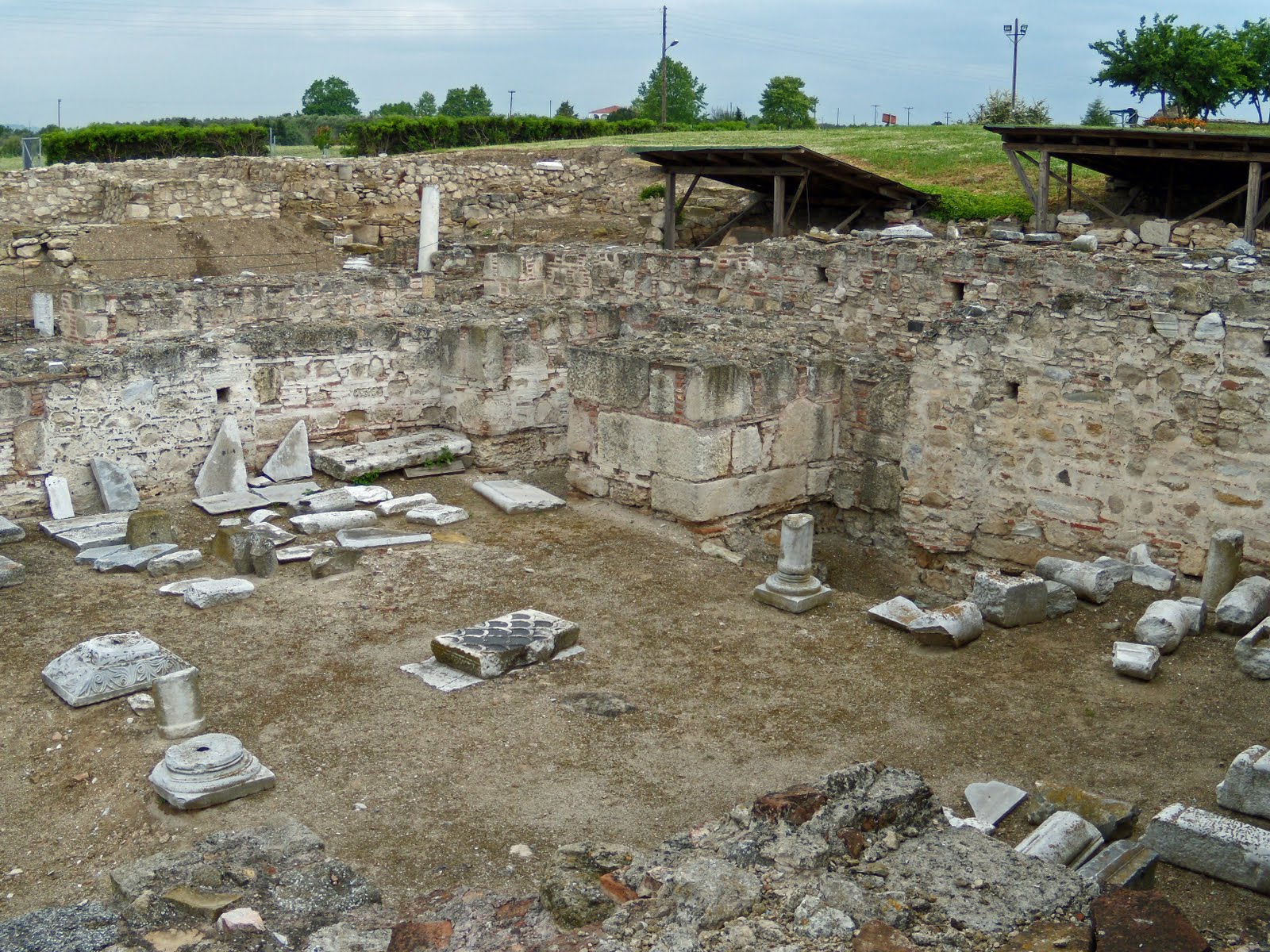
Within the perimeter of the fence, the remains are definitely Byzantine. Typical, of course, as they built their forts and churches right on top of older Roman or Greek construction, reusing the stones they found at hand. This site is no different, and as I question the local archaeologist and guardian, he willingly shows me the scattered remains from Greek temples, Macedonian city walls, and Roman olive- or winepresses. Further in the landscape, he also points to the line in the trees, walls, and houses that are supposedly part of this old fort. Excavations over here certainly are still in their infancy, and I can imagine how many archaeologists’ hands are itching to start digging for more treasures before they disappear through the illegal circuit, forever ripped out of their context.

Wednesday, August 3, 2011

A moment of glory - Macedonia forged by Philip II - 4

A moment of glory in 356 BC

Three years into his kingship, in 356 BC Philip must have looked back at his achievements with some degree of satisfaction. He now had secured most of Macedonia’s borders and built up a nearly invincible army, money was flowing in from the recently acquired mines of Philippi (more than 1,000 talents a year), his race-horse had won at the Olympic games, and most important of all Olympias bore him a son, Alexander.


Towards the end of 355 BC, Philip decided to besiege Methone in order to complete his control of the entire coastline towards Thessaly. Besides, Methone was located on a strategic communication route to Dion, Macedonia’s major religious sanctuary. He generously gave the people a chance to surrender but when they refused, he besieged the city. Methone had huge walls and in spite of Philip’s equipment and repeated efforts, it took him several months to succeed. But while he was inspecting his own siege craft, an arrow from an enemy catapult hit him in the eye. It seems that an eye injury is a bloody affair and one can easily imagine the commotion among his men. The siege may have been brought to a halt for a while, waiting for the outcome of the king’s wounds. The city was eventually taken in the early summer of 354 BC. Methone’s walls and buildings were razed to the ground so that even today it is difficult to locate.

The result of these moves meant that Macedonia’s coastline was now free of Greek cities, that Chalcidice was bound to Macedonia by a thorough treaty, and that the country reaped large revenues from the Crenides mines – more than enough to cover his military expenses and provide regular pay to his soldiers. Athens, by contrast, had exhausted its finances and was lucky enough to be saved by its archon Eubulus who created a special fund to stimulate the city’s economy.


Tuesday, July 26, 2011

King Philip, one year later - Macedonia forged by Philip II - 3

King Philip, one year later (358 BC)

But, returning to 358 BC after one full year of kingship, Philip had to secure his border with the Paeonians again and trounced them. As a result, Paeonia became a sort of buffer zone between Macedonia and the tribes of the Danube to the north, which was the trade route up the Axios Valley and beyond. Philip’s army now numbered 10,000 infantry and 600 cavalry, no small achievement if you consider that only a year or two earlier, the Illyrians had defeated nearly the entire Macedonian army. He was confident about marching into Illyria and bluntly refused to accept old King Bardylis’ terms. Both armies met near today’s Lake Ochrid, maybe close to the town of Heraklea Lyncestis, and by the end of the day, the Macedonians had killed 7,000 Illyrian soldiers.


Philip seemed to have it all planned. He demanded that the Illyrians pull out of Upper Macedonia north to Lake Lychnitis, including the tribes of Orestis, which until now were controlled by the Molossian King of Epirus. This way, he had an open route into Epirus to the south and Orestis in the east. A surprising fact is that Parmenion, one of the Paeonian chieftains, was made a general soon after coming over to Philip’s side – an interesting background for this man who served both Philip and Alexander for many years. At this stage, Philip started training recruits from these newly conquered territories, the non-nobles as infantrymen and the nobles as cavalry. This practice stayed in place far into our 20th century!

This latest victory also meant that Macedonia virtually doubled in size, that the size of Philip’s army increased substantially in only one year, and that Upper and Lower Macedonia were united as never before. Philip, still married to the Illyrian princess Audata, found it wise to change her name to Eurydice to mask her origin. Their daughter Cynane later married Amyntas, the original heir to the Macedonian throne.

Let us switch our attention to the southern borders with Thessaly and two of its cities in particular, Pherae, with its harbor, Pagasae, controlling the coastal states, and Larissa, which controls the inland states. Strangely enough, both cities were bitter enemies. It so happened that Larissa turned to the king for an alliance against Pherae. Philip agreed, be it for his own reasons, i.e., to incorporate the expert Thessalian cavalry into his new army (estimated to be 3-6,000) and to consolidate Macedonia’s southern borders. This alliance was cemented by Philip’s (third) marriage to Philinna from Larissa. She was to bear him a son, Arrhidaeus, the following year.

After these events in 358-357 BC, Philip planned to include Epirus to consolidate his borders. Three large tribes dominated that country: the Thesprotians, the Chaonians, and the Molossians, who spoke a kind of Greek dialect and were the most powerful and prosperous. Since Epirus had also suffered from the Illyrians, a treaty with Philip was relatively easy, and it was sealed by his marriage to Princess Olympias, Philip’s fourth wife. So in 357 BC, Philip’s borders were mainly secure, but there were still two significant enemies to deal with: Athens and the Chalcidian League, who, luckily, were not on friendly terms with each other!

The Chalcidian League had a powerful army, counting 10,000 infantrymen and no less than 1,000 cavalry. We should remember that the Chalcidice owed its economic importance to the mines of the Crenides. The Athenians, meanwhile, had established settlements at Potidaea (on the neck of the Kassandra peninsula), close to Olynthus, and had captured Torone at the tip of the middle finger of the Chalcidice. And, of course, they still had an eye on Amphipolis, a most important crossing on the trading route with Thrace, including the rich mines of Crenides, the waterway to the Strymon River, and the Danube beyond. To send help to Amphipolis, Athens needed a nearby base for their fleet, and it eventually found one on the island of Thasos.

Philip’s attack on Amphipolis was quickly settled, and the city capitulated in the late summer of 357 BC. He also attacked Athens’ ally Pydna, which promptly fell to him. As a reminder, we should not forget that Philip was only 26 years old then.

Tensions between Philip and Athens ran high at this point, and both parties sought an alliance with Olynthus because of the forces it could muster. Olynthus apparently was blinded by Philip’s promises, and a treaty was made in the winter of 357-356 BC. Copies were set up in Delphi, at the Temple of Zeus in Olympia, in Dion, and at the Temple of Artemis in Olynthus. As a consequence, Philip besieged Potidaea and occupied the city.


He had no time to take a break, for now, the king of eastern Thracia besieged the strategic and precious city of Crenides. It was only about 40 miles east of Amphipolis, right above the port of Neapolis (today’s Kavala), a valuable naval base in the region. Philip immediately marched in and defeated the Thracian forces despite their sudden coalition with Illyria and Paeonia. Philip was determined to stay and to put his stamp on this place; he changed its name to Philippi. He fortified the city walls and towers and increased the output of silver coinage. The marshy plain was drained and cultivated, meaning another boost for the local economy.

Friday, July 15, 2011

Start of Philip's reign - Macedonia forged by Philip II - 2

Start of Philip’s reign (359 BC)

At twenty-four, Philip II became king of Macedonia. That is only four years older than Alexander was when he succeeded his father, but the Macedonia he inherited was a coherent one whereas Philip was facing a formidable and nearly impossible task. He had to set his priorities, and quickly too.

The most urgent threat came from the Illyrians who had just defeated his brother, and it seems that Philip managed some treaty which may have included his marriage with Audata (Philip’s second wife), King Bardelys’ granddaughter. He then turned towards the Paeonians, whom he corrupted with gifts and generous promises to reach a peace agreement. Athens with Argaeus was a far more serious problem and Philip tricked them into believing he was giving up any claim on Amphipolis by withdrawing his Macedonian soldiers. The Athenians took the bait and their commander stayed in Methone with his troops. Argaeus, meanwhile tried to gain support for his cause from Aegae, the Macedonian capital but left unsuccessfully for Methone also. En route, Philip and a small force surprised him and Argaeus disappeared from the scene. To settle this matter, a peace treaty was signed with Athens, stipulating clearly that Amphipolis no longer would be claimed by Macedonia. Another potential danger however was coming from the Chalcidians who sent an embassy from the main city of Olynthus to Athens for support against Philip, but now that Athens had made peace with Philip they rejected this request.

Within a year, Philip had accomplished the miracle of putting an end to the four major threats that had led to his accession to the throne. The means he used became his trademark: diplomacy, deceit, bribery, and political marriage as well as the lightning speed of his actions. He must have known however that these arrangements were only buying him time. His priority now was to get his kingdom and his army organized.

Philip began by switching the main attacking force of his army from infantry to cavalry as had always been the common practice. He had the cavalry attack the flanks of the enemy lines where his infantry would push down in the centre. He also equipped his infantry with the new sarissa, a long pike of about 4.25 to 5.50 meters long made of cornel wood. The shape of the head was designed in such a way that it would penetrate the armor and the body of the enemy as the previous conventional pikes were meant only to wound the opponent. The cavalry on the other hand was set up in a wedge formation instead of the usual frontal charge lines, which Philip had copied from the Thracians and Scythians. Thus the Macedonian soldiers became highly trained and learned to carry their own arms, equipment, and food – ensuring them to be self-sufficient at all times. Instead of poorly trained farmers and unreliable mercenaries, Philip put in place a full-time army in which the soldiers received regular pay for the first time in history.

Philip was also keen to introduce new war machines. Where he originally used the mechanically drawn catapults (see Olynthus in 348 BC and Perinthus in 340 BC), he used a new type of siegecraft, the torsion catapult that was far more powerful than the other catapults as proven during the siege of Byzantium in 340 BC.
In addition, he created the new body of Royal Pages, i.e., boys (at least two hundred of them) who entered service at the age of fourteen for four years. They were the personal attendants to the king, meaning that they prepared his horse, accompanied him on his hunting or warring expeditions, and watched over him at night. It was an enviable position which at the same time meant that the boys lived and were educated at the Macedonian court and served as hostages to ensure the loyalty of their families.

Monday, July 4, 2011

Philip's Boyhood - Macedonia forged by Philip II - 1

Philip’s boyhood (383-382BC)
Although we have a pretty good idea of what Macedonia looked like when Alexander succeeded his father in 336 BC, we have only a vague vision of this country when Philip became king some twenty years earlier. Since it was Philip who put Macedonia on the map to start with (something we generally tend to forget), I decided to investigate this chapter of history. Without his relentless efforts and strong ambition, he would not have succeeded – and let’s not forget his excellent judgment of characters and his evaluation of political and military situations, which have largely contributed to achieving his goal.

Macedonia was hardly a country to be reckoned with, and the only envy of the surrounding enemy tribes was its fertile lowlands. Greece as such did not exist yet, only leading city-states and dispersed bands of tribes constantly at war with one another. And Macedonia was no exception. However, the situation was going to change dramatically after the death of King Perdiccas III in 359 BC.

At that time, Macedonia covered a rather restricted area that started north of Mount Olympus and was squeezed between the valleys of the rivers Haliakmon in the west and Axios in the east, where they flow into the Thermaic Gulf. The most fertile part and the very heart of Macedonia was, of course, this rich coastal plain, also called Lower Macedonia, whereas Upper Macedonia stretched vaguely to the west into the remote cantons of the Illyrians. The Illyrians envied the good agricultural land and lush grasslands of the Macedonian floodplains and invaded the country on a more or less regular basis. It was during such an attack by the Illyrian King Bardylis that Perdiccas III was killed, and with him 4,000 brave Macedonian soldiers. This incursion left the door open for further invasions, for not only could the Illyrians push all the way down to the Thermaic Gulf, but neighboring tribes like the Paeonians from the north and the Thracians from the east could also seize this opportunity. And we shouldn’t forget Thebes, which was the dominant military power at that time, and Athens, which had an eye on several harbors up north serving as safe havens for their wheat ships on their way home from the Pontus Euxinus.


The situation in Macedonia at this point was rather dramatic. The borders were open game; its manpower was very much depleted with so many men killed in action, and to make things worse, they had lost their King and leader. Perdiccas’ son Amyntas, the heir to the throne, was only an infant, so all eyes were turned toward Philip, Perdiccas’ youngest brother, who, according to the ruling laws, should be named regent until Amyntas’ coming of age. However, hard decisions had to be made very quickly. Instead of being called to the regency, Philip, then 24 years of age, was proclaimed King by the Macedonian Assembly. King Philip II of Macedonia made his entry on the stage of history.

Now, who was this Philip? Philip was born in 383 or 382 as the third son of King Amyntas III and Queen Eurydice. The eldest son, Alexander II, lost the battle against mighty Thebes, which demanded the surrender of 50 sons of noble Macedonians as hostages, including his youngest brother Philip. Philip must have been about 13 years old at that time, just a year or so older than Alexander when he tamed Bucephalus when he was led to Thebes. He must have spent about 3 years there at the house of Pammenes, a leading general and statesman during the days that Thebes was the dominant power in Greece. According to Justin, Philip learned much about military strategy from Pammenes’ friend Epaminondas, especially when it came to the use of shock tactics and the combined attack from infantry and cavalry. He must have watched when the famous Sacred Band was training, the elite corps made of 300 Theban soldiers – supposedly 150 pairs of lovers who would fight to the death to defend their partner in battle. Epaminondas, despite Thebes being so far inland, also had solid plans to build a naval force to face mighty Athens in due time, a tactically important prowess that certainly was not lost on Philip. And there was the fact that Thebes was a polis, a true city with its benefits and shortcomings, something that was not known in Macedonia yet.


Although Philip was only a teenager, we should not forget that Macedonian princes learned by example. From an early age, they were trained in warfare, to admire courage and to aspire to excellence, schooled in the great battles of the Iliad, no doubt. Philip was no exception. We will remember how the story goes that Alexander, at the age of seven, inquired with the Persian envoys about their communication routes and their army. Philip would not have done less.


Living the daily life of a city like Thebes, Philip had witnessed the importance of military power, and although this was essential, he was also aware that a state needed to be unified and able to keep actual and potential opponents from uniting with others against him. Securing its borders was an important component of this complex pattern.

After the death of Alexander II (who was killed by his mother’s lover, Ptolemy), his brother Perdiccas III took over after murdering this Ptolemy, and during this time, Philip apparently returned to Macedonia. From the little that is known from that period, it seems that Perdiccas gave his brother part of his kingdom, probably not to rule in his place but merely to rule on his behalf. According to speculations, he would be entrusted with the territory of Amphaxitis, a strategic stretch of land between the Axios River and the Thermaic Gulf. At this time, Philip married his first wife, Phila, the daughter of Derdas II of Elimeia, probably a diplomatic alliance arranged by Perdiccas, as was his right as king. Macedonia was in turmoil, and Philip may have done his share in the fights to secure its borders, especially with the Paeonians and the Thracians. It is not impossible that he experimented with some of the military tactics he had picked up in Thebes.


So, when in 360/59 BC Perdiccas III was killed in a battle against the invading Illyrians, as mentioned above, Macedonia was faced with several threats to the kingdom’s security. And there was also the matter of succession to the throne since the dead king’s son, Amyntas, was still a youngster. The Athenians tried to interfere, pushing forward a certain Argaeus and the Thracians with a certain Pausanias who already marched towards the capital city of Pella. Given all these threats, the Macedonian Assembly unexpectedly proclaimed Philip as King, and the people swore their oath of allegiance to him. There is no question (according to Ian Worthington) that Philip was more experienced in military and administrative affairs than either the infant Amyntas or Philip’s three half-brothers (the sons of Gygaea), whose interference, if any, was inconsequential. It is possible that at this point Philip had his oldest half-brother, Archelaus, killed as a warning to the others who found shelter at Olynthus, which Philip besieged later on.

Click here to read the full story about Philip II from the beginning

Saturday, June 25, 2011

Alexander the Great. The Brief Life and Towering Exploits …


Alexander the Great. The Brief Life and Towering Exploits of History’s Greatest Conqueror as told by his Original Biographers. By Brenda Jackson and Ronald L. McDonald. Edited by Tania Gergel. Introduction by Michael Wood. ISBN 0 14 20.0140 6

Just what I wanted, Alexander’s life story “as told by his original biographers” and since it included a foreword by Michael Wood, whom I hold in high esteem, I thought this would be the purchase of my life!

Although it is a noteworthy book where classic authors like Arrian, Plutarch and Curtius Rufus, are skillfully tied together in a pleasant narrative, I ended up feeling that the most interesting section was actually Michael Wood’s introduction. He at least knows how to kindle that sparkle that makes a book interesting and fascinating to read. Brenda Jackson and Ronald L. McDonald's story is more a flat statement of facts and figures from a past that seems even more remote than it already is.

I’ll hang on to Michael Wood’s last introductory sentence where he is quoting Arrian “… It is my belief that … never in the world was there another like him [Alexander]”.

Saturday, June 18, 2011

A thought for Roxane, Alexander’s Bactrian wife

At times my mind travels in strange ways or I may simply get carried away by the emotions of the moment as happened recently went I attended a singing performance from Samarkand by a lady called Monajat Yulchieva.

With her velvet voice and natural grace, she was meant to become an opera singer but turned instead to the old tradition of shashmâquam, the typical songs from Uzbekistan. She found inspiration in Sufi texts that matched harmoniously with the string and percussion instruments of her native country. This is how she was announced in the media and somehow I felt I needed to see and hear her on stage (Bozar, Brussels, Sept 2009). This turned out to be quite a revelation, I can assure you! 


Unfortunately, I couldn’t understand a word of what she was singing, so it was all pure emotion that came to me. The first three songs were adaptations from folk songs, but then the sound and expression took an entirely different turn. At times, the tunes reminded me of some Chinese songs; in other parts, the melodies reflected the emptiness of the steppe where the notes were suspended in the thin desert air.

Monajat Yulchieva has a fine appearance, someone you do justice by calling her a lady. Utterly gracious and although no longer in her youngest years, you’ll easily qualify her as very handsome. It was almost evident that my thoughts went to the women Alexander would have met on his journey through that part of Asia, and in particular to Roxane. If she was as beautiful as some ancient writers pretend, she might have looked something like Monajat in her teens. Why not?

Unfortunately, no image of Roxane has come to us and the only way I can visualize her is through Oliver Stone’s movie Alexander but that is as remote as Pietro Antonio Rotari’s painting that was shown recently at the Hermitage Museum in Amsterdam (see: Immortal Alexander the Great). So I feel entitled to having my own image of Roxane.

Those who are truly interested in sharing this very special musical experience can watch Monajat Yulchieva on video here. Let me know if I’m right, yes?

Saturday, May 28, 2011

Alexander de Grote, Macht als Noodlot by Peter Bamm

This book, written by Peter Bamm, is rarely mentioned in any literature about Alexander the Great. Yet I think this is a must for any novice willing to learn the basics about the person and the campaigns of Alexander.  ASIN: B0000COC3F


It was my very first substantial book I read about Alexander and I was hooked for the rest of my life! It was published in 1968 and may seem out of date here and there (the Macedonian city of Aegae is still believed to be in Edessa) with its black and white illustrations, but the photographs perfectly reflect the desolation of the eastern landscapes he was confronted with, the high mountain ranges, the wide wild rivers and unforgiving deserts. The illustrations are engraved in my memory forever and the vivid descriptions of Peter Bamm really make Alexander come alive.

Peter Bamm takes you by the hand as the story unfolds and leads you through a first-hand experience.

Saturday, May 14, 2011

Amidst Shrapnel in Afghanistan

A near miracle, I dare say, to see archaeologists at work in Afghanistan while the fighting between the Taliban and the Western forces is still an ongoing business. An article from Reuters, meaning that we can consider the information as trustworthy, reports on 17 August 2010 about Buddhist remains that are being discovered south of Kabul.

Mohammad Nader Rasouli, head of the Afghan Archaeological Department, mentions that two statues were found, respectively seven and nine meters high, and some coins. They also uncovered a temple, some stupas, and rooms decorated with colorful frescoes and gold. Some of the finds have been dated to the 5th century, but there may be artifacts dating from the BC era.

[Picture from Fox News]

The site is located in the Aynak region of the Logar province, close to the area where the Chinese have recently started mining copper ore. The mine exploitation is not harming the excavations, but looters and smugglers are. They were there even before the government could start excavation work last year. Always a pity when those things happen.

The situation is grim, as can be expected, for we all remember how the radical Taliban destroyed the giant Buddha statues at Bamyan at the end of the last decade; many more antiquities and historical sites were destroyed or pillaged in the process.

Rasouli says that they don’t have the resources to move the relics to a safe place, but he hopes to build a museum there instead, adding, "We need foreign assistance to preserve these and their expertise to help us with further excavations."

Safeguarding a country’s archaeological heritage is never easy, but in war zones it is always worse. Let’s hope that a reasonable solution can be found for Afghanistan, which, in my eyes, is part of the land conquered by Alexander the Great. There must be an enormous wealth of archaeological treasures from his days and from Hellenistic times still hidden out there … somewhere…

Thursday, May 5, 2011

All Alexander’s Women. Sisygambis’ Letters by Robbert Bosschart

The title alone made me stop in my tracks: Sisygambis' Letters (ISBN 1439272018)! I got “hooked” on this subject after attending a lecture by Robbert Bosschart at the Zenobia Congress 2010 when I heard his thorough investigation of the women in the life of Alexander the Great for the first time. Besides this book, which is a historic novel, he also wrote another one, All Alexander’s Women, that records his in-depth study of the matter, and I have to admit that I find this quite exciting.

How Bosschart dared talk about “all his women” made me raise my eyebrows at first for Alexander didn’t have that many wives or concubines. But Bosschart is not exactly talking about spouses and mistresses, but rather about the mother figures in Alexander’s life: his own mother Olympias, of course; Queen Ada of Caria; and most of all about Sisygambis, the Queen Mother of Persia. Alexander’s sister Cleopatra also enters the picture, although we know very little about her and most is pure speculation.

This novel gives us a kind of detective story in which a Swiss archaeologist with the significant name of Barsine gets hold of several secret papyri which she is able to decode. These documents turn out to be the private correspondence between Queen Ada and Queen Sisygambis mostly, but there are also a few coded messages written by Alexander personally. This is evidently a very utopian happening, but all in all, through these documents, we are able to shed an entirely new light on the Persian world in which Alexander had to move as a King.

New to me, and this is no fiction, is to hear that women in the East (which includes Persia) were very much emancipated. They occupied high positions, could exercise a profession, and were considered the equals of men! Once you manage to let that knowledge sink in, it is quite amazing and even more unbelievable to realize that thanks to the Romans and the Christian belief we needed more than two thousand years to start the process of emancipation all over again!

Keeping this concept of emancipation in mind, the person of Olympias –whose forefathers came from Troy – is to be seen in an entirely different light. The role of Barsine, the widow of Memnon and mistress of Alexander (she gave him a son, Heracles) cannot be neglected either, particularly if you remember that she spoke Greek and was able to converse with Alexander. Through her, he would have been aware of the protocol at the Persian Court, meaning that when he went to Sisygambis’ tent after the Battle of Issus, he must have known how to carry himself and how to handle this situation with the correct procedure. And let us not forget Queen Ada, who was put back on the throne of Caria by Alexander himself after the siege of Halicarnassus. She was not a queen by name only, but one who had full power to rule. Remember that unlike in other cities, Alexander did not leave a Macedonian garrison behind to have a finger in the pie. That is no small matter!

We are used to looking at Alexander as a conqueror, a fighter, and maybe even as a politician, but rarely as a human being and certainly not in a world where a woman had as much to say as a man. It is an intoxicating thought to even consider what our world would have looked like had Alexander lived long enough to organize his empire, taking this aspect into account! We certainly would not have known a Roman Empire, and Christianity would not have spread (or would have spread differently) in a world of religious tolerance and equality between men and women. I am sure the Greeks and more so the Macedonians will have taken great care to leave that knowledge out of their records!

A subject for deep reflection and lengthy discussions, no doubt! This very book, although it is a historic novel, is no less exciting and makes highly entertaining and intriguing reading!