Alexandria's founded by Alexander

Alexandria's founded by Alexander the Great (by year BC): 334 Alexandria in Troia (Turkey) - 333 Alexandria at Issus/Alexandrette (Iskenderun, Turkey) - 332 Alexandria of Caria/by the Latmos (Alinda, Turkey) - 331 Alexandria Mygdoniae - 331 Alexandria (Egypt) - 330 Alexandria Ariana (Herat, Afghanistan) - 330 Alexandria of the Prophthasia/in Dragiana/Phrada (Farah, Afghanistan) - 330 Alexandria in Arachosia (Kandahar, Afghanistan) - 330 Alexandria in the Caucasus (Begram, Afghanistan) - 329 Alexandria of the Paropanisades (Ghazni, Afghanistan) - 329 Alexandria Eschate or Ultima (Khodjend, Tajikistan) - 329 Alexandria on the Oxus (Termez, Afghanistan) - 328 Alexandria in Margiana (Merv, Turkmenistan) - 326 Alexandria Nicaea (on the Hydaspes, India) - 326 Alexandria Bucephala (on the Hydaspes, India) - 325 Alexandria Sogdia - 325 Alexandria Oreitide - 325 Alexandria in Opiene / Alexandria on the Indus (confluence of Indus & Acesines, India) - 325 Alexandria Rambacia (Bela, Pakistan) - 325 Alexandria Xylinepolis (Patala, India) - 325 Alexandria in Carminia (Gulashkird, Iran) - 324 Alexandria-on-the-Tigris/Antiochia-in-Susiana/Charax (Spasinou Charax on the Tigris, Iraq) - ?Alexandria of Carmahle? (Kahnu)

Monday, July 14, 2014

Tapestries showing Alexander the Great

Somehow, I missed the excitement around two huge Flemish tapestries depicting Alexander the Great!

Every year, Brussels is hosting a fair of Antique and Fine Art Dealers and recently the event was in the news because they contributed to the restoration of two tapestries made in the workshops of Pasquier Grenier around 1460 in Tournai (Belgium), and which are presently part of the Princes Doria Pamphilj Collection in the Palazzo del Principe in Genoa (Italy). 


Alexander is being represented here as rendered in the so-called Alexander Romance, a personage I find rather remote from his true historical context – in as far as we are still able to find it after two thousand five hundred years, of course.

Wool and silk, gold and silver threads were used to weave these huge tapestries that were in an advanced state of disintegration. The old silk threads were pulverized; most of the brown wool was corroded by the iron components used in the original dyeing process; and many warp threads were broken or missing due to accidents or mishandling.

The Royal Manufacturers De Wit in Mechelen (Belgium) is one of the rare places capable of performing this kind of restoration job although seldom done on pieces of such poor condition. Each tapestry (about 10 meters long) required two years of work, cleaning them first, followed by an overall stabilization of the material and a consolidation of the weaker areas. Finally, a sturdy lining provided the much needed support to hold the tapestry together and camouflage the gaps.

According to the specialists, these tapestries are spectacular, not only because of their composition and design, but also because of their technical aspect and color palette, and should be ranked among the finest examples of 15th century tapestries to survive. The Story of Alexander knew at least seven tapestry versions, all created between 1460 and 1470, and these two examples most likely belonged to Admiral Andrea Doria, who commanded the fleet of Charles the Fifth at the battle of Tunis in 1535.

The first tapestry shows young Alexander surrounded by his mother Olympias and his father, Philip II; the taming of Bucephalus; and his first military victories; culminating with the crowning of Alexander by his dying father. The second tapestry, depicts six scenes of Alexander’s conquests of Asia, including idealistic (and in my eyes unrealistic) images where Alexander soars the skies in a cage drawn by griffons, and later travels under water in a glass bulb, to finally journey to the end of the world where wild men and dragons live.

They are lively illustrations of the Alexander Romance that was popular at the time, embellished thanks to the ideals of the Crusaders, for whom Alexander became an example of virtue and morality for knighthood of the late Middle Ages. Not exactly my cup of tea, as you can imagine, but it shows how much Alexander stimulated the imagination of mankind over the centuries. And he still does …

Thursday, July 10, 2014

Plans to dig out Philippopolis (Plovdiv)

Few people are aware that modern Plovdiv is one of the oldest cities in Europe as its origins go back some 6,000 years. It was conquered by King Philip II of Macedonia who changed the Thracian name of Eumolpia into Philippopolis, meaning “the city of Philip”, in 340 BC.

Very few remains from those days have been revealed so far and what we see today is mostly Roman. In 46 AD Emperor Claudius made it “the largest and most beautiful of all cities” as Lucian tells us. The most important military road in the Balkans, the Via Militaris, passed right through Philippopolis, the major communication line between Belgrade and Byzantium. Roman times led to flourishing commerce and monumental constructions of which so far the theatre is the best known example.

In recent years many new excavations have been carried out and slowly the Roman city is rising from its ashes as archaeologists have been able to locate and partly expose many public buildings like the Stadium, Treasury, Baths facilities, Odeon, and other structures around the central Forum. A defensive double city wall has been found and an excellent water and sewage system has been established.

Lately, the archaeologists’ attention has focused on the area around the Forum which was built at the time of Emperor Augustus, probably in part on top of an older Hellenistic Agora although this is not yet entirely certain. This Forum however covers a surface of 11 hectares, arguably one of the largest Roman Forums in the country. On the eastern and southern sides, we find the known Theatre and the Stadium, while the western and northern sides were occupied by a series of shops connected to the Forum by a ten-meter-wide Stoa. Meanwhile, the Propylaea, defining the entrance to the Forum have been located and need excavation.


Unfortunately, under the communist regime of the 1970’s a concrete post-office was built smack in the middle of today’s excavation site and this is not helping in reconstructing the city’s past. It is in this area that the Odeon has been dug out next to a theater that is smaller than the existing one. Plans are made to remove some modern buildings, including the post office, in order to create an archaeological passage between the different monuments – but the matter is evidently subject to a lot of red tape.

For now, finds seem to be limited to smaller items like Roman and Medieval coins, tiles with theatrical masks, Roman bowls, cups, amphorae, and other pottery, some glassware, and vessels used in religious ceremonies.

No wonder that Plovdiv is running to become the European Capital of Culture in 2019.

Saturday, July 5, 2014

The Valley of the Temples at Akragas, Sicily

My first glance at these temples is quite exciting as I discover them on a high ridge above the road, playing hide and seek with the passing trees. According to my map, the string of temples at Akragas (modern Agrigento) is located between two rivers, the Hypsas and the Akragas, but why this place high up the ridge is called “The Valley of the Temples” I don’t know. It doesn’t make sense to me.

Roughly, all these temples were built within a period of one hundred years, somewhere between 500 BC for the Temple of Heracles and 400 BC for the enormous Temple of Zeus. The 6th and 5th centuries BC were definitely the most prosperous times for Akragas, which was founded as a colony of Gela in 580 BC to become one of the leading cities of Magna Graecia, with a population of as many as 100,000 to 200,000 people. The Carthaginians captured the city in 406 BC and burnt it to the ground, selling its inhabitants as slaves. Soon afterwards, Akragas fell victim to the disputes between Rome and Carthage during the First Punic War. After besieging the city and defeating the Carthaginians in 261 BC, the inhabitants were once again sold as slaves, this time by the Romans. Six years later, the Carthaginians recaptured the city, but in the end, they had to surrender it to Rome, ending the Second Punic War. In 210 BC, the Romans took possession of Akragas and renamed it Agrigentum, although Greek was still the common language. Those were hard times for such a proud city!

The temples we see here today do not tell this gruesome story and only testify to Magna Graecia’s grandeur. The best known is the Temple of Concord, simply because this is the best preserved sanctuary of the Greek world after the Temple of Hephaistos in Athens. It was built around 430 BC and suffered only slight damage from the Carthaginian invasion. It is a rather standard construction in Doric style, counting 6x13 columns nearly 7 meters high, that has kept its cella nearly intact thanks to the fact that it was converted into a church. This sounds familiar after seeing what has been done to the Temple of Apollo in Syracuse, with that difference, however, that here, except for the arches in the nave, the building has been entirely stripped of its Christian additions. Its location is absolutely superb as it shines there at the end of the Sacred Road, even without the coat of original white stucco that was enhanced with red, blue, green, and yellow details. It must have been visible from quite a distance!

When I enter ”The Valley of the Temples”, my first stop, however, is at the Temple of Hera, clinging to the edge of the cliff. For security reasons, I am not allowed inside. It is slightly smaller and about 20 years older than the Temple of Concord, although it has as many columns. This temple is in poorer condition, with only parts of the columns and the cella walls still standing, as it suffered from the (still visible) devastating Carthaginian fires in 406 BC. In fact, it is surprising that so much of the temple has survived after all.

As this Temple of Hera lies on higher ground, I have an excellent view over the city walls, which are generally an extension of the steep cliff that has been hollowed out to leave only a wall of some sort. More to the right and parallel to this wall runs the said Via Sacra that leads to the Temple of Concord and beyond that to the Temple of Heracles and across the modern road to the enormous Temple of Zeus. It is a beautiful walk among the blossoming trees and high grasses, overlooking the valley below.

Passing the Temple of Concord, I reach the end of the Via Sacra at the Temple of Heracles, which has only one row of nine columns left to fuel my imagination. This is by far the oldest temple of Akragas, built around 500 BC, and is a little larger than the two previous ones, counting originally 6 by 15 columns. It also has suffered badly from the Carthaginian destruction of 406 BC, and traces of fire are still visible. In its heyday, it contained a painting by the most famous artist of the ancient world, Zeuxis. I wonder what this must have looked like.

Across the modern road are the ruins of the Temple of Olympian Zeus that defy my wildest imagination. It was built in Doric style by the Carthaginians taken prisoners during the battle of Himera in 480 BC and measures as much as 110x53m, i.e., a double square, and for that reason it is unique among the Greek temples. It counted 7x14 columns, rounded on the outside and square on the inside, a staggering 4m across and 16.7m high. In between stood statues of colossal Telamones  (male caryatids), 38 pieces in all. A few of these Telamones or parts of them have been recovered and give an idea of the oversized proportions of the temple. Archaeologists have not yet agreed on the final layout of this temple, which has suffered from repeated earthquakes and from quarrying for several local projects. This Temple of Zeus was not finished in 406 BC when the Carthaginians arrived, and we know that it was converted into a fortress in 255 BC so the inhabitants and the Roman garrison could take shelter here from the Carthaginian attack. Walking among these huge blocks, it is very difficult to mentally reconstruct this sanctuary, and the remains of a few Telamones stretched out in their full length around the temple add to the general confusion about its true proportions. Luckily, the local museum shows a model reconstruction of the temple, at least one of the possibilities, putting things more or less in perspective. The benefit of visiting these remains lies in the details. When you see the sheer size of the triglyphs or the large U-shaped incisions on some of the stones that were used to lift the enormous blocks, you can somehow visualize the biblical proportions of this temple that certainly deserves the addition of Olympian to the name of Zeus.

Further to the west are the poor remains of the city of Akragas from the 6th century BC, divided by three five-meter-wide north-south streets. Much of the city was rebuilt in Hellenistic times, but only the base of the walls remains visible. At the far end of this plain dotted with patches of flowers of all colors, one can see the Sanctuary of the Chthonic Divinities (the gods of the earth), in which two temples of the 7th century BC have been erroneously assembled together in 1836. It is easy to recognize the two large altars in front of this reconstruction, belonging to the same period, a round and a square one. There are more remains of other temples, but I can't properly figure them out.

Behind this section of the Chthonic Sanctuary lies a small valley that separates me from the two columns that belong to the Temple of Hephaistos, which I can see among the trees. Down below lies the so-called Kolymbetra Garden, where a pool was dug by the same Carthaginian prisoners mentioned above, taken at Himera in 480 BC. It was meant to serve as a water reservoir and a pond for fresh fish. This pond was rather short-lived as approximately one century later, it was drained to become a garden where Arabs cultivated oranges. Unfortunately, there is no time to visit the Garden or the poor remains of the Temple of Hephaistos.

The site of Akragas and its “Valley of the Temple” covers an area of approximately 4.5 x 3 kilometers, and this means that even a full day’s visit is not enough to see it all. 

But a stop at the local museum is an absolute must, if only to see the one original re-erected Telamon. I feel dwarfed next to this enormous statue, and even next to the three rescued Telamon-heads! Together with the abovementioned reconstruction of the Temple of Zeus, these definitely are the highlights of the museum. Yet several other artifacts deserve attention. For a start, there is a terracotta Dinos with a triangular pattern from Gela belonging to the end of the 7th century BC, a pattern that still stands as a symbol for the triangular shape of Sicily and that is reproduced in colorful copies for tourists. Then there is a lovely marble head of a veiled goddess, probably Demeter from the end of the 5th century BC; a marble statue of a warrior in a style typical for 480-475 BC; a delicate statue of a young athlete, smaller than life-size and thought to be victorious at the Olympic Games dated to 480 BC; a small headless statue of Aphrodite bathing and wringing her hair in late Hellenistic style from Rhodes; fragments of Archaic architectural terracotta elements from the sixth century BC, probably belonging to the Temple of Zeus; a rather static Kouros-head from around 450 BC; and a wide range of terracotta heads, amphorae and craters from the fifth and fourth century BC. Quite a number of showcases are not lit, whether this is for economic reasons or because of some defect, I don’t know.

Strangely enough, this museum is partially built over what once was the Hellenistic ekklesiasterion that could hold 3,000 citizens for assemblies. It looks very much like an eroded semi-circular theatre, as it was leveled to accommodate the foundations of a later Roman temple. The 13th-century church of San Nicola, built with materials from nearby Roman constructions, does not help to get a clear view of this area.

I take one last glance back at where I came from. “The Valley of the Temples” with the Temple of Concord is beautifully framed by the trees in the foreground. What a place to truly taste the past!

[Click here to see all my pictures of Agrigento]
[Click here to see all my pictures of the Museum of Agrigento]

Monday, June 30, 2014

Bactrian Gold, the Hidden Treasures from the Museum of Kabul

Bactria, to me, is Alexander-country, the lands of Central Asia where he spent two years of his life in 228 and 227 BC. The exceptional exhibition “Afghanistan, hidden treasures from the National Museum, Kabul” covers this period and is presently traveling worldwide. It centers on four excavation sites covering roughly 2,500 years, i.e., from two thousand BC to the third century AD.


[Map from National Geographic showing Alexander's Route]

I knew French and Russian archaeologists had been working in the area for years, entrusting their treasures to the National Museum in Kabul. That is till 1979 when the troops of the USSR invaded Afghanistan. Archaeological diggings by Frenchman Paul Bernard at Ai-Khanoum, for instance, had to be interrupted abruptly, and when he returned to the site recently, it was thoroughly plundered and destroyed. Most damage was, however, done a few years later when the Taliban considered it their duty to obliterate every image of people wherever they found it: on frescoes, mosaics, paintings, reliefs, or statues. We all have witnessed what happened to the giant Buddha statues in Bamyan. Still, not many people know that the Museum of Kabul was one heap of rubble after the Taliban had thoroughly ravaged it – a frightening experience! A precious heritage that survived for centuries is being totally destroyed with just one single blow!


To use the old name, Bactria is located in Central Asia, right on the crossroads of old caravan routes, later the Silk Road, the meeting point of all trade routes between East and West. It is not surprising that Alexander the Great put so much time and effort into the conquest of this area, for it meant not only a way to secure his back while heading for India but also an economic asset precisely because of the geographic location of Bactria. His marriage to Roxana, the local chief's daughter, was, after all, a high political move rather than real or impulsive love, as some suggest. Who knows?

The first objects I encounter as I enter the exhibition are three statues from the Musée Guimet in Paris, dating from Buddhist times but showing a definite Hellenistic influence. You can’t miss them; the way they are presented in the floodlights against a black background instantly gives you a taste of what to expect. This magnificent high relief of a Genius with Flowers from the 4th-5th century AD was found in the Buddhist monastery of Hadda in remote northern Afghanistan, yet still magnificently Hellenistic.

At a right angle, right in front of me, stands a showcase filled with one hundred Buddhist heads, sorted by size, i.e., the smaller ones on the lower steps and the bigger ones at the top. It is a fascinating group, for all the heads are different, and as I take a closer look at each and every one of them, either at eye level or from the side, I see how they stare back at me or ignore me, looking away in an absent glance. I take my time to inspect and admire each face, some more Hellenistic than others, with a more elongated or rounder face, longer ears, closed eyelids, or just peeping at us visitors. All in all, an amazing group!

From here, the way leads to the movie theater, where this French documentary is shown about their exploration and excavations in the magnificent Afghan landscape. It is well documented with clear maps and a captivating view behind the scenes – absolutely worth watching. 

The oldest finds (2,000 BC) come from Tepe Fullol. There are only a handful of gold bowls and beakers made of thinly beaten gold that somehow remind me of old Mycenae and the death mask of Agamemnon. Archaeologists disagree about the origins of this form of art, and the link to other cultures remains obscure. To complicate things, most of the treasures had disappeared, first because the gold was split up between the local tribal chiefs of Northern Afghanistan when it was discovered, and secondly, because the entire collection at the Museum of Kabul fell apart. These pieces are a little out of the way. That is unfortunate, for they deserve better after being hidden for four thousand years, don’t they?

The section about Ai-Khanoum is the most important one, at least in my eyes, for it is the reason for my visit, as this city was built in the wake of Alexander the Great’s conquest of the area in 328-327 BC. I am very much impressed by the idea of discovering this Hellenistic city at the banks of the Amu Daria River (modern Oxus River), complete with a Gymnasium, a Citadel, a Theater, and temples. It is not as evident as it would seem! The Greeks even built a Palace here. It is unlike anything else, for they never had a king to build it for. This one is based on the Persian model but decorated in Greek style with monumental Corinthian capitals on top of the columns and flat roofs with the so-called antefix decorations at the edge. A capital and several antefixes are on display here, together with objects like a water jet in the shape of a theatrical mask, a couple of sundials (which I didn’t expect to find here at all), a Hellenistic Hermes pillar of high quality from the Gymnasium, a face of either a man or a woman, bronze decorative elements, etc.

Eye-catcher is the Disk of Cybele from the 3rd century BC, made of gilded silver, picturing the goddess Cybele on a chariot in Greek style mixed with several eastern influences, featuring the fire altar and Helios.


What excites me is the stone pedestal bearing the Delphic precepts. This wisdom comes from Delphi in the 5th century BC, and teaches us something along the lines of “As a child, learn good manners. As a young man, learn to control your passions. In middle age, be just. In old age, give good advice. When you die, do so without regret.” Can you imagine the impact of this old text, this old wisdom that traveled from Greece to resurface unexpectedly 2,500 years later at the very edge of the desert steppes? That leaves me utterly speechless for a while!


Next comes the collection from Begram, a small town north of Kabul. In the years before WWII, two sealed chambers were uncovered, still containing their treasures of ivory furniture from India, plaster medallions, and, most strikingly, an extensive collection of glasswork of Hellenistic origin. Here too, each archaeologist seems to have their own theory of whether these chambers were set up as storage areas (since all the ivory was put together, and so was all the bronze and all the glass), as religious offerings, or maybe this is a hidden treasure. 


In any case, the glasswork alone is absolutely fabulous and unique in shape, color, and decoration. There are, for instance, these three goblets (they look more like vases to me, so tall). The countless pieces have been glued back together, but just by looking at the colors of these fishing and hunting scenes, you would swear they were painted only yesterday – so vivid and lively! Now try to imagine the impact of such a find, for these drinking beakers were produced in Alexandria in the first century AD and traveled all the way from Egypt to Kabul.


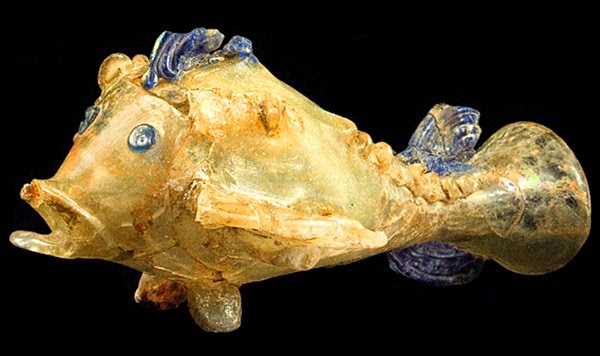
You have to admit that you are looking at something very exceptional. We all know there was an active exchange of goods in antiquity, and it comes to us like a simple statement from a history book, but here you are faced with the very product of such trade! I keep staring at this glasswork with wide-open eyes. Wow! Next to these painted glasses are a couple of glass drinking goblets or vases in the shape of fish, blue and off-white, with shiny eyes and sharp fins. I’ve never seen anything like this. There are glass-blown vases with honeycomb motives or wrapped in a net of glass lace; an elegant black glass vase with a high handle next to a translucent one covered with designs applied with gold leaf; for me, an unprecedented variety of delicate, colored, and painted glass that makes the cut-crystal bowl look rather primitive and dull. Amazing!

In another showcase, all the ivory artifacts have been brought together.

These objects from the first century AD originally all came from India, but again are drenched in a Hellenistic sauce. Unique is the ivory River Goddesses, approximately 45 cm high, clearly from a Buddhist background, among the exquisite openwork ivory panels showing Indian ladies in exotic gardens with fountains and temple-like buildings, a few monster figures, etc. Strange is the odd-shaped earthenware jar with blue-green glaze representing a bird-woman, for I cannot tie this style or shape to anything I have seen before.

The bronze artifacts somehow don’t add anything new. I only remember the cute figurine of Amor carrying a lamp and the young rider who seems to refer to Alexander the Great because of the way he is sitting on the horse that is lost from underneath him.

I stop to admire the row of plaster medallions, each about 15 cm in diameter, also dating from the first century AD. They look like oversized molds for the production of coins, but were used to create the bottom motives for silver plates and goblets as the silver was poured and hammered around these molds. There are a few striking designs, like the Winged Amor or the high relief of a youth. Just imagine these portraits staring back at you from the bottom of your silver goblet filled with water or wine. I certainly would love to give this a try, wouldn’t you?

Finally, there is the gold treasure from Tillya Tepe, a tomb hill just outside the Greek Bactrian city of Emshi-Tepe in the oasis of Sherberghan. The content of these six tombs was barely rescued when the Soviet Union entered Afghanistan in 1979, and it was safely transferred to the Museum in Kabul. There was a seventh tomb on that hill at the Turkmenistan border, but Viktor Sarianidi, the Russian archaeologist who had led these excavations together with his Afghan colleagues, ran out of time, and when he recently returned, the tomb had been thoroughly plundered. Such a shame! Luckily for us, Sarianidi managed to travel to the Museum of Kabul in the 1980s in order to take pictures of all 20,000 excavated objects, and he published an impressive book. So at least we know exactly what was found at Tillya Tepe.

What followed were uncertain times for the art world, and we owe it to a handful of brave Afghans that this treasure was rescued, safely locked away in the vaults of the Presidential Palace. They managed to keep the place a secret. The Museum itself has suffered a great deal from the civil wars, as it was repeatedly plundered and artifacts were stolen, and in 1994 it was hit by a rocket, setting it on fire. How dreadful! The worst, however, was still to come when in 2001, the Taliban decided not only to destroy the huge Buddha statues at Bamyan but also to annihilate the 2,500 statues and reliefs of the Museum. We had to wait till 2004 when the government of Afghanistan decided that the situation was safe enough to bring the gold treasures out in the open again, but as the Museum in Kabul could not shelter this precious collection yet, they contacted the Musée Guimet in Paris. Together, they agreed to send these rich finds on a traveling tour. After Paris and Turin (Italy), the collection can presently be seen in Amsterdam, moved on to the United States, and is now touring Australia.


The tombs are beautifully presented in high rectangular boxes covered with a glass plate showing the contours of the deceased with underneath each piece of jewelry in its original place. They unearthed one warrior and five women, the man lying at the top of the hill between the two most beautifully dressed women, the other three women being found on the hillside, which should have looked like a kurgan according to the nomads’ rituals.

This part of the exhibition clearly states that Northern Afghanistan was the melting pot of different cultures, where the influence of China and Greece is interwoven with the lifestyle of the steppe people. Each tomb is an exploration by itself, where all kinds of artifacts of different origins keep each other company in breathtaking harmony.

Of course, they all have gold bracelets and anklets inlaid or not with semi-precious stones, but I notice how some women hold a Chinese mirror, from the Han Dynasty apparently; gold pins with on top a gold flower with open petals and vibrant pistils; hairpins as I know them from Japanese geishas but executed in thin flaky gold and tiny pearls; a ring engraved with an Athena figure and Greek inscription, and rings inlaid with precious stones; ornaments for the neck of the robe laid out as a necklace made of gold, turquoise, garnet, carnelian, and pyrite; gold earrings preferably inlaid with turquoise; pendants like those of the Dragon Master with turquoise, garnet, lapis-lazuli, carnelian and pearls in a rare symbiosis of Greek, Indian and Chinese elements; a set of gold clasps showing Amor riding a dolphin with turquoise and mother of pearl; even gold foot soles! 

The warrior, supposedly a prince, carries an iron dagger with a gold-covered handle depicting animals and inlaid with turquoise. His belt, made of braided gold-thread strings connecting nine gold medallions showing a warrior riding a lion, is an exceptional masterpiece. His head rested on a phial, a plate used for offerings, made of pure gold and measuring nothing less than 23 cm in diameter!

The list seems endless, for besides the most striking objects, the collection contains numerous coins, pendants, and various decorative items. As the most recent coin found in these tombs is that of Emperor Tiberius (who ruled from 14 to 37 AD), they could be dated with certainty to the first century AD. We see a true amalgamation of art from the steppes (I would personally call this Scythian art), Greek, Indian, and Chinese art.

I am terribly excited to finally catch up with the Aphrodite of Bactria, a five-centimeter-high gold appliqué inlaid with turquoise. I know the piece from pictures and references, but here she is. I go down on my knees to look closer; for an instant, she is mine alone. The piece de resistance, however, seems to be the gold crown with gold spangles and flowers. It is, in fact, a travel crown that can be taken apart as it consists of five separate pieces mounted around a tiny stem holding flattened branches that fit into the band of the crown itself. The spangles gently shake as people walk by, so imagine this crown in the open steppe where the wind can play freely with every tiny detail! A true gem!

It is still unclear to which nomad tribes the tombs of Tillya Tepe belong and how far this melting pot of civilizations reached out. Generally, these steppe people came from northwestern China or Parthia (now part of Iran and Turkmenistan), but who knows? Further investigations will tell us. For now, we have to accept that this territory is vast, for we have jade from China, garnets from India, turquoise from eastern Iran, and lapis lazuli from the mines of Badakhshan (today’s Afghanistan), all found together in this area. And yet we have not mentioned the traders and artists who were constantly moving between China, India, and the Roman Empire to produce these beautiful artifacts. It’s a small world – or is it not so small after all?


Anyway, I am convinced that this wide exchange of art and knowledge would not have been possible without Alexander the Great conquering these territories and organizing his Empire as he did.


[Pictures from The Australian by Ollivier Thierry]