Alexandria's founded by Alexander
Thursday, March 21, 2013
Side didn’t put up any resistance to Alexander
Monday, March 18, 2013
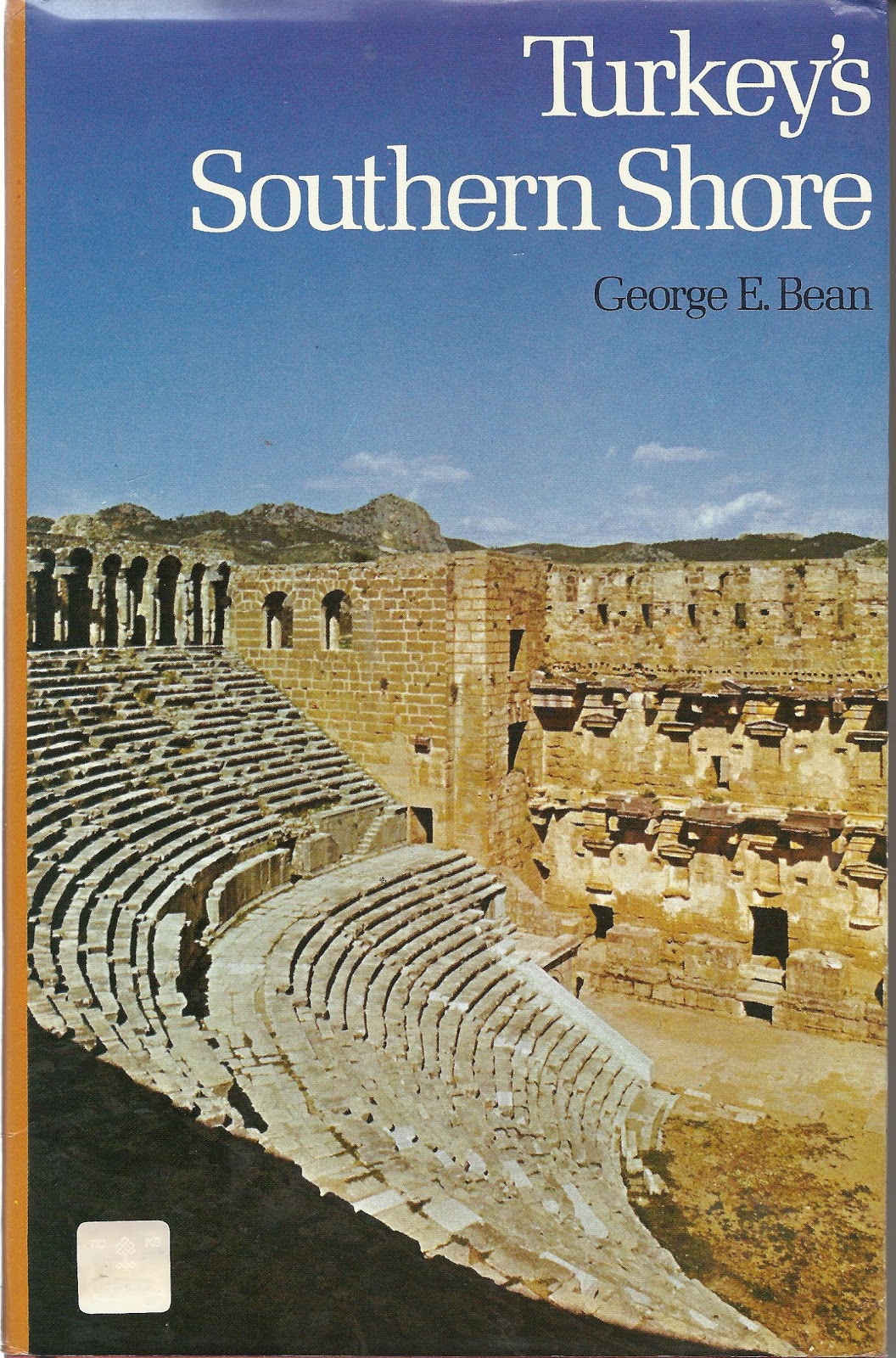
Turkey’s Southern Shore by George Bean
George Bean is a legend in this country where everybody seems to know him, has met him or their parents, relatives, neighbors have. He was a broad shouldered man of almost six foot tall and that alone was enough to impress whoever saw him. But apparently he had a most pleasant character and unlike today’s hurried archaeologists, he would simply make his way to the local coffee-house for a chat with the villagers about their daily business, the harvest and their way of living. Slowly winning their confidence, he then would bring up his interest in archaeology with surprising results.
He definitely loved this country and his deep interest for its past transpires through every line. It is surprising to discover how much history, facts and figures he manages to cramp in the story of each town he describes while at the same time he keeps things simple enough to make it passionate reading. Clear drawings, often just a few lines, illustrate his vivid tales and the book is further enhanced with a handful black-and-white pictures. No bombastic language that only an initiate can decipher, but plain words and sentences we all can understand.
In this book, George Bean mainly covers Pamphylia in southern Turkey, but also Pisidia with cities like Termessos and Selge, and Lycia with Phaselis and Olympos. When exploring Pamphylia on my own, it was a true pleasure to talk to locals about this book I carried under my arm. It was as if I were presenting George Bean’s business card for time and again I received a most warm welcome and appreciative words towards this esteemed author. Unbelievable!
Beside his “Turkey’s Southern Shore”, George Bean wrote another three books, “Aegean Turkey”, “Lycian Turkey”, and “Turkey Beyond the Maeander”. You may have a hard time finding any of them though; best chance is a second hand acquisition. Each and every one of these books is a precious tool and an unequaled jewel very much worth the effort looking for.
Thursday, March 14, 2013
Admiration for Alexander, or adulation, or veneration?

One of the most striking and best-known images of Alexander is, without doubt, the mosaic discovered in the Villa of the Faun in
Even in our modern times, I hear many tales of people creating Alexander shrines in their homes, enhancing their interiors with copies of statues, and wearing Alexander coins around their necks. In the third century already, a Roman aristocratic family wore coins with Alexander's image as jewels or stitched onto their garments. They reportedly ate from plates carrying a picture of his face and used unique bowls telling his life story! And this was only the beginning, of course. Shortly afterward, it became fashionable among the people of
King Louis XIV of France took great interest in Alexander the Great and proclaimed himself the new Alexander – why not? He commissioned a series of paintings by Charles Le Brun to enhance his palaces. Since the French King's fashions were copied by other European courts, we see painters at work in the palaces of Italy, Spain, Germany, and Austria, bringing the saga of Alexander back to life once again.
Whether or not Alexander thought of himself as a god or simply from godly descent, once he was dead, many people considered him to be a god or at least a hero. In our modern world, either definition is hard to value as nobody anymore reaches the state of godliness. Christianity has handily replaced all the gods of the ancient pantheon with saints, so today, we would speak about sainthood and then only in the context of the Christian belief, which has nothing in common with Alexander's great exploits. The church counts many saints called Alexander, but none refer to Alexander the Great.
On the other hand, today's heroes can only be found among those achieving heroic deeds like saving a stranger from a fire, drowning, or rescuing a comrade in war. The heroics of antiquity were of a different kind, attributed to men who, in their achievements, surpassed those of ordinary people and were placed somewhere between heaven and earth. Men like Achilles and Alexander, of course, but also dynastic leaders among the Ptolemies and Seleucids. We know that when Hephaistion died, the army honored him as a hero (not waiting for the official confirmation by the Egyptian priests) – they could not have done less for Alexander.
[Top photograph: Colin Farrell as Alexander in Oliver Stone's movie]
Monday, March 11, 2013
Greek wine, not so Greek after all
The consumption of wine was widespread
throughout antiquity and not only by the Greeks or Macedonians! I just
learned that a DNA study searching for the place where the wild grape was
domesticated for the first time has been undertaken.
Botanists collected samples from grapevines all over the Near East,
i.e., southeastern Anatolia (roughly today’s
Armed with their results from ancient
winemakers in
Thanks to DNA research, botanists were able to
isolate 13 so-called founder grapes by running through a family tree of
European grapes. This ancestor grape is called “vitis vinifera,” and the very theory cancels the idea that most
Western European grapes supposedly came independently from various places in
the Middle or Near East or
It is pretty interesting to learn that wild
grapevines still grow in gullies and washes somewhere between the Turkish
cities of Elazig and
Unfortunately, these ancestral wonders are
endangered by a virus called phylloxera, which in the late 19th century
annihilated so many vineyards all over
It is quite dramatic to realize that these
precious grapevines that have survived so many centuries and even millennia
might soon disappear forever.
Saturday, March 9, 2013
Good news from the Museum of Olympia
Presently, the Greek police are proud to announce that all the stolen items have been recovered in Patras, when a gold ring from the collection was put up for sale. A police officer posing as a potential buyer was presented with a 3,200-year-old gold ring with a starting price of 1,5 million Euros, which soon dropped to 300,000 Euros. This ring eventually led to the other stolen items, which had been buried in the fields near Patras.
All is well that ends well …
Wednesday, March 6, 2013
Ancient Greece in full Technicolor
Greek statues and temples in full Technicolor? It is a very shocking idea that colors are obvious, but it is much closer to the truth than one would expect initially.
The first color reconstruction I ever saw was a corner of the Alexander Sarcophagus at the Archaeological Museum in Istanbul, and honestly, I thought it was somewhat exaggerated. The colors were simply too bright, too blunt, too plain, and did in no way match my concept of Greek perfection. It wasn’t until I unexpectedly stopped at the rarely visited Macedonian Tomb of The Judges and the Tomb of the Palmettes that I was entirely taken by the charm and exotic feeling of the bright yet delicate polychromy.
A few years ago, I saw the painstaking
reconstruction work done by the team of Prof. Vinzenz Brinkman on TV and their
ensuing display at the Liebieghaus in
I lost track of these precious objects until
last summer when I found the “Bunte Götter” (Gods in Colour) catalog as I
visited Die Rückkehr der
Göter in
One of my favorites is the figure of an archer,
identified by some as Prince
Paris of
This is an entirely new way to look at early
Greek marble sculptures and ornamentation. Who would have expected such
magnificent dresses, bright details, or colorful statues decorating ancient
Greek temples, tombs, and perhaps even houses? I remember the circle of Kore as it stood in
the old
Polychrome paintings were not limited to early
Greek statues alone, although they may be the most rewarding
examples. The technique was applied widely, covering pediments, friezes, walls, and ceilings of temples and tombs, decorating theatres and other public places,
terracotta statuettes like those of the well-known
I can’t wait till they tackle Alexander the Great. Wouldn’t it be wonderful to see the actual color of his hair and if he really suffered from heterochromia (one blue and one brown eye, according to Peter Green)? That will be the day!
Saturday, March 2, 2013
Exploring Olympos, next to Chimera
Back on the dirt road, I am directed towards a temple through lush greenery. In a clearing, the five-meter-high temple doorway suddenly faces me. It has a beautifully decorated lintel with consoles of big acanthus leaves at each corner and unfinished pearl motifs around the sides of the door jambs. This portal belongs to a Roman Temple built in Ionic style, apparently between 161 and 180 AD, according to an inscription stating that it once held a statue in honor of Marcus Aurelius. I peep around the corner, but except for the entrance, there are hardly any walls to speak of, and the floor is a rubble of broken blocks that may be sorted out one day. Somebody took the measurements of this temple, however, and came up with 10.5 by 12.5 meters.
I jump over a few narrow streams, but I stop in my tracks at the sight of an aqueduct (a walled canal system according to the Turkish translation) running parallel with one of the rivulets. My path follows the bottom of the canal, one meter wide by one meter high, I guess. How exciting! It runs straight, makes a sudden turn, joins up with a side canal, and runs on further into the thickets. I keep marveling at this centuries-old work of art that still carries traces of paint, and I reflect on how easy it would be to lead the spring water back through the bedding of this aqueduct.
On the right-hand side of the U-shaped podium stands the so-called Hoplon Sarcophagus (one of the foremost families of Olympos), made of white marble with gray veins imported from Marmara Island, that has approximately the same measurements as the previous one. The longer side is decorated with three stylish garlands, and the inscription on the podium reads: "Hoplon from Olympos built this grave for his relatives, father and mother, himself, nephew Gagatis and his wife Melitine." Any other person will be fined and thrown out. No kidding! The sarcophagus on the left is of the chest type and not as well preserved. I'm amazed to learn that it is made of crystallized white marble when staring at this grayish-dark tomb, whose long side has been pieced together again. Its measurements are again comparable to the two other tombs in this Mausoleum.
Returning along the channel to the main road, I glimpse slender arched windows resting on a polygonal wall of what once were the Harbor Walls on the other side of the river. It is hard to imagine that both banks of this now shallow stream, half hidden in the reeds and sweet laurel, were a sheltered mooring place for the ships sailing the Aegean! But it definitely is a unique photo opportunity.
I now reach the place where the Acropolis rises high above the city, but I find it far too risky to climb, even if the view over the beach must be worth it! In the shady thickets at the bottom of this hill, I come across a lonely sarcophagus dedicated to Antimachos. It is a typical Lycian saddle-back model from the end of the 2nd century AD. Nothing special or out of the ordinary, but finding it so unexpectedly in the middle of nowhere is exciting! The pseudo-door on the short end represents the entrance to Hades, the underworld, while the family tree motive on the corner plaster stands for eternity – a tradition that started around 3000 years BC, so it says.
Right next to the beach and protected by an unkept, rough wooden fence, I see two splendid examples of vaulted sarcophagi – thoroughly cleaned and restored. The one facing me carries a relief of a galley – a rarity, I am told. The Greek inscription in the frame above states that the tomb belonged to Captain Eudemos, who sailed to the Marmara and the Black Sea and had a good reputation. He had honorary citizenship of Chalcedon (today, part of Istanbul). The boat resembles a sponge fishing boat with a relief of Aphrodite on the keel, who is supposed to protect the sailors. There is another inscription next to the framed one saying:
The second sarcophagus is less photogenic but carries a lengthy Greek text without explanation or translation. Such a pity, for it may have revealed interesting details or the reason why it was put in this protected place.
The beach view exceeds my expectations as the entire setting, with the river and the rock formations, is so different from what I have seen in Lycia before. On my left, to the North, I see modern houses and hotels leading to Kemer. Higher up the opposite southern hill lies the ancient Olympos city, quite an idyllic place with an arched rock enhancing the view. I take a break to enjoy the scenery before I trace my steps back on the dirt road.
I remember seeing a signpost pointing across the river towards the Theater, and I walked back to that point. The riverbank is steep and slippery, but I find the path running over boulders carefully laid for a daring visitor like me. On the opposite bank, I dive into the thickets again, hoping to find the Theater - and I do! This Theater from the first half of the 2nd century AD is definitely Roman and resembles the one in Phaselis, but is in much poorer condition, probably due to the earthquake of 141 AD and more so after the quake of 240 AD. Unfortunately, during the Middle Ages, much of the material was removed for other constructions. I enter through a promising vaulted paradox but find very scattered tiers of seats. Amazingly, the archaeologists could identify twenty rows of seats after all, but it helped that the Theater was carved in the bedrock.
I walk on in the general direction of the Harbor when, suddenly, I see a good-sized limestone sarcophagus above me. The billboard reveals this is the Tomb of Alcestis or Aurelius Artemias and family from the 2nd century AD. The reliefs are worn down, but I recognize a figure of Nike on each of the four corners. The garlands and figures of Eros that stand for the four seasons are better preserved. On the long side, I find Artemis and her husband saying their goodbyes when leaving this world. The short sides are in better condition. One side shows a standing man and a veiled woman, and the other a veiled woman with a mace-bearing figure of Heracles, hence the deduction that the female figure may represent Omphale, but more likely Alcestis.
Reading up on its history, I learned that Olympos was founded in Hellenistic times, and by 100 BC, it was a major city with three votes in the Lycian League. During the 1st century BC, it was home to many pirates who threatened the interests of the Roman Empire, culminating in the conquest by Cilician pirates. Their leader was Zeniketes, who introduced the cult of Mithras exclusively for men, demanding the ritual sacrifice of bulls for the soul to gain redemption and immortality. In 78 BC, the Roman proconsul P. Servilius Vata chased and captured Zeniketes, razing the city to the ground. After the final defeat of the pirates in a significant sea battle by Pompey, the city became Roman, and the land was sold to new settlers. Roman soldiers continued the cult of Mithras, which spread across the entire Empire. In many garrison cities, Mitraea ceremonies developed in which the bull-killing god was worshiped.
In 130 AD, Hadrian visited Olympos and the Granary on the river's south bank, probably dating from this time. In the aftermath of the earthquake of 141 AD, it was again Opramoas of Rhodiapolis who donated 12,000 denarii "for festivities in honor of Hephaistos and the Emperor." The peak of development was reached during the 2nd and 3rd centuries AD, for after that, the lower city was sacked by pirates, and the population entirely abandoned Olympos in the 6th century AD. A true story of conquests and conquerors!
Tuesday, February 26, 2013
Chimera's eternal flames
Chimera, once ornated with a Temple of Hephaistos, the Roman Vulcan, and god of fire, is now known by its Turkish name Yanartaş, meaning “burning mountain”. This is where the famous Bellerophon defeated the Chimera, a mythical fire-breathing being, partly lion, partly goat, partly snake, with the aid of his winged horse Pegasus. The Chimera may have been an important religious place of pilgrimage, dedicated to the blacksmith god – the legend going back to 1200 BC at least. The Chimera is the place where gasses from the entrails of the earth escape through cracks and holes in the rock and spontaneously start burning when in contact with the outside air. It is said that in antiquity the flames were higher and brighter, an ideal beacon for the seafarers. Alexander definitely must have seen this "fire mountain" in the shade of Mount Climax where the waves bowed to him.
Once again, I am the first visitor of the day. Originally, I planned to visit Olympos first and walk up to the Chimera from there, but I think it is wiser to do the climbing before the heat of the day picks up. According to my Sunflower Guide, the trip should take me between 20 and 30 minutes, at first ascending over a track and then over a stepped, well-maintained footpath through pine forests, following the red and white flashes of the Lycian Way. This information is entirely correct. The Lycian Way runs over a distance of more than 500 kilometers all across Lycia. It is comforting to know that this is not an isolated trail and I am glad I took my walking stick to help me up the high steps.
A big rock along the trail carries a red-painted message “400 m” and I wonder what it means. Have I climbed to a height of 400 meters, have I walked 400 meters of the trail, or it is still 400 meters to the first flames? It surely has something to do with the Lycian Way running over this path, but that does not solve this enigma. Well, whatever. I scramble and groan my way further upwards and quite suddenly I reach an open rock space where I see the first flames. I don’t remember what I had in mind but the flames are definitively brighter and bigger than I expected. Strange things in the landscape, that’s for sure!
By now more visitors are reaching the flames. Time for me to turn around! Going down is much easier although I have to move with care as the steps are higher than you would think. Back at the parking space, I wonder if I could have some tea. This is Turkey after all, isn’t it? Yes, I can if I can wait that is because they just started the fire. I look at a kind of wood-burning stove with a high stovepipe and three (tea?) pots hanging from the hooks around it. A strange contraption that I don’t try to figure out. I settle for ice cream instead.
Wednesday, February 20, 2013
Mount Nemrud, as close as you can come to the gods
As I'm approaching Kâhta in south-eastern
When the van stops, I appear to be in a place
called Karakuş, i.e., a kind of
tumulus framed by two columns with an eagle on top keeping watch. This is the Tomb of King Mithridates II (124-87 BC).
In the back of the tumulus, I discover another set of two columns that were once topped by lions. Halfway in between stands a lonely column carrying a relief of
King Mithridates holding the hand of
his wife, Laodike. Mithridates ruled over the Commagene Empire, just like Antiochus I, the builder of Nemrud, and
his tomb is a discreet promise of what lies ahead. Since this is the first time
I'm confronted with the Commagene, I need
to dig back into history.The van drives on for another hour to stop at an idyllic mountain terrace with eating facilities situated amidst apple orchards. The view is superb, and I have no idea how much further or higher I'll have to climb, for it already feels like I have reached the mountain range. The black ribbon of our road winds away in the landscape and disappears beyond the horizon into the unknown. Picking up the drive again, the van rattles over occasional brick-paved or totally unpaved roads. On a steep hill, it suddenly comes to a final halt; this is the end. The last stretch has to be climbed on foot, although I still fail to see the colossal heads that must be out there somewhere. After half an hour of huffing and puffing, scrambling over high steps up the rough slope, I finally reach the top at
What a place, however, for a sanctuary! It's hard to come any closer to the gods, I think. The view from up here beats everything I have ever seen and surpasses any possible description. It is too grand, too wide, and too panoramic to comprehend. I take pictures, perfectly realizing that the eye sees far more than my camera, but the temptation is far too big. I'm genuinely standing on top of the world! Who says that's in the