Alexandria's founded by Alexander

Alexandria's founded by Alexander the Great (by year BC): 334 Alexandria in Troia (Turkey) - 333 Alexandria at Issus/Alexandrette (Iskenderun, Turkey) - 332 Alexandria of Caria/by the Latmos (Alinda, Turkey) - 331 Alexandria Mygdoniae - 331 Alexandria (Egypt) - 330 Alexandria Ariana (Herat, Afghanistan) - 330 Alexandria of the Prophthasia/in Dragiana/Phrada (Farah, Afghanistan) - 330 Alexandria in Arachosia (Kandahar, Afghanistan) - 330 Alexandria in the Caucasus (Begram, Afghanistan) - 329 Alexandria of the Paropanisades (Ghazni, Afghanistan) - 329 Alexandria Eschate or Ultima (Khodjend, Tajikistan) - 329 Alexandria on the Oxus (Termez, Afghanistan) - 328 Alexandria in Margiana (Merv, Turkmenistan) - 326 Alexandria Nicaea (on the Hydaspes, India) - 326 Alexandria Bucephala (on the Hydaspes, India) - 325 Alexandria Sogdia - 325 Alexandria Oreitide - 325 Alexandria in Opiene / Alexandria on the Indus (confluence of Indus & Acesines, India) - 325 Alexandria Rambacia (Bela, Pakistan) - 325 Alexandria Xylinepolis (Patala, India) - 325 Alexandria in Carminia (Gulashkird, Iran) - 324 Alexandria-on-the-Tigris/Antiochia-in-Susiana/Charax (Spasinou Charax on the Tigris, Iraq) - ?Alexandria of Carmahle? (Kahnu)

Thursday, March 21, 2013

Side didn’t put up any resistance to Alexander

The name Side means “pomegranate,” a well-known fertility symbol in antiquity that we also find on coins. The origin of Side itself is shrouded in mystery. Arrian tells us that the city was founded by people from Cyma, a town north of Smyrna (modern Izmir). However, if we believe Eusebius, the city was settled at least two hundred years before the Trojan War, i.e., about 1405 BC. For now, neither option can be proved.

In antiquity, however, Side occupied a special place because of the language spoken there, which did not resemble any other known language or dialect and didn’t sound like Greek. It was unique to Side if we believe Arrian (and why shouldn’t we believe him?) Inscriptions and coins use this unique language as far back as the 5th and 3rd centuries BC. In any case, it has been determined that it can only be of Anatolian origin, i.e., proper to Pamphylia, because it is unrelated to Sillyum or Aspendos' Greek dialects. Greek started to be used only after the conquest of Alexander the Great, which is supported by an inscription from about 300 BC.

On his march through Pamphylia in the early spring of 333 BC, Alexander took possession of Side. Not much has been said about it, just that he left a garrison behind before moving on to Sillyum. 

After his death, his general Ptolemy ruled the city until the Seleucid Dynasty took over in the 2nd century BC. Later on, Side was included in the Pergamon Empire. However, the town was involved in the profitable piracy business, and the Cilicians used it as a pivotal base for their slave trading. When Emperor Pompey expelled the pirates in 67 BC, the people of Side hurriedly erected a statue in his honor. The city flourished under Roman occupation but weakened as soon as the empire fell apart. This is evidenced by the city walls built about the fourth century inside the once larger city limits.

However, there was a short revival in the fifth and sixth centuries. The theater was repaired, and a new Forum was built in honor of Arcadius (395-408), as well as several other buildings. But the Arab invasion of the 7th century caused its final decline, and by the end of the 10th century, the few remaining inhabitants moved to the newly founded Antalya. The last people who lived here were the Seljuks in the 12th century. We have to wait till 1895, when Greek Muslims migrated from Crete and sought refuge among the ruins. The new village called Selimiye is consequently built on top of the old Side. Finding the ancient remains among today’s houses, gardens, and alleys takes some detective work. On the other hand, a large part of the antique city is still buried under drifting sand, especially in the northeastern corner, where the Roman city walls literally disappear in the dunes.

A parking lot has been built at the city entrance, and I’m glad I can leave my car there and don’t have to figure out the narrow street pattern. I am lucky to enter the city exactly where I wanted, meaning through the Hellenistic Gate (Megale Pyle) from the 2nd century BC, with its two round towers, just like the ones in Perge, but in much poorer condition. If I had not seen the Hellenistic Gate in Perge, I would have missed this one entirely, and it would have been complicated to imagine what the towers looked like.

The shocking picture here is the newly asphalted road, a coat smeared over and on top of the old Roman pavement – a barbarian crime, nothing less!

Behind me rise the impressive remains that belong to a large Nymphaeum, another mental link for me, this time with Sagalassos. I didn’t expect to find a fountain of this size in Side. The explanation panel is set up in Turkish, English, and German, with a drawing of the fountain’s reconstruction. This Nymphaeum dates from the 2nd and 3rd centuries, just like most of the ruins around here – i.e., the heydays of the Roman Empire.

The antique and now asphalted colonnaded street runs past elegant remains of a covered sidewalk with shops behind them. I can walk freely among these remains, which adds to the charm. I climb to the top of one of the sand dunes, hoping to spot the sea, and I do. In fact, my view reaches as far as Alanya to the east, while in the north, I’m stopped by the peninsula of Side. Inviting dark blue water splashes against the rocks and sunken ruins, creating a screen of thousands of sunlit stars.

I move on and climb to the next dune top, and from here, I clearly see the large Theatre, but that is for later, as I’m close to the beach and decide to walk to the old port, which is now entirely silted up. I pass impressive ruins with column stubs belonging to a Nymphaeum of which only the facade is still standing. The space in front was once occupied by the Agora, measuring nearly the standard 100 x 100 meters, but I miss the shops that usually surround it. Remains of columns and ceiling caissons lie everywhere, and I can’t help thinking that the sand surely will damage these carvings (a standard abrasive) – not the happiest way to preserve ancient stones.

The road now leads me to the center of today’s Selimiye, with a continuous row of restaurants and souvenir shops on either side. The merchants and waiters try all the tricks in the book to draw the attention of the tourists. Nothing has changed since antiquity.


At the end of the next side street, the white marble columns of the Temple of Apollo appear, the standard picture in every travel guide, which now becomes real. The effect of Carrara marble against the intense blue sky and sea is simply perfect. From between the arches of nearby Lima Basilica, I take my first pictures. At the same time, I marvel at the size of this Basilica from the 5th/6th century, which remained in use for many more centuries in a reduced size.

The longer I stare at those few slender columns of the Temple of Apollo, the more I see. The delicate, not entirely Corinthian capitals support a pediment decorated with numerous individual faces staring down at me. Somewhere between the broken marble on the floor, I find a piece of the pediment with one of those faces, finely decorated edges with lion heads; this temple must have been something extraordinary. Next to it, I should find its twin, a temple dedicated to Artemis, but I fail to see anything indicating the presence of a building. As always, the location has been chosen with perfection and is no less impressive than the location of Cape Sounion in Greece.

Back in the streets of Selimiye, I get terribly annoyed by the noise, the cars, and the tourists, but above all by this idiotic asphalted street still lined with stubs of the original colonnade. I discovered the remains of the Roman Baths, the so-called Harbor Baths from the second century, but since modern houses have been built inside and against the old walls, it is difficult to get a clear overall picture. These baths must have been quite large, measuring 36 x 19 meters, but it is a pity to find them in such poor shape.

Finally, I arrive at the theater, which has been considerably propped up, and the many vaults are reinforced with iron beams. I wonder how safe it is to get inside. I always find a theater a fascinating place to visit, where the past remains so palpable simply because, over the centuries, thousands of people have walked through its open or vaulted corridors or chatted comfortably sitting on the stone benches. The entrance takes me immediately to the diazoma, the promenade halfway through the theater, right in the middle. It is said to be one of the largest theaters in Pamphylia and should hold approximately as many people as the one in Aspendos. This is hard to judge because the scene is poorly preserved, and almost nothing is left from the backstage wall (paraskenia), either. From the coolness of the vaults, I admire its location amidst the sand-covered remains behind which the entire coastline unfolds towards Alanya.

The sides and upper parts of the theater are off-limits because of the danger of collapse, but most of the “safe” parts have been well restored. Like the city, this is clearly Roman, although there was originally a Greek theater on this spot. Meanwhile, I have stepped all the way down, and when I look back over my shoulder, I’m surprised by the height. Of the people at the entrance to the diazoma, I only see their heads. This was the first time in my life that I felt dwarfed in a theater, overwhelmed by the entire construction. I walk to both extremities of the semi-circle while admiring the decorated remains on the podium. It is said that the scene was completely overgrown with trees and bushes when it was first discovered, tearing the construction apart. Comparing the pictures George Bean took in the 1960s (see: Turkey’s Southern Shore) with today’s appearance, it is evident that a lot of work has been done. After a while, I climb back to the diazoma to find that the stairs to the upper seats start in the vaulted corridor – there was no outside access in this theater.

Back outside on the main street, I automatically reach the small Temple of Dionysus attached to the remains of the Arch of Vespasian. The cars must drive underneath the Arch, taking turns since the opening is not wide enough to enable two vehicles to pass together. When in the 6th and 7th centuries, the population of Side had shrunk considerably, this Arch became a city gate in the newly built protection wall. In a way that is still visible today, because, beyond this point, the modern restaurants and shops stop, giving way to the ruins of the antique stores with walls reaching approximately one or two meters high. One of these stores is quite unique because the owner's living quarters were located behind the up-front store, and in one of the rooms, I even discovered the original mosaic floor still in place.

To the right of the Triumphal Arch of Vespasian are the remains of a Nymphaeum, squeezed between the street and the space that belongs to the Archaeological Museum. This museum has been set up inside the well-preserved Roman Baths. It is one of those rare occasions where I can have a real feel of what such baths must have looked like in spite of the modern concrete roofing that seems to blend in elegantly. Entering through two arched doorways, I access the frigidarium, the coldest part of the baths; next is the sweating room, and finally, I reach the largest room, the caldarium or hot room, where pipes of the floor-heating system are still visible in places; the last two rooms were the tepidarium or washing rooms. The marble floors and the walls of the basins are in excellent condition, and the spare natural light sources add to the genuine feeling. Among the statues and other artifacts of the collection, I cannot find many striking pieces, except for an inscription in the language of Side, which I have never encountered before, and a Pamphylian sarcophagus from the 2nd century with high reliefs of dancing cupids under the sloping roof festooned with lion heads. The less important or broken pieces have found refuge in the adjacent garden, but are undoubtedly worth a visit; also, the workshop where a richly decorated sarcophagus is being painstakingly pieced back together.

All in all, I spent three and a half hours walking around in Old Side, purposely ignoring the modern tourist traps - lovely!

Monday, March 18, 2013

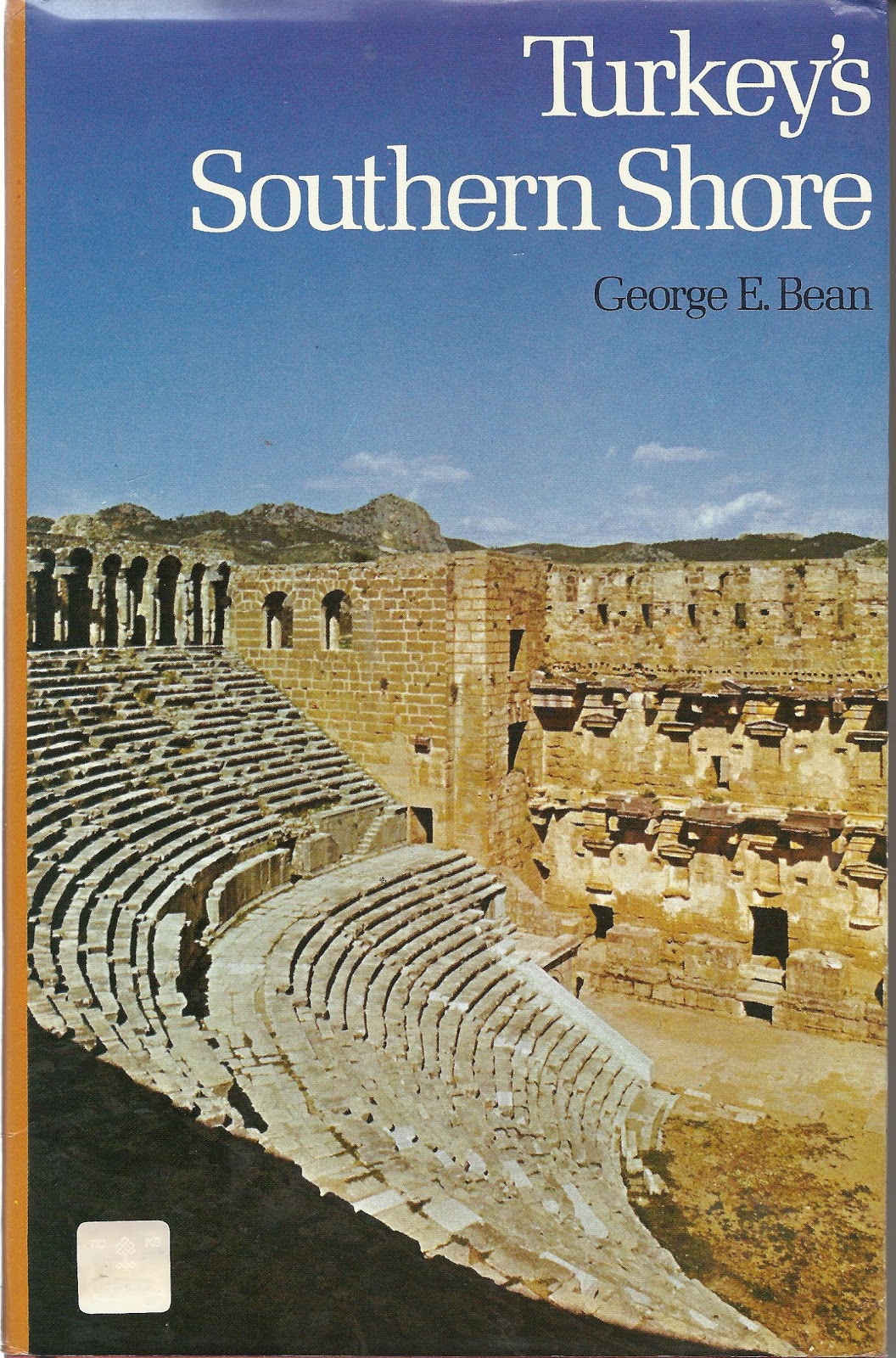
Turkey’s Southern Shore by George Bean

"Turkey’s Southern Shore" (ISBN 0 510 03202 8) is simply the best and most complete book one can find about the larger Antalya area in Turkey, in spite of the fact that information about accessibility and state of the excavations may be outdated since George Bean died in 1977.

George Bean is a legend in this country where everybody seems to know him, has met him or their parents, relatives, neighbors have. He was a broad shouldered man of almost six foot tall and that alone was enough to impress whoever saw him. But apparently he had a most pleasant character and unlike today’s hurried archaeologists, he would simply make his way to the local coffee-house for a chat with the villagers about their daily business, the harvest and their way of living. Slowly winning their confidence, he then would bring up his interest in archaeology with surprising results.

He definitely loved this country and his deep interest for its past transpires through every line. It is surprising to discover how much history, facts and figures he manages to cramp in the story of each town he describes while at the same time he keeps things simple enough to make it passionate reading. Clear drawings, often just a few lines, illustrate his vivid tales and the book is further enhanced with a handful black-and-white pictures. No bombastic language that only an initiate can decipher, but plain words and sentences we all can understand.

In this book, George Bean mainly covers Pamphylia in southern Turkey, but also Pisidia with cities like Termessos and Selge, and Lycia with Phaselis and Olympos. When exploring Pamphylia on my own, it was a true pleasure to talk to locals about this book I carried under my arm. It was as if I were presenting George Bean’s business card for time and again I received a most warm welcome and appreciative words towards this esteemed author. Unbelievable!

Beside his “Turkey’s Southern Shore”, George Bean wrote another three books, “Aegean Turkey”, “Lycian Turkey”, and “Turkey Beyond the Maeander”. You may have a hard time finding any of them though; best chance is a second hand acquisition. Each and every one of these books is a precious tool and an unequaled jewel very much worth the effort looking for.

Thursday, March 14, 2013

Admiration for Alexander, or adulation, or veneration?

Alexander, more than any other conqueror or King, has fired the imagination of scores of people over the centuries. In many eastern countries, his memory is still alive as locals can point you to a road he took, a mountain path he climbed, or a fort he built. Cities, lakes, and strongholds are named after him, and legends are still being told as bedtime stories and by traveling bards.

It must have started right after Alexander died in Babylon, by his generals and soldiers alike. We will remember how the men insisted on saying their goodbyes to their dying King. Despite their differences, they carried him in their hands when they refused to join him in his attempt to reach the outer eastern ocean, the end of the world as they knew it. Alexander's generals fought for nearly forty years to rule over at least part of his empire, maybe out of greed or ambition. Still, it all goes back to their admiration for Alexander and desire to follow in his footsteps.

The fight over his corpse is another sign. We must be thankful to Ptolemy that he snatched Alexander's funeral carriage from Perdiccas' escort to Macedonia. Had Alexander's body arrived in his homeland for burial, as was customary for all Macedonian kings, we may never have heard of the adulation and veneration he enjoyed in the following centuries. It took some chaotic years till Macedonia had a new ruler, and when this happened, it turned out to be Cassander, Parmenion's son. We know how he treated Alexander's son, Alexander IV, his wife Roxane, and his mother, Olympias! There would have been little or no hope for any respect or consideration for Alexander's body had it fallen in Cassander's hands.

We owe it to the Ptolemaic dynasty, which ended with Cleopatra of Egypt, that Alexander's body was kept "in state." In Egypt, the Great King's shrine was visited by many, the best known being the Roman Emperors. Julius Cesar is said to have wept over his tomb; Octavian, the later Emperor Augustus, laid a golden crown on the mummified corpse breaking off his nose in the process; the half-witted Caligula dressed up with Alexander's breastplate taken from the mausoleum; Vespasian must have visited the tomb since he reigned out of Alexandria instead of Rome; Hadrian crowned himself with the elephant headdress on specially issued coins in Alexandria, in an imitation of Alexander; Septimius Severus is reported to have been shocked by the accessibility of the dead King's remains and ordered the burial chamber to be sealed off; Caracalla, son of Septimius Severus, claimed to be the reincarnation of Alexander and is said to have taken some cups and weapons from the tomb. Clearly, the Roman emperors' admiration turned into adulation as they set out to imitate Alexander, whom they saw as their example and hero.

One of the most striking and best-known images of Alexander is, without doubt, the mosaic discovered in the Villa of the Faun in Pompeii. We do not know who lived in that house and ordered this magnificent floor, but he must have been quite an admirer of Alexander, an adulator even.

Even in our modern times, I hear many tales of people creating Alexander shrines in their homes, enhancing their interiors with copies of statues, and wearing Alexander coins around their necks. In the third century already, a Roman aristocratic family wore coins with Alexander's image as jewels or stitched onto their garments. They reportedly ate from plates carrying a picture of his face and used unique bowls telling his life story! And this was only the beginning, of course. Shortly afterward, it became fashionable among the people of Constantinople to wear an Alexander coin on their heads to protect them from evil. Alexander's effigy soon appeared on coins and medallions of all sizes and shapes. Pure veneration, isn't it?

In the footsteps of the Roman Emperors, later rulers would be treading. Napoleon wishfully considered that he had found Alexander's tomb during his campaign in Egypt, but it turned out to be that of Nectanebo II. The so-called Alexander sarcophagus, now in the Archaeological Museum of Istanbul, depicting a fighting Alexander, never contained his body; it was found in Sidon and was made by a Phoenician admirer of the King.

Tsarina Catherine of Russia was inspired by Alexander and named her grandson after him, telling him about the extraordinary exploits of his illustrious namesake. In a way, her ambition to build a vast empire was similar to Alexander's. In fact, when the Russians adopted the orthodox religion from the tenth century onward, the Alexander tradition had been carried over, and he became their hero.

King Louis XIV of France took great interest in Alexander the Great and proclaimed himself the new Alexander – why not? He commissioned a series of paintings by Charles Le Brun to enhance his palaces. Since the French King's fashions were copied by other European courts, we see painters at work in the palaces of Italy, Spain, Germany, and Austria, bringing the saga of Alexander back to life once again.

Whether or not Alexander thought of himself as a god or simply from godly descent, once he was dead, many people considered him to be a god or at least a hero. In our modern world, either definition is hard to value as nobody anymore reaches the state of godliness. Christianity has handily replaced all the gods of the ancient pantheon with saints, so today, we would speak about sainthood and then only in the context of the Christian belief, which has nothing in common with Alexander's great exploits. The church counts many saints called Alexander, but none refer to Alexander the Great. 

On the other hand, today's heroes can only be found among those achieving heroic deeds like saving a stranger from a fire, drowning, or rescuing a comrade in war. The heroics of antiquity were of a different kind, attributed to men who, in their achievements, surpassed those of ordinary people and were placed somewhere between heaven and earth. Men like Achilles and Alexander, of course, but also dynastic leaders among the Ptolemies and Seleucids. We know that when Hephaistion died, the army honored him as a hero (not waiting for the official confirmation by the Egyptian priests) – they could not have done less for Alexander.

Time and again, I'm surprised to hear how many people carry Alexander in the corner of their hearts, often with a sense of homesickness for a time they never shared and a man who never had his equal in later history. So many wanted and tried to emulate him, to no avail. Yet he should be proud of his achievements, for he left us such incredible memories. One of his prominent heritages is definitely Hellenism, which spread around the world like wildfire and persisted for centuries in the East and the West. Rome or Alexandria could not have known their grandeur without Alexander's heritage, nor could the Graeco-Bactrian or the Indo-Bactrian civilizations have flourished. Persia's revival under the Sassanid dynasty existed because of Alexander, and Christianity or even Islam could not have caught on without the Greek language, which rested on Hellenism – all this we can thank Alexander for!

[Top photograph: Colin Farrell as Alexander in Oliver Stone's movie]

Monday, March 11, 2013

Greek wine, not so Greek after all

The consumption of wine was widespread throughout antiquity and not only by the Greeks or Macedonians! I just learned that a DNA study searching for the place where the wild grape was domesticated for the first time has been undertaken.

Botanists collected samples from grapevines all over the Near East, i.e., southeastern Anatolia (roughly today’s Turkey), Armenia, and Georgia. They also analyzed the residues from wine jars thousands of years old. I am not familiar with chemical techniques, but as I understand from this article published by Phys.Org, they looked for significant amounts of tartaric acid, which, by the way, was only available from grapes in antiquity.


Armed with their results from ancient winemakers in Georgia, Armenia, and Iran, cross-checked with the traces in old clay vessels, the researchers were able to place the first domesticated Eurasian grape in southeastern Anatolia between 8,500 and 5,000 BC. Southeast Anatolia is part of the Fertile Crescent, where our civilization is claimed to have been born. This is generally the area between the Euphrates and Tigris, called Mesopotamia in today’s Iran and Iraq, and comprises southeastern Turkey, the Levant, and down to ancient Egypt. This crescent is widely accepted as being the birthplace of the world’s first known domesticated plants. 

Thanks to DNA research, botanists were able to isolate 13 so-called founder grapes by running through a family tree of European grapes. This ancestor grape is called “vitis vinifera,” and the very theory cancels the idea that most Western European grapes supposedly came independently from various places in the Middle or Near East or Egypt, Greece, or Turkey. 

It is pretty interesting to learn that wild grapevines still grow in gullies and washes somewhere between the Turkish cities of Elazig and Diyarbakir. Specialists call it an actual pilgrimage to genetically 8,000-9,000-year-old vines! It seems like finding the mother of all grapevines! 


Unfortunately, these ancestral wonders are endangered by a virus called phylloxera, which in the late 19th century annihilated so many vineyards all over Europe. It seems that wild wines are somewhat protected by their ecosystem, while cultivated varieties are highly vulnerable. Because of that, experts fear the worst for the Kurdish Diyarbakir region, where we may lose a unique genetic diversity. A remedy is to graft vines onto disease-resistant rootstock. Still, this procedure is being rejected by the local population, and eventually, the Turkish wine industry is doomed to suffer the consequences.

It is quite dramatic to realize that these precious grapevines that have survived so many centuries and even millennia might soon disappear forever.

Saturday, March 9, 2013

Good news from the Museum of Olympia

Not all the news from Greece is bad and the headlines of a recent article made me very happy: “Greek police recover stolen antiquities from Olympia”.

[picture from BBC.co.uk]

In early 2012, we got the devastating news that two masked men smashed display cabinets at the Archaeological Museum of Olympia, where some of the most valuable treasures from the temples of Olympia were kept. The robbers took 76 precious artifacts, mainly bronze and clay statuettes of apparently incalculable value. Because of austerity measures here as well as all over Greece, museum staff were reduced to a minimum, and the poor lady keeping watch in Olympia was gagged and threatened at gunpoint.

Presently, the Greek police are proud to announce that all the stolen items have been recovered in Patras, when a gold ring from the collection was put up for sale. A police officer posing as a potential buyer was presented with a 3,200-year-old gold ring with a starting price of 1,5 million Euros, which soon dropped to 300,000 Euros. This ring eventually led to the other stolen items, which had been buried in the fields near Patras.

All is well that ends well …

Wednesday, March 6, 2013

Ancient Greece in full Technicolor

Greek statues and temples in full Technicolor? It is a very shocking idea that colors are obvious, but it is much closer to the truth than one would expect initially. 

The first color reconstruction I ever saw was a corner of the Alexander Sarcophagus at the Archaeological Museum in Istanbul, and honestly, I thought it was somewhat exaggerated. The colors were simply too bright, too blunt, too plain, and did in no way match my concept of Greek perfection. It wasn’t until I unexpectedly stopped at the rarely visited Macedonian Tomb of The Judges and the Tomb of the Palmettes that I was entirely taken by the charm and exotic feeling of the bright yet delicate polychromy.

A few years ago, I saw the painstaking reconstruction work done by the team of Prof. Vinzenz Brinkman on TV and their ensuing display at the Liebieghaus in Germany. For more than 25 years, they analyzed the pigmentation of antique sculptures using digital methods whereby the originals were left untouched. New technical photographic techniques using UV light and –reflectography enabled them to disclose the painted parts of the statues. Even those areas where no pigment had survived could be revealed thanks to the chemical and mechanical transformations on the stone's surface over the centuries. They applied the matching colors on copies of existing statues based on those discoveries. It was absolutely mind-blowing and a true eye-opener.  

I lost track of these precious objects until last summer when I found the “Bunte Götter” (Gods in Colour) catalog as I visited Die Rückkehr der Göter in Cologne, Germany. It revealed that the collection of polychrome statues had grown considerably as it traveled around the world from one museum to the next, from one city to the next. Meanwhile, several of the most colorful pieces have made the headlines, and personally, I had great difficulty choosing from the superb pictures in the catalog mentioned above. I can’t wait to see them for real!

One of my favorites is the figure of an archer, identified by some as Prince Paris of Troy. It was made around 500 BC and belonged to the west pediment of the Temple of Aphaia on the island of Aegina (Greece). I can’t get enough of the vibrant colors, the patterns of his pants, the livelihood of his presence. The Persian horseman from the Acropolis in Athens shows the same patterns in the rider’s pants (today, we speak of leggings). Still, he looks less appealing because his horse is left blank since its original color cannot be defined with certitude. Another statue from that same time frame is that of Athena with striking (and at first sight, somewhat unreal) green-colored snakes at the edge of her cape. And then there is the so-called Peplos Kore (approx. 530-520 BC), whose original condition revealed traces of red, blue, yellow, and green pigments. Close scrutiny with modern technology brought this young girl to life, dressed in a ritual garment embroidered with animals, moving her to a state of godliness rather than that of an ordinary girl. This proves that the new techniques lead to new discoveries as well.  

This is an entirely new way to look at early Greek marble sculptures and ornamentation. Who would have expected such magnificent dresses, bright details, or colorful statues decorating ancient Greek temples, tombs, and perhaps even houses? I remember the circle of Kore as it stood in the old Acropolis Museum, where I marveled at the traces of color in their hair and painted earrings, wondering what they must have looked like new. Well, now I know. 

Polychrome paintings were not limited to early Greek statues alone, although they may be the most rewarding examples. The technique was applied widely, covering pediments, friezes, walls, and ceilings of temples and tombs, decorating theatres and other public places, terracotta statuettes like those of the well-known Tanagra type, sarcophagi, and even mummy portraits. The practice continued all the way through the classical Greek period and Hellenistic times, as is proven by the famous Alexander Sarcophagus from Sidon, and copied by the Romans, as shown by the impressive head of Emperor Caligula from ancient Rome. 

I can’t wait till they tackle Alexander the Great. Wouldn’t it be wonderful to see the actual color of his hair and if he really suffered from heterochromia (one blue and one brown eye, according to Peter Green)? That will be the day!

A selection of this polychromic artwork can be admired on this link: "Gods in colour".

Saturday, March 2, 2013

Exploring Olympos, next to Chimera

From the main road, I follow the signpost down to Olympos through the splendid Lycian landscape of pine trees amidst park-like grassland full of spring flowers.

Olympos has been well-investigated by the archaeologists of Antalya, but in the heavy overgrowth of spring, it looks as if everything remains to be discovered. Luckily, plenty of signs guide me through the remains hidden in the thick bushes, brushes, and swamped reeds behind the dirt road leading to the pebble beach.

I start along the north side of the river with crystal clear water (that has not changed course since antiquity), noticing the remains of a bridge that once crossed it and seems to date from Roman times. Behind the dirt road, only vague footpaths run among the tombs. They are mainly vaulted family graves bearing Greek inscriptions about the deceased on the marble lintels above the entrance gate. It is fun in a way, for it seems like detective work to locate them hidden in the clusters of low trees, half buried in eons of soil and marshy deposits.

Back on the dirt road, I am directed towards a temple through lush greenery. In a clearing, the five-meter-high temple doorway suddenly faces me. It has a beautifully decorated lintel with consoles of big acanthus leaves at each corner and unfinished pearl motifs around the sides of the door jambs. This portal belongs to a Roman Temple built in Ionic style, apparently between 161 and 180 AD, according to an inscription stating that it once held a statue in honor of Marcus Aurelius. I peep around the corner, but except for the entrance, there are hardly any walls to speak of, and the floor is a rubble of broken blocks that may be sorted out one day. Somebody took the measurements of this temple, however, and came up with 10.5 by 12.5 meters.


I jump over a few narrow streams, but I stop in my tracks at the sight of an aqueduct (a walled canal system according to the Turkish translation) running parallel with one of the rivulets. My path follows the bottom of the canal, one meter wide by one meter high, I guess. How exciting! It runs straight, makes a sudden turn, joins up with a side canal, and runs on further into the thickets. I keep marveling at this centuries-old work of art that still carries traces of paint, and I reflect on how easy it would be to lead the spring water back through the bedding of this aqueduct.

I stop at the remains of an imposing Mausoleum on my left, built for three tombs and called the Lyciarch Grave, dating from the second half of the 3rd century AD. Originally, it was roofed with a vault that had collapsed. The rough outer walls now shelter only two sarcophagi, as the central and most beautiful one has been taken to the Museum in Antalya. Measuring 2.4 x 1.15 m and one meter high, the crystallized white marble is decorated with columns and band motifs in relief. The well-preserved lid shows a couple, a man, and a woman, lying down. I must have seen it in Antalya earlier this year, but I probably didn't pay too much attention. One of the billboards gives a translation of the inscription that was found on the tomb: "I, Lyciarch Marcus Aurelius Archepolis from Olympos, also known as Hoplon, son of Rhesimachos also called Diotimos (constructed) this grave for my dear father Rhesimachos, also called Diotimos and my dear brother Marcus Aurelius Menodoros, also called Rhesimachos, and for myself and for the persons that I determined in my will. There will be no permission for any other person to be buried in it. Otherwise, the burying person will pay 2,000 silver coins to the Sacred Treasury of the Empire". Five generations in all have been buried here together.

On the right-hand side of the U-shaped podium stands the so-called Hoplon Sarcophagus (one of the foremost families of Olympos), made of white marble with gray veins imported from Marmara Island, that has approximately the same measurements as the previous one. The longer side is decorated with three stylish garlands, and the inscription on the podium reads: "Hoplon from Olympos built this grave for his relatives, father and mother, himself, nephew Gagatis and his wife Melitine." Any other person will be fined and thrown out. No kidding! The sarcophagus on the left is of the chest type and not as well preserved. I'm amazed to learn that it is made of crystallized white marble when staring at this grayish-dark tomb, whose long side has been pieced together again. Its measurements are again comparable to the two other tombs in this Mausoleum.

My canal road takes me further into the bushes, and after a sharp left turn, the soil is rather swampy and muddy. I move cautiously between the reeds and yellow irises, following the sign "Mosaics." And here they are, pieces of a two-story building that may have been a Basilica or the Bishop's Residence built at the end of the 5th century AD. The rough walls show decorative brickwork, and I find plenty of mosaics representing birds and other animals on the floor of the asymmetrical rooms.

Returning along the channel to the main road, I glimpse slender arched windows resting on a polygonal wall of what once were the Harbor Walls on the other side of the river. It is hard to imagine that both banks of this now shallow stream, half hidden in the reeds and sweet laurel, were a sheltered mooring place for the ships sailing the Aegean! But it definitely is a unique photo opportunity.

I now reach the place where the Acropolis rises high above the city, but I find it far too risky to climb, even if the view over the beach must be worth it! In the shady thickets at the bottom of this hill, I come across a lonely sarcophagus dedicated to Antimachos. It is a typical Lycian saddle-back model from the end of the 2nd century AD. Nothing special or out of the ordinary, but finding it so unexpectedly in the middle of nowhere is exciting! The pseudo-door on the short end represents the entrance to Hades, the underworld, while the family tree motive on the corner plaster stands for eternity – a tradition that started around 3000 years BC, so it says.

Right next to the beach and protected by an unkept, rough wooden fence, I see two splendid examples of vaulted sarcophagi – thoroughly cleaned and restored. The one facing me carries a relief of a galley – a rarity, I am told. The Greek inscription in the frame above states that the tomb belonged to Captain Eudemos, who sailed to the Marmara and the Black Sea and had a good reputation. He had honorary citizenship of Chalcedon (today, part of Istanbul). The boat resembles a sponge fishing boat with a relief of Aphrodite on the keel, who is supposed to protect the sailors. There is another inscription next to the framed one saying:

"The ship has entered and anchored in the last port, for not to go out any more
For there is no more benefit from the wind nor from the daylight
After leaving the morning twilight captain Eudemos
Buried there his short-lived ship like a broken wave.


The second sarcophagus is less photogenic but carries a lengthy Greek text without explanation or translation. Such a pity, for it may have revealed interesting details or the reason why it was put in this protected place.

The beach view exceeds my expectations as the entire setting, with the river and the rock formations, is so different from what I have seen in Lycia before. On my left, to the North, I see modern houses and hotels leading to Kemer. Higher up the opposite southern hill lies the ancient Olympos city, quite an idyllic place with an arched rock enhancing the view. I take a break to enjoy the scenery before I trace my steps back on the dirt road.

I remember seeing a signpost pointing across the river towards the Theater, and I walked back to that point. The riverbank is steep and slippery, but I find the path running over boulders carefully laid for a daring visitor like me. On the opposite bank, I dive into the thickets again, hoping to find the Theater - and I do! This Theater from the first half of the 2nd century AD is definitely Roman and resembles the one in Phaselis, but is in much poorer condition, probably due to the earthquake of 141 AD and more so after the quake of 240 AD. Unfortunately, during the Middle Ages, much of the material was removed for other constructions. I enter through a promising vaulted paradox but find very scattered tiers of seats. Amazingly, the archaeologists could identify twenty rows of seats after all, but it helped that the Theater was carved in the bedrock.

I walk on in the general direction of the Harbor when, suddenly, I see a good-sized limestone sarcophagus above me. The billboard reveals this is the Tomb of Alcestis or Aurelius Artemias and family from the 2nd century AD. The reliefs are worn down, but I recognize a figure of Nike on each of the four corners. The garlands and figures of Eros that stand for the four seasons are better preserved. On the long side, I find Artemis and her husband saying their goodbyes when leaving this world. The short sides are in better condition. One side shows a standing man and a veiled woman, and the other a veiled woman with a mace-bearing figure of Heracles, hence the deduction that the female figure may represent Omphale, but more likely Alcestis.

Reading up on its history, I learned that Olympos was founded in Hellenistic times, and by 100 BC, it was a major city with three votes in the Lycian League. During the 1st century BC, it was home to many pirates who threatened the interests of the Roman Empire, culminating in the conquest by Cilician pirates. Their leader was Zeniketes, who introduced the cult of Mithras exclusively for men, demanding the ritual sacrifice of bulls for the soul to gain redemption and immortality. In 78 BC, the Roman proconsul P. Servilius Vata chased and captured Zeniketes, razing the city to the ground. After the final defeat of the pirates in a significant sea battle by Pompey, the city became Roman, and the land was sold to new settlers. Roman soldiers continued the cult of Mithras, which spread across the entire Empire. In many garrison cities, Mitraea ceremonies developed in which the bull-killing god was worshiped.

In 130 AD, Hadrian visited Olympos and the Granary on the river's south bank, probably dating from this time. In the aftermath of the earthquake of 141 AD, it was again Opramoas of Rhodiapolis who donated 12,000 denarii "for festivities in honor of Hephaistos and the Emperor." The peak of development was reached during the 2nd and 3rd centuries AD, for after that, the lower city was sacked by pirates, and the population entirely abandoned Olympos in the 6th century AD. A true story of conquests and conquerors!

Tuesday, February 26, 2013

Chimera's eternal flames

Driving east from Finike, I'm heading for Chimera and Olympos. I find the car park at the foot of the hillside, next to a small café selling refreshments as mentioned in the Sunflower Guide “Turkish Coast, from Antalya to Demre”, as well as the clean toilets and the booth to buy my entrance ticket.

Chimera, once ornated with a Temple of Hephaistos, the Roman Vulcan, and god of fire, is now known by its Turkish name Yanartaş, meaning “burning mountain”. This is where the famous Bellerophon defeated the Chimera, a mythical fire-breathing being, partly lion, partly goat, partly snake, with the aid of his winged horse Pegasus. The Chimera may have been an important religious place of pilgrimage, dedicated to the blacksmith god – the legend going back to 1200 BC at least. The Chimera is the place where gasses from the entrails of the earth escape through cracks and holes in the rock and spontaneously start burning when in contact with the outside air. It is said that in antiquity the flames were higher and brighter, an ideal beacon for the seafarers. Alexander definitely must have seen this "fire mountain" in the shade of Mount Climax where the waves bowed to him.

Once again, I am the first visitor of the day. Originally, I planned to visit Olympos first and walk up to the Chimera from there, but I think it is wiser to do the climbing before the heat of the day picks up. According to my Sunflower Guide, the trip should take me between 20 and 30 minutes, at first ascending over a track and then over a stepped, well-maintained footpath through pine forests, following the red and white flashes of the Lycian Way. This information is entirely correct. The Lycian Way runs over a distance of more than 500 kilometers all across Lycia. It is comforting to know that this is not an isolated trail and I am glad I took my walking stick to help me up the high steps.

It is a rather strenuous climb and in between my huffing and puffing, I take the time to admire the spectacular Lycian landscape while sipping my water. I try to catch the moment with my camera but the outcome is poor. Everything is green, the grass and the weeds, the trees on the hillsides, and the pine trees with shiny needles in the foreground. The sharp rock formations are dull gray and the overall view is hazy because of the moisture in the air left by the rain of these past days and which the sun is trying to burn off. Somehow I am reminded of the sugar rocks around Rio de Janeiro, just as steep but not as green as here, I would say. There are however plenty of flowers, white and yellow ones mainly but also big wild lilac anemones. When I catch my breath again I can even hear the many birds singing in chorus. How wonderful!

A big rock along the trail carries a red-painted message “400 m” and I wonder what it means. Have I climbed to a height of 400 meters, have I walked 400 meters of the trail, or it is still 400 meters to the first flames? It surely has something to do with the Lycian Way running over this path, but that does not solve this enigma. Well, whatever. I scramble and groan my way further upwards and quite suddenly I reach an open rock space where I see the first flames. I don’t remember what I had in mind but the flames are definitively brighter and bigger than I expected. Strange things in the landscape, that’s for sure!

Shooting my pictures, I am amazed to see how clearly the flames are burning with a soft hissing sound and I even notice a faint smell of gas. At times there are clusters of two or three holes next to each other with flames licking the blackened rock around them. Turning around and to my left now below the flames, I see the ruins of a Byzantine church that must be standing on top of the ancient temple dedicated to Hephaistos. In fact, all I can see are the walls and cupolas still carrying clear traces of paint, but the building is mostly buried in the debris and I cannot find any indication of Roman or Greek architecture. Around the lowest fire, there are some loose carved blocks lying around that may refer to the altar that once stood in front of the Temple of Hephaistos. Who knows?

By now more visitors are reaching the flames. Time for me to turn around! Going down is much easier although I have to move with care as the steps are higher than you would think. Back at the parking space, I wonder if I could have some tea. This is Turkey after all, isn’t it? Yes, I can if I can wait that is because they just started the fire. I look at a kind of wood-burning stove with a high stovepipe and three (tea?) pots hanging from the hooks around it. A strange contraption that I don’t try to figure out. I settle for ice cream instead.

Wednesday, February 20, 2013

Mount Nemrud, as close as you can come to the gods

The road to getting there is a unique experience as tension and expectations are building up all along the way!

As I'm approaching Kâhta in south-eastern Turkey,  I first glance at the mountains topped by the perfect conically shaped Tomb of Mount Nemrud. I have no idea what to expect, for I only know the pictures of the colossal heads from many a travel magazine. Kâhta isn't much; a few hotels and car rental companies - sum it up. Yet it's the last town of any significance before reaching my destination, Mount Nemrud. From here onward, it is impossible to travel by bus, and I have to board one of the smaller vans. This is where the actual climb starts, a winding dirt road with short stretches of asphalt. I pass through settlements of about a dozen houses amidst generally bleached land. Higher up from one of the hilltops, I view the immense surrounding landscape stamped by the Euphrates River, which, because of the many dams built for irrigation purposes, looks as wide as a succession of lakes. Occasionally I pass patches of cultivated land fed by a scarce mountain stream. I don't see a single soul, although the houses seem occupied.

When the van stops, I appear to be in a place called Karakuş, i.e., a kind of tumulus framed by two columns with an eagle on top keeping watch. This is the Tomb of King Mithridates II (124-87 BC). In the back of the tumulus, I discover another set of two columns that were once topped by lions. Halfway in between stands a lonely column carrying a relief of King Mithridates holding the hand of his wife, Laodike. Mithridates ruled over the Commagene Empire, just like Antiochus I, the builder of Nemrud, and his tomb is a discreet promise of what lies ahead. Since this is the first time I'm confronted with the Commagene, I  need to dig back into history.

This region was included in the Persian Empire from the 6th century BC until Alexander the Great's victory at Issus in 333 BC. After he died in 323 BC, this part of his empire fell to Seleucos I Nikator (see: In the wake of Seleucos Nicator I). When, in turn, the Seleucid Empire was conquered by the Romans in 189 BC, it didn't take long for new kingdoms to emerge. Commagene, one of the successors of the Seleucids, occupied the area between the Taurus Mountains and the Euphrates River. The kingdom of Commagene was founded in 162 BC. In 109 BC, Mithridates Kalinikos I, who ruled over the Persians and Macedonians (descendants of Alexander the Great), joined both countries into a mighty buffer zone between the Parthians in the east and the Romans in the west. The peak of this kingdom was reached under Antiochus I Epiphanes (69-36 BC), the successor of Mithridates and thus the builder of Nemrud. Eventually, in 72 AD, the territory was annexed by Emperor Vespasian to the Roman province of Syria.

A tributary of the Euphrates, the Cendere, is a wide but short watercourse that lies across my road. It has been bridged on its narrowest point. This is not just any bridge but one that dates back to the 2nd century AD, built by the Roman Emperor Septimius Severus. I am allowed to walk across the bridge on foot, a hugely gratifying experience! Imagine threading over a 2,000-year-old bridge. It makes you wonder about its role and purpose in this isolated and steaming hot place – it definitely commands high respect for the builders as far as I'm concerned.

The van drives on for another hour to stop at an idyllic mountain terrace with eating facilities situated amidst apple orchards. The view is superb, and I have no idea how much further or higher I'll have to climb, for it already feels like I have reached the mountain range. The black ribbon of our road winds away in the landscape and disappears beyond the horizon into the unknown. Picking up the drive again, the van rattles over occasional brick-paved or totally unpaved roads. On a steep hill, it suddenly comes to a final halt; this is the end. The last stretch has to be climbed on foot, although I still fail to see the colossal heads that must be out there somewhere. After half an hour of huffing and puffing, scrambling over high steps up the rough slope, I finally reach the top at 7,700 feet.

I arrived at the very foot of a clean conical heap of loose gravel, approximately 50 meters high and 150 meters in diameter, piled up on top of the existing mountain, presumably covering the Tomb of Antiochus. In fact, this cone has been built with the material left over from carving the giant statues and many friezes that I'm about to see.


On the east and west sides, I discover the enormous statues and heads I recognize from the pictures. On the east side, a row of styled sitting figures that originally stood 8-10 meters high is facing me, their decapitated heads resting at their respective feet. From left to right, I'm identifying Apollo (equaling Mithra, Helios, Hermes); Tyche, Commagene's goddess of fertility; Zeus (equaling Ahura Mazda); Antiochus in person (why settle for less!), and Heracles (equaling Artagnes or Ares). These are, in fact, all the most important Persian and Greek gods of Antiochus' empire, and it is generally accepted that he attempted to unify his multi-ethnic kingdom to secure his authority. On either side of this group of statues stands an eagle, the symbol of freedom. Next to it is a lion, a symbol of courage. An identical group of figures stands on the western side, all decapitated as well, but catching the full sunlight this time of day. Whereas the statues on the eastern side are decorated with Asian attributes, those on the western side show European accessories – a sign of Antiochus' goal of joining the East and West.

It is unclear whether the statues have suffered from the frequent earthquakes or if some odd archaeologist tried to blow up the pile of gravel to find the still-eluding tomb of Antiochus I. The path connecting the east and west sides runs along the northern slope, where several reliefs with unrecognizable artwork have been aligned. It appears they were fitted in the ground with a kind of wedge, an intriguing feature. On the west side, a few original reliefs are still in situ, representing King Antiochus in person together with Apollo on one, Zeus on the other, and finally, Heracles on the next one.

What a place, however, for a sanctuary! It's hard to come any closer to the gods, I think. The view from up here beats everything I have ever seen and surpasses any possible description. It is too grand, too wide, and too panoramic to comprehend. I take pictures, perfectly realizing that the eye sees far more than my camera, but the temptation is far too big. I'm genuinely standing on top of the world! Who says that's in the Himalayas? I doubt you'll have such a view from there! What a beauty.

The big attraction is visiting these altars by sunrise or sunset. The thought of witnessing the sun peeping above the horizon in the great silence and peace that comes with it must be awe-inspiring and rewarding. Yet, you will not be able to enjoy the exceptional panorama I've been treated to. Besides, to get here before sunrise, you'll have to be on your way before the crack of dawn, and if you want to arrive by sunset, you'll have to face a long, scary, and dangerous drive back in the dark. I'm not sure I would like that.