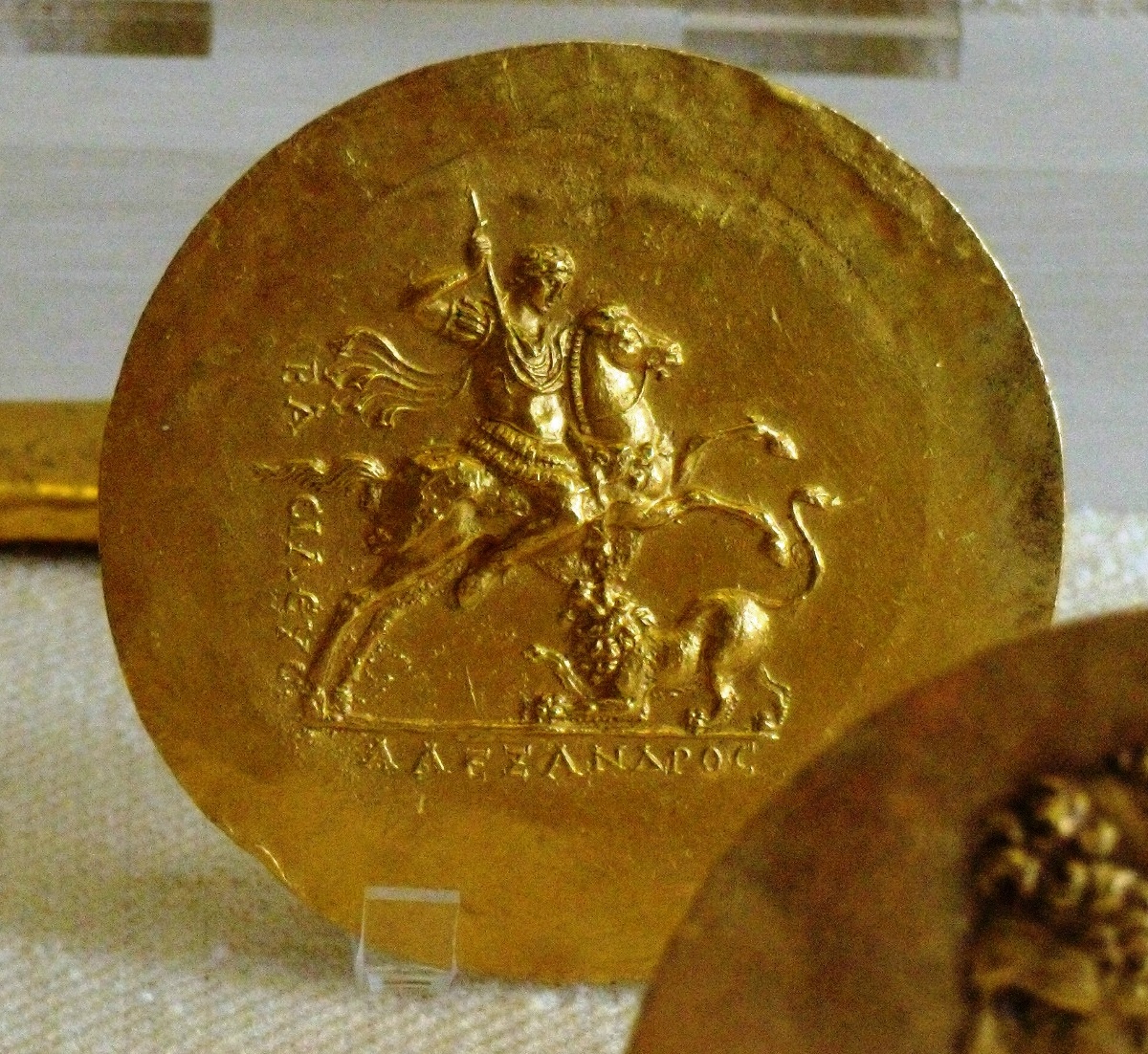
Alexandria's founded by Alexander

Alexandria's founded by Alexander the Great (by year BC): 334 Alexandria in Troia (Turkey) - 333 Alexandria at Issus/Alexandrette (Iskenderun, Turkey) - 332 Alexandria of Caria/by the Latmos (Alinda, Turkey) - 331 Alexandria Mygdoniae - 331 Alexandria (Egypt) - 330 Alexandria Ariana (Herat, Afghanistan) - 330 Alexandria of the Prophthasia/in Dragiana/Phrada (Farah, Afghanistan) - 330 Alexandria in Arachosia (Kandahar, Afghanistan) - 330 Alexandria in the Caucasus (Begram, Afghanistan) - 329 Alexandria of the Paropanisades (Ghazni, Afghanistan) - 329 Alexandria Eschate or Ultima (Khodjend, Tajikistan) - 329 Alexandria on the Oxus (Termez, Afghanistan) - 328 Alexandria in Margiana (Merv, Turkmenistan) - 326 Alexandria Nicaea (on the Hydaspes, India) - 326 Alexandria Bucephala (on the Hydaspes, India) - 325 Alexandria Sogdia - 325 Alexandria Oreitide - 325 Alexandria in Opiene / Alexandria on the Indus (confluence of Indus & Acesines, India) - 325 Alexandria Rambacia (Bela, Pakistan) - 325 Alexandria Xylinepolis (Patala, India) - 325 Alexandria in Carminia (Gulashkird, Iran) - 324 Alexandria-on-the-Tigris/Antiochia-in-Susiana/Charax (Spasinou Charax on the Tigris, Iraq) - ?Alexandria of Carmahle? (Kahnu)

Monday, June 9, 2014

Syracuse rivaled Athens to be the most powerful city

Syracuse always had a magical sound, tucked away down south of Italy on the island of Sicily, that, like no other, was and still is at the crossroads between east and west, north and south. This strategic location not only shows on the map of the Mediterranean but more so when you visit the island. That is precisely what I finally did after dreaming about it since my teenage years. Finding myself in the very heart of Syracuse, it is hard to describe what I feel or expect. I’m totally overwhelmed, as if floating on some imaginary sea, the currents taking me to the core of its great past.

It may come as a surprise to learn that Syracuse once rivaled Athens for its power over the Greek world, but as part of Magna Graecia, this was Greece away from Greece, which we have to approach from a totally different angle. Syracuse was the very first city to be settled in Sicily, and it was the Corinthians who, in 733 BC, disembarked on the small island of Ortygia just off the coast. It was soon attached to the mainland by a causeway, creating two practical harbors, one on the southwest and one on the northeast. Syracuse grew quickly and then created its own colonies, like Akrai, Kasmenai, Heloros, and Kamarina.

With its expansion came the need for some form of government. Not being happy with the Corinthian aristocrats who imposed themselves from the onset, Syracuse turned to Gelon, tyrant of neighboring Gela, a colony of Rhodians and Cretans that had settled as early as 688 BC. Gelon took his task seriously and moved the larger part of Gela’s population to Syracuse, which became his capital in 485 BC. The Syracusans must have felt they made the right decision, for Gelon was able to defeat the Carthaginians at nearby Himera five years later. However, it must be said he did so with the help of his father-in-law, Theron of Akragas (modern Agrigento). This at least kept the matter in the family. The victorious Gelon had taken thousands of prisoners of war, whom he now enslaved. The finest artisans among them built a temple at the summit of Ortygia dedicated to Athena to thank her for this victory. It probably was finished in 480 BC.

We can still admire this temple in the old town of Syracuse as an integral part of the cathedral (Duomo), whose façade was rebuilt in 1728-1754 in Sicilian-Baroque style after several earthquakes had damaged the Norman entrance. Isn’t it amazing that a place of worship has been used and reused continuously for 2,500 years? This temple was erected in the Doric style, six columns wide and fourteen deep, with doors inlaid with ivory and gold. The larger-than-life statue of Athena would have ruled over the inside, an imposing figure made of Paros marble with her face, hands, feet, and weapons of pure gold. The tympanum of the temple was enhanced with a golden shield that reflected the sunlight, a landmark to the sailors. A refined statement of the city’s wealth, no doubt, till it was taken down by a too-greedy Roman politician, Caius Verres, some four hundred years later.

In Byzantine times, the temple was converted into a church, and the cella walls were pierced to create open arches while the space between the columns was walled up. Under the Arabs, the church became a mosque. Traces of this period can be seen on the outside walls where the Muslims added crenellations above the Greek triglyphs and metopes. Upon their arrival, the Normans raised the roof and inserted narrow windows. The chestnut ceiling is a later Spanish addition (using the hard chestnut wood from the Etna region). I read all this information but still need to figure out what to expect from this sanctuary that is right around the corner from my hotel.


The Baroque façade flanked by statues of the apostles Peter and Paul, carved in pure Carrara marble, doesn’t betray what the inside has in store for me. Once I cross the threshold of the Duomo, I am stepping into another world. It literally takes my breath away as I’m immediately confronted with the interior of a Greek temple – or at least as close as one can come to it. I’m standing in the temple’s opisthodomos, looking into the north apse between the outer columns (now walled) and the wall of the cella. The Byzantines have opened that up to let the light flow through the inner sanctuary. The narrow windows the Normans inserted near the capitals of the Doric columns filter the late-afternoon sunlight. There are more windows above the vaulted walls of the inner cella, where stylish chandeliers add to the eerie atmosphere of this church. It is hard to figure out which part is Greek, Byzantine, or Norman, but the result is absolutely superb and harmonious. Along both sides of the modern nave, we can read the Latin inscription “Ecclesia Syracusana prima Divi Petri filia et prima post Antiochenam Christo dicata.” In other words, “The church of Syracuse is the first daughter of divine Peter and the first to be dedicated to Christ after Antioch,” i.e., a confirmation that this is the oldest Christian community in Europe.

Two columns from the original opisthodomos of the cella flank the entrance door. Another twelve columns on the north and nine on the south side are still in situ, sturdy Doric fluted columns almost nine meters high and two meters in diameter! The twelve columns of the north side are also visible from the Via Minerva, around the corner of the piazza. They include their architrave and triglyphs above which the Muslim crenellation has been added.

The floor of the Duomo is covered with colored marble, and I wonder about the dating of the different designs, interrupted by colorful tombstones that carry coats of arms. The main altar is typical 16th century with a painting of the Nativity of the Virgin, which I find somewhat out of place, as much as I am absorbed by the antique Greek remains. In the eastern corner is a chapel, the Cappella del Crocifisso, with ceiling frescos that remind me of the Sixteen Chapel at a very early stage. There are two more chapels along the south wall, but these are unfortunately closed at the time of my visit.

Walking back to the entrance, I get an unexpected glimpse of the north aisle and notice three commanding statues positioned in the perfect place between the columns and the openings in the cella-wall. They could well be antique gods or goddesses as far as I am concerned, but on closer look, they are 15th-century statues of St Lucy, a Madonna with Child, and St Catherine of Alexandria, made in pure white Carrara marble.


Amazing how this amalgam of architectural styles and religions can trick the eye and the mind. A true jewel, though …

[Click here to see all the pictures of Akrai]

Wednesday, June 4, 2014

Who is Alexander? Part I

That is a good question, especially since most people have no idea. The answer, however, is a challenge. Alexander the Great was the greatest general ever and one of the world's greatest conquerors, creating an empire reaching from Greece to India and from the Caspian Sea to Egypt. His exploits have been handed down over the centuries and still fuel serious discussions 2,500 years after his death. Yet his fame among the general public is overtaken by people like Julius Caesar, Genghis Khan, and Napoleon, to name only a few – a very unfortunate fate for such a great man!

Alexander was born as the son of King Philip II of Macedonia and Queen Olympias, meaning that on his father's side, he was a descendant of Heracles, and on his mother's side, of Achilles. At age twenty, in 336 BC, he ascended the throne after his father was murdered. It took him two years to secure Macedonia's northern borders and obtain recognition from the other Greek city-states to act as their leader in his campaign to free the Greek cities of Asia Minor still under Persian rule. By capturing all the harbors of the eastern Mediterranean, he inevitably made the Persian navy inoperative and obsolete. He faced the Great King Darius III during the Battle of Gaugamela and came out victorious, although he had not captured the King. That happened only after a wild chase further east in Central Asia's heart. Having acquired the title of King of Asia, he pursued his dream east to the Indus, where his army mutinied and refused to march further east. Alexander had no choice but to turn back. In 323 BC in Babylon, he died from an unconfirmed illness – not the heroic death he evidently must have wished for (see updated info: About the death of Alexander). During his years of kingship, he outdid and outshone every King before and after him.
 
His life and exploits have reached us only second-hand as the original texts by his court historians, Callisthenes, the nephew of Aristotle, and Eumenes, his father's secretary, were lost in time. King Ptolemy I Soter of Egypt, of Macedonian stock and one of Alexander's generals, wrote an Alexander biography which, although lost, was still available at the time Plutarch, Arrian, Diodorus, and Curtius wrote their histories. There are other, less complete literary sources to which we must add information provided by archaeological excavations and discoveries – an ongoing process. 

Unfortunately, there is no easy way to summarize Alexander's all too short life, crammed with battles, sieges, campaigns, and endless marches over hills, crossing rivers, deserts, and towering mountain ranges. The further east he moved, the more challenging his operations became as he ventured through generally uncharted territories.  

So, it may be best to illustrate his life and exploits piecemeal, just as I discovered them over the years. An excellent place to start is Pella in modern Greece, where Alexander was born in the early summer of 356 BC. In fact, his birth coincided with the fire of the Temple of Artemis in Ephesus, and it is said that the goddess was too busy helping Alexander into this world, neglecting her temple duties. Legend or not, the fact remains that Alexander made quite an entrance on the stage of life! 

We know very little about his youth, which 
Plutarch tells us nearly exclusively. Every schoolboy, however, is familiar with the story of Alexander taming the wild horse Bucephalus. King Philip was presented with an unusual Thessalian horse during the yearly horse market. The horse reared up, ignoring all commands, and Philip found it unmanageable and vicious, not the kind of mount he would trust in the heat of a battle. But the ten-year-old Alexander had other ideas and wanted to have this horse at all costs, much to Philip's annoyance, no doubt, as he was himself a fine connoisseur. Anyway, the King gave his son a chance. Alexander had noticed that the horse was afraid of his own shadow and turned him to face the sun, whispered sweet words in his ear, and was able to calm him down. This is how he won his confidence and managed to ride him to the greatest joy and probably relief for his father and all present. This may have been when Philip exclaimed, "look for another kingdom, my son; Macedonia is too little for you." Alexander called his horse Bucephalus, meaning Oxhead, after the white blaze on its head. Since that day, Alexander and Bucephalus 
have been inseparable. When his magnificent mount died of old age in India, he even named a city after it.

Plutarch also tells us another anecdote about young Alexander, who apparently received a group of ambassadors from Persia in his father's absence. The prince impressed them by asking the right questions that were not childish. He inquired, for instance, about the roads leading to the heart of Asia, their King, and how he carried himself towards his enemies, what size of army he could muster, and other things along that line. Useless to say that the Persian delegates were very much impressed and full of admiration for the son of Philip.

Alexander's first preceptor was the austere Leonidas, a kinsman of Queen Olympias, followed by Lysimachos the Acarnanian, who called himself Phoenix, and Alexander Achilles. When the young prince was about twelve years old, his father sent for Aristotle, the most learned and celebrated philosopher of his time. He thought the temple of the Nymphs at Mieza was the appropriate location (see: Mieza, Alexander's schooling). With boys his age, he received the doctrine of Morals and Politics, and those theories the philosophers professed, for oral communication only to the initiated. Alexander's interest in medicine must have come from Aristotle, a skill he used to treat his sick friends throughout his life.
 
Even King Philip must have noticed and recognized how bright and intelligent his son was. After all, 
he trusted him with the seal of Macedonia while he led an expedition against Byzantium. Alexander was only sixteen years old at the time and proved up to his role of Regent as he successfully fought the rebellious Maedi. That is when he founded his first city.
 
At the Battle of Chaironeia, opposing King Philip's forces against an alliance of the Greek city-states led by Athens and Thebes, who felt that Macedonia under Philip was gaining too much power, the King entrusted his son with the command of the left wing. At eighteen, the young prince and his cavalry killed the unbeatable Theban Band to the last man, eliminating the centuries-old entity for good. Despite Athens' resentment to accept Macedonia as their equal in the repeated peace negotiations, they were ruled by the master of all the free city-states, although they so profoundly believed in their own freedom. That winter, Philip summoned them to send their delegation to Corinth, and soon The League of Corinth was born. This meant that each state individually had to swear not to harm any other member of the Common Peace (or Philip or his descendants, for that matter) and not interfere in their internal affairs. They also swore not to become allies with any foreign power that could damage any member of the Treaty. No member could undertake any operation that might endanger the peace or overthrow its constitution.

This is, in a nutshell, the baggage Alexander had accumulated when his father was brutally murdered during the wedding of his daughter Cleopatra, Alexander's sister, in the summer of 336 BC. Alexander, now twenty years old, became King of Macedonia and Hegemon of all Greece, except Sparta, which always wanted to stand apart. His task was to continue in his father's footsteps, who had already made preparations to free the Greeks of Asia Minor.

[Picture of Philip and Alexander from Oliver Stone's movie Alexander]

Thursday, May 29, 2014

More about Magna Graecia: a testimony from Calabria

The Province of Calabria is generally seen as the stepchild of Italy, although very few people ever took the trouble to visit this region so rich in history and culture. Sorry to add that I haven’t been there either … yet.

Situated at the southern tip of Italy, it was widely settled by the Greeks in the period between the eighth and the fourth century BC (see: Magna Graecia, the forgotten Greek legacy) and the modern cities of Reggio (Rhegion), Rosarno (Medma), Lamezia Terme (Terina), Crotone (Kroton), Catanzaro (Scylletium), Caulonia (Kaulonia), Locri (Epizephyrian Locris) and coastal cities of Bruttium (Scyllaeum and Petelia) have their roots back in those early days.


Among those forlorn towns, there is Riace near the toe of Italy that merits all our attention as it made history in 1972 when an amateur snorkeler and diver discovered by chance two magnificent bronze statues – one of Italy’s greatest discoveries of the past 100 years. As we don’t know who they represent, they are simply called the “Riace A” and “Riace B” – not very evocative.

Except for a few vague architectural remains, no shipwreck that could give any indication about their provenance or destination was found, which evidently fueled further speculations. 

Meanwhile, it has been established that the statues were made about thirty years apart: “Riace A” was apparently created between 460 and 450 BC, whereas “Riace B” fits between the years 430-420 BC. So far, archaeologists have not been able to agree whether they represent warriors, athletes, or gods. Both are larger than life-size and measure nearly two meters. Both men are naked; the older man (Riace B) wears a helmet, and the younger one (Riace A) shows his wavy hairdo. They may have carried a spear and shield; both are made of cast bronze, but their eyelids and teeth are of silver, their nipples and lips of red copper, while their eyes are composed of ivory, limestone, and a paste of glass and amber. 

Scholars do not agree about the makers of these bronzes. “Riace A”, a man conscious of his good looks, may have been made by Myron of Eleuthera, an Athenian-based artist of the mid-5th century BC; “Riace B” on the other hand, depicts a more mature man in a relaxed pose with a kind look in his eyes and could be from the hand of Alkamenes, a pupil of the great Phidias.

These magnificent bronzes made headlines again recently when after four years lying on their backs pending some repair and cleaning as victims of budget cuts and lots of red tape, they finally are back at the Archaeological Museum of Reggio Calabria. They are now once again standing in all their glory for everyone to see.

At the end of the last century, both statues went on a triumphant pilgrimage through Italy to cities like Rome, Florence, and Milan. Still, this kind of travel will not be repeated for the World Fair in Milan next year because their overall condition is far too delicate. Their exhibition for the G8-top in Genoa, held in 2001, had already been refused. So, whoever wants to see these unique bronzes will inevitably have to travel to Reggio Calabria – an opportunity to visit more of Magna Graecia on the way?

[pictures from ANSA]

Sunday, May 25, 2014

Plutarch’s Lives or The Lives of the Noble Grecians and Romans by Plutarch

Plutarch's Lives (ISBN 978-0375756764) is an excellent reference book and a very worthwhile reading as he describes the lives of prominent Greeks and Romans individually and draws parallels between them according to their status or function.

This translation by John Dryden (revised by Arthur Hugh Clough) may seem old-fashioned and in a way it is. Yet it somehow adds an extra flavor to the antique texts. It is not as easy to read as any other contemporary translation of Plutarch's work but it has a feel of being close to the original script and the original way of understanding what Plutarch meant. A native English speaker will not find it so difficult to read as a foreigner, yet it is definitely worth the effort.

As far as Alexander the Great is concerned, Plutarch is the only author from antiquity to tell us something about Alexander’s youth – all the others start right away with his conquests and generally at his crossing to Asia Minor, leaving out the fierce campaign he had to lead at home before crossing the Hellespont. 

It is rather obvious that Plutarch compares him with Julius Caesar ...

Tuesday, May 20, 2014

The Ladies of Morgantina

Alexander lived during the rich days when the Classical Greek art had reached its apogee. We can only guess what beautiful architecture and statues he may have grown up with and may have surrounded him. In whatever I see, I always wonder if it is something that Alexander may have known or if it was the product of his spreading of Hellenism.

Once in a while though, I find myself confronted with striking objects or out of common statues and on such occasions these questions surface once again. This is exactly what happened in the small but very fine Archaeological Museum of Morgantina, Sicily that exhibits quite a few special artifacts.


For now, let’s focus for a moment on a group that is generally called The Ladies of Morgantina. It is the strangest pair of women I’ve ever seen, in fact only marble acroliths: two heads, three feet and three hands. The statues themselves would have been made of wood, now gone, to which the extremities were attached. The faces have that serene expression, typical for the classical period with almond-shaped eyes and enigmatic smile, which led experts to date them to around 530 BC. The heads and hands are perfectly well preserved while the feet are strangely worn, perhaps because of repeated caresses by their worshippers. The Ladies’ hair and their jewelry like diadems and earrings were probably made of some precious metal and the statues themselves were wrapped in a mantel of linen or wool, the head covered with a veil. They must have looked extremely true to life.

Lots of speculations and debates have surrounded these statues but in the end most scholars agree that both are female and could represent Demeter and her daughter Persephone. The position of their fingers suggests that they must have held an object in their hands.

The way they sit today in Morgantina’s Museum does them credit. A simple wire construction hidden by dark tulle outlines the body of these goddesses while the spotlights lay the accent justly on the acroliths, making them again very respectable as they stare at their visitors from the height of their podium. They have a very dignified posture and pose, accentuated by the correct light and their timeless smile.

It is a great pleasure to see these goddesses right here where they belong after having traveled around for many years. They were smuggled out of the country after illegal digging in the second half of last century and eventually found their way to the United States. Shortly after 2005 they luckily came home to Morgantina and it is no surprise that they are a prized possession of the museum.

[For more pictures click on this link to the Morgantina Museum]

Thursday, May 15, 2014

Magna Graecia, the forgotten Greek legacy

Many, many years ago, I traveled to southern Italy off-season to visit Pompeii and Herculaneum. Unfortunately, my lodging address was much further away than what the travel brochure made me believe, and I wound up way south of Salerno. This is how I discovered the existence of sites like Paestum and Velia, once part of Magna Graecia. Until then, I had not heard of Magna Graecia, and I had no idea what it meant. When we talk about Greece, we automatically think of mainland Greece and Athens in particular but not of any colonies or overseas settlements.

That trip was my very first encounter with Greek civilization, even if it had been adapted and reshaped by the Romans. In those days, before the internet, color TV, and a few books with colored pictures, my perception of Pompeii and Herculaneum was based on lots of imagination. Still, I was over the moon to investigate these places by myself. It was February when no tourist in his right mind would venture to those parts of Italy, and I remember that only seven cars were parked outside Pompeii. In short, I was not disturbed or hampered by any crowd, meaning that conditions were right to get a true feeling of these antique remains. I found the same emptiness in Herculaneum, where I thought I could inhale the smell of the burnt wooden beam that had survived, much unlike Pompeii. The Archaeological Museum of Naples was nearly empty, making me feel lost till I came face to face with Alexander on the famous mosaic from the Villa of the Faun. It felt like a private audience with Alexander the Great, an unforgettable experience!


On this first “archaeological” trip, I learned many precious lessons for the future. The first lesson was to prepare a trip and inquire locally about what to see and the opening hours. Second lesson: get all the information I can about a museum before going there. I spent several hours in Naples' museum before reaching those rooms with Alexander and other precious objects I wanted to see. Third lesson: do your homework. Since then, I have done all three and never had to regret missing anything significant.


As I said, my lodging address was too far away, a good two-hour drive from Salerno over winding local roads through beautiful landscapes. But there was an advantage to this unfortunate situation since I was close to the ancient sites of Elea (modern Velia) and Poseidona (modern Paestum), my introduction to Magna Graecia. Life takes strange twists at times.


It was here that I heard for the first time how an impressive number of Greek colonies were founded all around the Mediterranean. The reasons often included famine or overpopulation at home and friction and competition between the rising city-states, which induced many Greeks between the 8th and 4th century BC to emigrate in search of new opportunities overseas. After all, the Greeks always sought business opportunities and perfectly understood the advantage of establishing good trade relations with foreign countries. Settlements varied widely from the Black Sea, including Crimea and Asia Minor, to North Africa and the Iberian and Italic peninsulas. One of the most flourishing areas was to become Magna Graecia or Great Greece, i.e., the coastal region of southern Italy, which also includes Sicily, heavily colonized by the Greeks during the 8th and 7th centuries BC.


Two types of colonies existed: one as independent city-states, the other as widely spread trading colonies. We must thank these Greek colonies for spreading Hellenistic culture, as most cities around the Mediterranean somehow have Greek roots.


Paestum was my first city to visit. It looked familiar right away since I discovered it was the setting of the well-known Sissi II movie in which the Empress of Austria, who, according to history, went to Greece to recover from tuberculosis, is walking among these temples! I have not returned there since, but in those days, the only buildings standing were the three temples: the Temple of Ceres, the Temple of Poseidon (Neptune), and the Basilica. Besides that, the main Roman roads had been exposed, with the Decumanus exiting the city at the Porta Marina in the West and the Porta Sirena in the East. At the same time, the Cardo linked the Porta Aura in the North to the Porta Giudizia in the South – all gates still visible in the existing city walls. The central Forum and part of the Amphitheater had been excavated, but that was about all.


I was very impressed by the compact and sturdy Basilica or Temple of Hera, which counted an unusual nine columns in its façade. However, all temples had an even number of columns (another thing I learned). 


The middle temple dedicated to Poseidon (or maybe also to Hera) corresponded time-wise to the construction of the Parthenon in Athens when the purity of proportions reached its peak. No wonder this Temple of Poseidon steals the show in every way! A curious oddity used in only a few temples is the two rows of superposed columns inside the cella, where the god resides. These columns are incredibly slender and elegant, making the temple feel light. Greeks in antiquity would laugh at our admiration for these ruins, which they would have torn down without mercy, but they have not seen how the color of the travertine stone turns to golden as the material aged and hardened over the centuries. Watching the sun and shadows play with the ocher-colored colonnades set against a steel-blue sky is now a beautiful spectacle.


On the other hand, the Temple of Ceres is more austere, probably because, like for the Basilica, the construction material comes from a different quarry than the Temple of Poseidon. Smaller than the two other temples, it stands slightly aside and has the oddity of counting 6x13 columns instead of the usual proportion of 6x12. There are exceptions to every rule, even when it comes to building temples.


Poseidonia was founded early in the 6th century BC by the Achaeans. By the end of the 5th century, the city was conquered by the Lucanians, who more or less followed the customs of the early settlers. In 273 BC, however, after siding with Pyrrhus against Rome and sharing his defeat, it became the Roman city of Paestum. It continued to flourish till the 4th century AD when decline set it, and by the Middle Ages, Paestum was entirely abandoned.


The story of Elea is slightly different. Greeks from Phocaea, who fled Asia Minor around 538-535 BC after a siege by the Persians, founded it. As opposed to Paestum, Elea was not conquered by the Lucanians but fell to Rome at the same time as Paestum. More importantly, it was the home of the Eleatic School founded by the philosopher Parmenides at the beginning of the 5th century BC that included Zeno of Elea and Melissus of Samos – maybe even Xenophanes, but that is not proven.


The location of Velia, as I saw it, was quite striking. Early in spring, the light was gentle, and the skies were pale blue. The landscape was very green, with valleys of olive trees, fig-trees, and vines introduced by the Greeks. The mimosa bloomed, and the small mountain oranges were ripe for the picking. In the distance, the snow-capped mountains of the Apennines watched over these lands, unchanged throughout the centuries. What an excellent spot for founding a city!


High on the Acropolis of Elea stood an Ionic temple of which only the crepidoma and a few column stubs remain as most of the material was reused to build the medieval tower on top of it, commanding the view from afar. To reach the Acropolis, I remember walking over a most beautiful Greek road made of cobblestones with intermittent horizontal slabs to keep them in place and flanked on each side by a deep gutter (4th-3rd century BC). This road ends at the Porta Rosa, a magnificent example of a vaulted gate built by the Greeks and the only one found in Magna Graecia.


In the lower part of Elea, the Porta Marina was the eye-catcher. Elea was an active port that silted up in antiquity and now lies much further inland. The surprise was to find this southern city gate flooded after recent rainfall making it look like a gate to the sea. The five kilometers long city walls were built in the 6th century BC. Two centuries later, they were reinforced with sturdy towers to defend Elea against a possible attack from the Lucanians. There was no further explanation available. I located a Roman Bath, which Emperor Hadrian had built. There was also a vast Roman residence and other unidentified remains. Looking for pictures of Elea online today, I’m surprised that a Roman theater and an Asclepion have been excavated. Still, I find no traces of the aqueduct that I discovered there, partially running underground and covered by two slabs of stones between the cisterns that used to filter the water before reaching the lower city. It is all very intriguing, and I hope to return there one day.


In any case, my visit to Paestum has set my life-long love for and understanding of Greek art in motion. First in the Classical Period but mainly during the following Hellenistic era, when perfection was reached. that was never surpassed. Despite time and repeated wars, we are blessed that many buildings, statues, pots, jewelry, and other remains are still there. The many temples in Magna Graecia tend to give us the impression that the colonizers were even more Greek than the Greeks themselves!