Alexandria's founded by Alexander

Alexandria's founded by Alexander the Great (by year BC): 334 Alexandria in Troia (Turkey) - 333 Alexandria at Issus/Alexandrette (Iskenderun, Turkey) - 332 Alexandria of Caria/by the Latmos (Alinda, Turkey) - 331 Alexandria Mygdoniae - 331 Alexandria (Egypt) - 330 Alexandria Ariana (Herat, Afghanistan) - 330 Alexandria of the Prophthasia/in Dragiana/Phrada (Farah, Afghanistan) - 330 Alexandria in Arachosia (Kandahar, Afghanistan) - 330 Alexandria in the Caucasus (Begram, Afghanistan) - 329 Alexandria of the Paropanisades (Ghazni, Afghanistan) - 329 Alexandria Eschate or Ultima (Khodjend, Tajikistan) - 329 Alexandria on the Oxus (Termez, Afghanistan) - 328 Alexandria in Margiana (Merv, Turkmenistan) - 326 Alexandria Nicaea (on the Hydaspes, India) - 326 Alexandria Bucephala (on the Hydaspes, India) - 325 Alexandria Sogdia - 325 Alexandria Oreitide - 325 Alexandria in Opiene / Alexandria on the Indus (confluence of Indus & Acesines, India) - 325 Alexandria Rambacia (Bela, Pakistan) - 325 Alexandria Xylinepolis (Patala, India) - 325 Alexandria in Carminia (Gulashkird, Iran) - 324 Alexandria-on-the-Tigris/Antiochia-in-Susiana/Charax (Spasinou Charax on the Tigris, Iraq) - ?Alexandria of Carmahle? (Kahnu)

Friday, May 15, 2015

Revealing Byllis in ancient Illyria

Before my trip to Albania in search of Illyrian remains (see: A closer look at Illyria), I had never heard of Byllis, for even on the internet, the information is pretty scant and vague. Yet the site of Byllis is one of those where you feel at home and where every ruin is exactly as it should be – a very strange awareness!

The location of Byllis has nothing to envy any antique city and certainly not any Greek or Roman city situated at the border between Illyria and Epirus. Had I studied the life and conquests of Pyrrhus of Epirus more closely (which I’ll do pretty soon), I would inevitably have come to this remarkable city, but at this stage, it is a blank page. The origins of Byllis are still obscure, but according to one theory, it may well have been founded by this very King Pyrrhus, who is still held in high esteem today. Another theory, confirmed by numismatics, pretends, however, that the city was built by Myrmidons returning from the Trojan War.

Byllis is perched high on top of a hill, some 520 meters above sea level, overlooking the Vjosa River and definitely occupying a strong strategic position. The city is surrounded by sturdy Hellenistic walls over a distance of more than two kilometers, 3.5 meters thick, and reaching a height of eight to nine meters; it is interrupted by six fortified entrance gates. No less than four inscriptions testify to the reconstruction by the Byzantine engineer Victorinus, who worked upon instructions of Emperor Justinian (end of 5th-early 6th century AD).  Enough of this wall has survived to underscore the sense of security the inhabitants must have felt. To me, it looks like an eagle’s nest overlooking and commanding the entire valley below.

It is, however, very difficult to label Byllis as Illyrian since the vehicular language was Greek (although most people were bilingual) and all the institutions, officials, fortifications, and city planning were clearly Greek also. The ancient road to Apollonia ran right through Byllis, connecting the city with Macedonia at one end and with Antigonea in Epirus on the other side. Buildings like the stadium and theater, for instance, are pure Hellenistic.

I first walk through so-called storage rooms, but it is unclear why they were built here and who could profit from this storage area. Huge earthen jars and pots, now in shards, remind me of Minoan pottery and were definitely well-secured by the maze of thick-walled rooms.

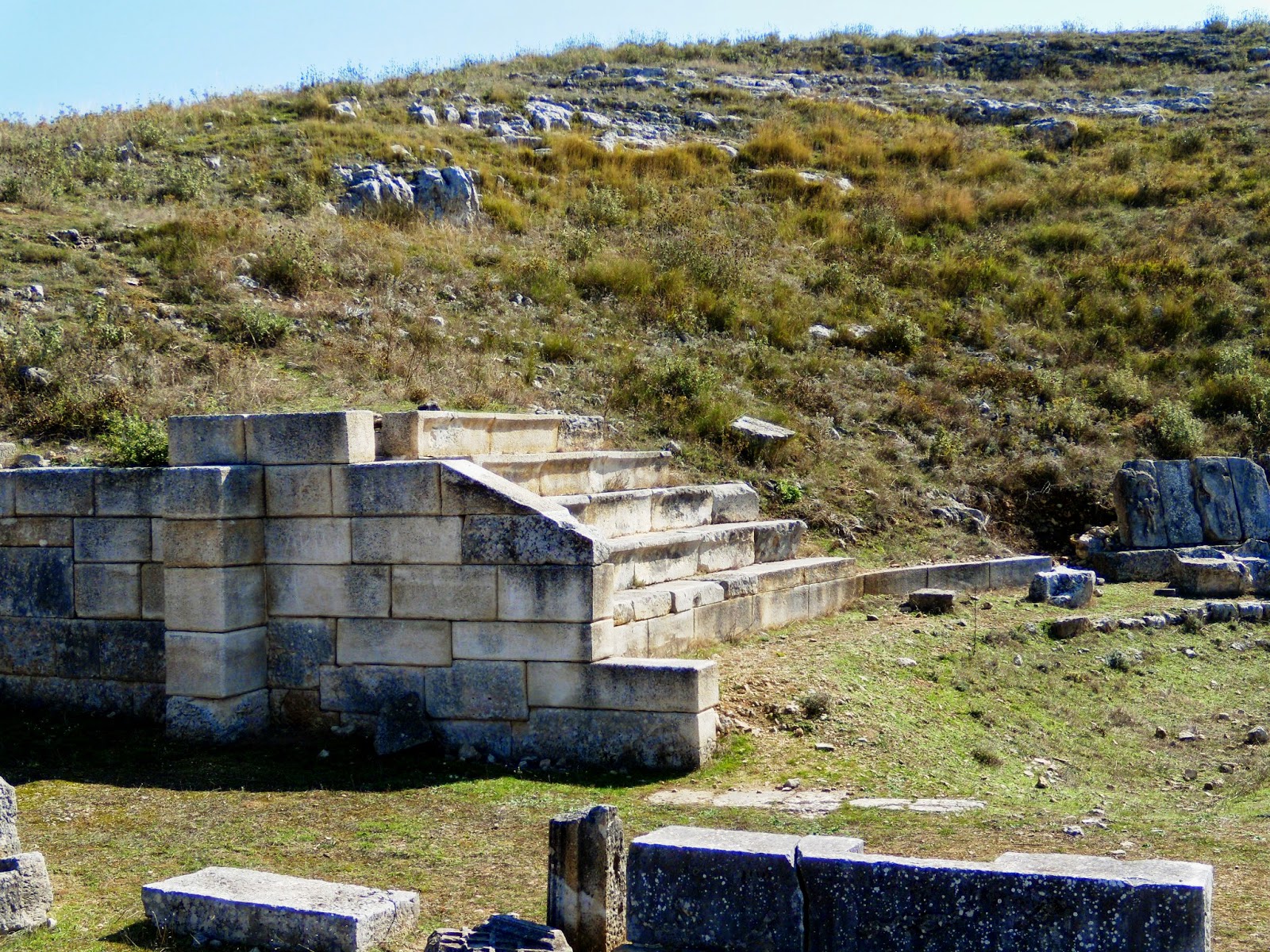
Pretty soon, I arrive at the recognizable Forum – no doubt built on top of the Hellenistic Agora - surrounded by an L-shaped Stoa, two stories high. The earliest agora has been dated to the second quarter of the 3rd century BC, and the 11.4 meters-wide Stoa ran over a total length of 144 meters: the eastern wing (partially cut out of the rock) was 37 meters long and the southern wing 73 meters. The supporting columns were of Doric order, with hexagonal columns on the ground floor, while Ionic columns on the upper floor supported the roof. The set-up of this Stoa is inspired by the one at Apollonia (see: Along the Via Egnatia: Apollonia). Later, the Byzantines built their basilicas inside and in between these remains, meaning that one has to be alert when looking at stones and walls, but the typical Byzantine crosses on column capitals and altar slabs are very helpful.

Comfortably nestled against the hillside, most of the theater has survived, although it has been used as a quarry by the Byzantines.  The original Greek theater was built in the middle of the 3rd century BC and counted 40 tiers, providing seating for as many as 7,500 spectators, which, based on the size of Byllis, means that visitors from neighboring towns attended the performances. It is said to resemble the theater of Dodona in neighboring Epirus, but I am not in a position to compare. Clearly, this theater has been “updated” by the Romans, who added the skena of which only the foundations remain. A corner of the seating area has been reconstructed to give a better feel of the building, and it is interesting to look around for the many details of decorations for the walls, seats, and the trimmings of the skena. I find it striking that the VIP seats are still present around the orchestra in Greek fashion, meaning that this theater was never adapted to be used for animal fights, as the Romans generally loved to organize. The view from up here is, as always, breathtaking!

Turning away from the steep edge on which the theater stands, are the remains of the arsenal, also from the 3rd century BC, and reconstructed during the 1st century AD using the so-called opus reticulatum technique (square diamond-shaped tufa blocks positioned with their corners downwards). It lies about three meters below the adjacent prytaneion (sacred meeting place) and measures 18.2x6.2 meters. This prytaneion, dedicated to Artemis, in turn, is 20 meters long by 6 meters wide and may well be one of the earliest buildings in the Agora.

Byllis also had a stadium from the end of the third century BC, one of the strangest constructions I have ever seen. Only one side of this stadium has been preserved. From the original length of 190 meters, the bottom seating stairs have survived over 134 meters. Near the theater, we can find as many as 19 steps still in place, but overall, there are no more than three or four. But what makes this track so unique is that it runs alongside a huge public water cistern of 51 meters and 4.2 meters wide. This means that this vaulted cistern with a capacity of about 1,200 m3 was constructed underneath the stadium itself. The water was collected from the roofs of the Stoa and from the stairs on the south side of the stadium. In Byzantine times, Emperor Justinian built his baths right next to this cistern, and the facilities were used till around 550 AD.

Remarkably, some remains of private houses have been excavated as well, both Hellenistic and Roman, which I think is rather unusual. Hellenistic houses are rare, and I’m glad to find a clear layout for one of them. It dates from the third century BC and measures 30m x 25m. It is built around a central courtyard of approximately 10m x 10m surrounded by colonnades behind which we find the various rooms; typically, it had its own well (see also: Olynthus and its houses).

All in all, I find it strange that neither here at Byllis nor at any of the other ancient cities in the area (Apollonia, Brundisium, Buthrotum, Dyrrhachium) so little remains from the Macedonian occupation of Alexander and his father, Philip II, before him. Obviously, neither king was there to build a city as their only purpose was to submit the Illyrians as a whole, but since it was the Greeks who colonized this region in the first place, it is awkward to find only sporadic remains of that period – unless the Romans have thoroughly destroyed the buildings that existed previously in those settlements.

[Click here to see all pictures of Byllis]

Monday, May 11, 2015

What became of Alexander’s closest commanders after the War of the Diadochi?

Alexander was surrounded and supported by his highly skilled and efficient Bodyguards or Companions, who, after his death in 323 BC, had to take charge and rule his vast empire. They definitely were not prepared for this task, as Alexander obviously had not expected to die at such a young age.

The ensuing war that lasted for almost forty years and went into history as the War of the Diadochi was inevitable. Time and again, the commanders took sides and changed sides, made peace treaties, but coveted each other’s possessions soon after. Their lust for power and innate Greek competitiveness led them, at the head of their seasoned armies, to conquer ever more land. In the process, they eliminated each other systematically, till around 280 BC only four dynasties remained: the Ptolemies in Egypt, the Seleucids in Asia, the Lysimachids in Thrace, and the Antipatrids in Macedonia.

At the time of Alexander’s death, all his Bodyguards were in Babylon: Aristonous, Leonnatus, Lysimachos, Peithon, Perdiccas, Peucestas, and Ptolemy. Other powerful men were also present, like Seleucos, one of his principal commanders over the past seven years; Nearchus, his fleet admiral; and Eumenes, his secretary and archivist. However, Craterus was still in Cilicia on his way to Macedonia, and Antipater, as the Regent, was in Pella. Sooner or later, all these leaders got involved in the Succession War and died while defending their rights or in their increasing ambition to expand their territory.

"Diadochen1" by Captain_Blood - Own work. Licensed under CC BY-SA 3.0 via Wikimedia Commons 
Here is what became of them:

The first to die was Leonnatus, who relieved Antipater during the siege of Lamia in 322 BC and was killed by the Athenian enemy.

The next victim was Craterus in 321 BC, as his horse stumbled during a fierce confrontation with Eumenes on the borders of Cappadocia. He was trampled to death.

Perdiccas followed in 320 BC after failing to lead his troops safely across the Nile when he invaded Egypt held by Ptolemy. He was killed by his own officers.

Antipater died of old age in the late summer of 319 BC, nominating Polyperchon as his successor instead of his own son, Cassander.

Later that year (319 BC), the generals Arrhidaeus, Nicanor, and Cleitus were eliminated.

Eumenes, after desperate and repeated attempts to win the confidence of his troops, was killed by Antigonus Monophthalmus, the rising star in 317 BC. At the same time, Antigenes was burnt alive by Antigonus.

Under false pretexts, Peithon was summoned to Ecbatana by Antigonus some time later, where he was accused of treachery and executed.

Aristonous became the general of Olympias in her war against Cassander, but when the queen was taken prisoner in 316 BC, he was put to death by Cassander.

Nearchus disappeared from history around 300 BC, after he had joined Antigonus Monophthalmus and acted as adviser to his son, Demetrios Poliorcetes.

Lysimachus had the difficult task of ruling Thrace, which served as a buffer zone between east and west. He was killed in 281 BC after crossing the Hellespont into Lydia.

Peucestas had a less glamorous end to his career. He surrendered to Antigonus after acting as an unwilling ally of Eumenes and was kept as Antigonus’ close advisor and afterward for his son Demetrios Poliorcetes. The last time we heard from him was in 290 BC.

Ptolemy made a better choice with Egypt, which he ruled successfully, starting a dynasty that lasted three hundred years. Ptolemy I Soter died in his mid-eighties in 283 BC.

The same applies to Seleucos, who, after many fights on different sides, gained protection from Ptolemy and managed to establish himself as ruler of Alexander’s eastern provinces (311-302 BC). In his ambition to conquer Macedonia and Thrace as well, he was assassinated in 281 BC by Ptolemy Keraunos, son of Ptolemy I. He was the last of the great men who once rode by Alexander’s side to the end of the world.

Saturday, May 9, 2015

A double highway in antiquity

We like to believe that the double highway is an invention from the 20th century. Well that is not so since remains of what is likely to be the first double highway ever have been discovered in Anavarza, near the village of Dilekkaya in the province of Adana, Turkey.


The origins of the city go back to the days of Assyrians and was successively occupied by the Sassanids, the Byzantines (Emperor Justinian I rebuilt the city after a destructive earthquake in 525 AD and renamed it Justinopolis), the Armenians, and the Ottomans. It still holds traces from Hellenistic and Roman times, which is why it is named Caesarea. The fact that Anavarza was situated on the main road east after leaving the Cilician Gates made it one of the most important cities of Cilicia in the third and fifth centuries, after supplanting nearby Tarsus in the first and second centuries AD.

Unfortunately, Anavarza’s well-preserved remains have been damaged by powerful earthquakes as recent as 1945, during which the three aqueducts that stood there for nearly two thousand years collapsed. Among the ruins are colonnades along two streets, a gymnasium, a triumphal arch, a theater, a stadium, and a fort.

The most striking element, however, is this double-columned highway, approximately 35 meters wide and 2.7 kilometers long. It has been established that columns were of the Corinthian order and were erected at 2.15-meter intervals. At present, work is underway to restore a 250-meter section of this highway in the hope of making it accessible for tourists in a few years.

So far, 1,360 columns have been unearthed, and plans are to restore them. The entrance gate will also be put back together, as no fewer than 500 pieces have been found lying around the monument. Two more streets will be excavated, and archaeologists hope to locate the sewage system as well as the stores on either side of the streets.

Once again, Anavarza may become one of the most magnificent cities from the ancient world after being cleared and restored. After all, this city is larger than Ephesos, for instance! 

It is not unthinkable that Alexander passed through this city, this very highway even, on his way from Tarsus to Issus. In any case, it is a place worth adding to our next travel plans.

Wednesday, May 6, 2015

Underwater excavation at Heracleion still ongoing

It is nice to read about the progress of underwater excavations at the Egyptian site of Heracleion. It is in the news again as Oxford University is also diving at the site (see my earlier post: Heracleion, an ancient Greek port in Egypt) and presenting a few interesting pictures.


For the Oxford Centre for Maritime Archaeology, it is a unique opportunity to partake in this project and divers have recovered many important ancient landmarks at the mouth of the Nile. There are, for instance, more than five meters tall statues that were hauled to the surface, not counting the hundreds of smaller statues that were retrieved from the sea floor. So far a monumental statue of goddess Isis and a massive head of the god Serapis have been removed. Art treasures like jewelry, coins, and ceramics have also been recovered and testify of the glorious past of Heracleion, named according to Diodorus after Heracles because he stopped the flood of the Nile.

Work in this murky water is pretty difficult but very promising. The article published in The Oxford Times adequately states that “it can appear that someone emptied the contents of the Museum of Cairo on the bottom of the Mediterranean, while the images of building foundations appear akin to an underwater Pompeii”.

As mentioned in my earlier post (Heracleion, ancient Greek port in Egypt), the remains of 64 ships have been found, but also over 700 anchors. At present the archaeological team is focussing on what they call Shipwreck 43, a 24-meter long vessel that has been dated between 785 and 480 BC and is one of eight belonging to the same size. This is a flat-bottomed vessel, ideal to operate in shallow waters. 

The article in the Oxford Times mentions further that a major exhibition will be held in Germany next year and hopefully will come to the UK at a later date.

Friday, May 1, 2015

Ptolemais, heritage of the Ptolemies in the Cyrenaica (eastern Libya)

The origin of Ptolemais (or Barca) of the Libyan Pentapolis (see: Apollonia in Cyrenaica (eastern Libya) after Alexander) goes back to the middle of the 6th century BC. Still, the name Ptolemais was probably given by Ptolemy III Euergetes, the grandson of Ptolemy I, who, in 322 BC, added the city to his realm after becoming the ruler of Egypt as successor to Alexander the Great. When the Romans annexed Egypt in the first century BC, they granted Ptolemais the status of a separate province. Since the city had no local water supply, the Roman architects managed to bring in water from the surrounding hills and store it in seventeen huge cisterns under the Forum. It was a flourishing city until it was struck by the destructive earthquake of 365 AD, which caused the entire North African coast to drop by about 4 meters. The invasion of the Vandals in 428 probably gave the final blow. The Byzantines moved their military governor to Apollonia, and the Arabs ensured the city was abandoned.

It still looks abandoned today, a mere flat site thrown with stones and rocks, with a sporadic tree to bring in some color. The access road to ancient Ptolemais is not inviting either, as it runs through a solid row of abandoned houses that the Italians built last century – a proper ghost town known as Tolmeitha. It is an eerie feeling to drive over this straight road flanked by colorful facades with cast-iron decorations, which, for some reason, made me think of the Via Appia in Rome, where the tombs are replaced by empty houses.

The city of Ptolemais is no more than a field on a gentle slope from the Mediterranean up to the mountains, where even the Hippodamian plan is hard to figure out. I am happy to be pointed to the familiar Decumanus and Cardo once I’ve reached the crossroad where a piece of wall and a lonely column are all that remains of the Arch of Constantine from 312 AD. The Decumanus has been promoted to Monument Street or Via Porticata, with on one side the Roman Baths and on the other side the remains of a private house. It was on this road that the Edict of Diocletian from 301 AD was found, setting the prices for the trade goods now in the local museum.

At the next crossroad, marked with Four Columns, I turn right to visit the imposing remains of the so-called Palazzo delle Colonne, meaning the “Villa with the Columns.” Since this is about the only reconstructed building, it can hardly be missed. The Villa lies here in all its splendor, and it is generally accepted that it was built according to the then-prevailing fashion in Alexandria (Egypt). This theory is hard to verify since old Alexandria is still buried deep under the modern city, and an excellent example of such a villa has never been found, but I like the idea. In any case, the owner was not a poor man.

We owe the qualification of Palazzo to the Italian archaeologists of the last century, who found that it covered an entire street block (600 sqm) and counted two levels. The rear of the building, the living quarters, is resting on a plateau from where the owner had a panoramic view over the city, and I can see all the way to the seafront. This part had an upper level, probably the sleeping quarters. In front of these quarters below me, there is space for eight shops opening into the street, with, in the back, their own storage rooms. This storage lies next to a large patio and a complete bathing complex, including a Caldarium, Tepidarium, and Frigidarium, probably for the master of the house and his family. A separate staircase leads from the house directly to the patio below.

The re-erected columns are not well restored, with big blobs of cement in between, but they give an excellent idea of the past glory. The leaves at the bottom of the columns are quite exceptional, a subtle hint to Egypt – hence the name oecus aegyptius used to name this room. It takes some imagination to crown these columns with the capitals (now at the local museum) of the Corinthian order, with the heads of Jupiter and Mars staring down from between the acanthus leaves.

Behind this room and in the center of this complex lies the Atrium, including the earthen pipes that led the water to the bubbling fountain in the center of the pool. The Atrium was surrounded by a covered gallery resting on Ionic columns and paved with black and white mosaics, now carefully covered with plastic and soil. However, the edges are still exposed here and there. Central in this Atrium is the summer dining room that offers a view over the inside garden, and the water basin, once paved with magnificent mosaics. More protected from the elements lies, on the right-hand side, the winter dining room adjacent to the so-called Medusa room, after the mosaic found here, which has also been moved to the museum.


I am quite impressed by this Palazzo delle Colonne, not only because of its location, which is striking by itself, but also by the entire combination of these unique columns with their decoration and paintings, the many mosaic floors in color as well as black and white, and the many statues that enhanced these rooms because the Venus and Bacchus from the museum certainly were not the only ones found here. This Villa, in my opinion, goes beyond what has been found in Pompeii or Herculaneum, although they have other characteristics.

The next house block is entirely occupied by the Forum, paved with small slabs of marble and surrounded by columns, a few of which have (not too well) been restored. Under this Forum from the second century AD (in Greek times, this was a Gymnasium), the true treasure of Ptolemais lies buried: its water cisterns. Eight such huge galleries run north-south over a total length of 50 meters, and nine run east-west over 20 meters. I have seen such cisterns in cities like Termessos and Sillyum in Turkey, but not of this size. The oldest cisterns are from Hellenistic times, and when I climb down the stairs in the center of the Forum, I can clearly see the marks where supporting beams held the flat wooden roof of that period. The Romans later covered the entire system with vaulted ceilings and, in the process, more than doubled the storage capacity to reach as much as six million liters! It is a unique experience to walk through these vaulted galleries!

Right behind the Forum lies the Odeon – a somewhat controversial building. Originally built as a Bouleuterion, this Odeon dates from the 4th-5th century AD but might as well be a small theatre since the half-circular orchestra could be filled with water. However, the water supply is too far away from the theatre to be used as such, and even if this space could be filled with water, to what purpose was it used? Some archaeologists opt for miniature sea battles, while others think the water would be used to improve the acoustics. For the time being, this remains a mystery.

At the far end to the left, on the west side, one can discern the contours of the Teucheira city gate from the 5th century AD, but the entire extent in between seems still in dire need of excavation. Ptolemais definitely was an important city.

On my way back, walking over the westerly Cardo to the exit, I stopped at the Roman Villa where the mosaic of the Four Seasons was found (now at the local museum). Not much to see except that this building deserves to be called a villa. Noteworthy is that the colonnade around the Atrium ends in a horseshoe shape – an exception to the standard square pattern. Simple, smooth columns surround the central area, neatly restored without the blobs of cement the Italians used elsewhere.

The local museum is nothing more than a large storage room, but it is nice to have it so close to the excavation site (Now, a few years after the fall of Gaddafi, I wonder what has become of this place). I marvel at the fine mosaics apparently imported from Alexandria, framed with rougher mosaics laid by local craftsmen. The Medusa-mosaic from the Palazzo delle Colonne steals the show, next to two fragments with hens and fishes, and another large mosaic carpet showing the Four Seasons with two panthers underneath. True gems!

Next to a beheaded Bacchus and an elegant Venus with the head of Demeter (a strange combination), both from the 2nd century AD and found at the above-mentioned Villa, there are several painted and artistically carved Corinthian capitals revealing the heads of Jupiter and Mars. Interesting also are the aerial views of the villas I just visited. In a corner, I find the remains of a sarcophagus with an image of Achilles and, standing behind him, his mother, Thetis. An intriguing discovery, although I need help understanding what they are doing here.

One of the masterpieces is the slightly damaged panel from the Via Porticata, which shows several goods and their respective prices according to the Edict of Diocletian from 301 AD. That such legislation existed at all is quite impressive! Next to it stands a particularly graceful relief with six dancing Maenads found on the same avenue. The Maenads were a favorite subject in antiquity, and this relief has enhanced the base supporting a statue of the dramatist Euripides. The original statue was sculpted in Athens in 405 BC, but this is the best (Roman) copy. The ecstatic Maenads, followers of Dionysus, are particularly elegant in their floating robes, waving the thyrsus staff and shaking their tambourines. Such a pity that in later years, the piece was used around a well, for otherwise, it is relatively well-preserved.

Once more, this is a city that owes its glory to Alexander and his successors, as it lived on for another 700 years. Ptolemais definitely deserves to be added to the list of Alexander’s achievements.

If we pay more attention than usual, we find much more than the sites and buildings we are pointed towards. It happened to me while driving out of Ptolemais, as I noticed the remains of a Hellenistic tomb, clearly inspired by the Mausoleum of Halicarnassus. It is no more than a lonely square in the middle of an abandoned field used as a garbage dump, although fenced off with barbed wire, planks, and corrugated roofing. The original tomb must have been much higher than the remaining 11 meters, but the floor plan of 12 x 12 meters is still intact. This tomb belongs to the 2nd century BC, Ptolemaic times, and still carries the alternating motives of triglyphs and metopes along the top edge, although the friezes have long since disappeared, just like the steps at the base. As elsewhere, it was common practice to dismantle old buildings to reuse the recuperated stone blocks in new constructions (spolia).

Tuesday, April 28, 2015

Looting, not only a plague in war-torn countries

This time, the news comes from Shumen, a city located some 88 km east of Varna in Bulgaria, where four men have been arrested for trading and possessing archaeological artefacts. Nothing new, I would say, were it not that the police came into action and seized 19 marble sculptures and plates as well as some 9,000 Roman coins together with molds to produce imitations. More metal artefacts, together with some 80 coins, were retrieved from another house. Also found were a Greek altar, a lion’s head, a number of ancient figurines, and the central part of a Greek sarcophagus showing the head of Medusa.

The three Bulgarians who were arrested face imprisonment of one to six years and fines ranging between BGN 1,000 and 20,000 if convicted. Why do I have the impression that they will not be convicted?


More alarming news comes from the Museum of Macedonia in Skopje, FYROM (meanwhile renamed the Republic of Northern Macedonia). Here, six people, including two former officials from the museum, have been found guilty of stealing 160 artefacts from the museum between November 2011 and October 2013. The items, among which we count silver and gold jewelry, all date from the fourth century AD and have been sold abroad through obscure channels, making it impossible to trace them.

It takes more than sledgehammers to kill our culture and heritage, and for what? A quick buck or simple greed of our proud human race? Very sad …

Friday, April 24, 2015

Reconstructing ancient Greek music, an impossible task?

This is what I thought: it is an impossible task. Lately, I saw a replica of the Seikilos Epitaph from 200 BC/100 AD found in Aydin, Turkey (see: Revealing ancient Greek music, the Seikilos Epitaph). Since then, I have come across many articles treating and analyzing this unique subject.
 
The remains of ancient Greek music are very scant, leaving the impression that music was not popular in ancient Greece. Nothing is further from the truth since music then was all around, in theaters, athletics, education, and everyday life to express joy or sorrow. Ancient Greek music has been brought back to life thanks to, for instance, the achievements of the group LyrAvlos, a contraction of "lyra" (lyre) and "avlos" (flute). The group made several appearances, among which The Athens Hall of Music and the Warsaw Opera shows, the Festival of Old Music in Stockholm, the Corcoran Gallery in Washington, the co-operation with the National Orchestra of Athens in the First Greek Musical Celebrations, as well as at the 2004 Olympic Games.
 
Stefos, the leader of Lyravlos, worked hard to construct precise replicas of the old instruments to play the music from eons past. So far, 61 ancient songs have been saved, some on papyrus, others on shards or stone like the above-mentioned Seikilos Epitaph. Such stones and papyri from Egypt, dating overall between 300 BC and 300 AD, show a vocal notation consisting of letters and signs placed above the vowels of the words. Besides, the Greeks had worked out the mathematical ratios of musical intervals, in which an octave is 2:1, a fifth 3:2, and a fourth 4:3.
 
On the other hand, a musician and tutor in classics at Oxford University, Armand D’Angour, reminds us of Homer's epics, the love poems of Sappho, and the tragedies of Sophocles and Euripides that originally were music. This means that pieces composed between 750 and 400 BC were to be sung partially or in their totality, accompanied by the lyre, reed pipes, and some percussion instruments.
 
The oldest musical document discovered to date shows only a few bars from Orestes, probably written by Euripides himself in the 5th century BC. How Euripides exactly fits modern analysis is hard to figure out, but it is known that with the words “I lament” and “I beseech,” he uses a falling, mournful cadence, while with the words “my heart leaps wildly,” the melody is rising. It is astonishing to learn that Athenian soldiers earned their meals while singing Euripides during their captivity in the quarries of Syracuse in 413 BC - a moving detail reported by Plutarch. From Homer, we know that the bards used a four-stringed lyre, the “phormix,” and we may assume that those strings were tuned to the four notes that survived in the later basic Greek scales. 

A thorough analysis has proved that rhythms, for instance, are preserved through the words themselves, based on the short or long syllables. The instruments are known from statues, paintings, and literary descriptions, by which a musician can amazingly find the timbre and range of pitches they produce. For instance, the letter A at the top of the scale is actually a fifth higher than the letter N halfway down the alphabet. Absolute pitch can then be figured out based on the vocal ranges required to sing the surviving tunes. 

Yet this music is very far from our Western conception and comes closer to the sounds produced in India or the Middle East. It seems, however, that instrumental practice from the ancient Greeks still survives in some specific areas of Sardinia and Turkey. More technical details can be found in the article “How did ancient Greek music sound?” by Armand D'Angour.

Another important story is about a chip of papyrus found in a forgotten corner of the Louvre’s basement in 2002. It turned out to be a partition of Medea by Carcinos the Younger (approximately 360 BC) that was mentioned by Aristotle in his Rhetorics, and in which the heroine, unlike in Euripides’ version, is innocent. So today, we can listen to the bewitching aria sung in a deep voice, as in antiquity, the role of women was held by men. Annie Bélis, a world-renowned specialist in ancient music, studied this papyrus and other bits and pieces; she now concentrates on performing both vocal and instrumental scores that have survived, creating an ensemble called Kérylos. All the music partitions are authentic. The already known chorus score from Euripides’ Orestes, and the Seikilos Song of the two Delphic Hymns to the Pythian Apollo, have been deciphered and reproduced in her musical works. Among them, there also is an excerpt from Aristophanes’ Birds (nothing to do with Hadjidakis’ interpretation), a paean by Mesomedes of Crete (favorite composer of Emperor Hadrian), a piece from Carcinos’ Medea mentioned above, and an anonymous paean to the stars to name just a few. 
 
Based on strict archaeological references, Annie Bélis uses carefully rebuilt lyres, kitharas, flutes, and percussion instruments. For instance, statues, mainly of Apollo playing the lyre, and remains of instruments gleaned from different archaeological locations. So far, she has performed with the Ensemble Kérylos in several countries, including Greece, at Delphi. More recently, a special concert in Paris was organized in the frame of the exhibition “Au Royaume d’Alexandre le Grand. La Macédoine Antique” in 2011. Sorry to have missed it. More details can be found on the Kérylos site.

Based on all the above information and interpretation, we can almost recreate Alexander the Great's music. Isn’t that wonderful?

Tuesday, April 21, 2015

Another great bronze statue on display in Israel

Some rejoicing news for a change in these times of widespread destruction where so many artifacts disappear on clandestine markets.

The centerpiece of the news is a bronze statue which, together with many more artifacts has been recently donated to the Israel Museum by art-collectors Robert and Renee Belfer from New York. Just imagine having such a statue in your living room!

The nude Roman bronze from the first century BC is totally intact and still has his original inlaid glass eyes, which is rather rare. Starting this coming June (2015) it will go on public display for the first time under the title “A Roman Villa – The Belfer Collection”. How exciting!

Unfortunately, we don’t know the identity of this young man and have no clue as to what he is supposed to hold in his right hand. Speculations go towards Heracles who may have held his club, or Bacchus who could have held his kantharos, or again it might be an athlete carrying the palm branch of victory or a wreath. The provenance also remains obscure although the Belfer family acquired the statue as recently as 2004 through Christie’s.

The four-foot-tall bronze statue will not be lonely as about one hundred of the newly acquired pieces will also be on display, giving the visitor an idea of the luxury the Roman elite enjoyed at their homes. Most pieces are rare objects, including glass (the oldest piece being Egyptian from 1550-1330 BC), bronzes, ceramics, and marble sculptures. There is, for instance, a magnificent Roman head, a copy from an earlier Greek bronze that seems to point towards Polycleitus, a sculptor from the 5th century BC. The marble is probably from Rhodes and the wear and tear indicates that it was retrieved from the sea, meaning it possibly sank aboard a ship on her way to Rome. Other noteworthy objects are a Phrygian helmet made of bronze; a gilt glass tomb marker; and two high-quality mosaics, one of a fish that seems inspired by a digital photograph and one showing a bird’s eye view of Rome.

Of particular interest is a pendant from Carthage with its typical Punic look of glass inlaid details.

Robert Belfer apparently donated many artifacts to the Metropolitan Museum of Art in New York before he decided to entrust his present collection to the Israel Museum in Jerusalem. In his eyes, the objects represent an important chapter in the history of civilization in which Jerusalem played a central role.

Saturday, April 18, 2015

Traces of Alexander in Israel

No, of course, Israel did not exist in Alexander’s days, but he did march through these lands on his way to Gaza after conquering Tyre, although his exact route remains obscure.

In any case, it is quite rejoicing to hear that two coins minted during the reign of Alexander the Great have been recently found by members of the Israel Caving Club while investigating a large stalactite cave “somewhere” in northern Israel (the location is kept secret to avoid illegal looting).

Beside the coins, the team also discovered silver jewelry like rings, bracelets and earrings, probably hidden in a piece of cloth during Hellenistic times, most probably shortly after Alexander’s death when the Wars of the Diadochi were raging through his empire.

Researchers have labeled this find as one of the most important discoveries in recent years.

Wednesday, April 15, 2015

What tourists don’t know when stopping at Manavgat

The waterfalls of Manavgat are generally on every tourist’s program visiting western Turkey while nearby Side is often neglected. Yet Side has many remains from antiquity worth a visit (see: Side didn’t put up any resistance to Alexander), especially its superb white marble Temple of Apollo overlooking the dark blue water of the harbor where extensive restoration works have been carried out over the past few years (see: Restoration of the Temple of Apollo in Side, Turkey).


It has been revealed that an Omphalos stone was found in this very city in 2001 but details are only surfacing now – not surprising when you know that an Omphalos stone implies the presence of a prophecy center. The original Omphalos is made from a meteorite, which was copied in many marble versions, including this one found here at Side. This 40-centimeter high stone is decorated with a snake and other ornamentations and would have sat in the very center of a temple. Finding it here in Side, one of the main accesses to the Mediterranean ever since the 7th century BC turns this temple into a center of prophecy. 

This is quite amazing since Delphi was the best-known center of the world, the Omphalos of the Greeks, and that stone has been recuperated from the city’s ruins many years ago. Since then, other centers of prophecy with their own Omphalos have been established, like Didyma, Claros, and Patara in western Turkey.

The Omphalos goes back to very ancient times when people wondered about the shape of the world and its center. Early sources have defined the world as a flat pancake surrounded by the ocean; the navel or center of this world was the Omphalos. Legend has it that Zeus sent two eagles to the edge of this flat world and the place where they met was at the Omphalos stone. Ever since the area of this stone was considered as being the center of the world.

The newly discovered Omphalos of Side is now on display at the local Museum for us to admire.