Alexandria's founded by Alexander

Alexandria's founded by Alexander the Great (by year BC): 334 Alexandria in Troia (Turkey) - 333 Alexandria at Issus/Alexandrette (Iskenderun, Turkey) - 332 Alexandria of Caria/by the Latmos (Alinda, Turkey) - 331 Alexandria Mygdoniae - 331 Alexandria (Egypt) - 330 Alexandria Ariana (Herat, Afghanistan) - 330 Alexandria of the Prophthasia/in Dragiana/Phrada (Farah, Afghanistan) - 330 Alexandria in Arachosia (Kandahar, Afghanistan) - 330 Alexandria in the Caucasus (Begram, Afghanistan) - 329 Alexandria of the Paropanisades (Ghazni, Afghanistan) - 329 Alexandria Eschate or Ultima (Khodjend, Tajikistan) - 329 Alexandria on the Oxus (Termez, Afghanistan) - 328 Alexandria in Margiana (Merv, Turkmenistan) - 326 Alexandria Nicaea (on the Hydaspes, India) - 326 Alexandria Bucephala (on the Hydaspes, India) - 325 Alexandria Sogdia - 325 Alexandria Oreitide - 325 Alexandria in Opiene / Alexandria on the Indus (confluence of Indus & Acesines, India) - 325 Alexandria Rambacia (Bela, Pakistan) - 325 Alexandria Xylinepolis (Patala, India) - 325 Alexandria in Carminia (Gulashkird, Iran) - 324 Alexandria-on-the-Tigris/Antiochia-in-Susiana/Charax (Spasinou Charax on the Tigris, Iraq) - ?Alexandria of Carmahle? (Kahnu)

Saturday, February 16, 2013

More descendants of Alexander the Great in Pakistan?

After publishing my article about the Kalash People (see: The Kalash, a lost tribe of Alexander the Great?), I received a comment making me aware of the Burusho people, also living in northern Pakistan. This asked for some research, of course.


The Burusho or Brusho people live at the foot of the Karakorum Mountains in Northern Pakistan, and their language, strangely enough, seems not to be related to any other. They are better known as the Hunza People after the main valley of Hunza where they live but they are also spread over the Nagar and Yasin valleys of Gilgit Baltistan.

Yet, they pretend to be descendants of the Macedonian soldiers who were part of Alexander the Great’s army that crossed the region in 326 BC. Stories like this one still circulate in much of today’s Afghanistan and northern Pakistan, but legend or not, the Burushos or Hunzas believe that it was a Macedonian soldier who founded the town of Baltit. Genetic evidence, however, reveals only a 2% component – very much like that of the Kalash people; they also have some East Asian genetics suggesting some ancestry from north of the Himalayas.  DNA research, on the other hand, shows that the Hunzas share ancestry with the speakers of Pamir languages (Afghans) and the Sinti (Gypsies). The strangest of all assumptions is that they may be related to the lost or imaginary kingdom of Shangri-La! Time to tell tales. According to Dr. John Clark, who lived among the Hunzas for nearly twenty years, the Burushos do not count their age only in calendar years but also in a personal estimation of wisdom, making them often reach ages of above one hundred!

It is obvious that during his thousands of miles-long marches, Alexander’s men have left many children behind. If you consider that this army counted an average of some forty thousand soldiers, I dare anyone to figure out how many children they generated. These offspring are not mentioned as such in our history books, but their presence obviously is non-negligible. Alexander arranged for 30,000 of such boys to be trained as “Macedonian” soldiers; on average, there must have been at least as many girls also. Basic math makes this total account for one and a half child per capita, but their numbers simply must have been much higher. We will remember that at his Susa wedding, Alexander officially granted a proper dowry to over 10,000 soldiers in his army who had taken a Persian wife. No account exists for the many concubines or occasional affairs that must have occurred all along the road, producing even more future soldiers to swell the ranks of his army.

[picture from Wikipedia]

The valleys of Gilgit Baltistan are still too remote at present for serious scientific research, and I personally feel too insecure as well. We are already struggling with Alexander’s heritage in Central Asia and Pakistan is definitely no exception. Only time will shed more light on this possible heritage.

Monday, February 11, 2013

Still in the wake of Central Asia

As can be expected, my trip to Uzbekistan (read more under the Label Central Asia) in search of the footsteps of Alexander the Great in Central Asia is still an ongoing matter.

That is the reason why I went to Paris to see the collection of the Musée Guimet, something that has been on my wish list for the past thirty years or so. Guimet specializes in Asian art, a vast territory, but I have evidently limited my interest to Central Asia, including Afghanistan, Pakistan, and a small part of India and China as well. Being in France, all honors and merits go to the French, of course, with men like Joseph Hackin (1923-1937), Jules Barthoux (1926-1928), Dutreuil de Rhings (1890-1895), and Paul Pelliot (1906-1909). It must be said that in the early 20th century, the ruling King of Afghanistan, an art-lover no doubt, approached the French to carry out serious excavations in his country since he didn’t want to lag behind the archaeological finds made in the neighboring countries. It was only when the Soviet Union invaded Afghanistan in 1979 that these rewarding projects were put to a halt (Ai-Khanoum was one of those projects, with the disastrous results we know).

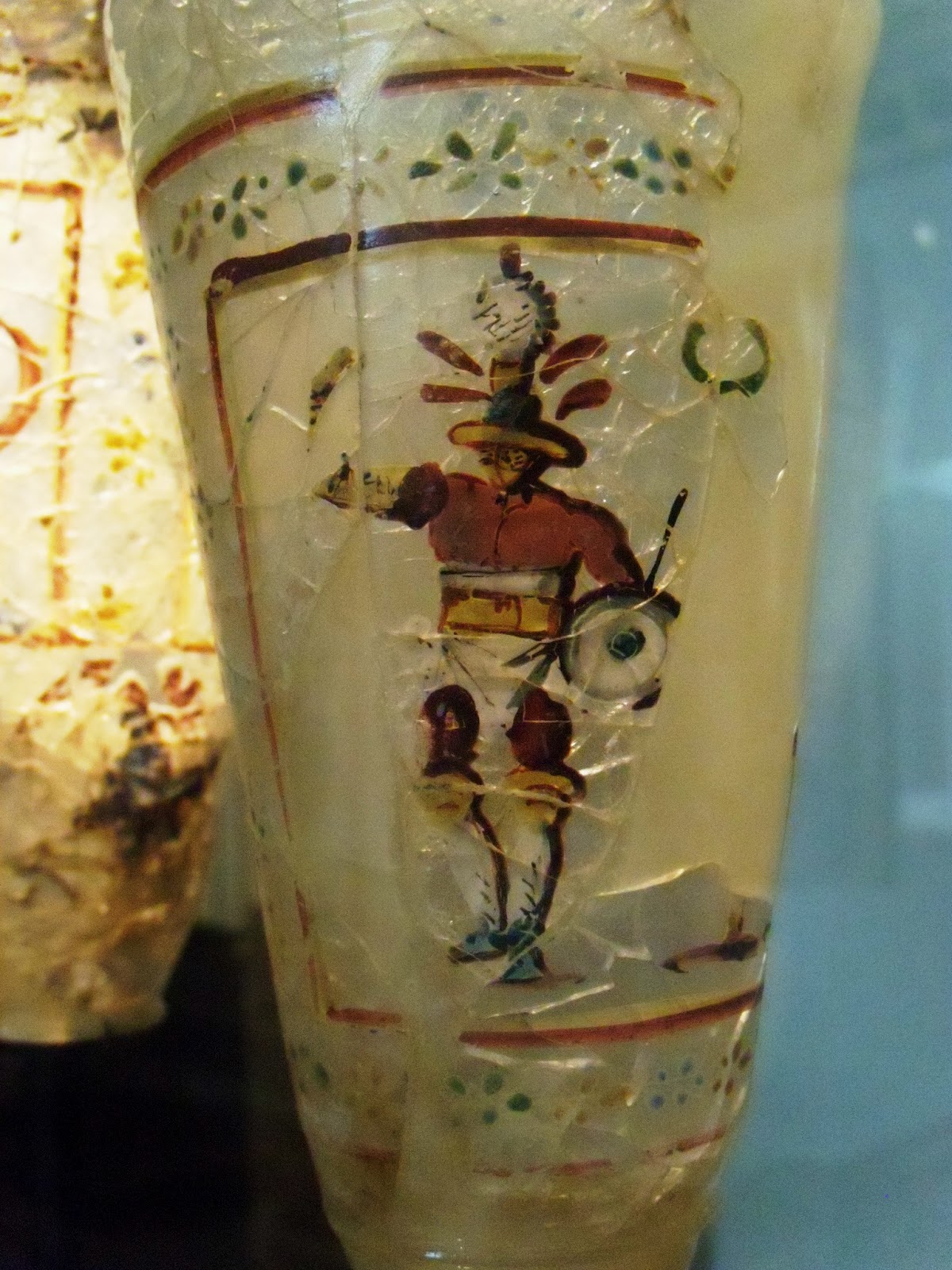
One of the absolute highlights in this Museum is, in my eyes, the Buddhas, Bodhisattvas and other statues and stupa decorations from Hadda in Afghanistan, which we owe to Jules Barthoux. The faces, postures, and clothing of these statues are unmistakably Hellenistic, and the true jewel in my eyes is the “Génie aux Herbes”, a spirit holding flowers in his lap. Another precious place is taken by the glassware excavated by Joseph Hackin on the site of Begram in Afghanistan also, with its blue, white, and transparent fish-shaped vessels and the colourful painted glass beakers with scenes from Greek mythology and daily life. I had seen some of these items in the travelling exhibition Afghanistan: Hidden Treasures from the National Museum in Kabul a few years ago in Amsterdam, but that was only a selection of items – now here I find a lavish collection.

An entirely different chapter is occupied by the polychrome Chinese terracotta figures from the 7th and 8th centuries, with dancing girls, musicians, girls playing polo on their horses, and several terracotta Sogdian merchants with their horses or camels walking straight out of the desert dust. What I didn’t expect, though is finding these exceptional Chinese terracotta statues from as early as the second century BC, which look more Greek than Chinese - unbelievable!

Any description as detailed as I could make it will fall short of the beautiful artefacts exhibited at the Musée Guimet. A better impression can be obtained by flipping through my pictures on this link: Paris, Musée Guimet.

Saturday, February 9, 2013

Ulpia Serdica, the Roman name for Sofia

What to do when remains from antique cities are found right in the middle of a major modern city? The question is not new and the answer as always is a compromise between extra expenses and the urge to preserve ancient constructions. Sofia, the capital of Bulgaria is no exception.


For several years, archaeologists are excavating the Roman town of Ulpia Serdica, whose remains are located on top of the underground extension plans of Sofia. So far a Roman palace, baths and burial sites have been excavated at the intersection of what is believed two major streets. At least two more Roman palaces are waiting to be uncovered and parts of the Roman fortress and adjacent church from the 4th century have already been excavated and fully reconstructed. We should not forget that this Roman Ulpia Serdica was entirely built above the Thracian city from the first century BC.

The debate here as elsewhere has raged on for years. A major metro station was planned exactly underneath the historical site. At last the authorities have opted to preserve the remains where they are, be it at excessively high costs, of course. An underground museum covering 1.9 ha will be built and with the help of EU money they hope to create a centre for exhibitions and performances that will put Sofia on the map in competition with other major cities like Rome. 

In my humble opinion this may take quite a while to materialize, if ever they get that far …

Wednesday, February 6, 2013

Foreign Devils on the Silk Road by Peter Hopkirk

I have been fascinated by the cities along the Silk Road following a recent exhibition held in Brussels about the Chinese part and further to my trip through Uzbekistan where I inevitably winded up on its traces. Yet, I didn’t have an overall picture, especially since we generally talk about “The” Silk Road while in reality there are many – although all are intertwined to reach east or west one way or another.

“Foreign Devils on the Silk Road” is subtitled “The Search for the Lost Treasures of Central Asia” (ISBN 978-0719564482) – how appropriate! In his book, Peter Hopkirk collects and summarizes the handful of expeditions made over less than thirty years. Basically, Central Asia was shared by Tsarist Russia and the British Empire because of their presence in India.

The very first westerner to set out in the inhospitable Desert of Taklamakan was the Swede Sven Hedin, a scientific explorer, fluent in seven languages who visited the area in 1895 and in1899. Although he was neither a historian nor an archaeologist, but a trained geographer and cartographer, his meticulous studies turned out to be very useful for the brave explorers who followed.

Next arrived Aurel Stein, a Hungarian-born orientalist who became a British citizen. He hit a soft spot in my heart because he was fascinated by the campaigns and travels of Alexander the Great, spending much of his early years retracing Alexander’s routes and battlefields, and eventually his legacy in Central Asia. Stein started his fruitful and daring explorations of the Taklamakan Desert in 1900. One his most exciting finds in my eyes is, for instance, the wooden tablets with clay seals with figures of Pallas Athena and other Greek deities, but this is only the tip of the iceberg of his fertile harvest, of course. By the time he returned to Britain, it became clear that an entirely new civilization had evolved in the very heart of Central Asia.

Soon it were the Germans who set out on an expedition in 1904 to be led by Albert Grünwelde. Unfortunately, he fell ill and was replaced by Albert von Le Coq, a most capable man, much to Grünwelde’s dismay as he wanted to reap all the honors. The French were late to show up in Central Asia (1906), simply because they had been busy in Indo-China’s jungle where they discovered the unique site of Angkor. Paul Pelliot was a linguistic genius, speaking thirteen languages including Chinese (which none of his predecessors mastered). This knowledge was highly appreciated by the locals and opened many doors otherwise locked. The Japanese were among the strangest diggers, sending two scholar-monks in 1908 financed by a certain Count Otani in Kyoto. They were generally seen as spies although nothing could be proved. The Russians, in spite of their priority location only made occasional incursions of no consequence. The very last visitors were the Americans in 1923, with the orientalist Langdon Warren who discovered a lost part of the Chinese Wall. By 1925 the free-for-all to take in this meanwhile well-mapped desert was all over, the first hostilities between China and Britain exploded. China closed all doors to foreign visitors.

To make this story complete, Peter Hopkirk has followed the road taken by the vast quantities of colorful wall paintings, gorgeous sculptures, precious manuscripts and other artifacts from the Silk Road. In fact, they are scattered among many different museums worldwide. Hedin’s collection has found a place in the Ethnographical Museum of Stockholm, while Pelliot’s artifacts are exhibited at the Guimet Museum in Paris. Stein’s treasures were generally split between the National Museum in Delhi and the British Museum in London. The German collection gathered by von Le Coq got its own museum in Berlin, unfortunately heavily bombed by the allied during WW2 destroying the biggest fresco’s that had been cemented in its walls. Smaller frescos, other artifacts and manuscripts could luckily be saved and are now part of the largest and most imaginative display at the Dahlem Museum in Berlin. On the third place comes the Japanese collection that originally was kept at Count Otani’s villa, but was later partially sold. A selection of the treasure ended up in Seoul, packed in the storerooms of the National Museum. Another part travelled to Manchuria from where it was probably removed by the Russians in 1955 when they handed this land back to China. Some pieces, however, are on display at the Tokyo National Museum. Finally and as a matter of course, The Hermitage in St Petersburg has its own display of the Silk Road treasures spread over eight rooms.  

It is amazing how much information has been gathered in this relatively small book, for the story is not complete yet. There is a special chapter dedicated to the early discoveries of manuscripts written in previously unknown languages and found accidentally by local treasure hunters. These documents among which fifty-one birch-bark leaves made their way to Calcutta and were found to be written in Sanskrit using the Brahmi alphabet in the 5th century. This made it one of the oldest written works to survive anywhere. A vivid interest from western scholars set a machinery in motion to find more of such manuscripts. There was money to be made and local forgers discovered that they could get away with their loads of faked manuscripts, even inventing unknown characters. To increase their production they didn’t refrain from using block printing. Some orientalists accepted these documents as originals, but Stein was one of the skeptics and he got to the bottom of the story, exposing the mastermind. A good deed that was not fully accepted by those who strongly believed they would be the first to decipher this new “unknown” language. Yet, all the news was not bad, for eventually the long-lost language of Khotanese was discovered.

Today the manuscripts from the Silk Road are divided between the British Library (Chinese, Sogdian, Uighur and Tangut works) and the India Office in London (Tibetan, Sanskrit and Khotanese). The thirteen thousand Chinese manuscripts and books are now neatly stored on the shelves of the British Library, an honorary place I would say.

After reading about this history of the Silk Road, the Taklamakan Desert and Central Asia, in general, it is hard not to be interested in digging any further. It certainly has sharpened my interest!

Saturday, February 2, 2013

From Thutmosis III to Alexander III

History, as it is generally taught in our schooling system, is a mere succession of names and dates, of kings and battlefields, of peace treaties and foreign invasions. It usually starts with rough sketches of prehistoric times, to be soon followed by the Sumerians, Babylonians, Egyptians, Greeks, and Romans, till after the separation of east and west we soon get to the Middle Ages. In these dull lessons, each civilization was compartmented, one making place for the next. This misconception, unfortunately, is one that we carry along for the rest of our life. How wrong this is!

It is not so long ago that I discovered that rather than a vertical list of events, history is an exciting world spreading horizontally, overlapping east and west where each kingdom ultimately "borrowed" and used knowledge from their enemies in newly conquered territories. Since then, I keep marveling at this ever expanding ancient world.

Oliver Stone in his Alexander movie puts a remarkable idea in the mouth of Aristotle: that of looking at the Middle (Mediterranean) Sea as a frog pond. I think this is a fairly truthful picture, as “frogs” from all the harbors and cities bordering the Mediterranean jumped back and forth over the centuries. We have no idea of the intense traffic of ships ferrying goods (and ideas) from one place to the next, or sailing up main rivers to reach further inland destinations. It was not all pillage and warfare, there definitely was commerce, the very keystone of a flourishing economy. This is something every king or citizen understood and worked for.


It so happened that I was confronted with Thutmosis III, pharaoh of Egypt from 1479 BC to 1425 BC reigning partially in the shadow of his co-regent and aunt, the exceptional Queen Hatshepsut. As strange as it may seem and although Thutmosis III lived more than a thousand years before Alexander the Great, he got my undivided attention when I learned about the new equipment he used in his army and the talent he developed in his conquests. Immediately, I made the link with Alexander who is never far away in my thoughts anyway.

There is the case of the Battle of Megiddo when Thutmosis fights against rebellious Canaanites led by the King of Kadesh. Here, Thutmosis used the composite bow for the first time and he was able to push the Canaanites back inside the city walls. As a consequence, Megiddo was kept under siege for seven months and when the city finally surrendered, Thutmosis had to solve another problem: how to govern a city so far away from his native Egypt. He decided to take with him all the children of the noblemen in order to give them a proper Egyptian education; they would eventually return to their hometowns as true Egyptians. By doing so, he obviously kept the elders and nobles under control. Inevitably this action reminded me of Alexander who created an army of 30,000 Persian boys, sons of prominent leaders and members of the local nobility, to be drilled and educated the Macedonian way. His goal was the same as that of Thutmosis: to control the influential class of natives and using the young men to his own benefit. Maybe that was a generally accepted procedure but even in antiquity historians presented Alexander’s action as an exceptional move and even as an innovation.

[Click here to read two interesting article published in Ancient History about this battle of Thutmosis and the site of Megggido]

The other fact that made me link Thutmosis to Alexander was Thutmosis’ attack on Mitanni after having taken control of Syria. The pharaoh sailed from Egypt to Byblos, where he disassembled his boats and took them with him, knowing that he had to cross the Euphrates River later on. At the banks of the river, he had his ships reassembled to put his men and horses across. Amazingly enough, the pharaoh took the Mitannian King entirely by surprise, for he was not expecting an invasion at all. Mitanni had no defense line or walls; they could only try to stop the Egyptians from crossing the Euphrates – a futile attempt as it turned out. This story reminded me of the course of Alexander crossing the many rivers in India, where he regularly dismantled and reassembled his ships. I thought this was a novelty, but now I hear that the Egyptians used the same technique tens of centuries earlier! Of course, this doesn’t make Alexander any less of a genius in my eyes, for after all, there is still a difference between knowing the technique and implementing it. Maybe the very idea had been forgotten meanwhile?

So much of the knowledge from the ancients has been lost over the centuries that we will never know how much they really knew and how much information was exchanged between the different civilizations.

[Picture of Thutmosis III at the Temple of Karnak]

Wednesday, January 30, 2013

Lost World of the Golden King by Frank Holt

Lost World of the Golden King, In Search of ancient Afghanistan by Frank Holt (ISBN 978-0-520-27342-9), is the latest book by this author, who has an unparalleled knowledge of Bactria, a country often neglected by and unfamiliar to most historians.

I totally enjoyed his earlier books: Into the Land of Bones, Alexander the Great and Bactria and Alexander the Great and the Mystery of the Elephant Medallions, as no one knows Bactria more intimately than Frank Holt. He was my mental guide and support source when I visited Uzbekistan (see several articles under the label: Central Asia), so I couldn’t skip reading this latest update of his.

As always, his work is exact and consistent. After Alexander’s conquests in 329-327 BC, the country kept many of its invested Greek influences, eventually giving birth to the Graeco-Bactrian kingdom, followed by the Indo-Bactrian rule. However, after repeated and devastating attacks by its nomadic neighbors, the empire of “a thousand cities” vanished, and from the tenth century onward, only the name of Bactria survived. We had to wait till the eighteenth century when a Greek coin was unearthed, and the first explorers started their search.

Frank Holt follows them step by step, all through the 18th and 19th centuries, analyzing their assessments and holding their conclusions against today’s still sparse knowledge about the Bactrian Kingdom. Not all the coins carry an inscription with the name of their Basileus, and those who do so don’t specify if we are looking at Eucratides I or II, Demetrius I or II, or Diodotus I or II, while on the other hand, we still have no way to put them conclusively in their correct chronology. The studies of these earlier explorers have merit, of course, but archaeology has evolved since then, new techniques have been applied, and the fundamental research of numismatic evidence has progressed.

Meanwhile, one of the “thousand cities” was located and excavated extensively by Paul Bernard (1964-1978) till modern wars put everything on hold and destroyed his painstaking work. By now, Ai-Khanoum, at the far northern border of today’s Afghanistan, has made headlines, and most of his precious finds have found shelter inside the walls of several museums (see the exclusive and still traveling exhibition, Afghan Gold Treasure)

Frank Holt uses the excavation results and artifacts from Ai-Khanoum to reconstruct as much as possible of Bactria, whose most famous king was Eucratides. His huge golden “Eucratidion” was the very first coin that rose from Bactria’s ashes. Sporadic texts and inscriptions and the various hoards add further information and raise more questions.

The reader will get a fresh look at Bactria, its kings, and its heritage. Besides a whole chapter about the mining and minting techniques, including the knowledge involved, Frank Holt’s book offers a wealth of information about every possible aspect of life after the campaign of Alexander the Great in the furthest northeastern corner of his empire.  

Sunday, January 27, 2013

Latest find at Stratonikeia, Turkey

Turkey is an everlasting source of new discoveries. The country has such a rich past, of which only a few tourists seem to be aware, and then only with names like Ephesos, Miletus, Priene, and maybe Didyma or Halicarnassus, modern Bodrum. But there is so much more with constant new finds, some more spectacular than others. 

A while ago, I wrote about the amazing sarcophagus that was unearthed in the area of Milas (see: Sensational Archaeological find near Milas), and today it is the turn of Stratonikeia , roughly halfway between Milas and Muğla. Stratonikeia was part of Caria, a generally unknown kingdom, although in its heyday it was ruled by none less than King Mausolos, the builder of the Mausoleum of Halicarnassus - one of the Seven Wonders of the World.

During their seventeen-month excavations, archaeologists have uncovered part of a road flanked by columns that led to the gate in the city walls. These walls are estimated to be 3,6 kilometers long, and for now, a stretch of 400 meters has been exposed. It seems that the walls were restored by King Mausolos some 2,400 years ago.

[Photo: AA, from Today's Zaman]

The main find in the area was this huge 2,000-year-old Hellenistic bust of a king that stood one and a half meters high and is two meters wide, showing features of a bull’s head and a goddess – signs of wealth and power. Previously, a chariot had been discovered, as well as a 1,500-year-old Byzantine mosaic. All in all, 460 artifacts, both Roman and Byzantine, have been collected by the archaeological team and are now transferred to the nearby Museum of Muğla.

After full restoration, the wall will be accessible to visitors, and so will the Museum once the finds have been treated appropriately.

For a great overview of Stratonikeia, please refer to this link at Peter Sommer Travels.

Thursday, January 24, 2013

Irbil, and no mention of Alexander?

I am very much excited to hear that in spite of the war a new archaeological project has been started in the region of Irbil, the capital of the Kurdish region in Northern Iraq in search of ancient cities, roads, walls, etc. In just a few months the Harvard-led project covering some 3,200 square kilometers has revealed about 1,200 potential sites and they are still counting.


There is, however, a downside to the project because the economy of Kurdistan is booming and new developments are exploding all around. One of the main problems is that the archaeologists don’t limit themselves to the individual sites but are also interested in the spaces in between, looking for traces of agriculture and irrigation canals as well as for roads and tracks that connected the settlements. Because of these widespread constructions, these are the areas that are most prone to be destructed before being properly studied and documented.

Evidently, the archaeologists are very keen to work in the area because it has been a zone of conflict for so many years. At last, they are able to take a close look at early civilizations as is mentioned by Phys Org in November 2012.

Yet, in all of this research, I don’t find a single word about Alexander the Great while Irbil  is only 100 kilometers away from the very spot where the famous Battle of Gaugamela was fought in 331 BC – the supreme encounter of Alexander and Darius III of Persia. How dare these archaeologists omit Alexander from their reports!

[picture from Oliver Stone's movie Alexander]

Saturday, January 19, 2013

Poor Babylon

Babylon once hosted one or more of the Seven Wonders of the ancient world, when, during its heyday, King Nebuchadnezzar II, out of love for his homesick wife, built the famous hanging gardens. It was here that Hammurabi wrote the very first laws etched in stone and now one of the proud possessions of the Louvre Museum; it is also where the biblical and historical Tower of Babel ruled over the surroundings of the Temple of Ishtar; and where the Achaemenid kings occupied their luxurious palaces till King Darius III of Persia was defeated by Alexander the Great, who died within its very walls.

Babylon, or what is left of it, is located about 90 kilometers south of Baghdad, Iraq, along the banks of the Euphrates River. Today, the remains of this ancient site are in very poor condition, and we are too close to losing it altogether.

Although the first excavations in the Babylon area started in the early 19th century, serious work began towards the end of that century by successive archaeologists from England, Germany, and Italy. Useless to point out that much of the finds are spread between their respective museums. When Saddam Hussein came to power, he wanted to wallow himself in the splendor and fame of this ancient capital, and in 1983, he started to build a city of his own on top of the fragile ruins of the dried brick walls. He inscribed his name in the bricks, just as Nebuchadnezzar had done before him, and as if the damage done to these ancient walls was not enough, he had serious plans to erect a palace of his own atop some other ruins. The outbreak of the Gulf War put an end to this madness, but by then the modern bricks and mortar of Saddam’s megalomania had dangerously damaged the brittle ruins.

After that, in 2003, the coalition forces camped in parts of ancient Babylon’s ten square kilometers for two years. They dug trenches, drove steel stakes into the ancient walls, and built roads, parking lots, and even a helicopter landing pad, bringing further damage to Babylon, including the famous Ishtar Gate and the Procession Way through which Alexander the Great made his triumphal entrance some 2,500 years ago.


Peace has not returned yet. For several years, villagers, invading armies, and fortune seekers plundered whatever they could. An ever-increasing number of people settled in new villages on top of the ruins, and now rising groundwater threatens the ancient walls even further. To make matters worse, the Iraqi oil business is spoiling the precious grounds of this wondrous city, tearing up the soil to lay down their pipelines 1.7 meters deep right next to two other pipelines that were dug under Saddam Hussein. The Ministry of Oil ignored the pleas from their own Iraqi archaeologists, simply stating that they didn’t find any artifacts while digging, as if they were experts in the matter!

Meanwhile, UNESCO has written to the Iraqi authorities to express their concern, and Iraq’s own department of Antiquities has sued the Ministry of Oil demanding the removal of the pipelines. The World Monument Fund, on the other hand, is helping to protect the damaged ruins of Babylon against the rising groundwater, which is caused by new irrigation policies. But overall, the situation is at a standstill since the government of Iraq has decided to suspend its contacts with US universities and institutions that are involved in saving Babylon. Let’s hope that these measures are only temporary and that the ban will soon be lifted.

Today, desolation and destruction are all too evident. Poor Babylon.


[Picture of the map is from NBC News, and the lion picture is from The Australian]

Monday, January 14, 2013

New hope for the Museum of Baghdad

Thanks to the travel blog of Gadling, I have been made aware that the National Museum of Iraq is to reopen soon. One of the authors of this blog, Shean McLachlan, was allowed inside for a sneak preview.

After the fall of Baghdad in 2003, the entire city was in chaos, and nobody was there to protect the museum – probably the last concern for the invading armies. As always, looters swarmed in like vultures, ransacking and stealing whatever fell into their hands. The Museum staff resisted as best as they could, asking the American army for protection, but it is still not clear how well this was handled. Countless artefacts were smashed, thousands were stolen. Yet, thanks to the bravery of the museum staff, the best pieces were hidden in secret locations, and others were later on recovered, although most disappeared in the hands of private collectors. A very sad story of lost culture!

So, I am very pleased to hear the good news that Baghdad is working on reopening its precious Museum, where treasures from the dawn of civilization have found refuge. In his sneak preview, Shean McLachlan witnessed giant Assyrian statues standing next to peculiar, bright-eyed Sumerian ones. Reliefs with hunting scenes and warfare have found their way back, together with cases full of cylinder seals that somehow survived the looting (they are so easy to smuggle out of the country!). All in all, he saw twenty-two completed galleries, with five more still being under construction. It seems that some rooms have been reproduced as they were before the war, while others are completely remodelled and modernized. Interestingly, all the galleries are now labelled in both Arabic and English. This does not mean that everything has returned to the museum, and illegal transactions are still ongoing – unfortunately.

Anyway, the Museum is to be reopened at some time in 2013. When you consider that this is one of the greatest museums in the Middle East and definitely the greatest museum in Iraq, we have something to look forward to!

I wish Iraq and more specifically Baghdad were a safer place to travel to, for I can’t wait to go there and look around for what Alexander could have seen or even left behind – after all, Babylon is not too far away.

All the pictures in Shean McLachlan’s article are under copyright. So please visit his Gadling weblog for his photos – the one of the jade Sumerian is absolutely superb!
[Picture of the Museum is from the Digital Journal]