Alexandria's founded by Alexander

Alexandria's founded by Alexander the Great (by year BC): 334 Alexandria in Troia (Turkey) - 333 Alexandria at Issus/Alexandrette (Iskenderun, Turkey) - 332 Alexandria of Caria/by the Latmos (Alinda, Turkey) - 331 Alexandria Mygdoniae - 331 Alexandria (Egypt) - 330 Alexandria Ariana (Herat, Afghanistan) - 330 Alexandria of the Prophthasia/in Dragiana/Phrada (Farah, Afghanistan) - 330 Alexandria in Arachosia (Kandahar, Afghanistan) - 330 Alexandria in the Caucasus (Begram, Afghanistan) - 329 Alexandria of the Paropanisades (Ghazni, Afghanistan) - 329 Alexandria Eschate or Ultima (Khodjend, Tajikistan) - 329 Alexandria on the Oxus (Termez, Afghanistan) - 328 Alexandria in Margiana (Merv, Turkmenistan) - 326 Alexandria Nicaea (on the Hydaspes, India) - 326 Alexandria Bucephala (on the Hydaspes, India) - 325 Alexandria Sogdia - 325 Alexandria Oreitide - 325 Alexandria in Opiene / Alexandria on the Indus (confluence of Indus & Acesines, India) - 325 Alexandria Rambacia (Bela, Pakistan) - 325 Alexandria Xylinepolis (Patala, India) - 325 Alexandria in Carminia (Gulashkird, Iran) - 324 Alexandria-on-the-Tigris/Antiochia-in-Susiana/Charax (Spasinou Charax on the Tigris, Iraq) - ?Alexandria of Carmahle? (Kahnu)

Sunday, October 9, 2011

Dion, the Macedonian Sanctuary

Dion, at the feet of Mount Olympus, has been Macedonian Sanctuary for eons. It was here that Alexander brought offerings to Zeus before crossing to Asia. It was here that his father, King Philip II, came to celebrate his many glorious victories. It was here that King Archelaos started brightening up the festivals with athletic and theatrical performances. But all Macedonian kings had one thing in common: they gathered here to sacrifice and bring offerings to the Olympian gods, whatever the occasion. Enough reason for me to take a close look at the place, not the least because of Alexander’s multiple visits.

Although Dion became part of a Roman colony founded by Emperor Augustus in the 1st century AD, the city managed to preserve its Greek character up to the Byzantine times. Yet, after a combination of natural disasters and repeated invasions by the Goths in the 5th century AD, Dion sank into oblivion.

The drive from Thessaloniki takes me south past the antique sites of Methoni and Pydna, past modern Katerini till mighty Mount Olympus looms at the horizon on my right, an unforgettable and most rewarding view!

Directions in and around Dion (modern Dio) are very clear. The town has been able to lead tourist traffic in such a way as not to interfere too much with the community's daily life. Not much has changed here except for a handful of souvenir stores and cafés. I decided to start with the Museum as it is said to close at 3 pm (the excavation site is open until 7 pm) - we are never sure what to expect when walking through a museum or an archaeological site, are we?

The Museum is not big but offers some interest, although I am still trying to decide whether to visit the Museum before or after seeing the antique Dion. I have done it both ways, once in 2006 and now in 2011, but it does not make the explanations any easier. I still have difficulty matching one with the other. Dion is a sanctuary, meaning, in fact, a collection of temples and altars ranging from the 4th century BC all the way to the 5th century AD. Even walking around Dion, it is very confusing to sort out the array of buildings, especially here at the Museum, where bits and pieces must match the remains in the field.


I pick out the pieces that most appeal to me: some statues (like that of Hygeia); heads (Demeter and Niké); funeral steles (Hunter with his dog and Mother and Child); slender funeral craters that are well preserved; terracotta statuettes (a lovely Macedonian boy); coins of all kinds and mainly Macedonian; glass beads and other pieces of jewelry; small ivory heads from funeral couches; mosaics (spiral mosaic from the Villa of Dionysos); and a superbly reconstructed hydraulic organ. I even spent some time checking out the inscribed slabs: like the Treaty between King Perseus and the Boeotians, a Letter that Philip V wrote to a certain Eurylochus, and the base for a statue of Cassander. Outside in the grass, I find a dozen or so Roman tombs with Greek inscriptions and, in the shelter of a portico, a stone tomb door, much like the one reconstructed at the Museum of Pella.

The Museum has no cafeteria, but I find the place across the street inviting enough. Their coffee (Greek) is excellent, and their toilets are clean. It is a good thing to take a short break to digest all the impressions before heading for the actual site of Dion, which is, in fact, within walking distance.

Obviously, this location was chosen by the gods in a broad flat valley under the watchful eye of snowcapped Olympus. Its icy waters ran and still run through Dion, and this holy river saved the city from plundering when it disappeared under two meters of water and mud after heavy earthquakes. We had to wait for centuries to put the town back on the map, as many pumps and sluice gates are still helping to keep our feet dry.

I start with the Greek theater, where a wooden reconstruction has been implemented, and the original layout is still visible. It was located outside the actual city walls and built during the reign of Philip V (221-179 BC). It looks out over a splendid park-like field, where Alexander pitched the tents to entertain his one hundred guests, friends, officers, and ambassadors from all over Greece to celebrate his departure for Asia. The huge Altar of Zeus, where he made his offerings, is situated near the other end, close to the Roman Theatre from the 2nd century AD. Not often can one come so close to Alexander as we can here.

I wonder if it was in this area that I should picture the famous bronze group made by Lysippos, Alexander’s dedicated sculptor. It represented and was dedicated to 25 cavalrymen who had fallen during the Battle of the Granicus, Alexander’s first victorious confrontation with Persia.

Evidently, the main god worshiped in Dion was the Olympian Zeus, after whom the city was named (the genitive of "Zeus" being Dios). The sanctuaries were used not only by the inhabitants of Dion but also served the religious needs of a more significant number of people during the festivals, with thousands of visitors. Here, the base of a large statue of King Cassander was found, now in the Museum. Various pilgrims' offerings were placed in the sanctuaries of Dion. At the Sanctuary of Olympian Zeus, inscriptions referred to important state affairs such as peace treaties, regulation of boundaries, honorary decrees, etc., some of which are now in the Museum. The Macedonians who crowded these festivals could read these texts and be informed – an official newspaper, in a way.

It is a most pleasant walk along the banks of the clear, fast-flowing stream where fish and crabs have found a home till I reach the Sanctuary of Demeter. This is the earliest Macedonian sanctuary known to date and was used uninterruptedly from the late 6th century BC to the early 4th century AD. For a layman, it is not easy to figure out the remains of walls and chambers, but with some effort, one can discern two small temples of the megaron type with an open antechamber and a cella. This is where most of the offerings were found, statuettes, lamps, vessels, beads, etc., which all indicate that an earth goddess of fertility was worshiped here, confirmed by an inscription referring to Demeter (4th century BC).

I now have to cross the lowest part of this cult area, which always seems to be more or less flooded – no wonder, when to my great surprise, I see the many springs bubbling up amidst the ruins! Reflecting in the water and amidst lush green growths lie the elegant Sanctuaries of Serapis, Isis, and Anubis that came to this region during the Hellenistic period thanks to the propaganda of the Ptolemies of Egypt. It is a pleasant sight to see how these statues bathe in the water or admire their mirror image. A metal bridge has been put in place so we can walk closely through this eerie setting. When I climb out of this depth, I pass a Byzantine wall where an unknown deity and the head of Aigle have been reused in its construction. How dare they!

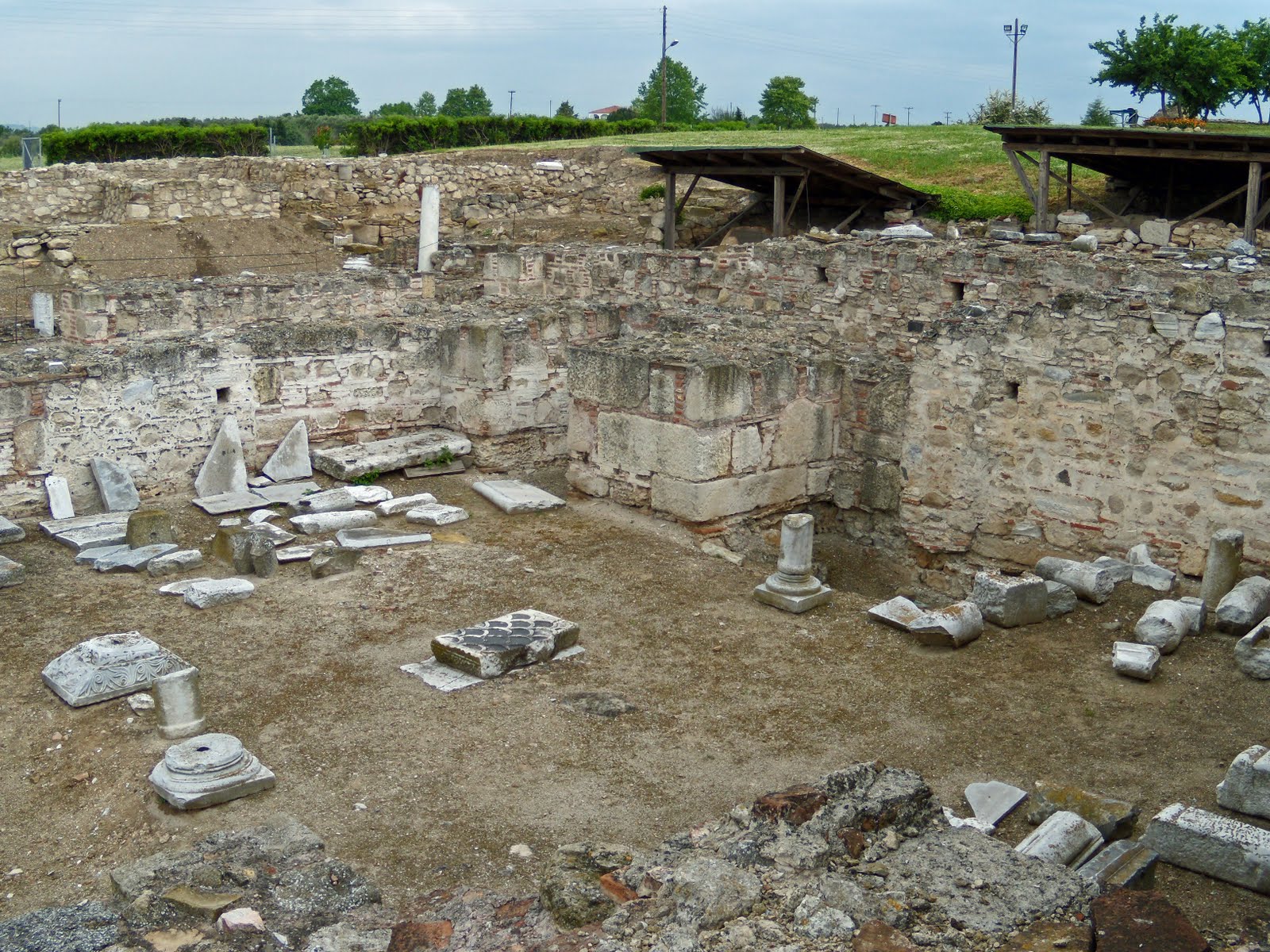
Past the remains of the Roman city wall, I finally enter the city of Dion, which is generally Roman from the 2nd century. There is an entire network of streets along which many buildings, warehouses, private houses, and public baths have risen. A few of these constructions stand out, of course, for instance, the Roman Baths with parts of the mosaic floors and the hypocaust still in place, or the Polygon Villa with a 12-sided courtyard surrounded by columns giving access to the house. At the entrance, we can still admire the 3rd-century mosaic of wrestlers at practice, a very Roman portrait. Further down to the east, we find the remains of the Villa of Dionysos, which takes its name from the large mosaic depicting the god that covers the floor of the banqueting room. And then there is the set of reliefs showing very Macedonian cuirasses and shields that have been set up alongside one of the streets dedicated by Alexander after the Battle of the Granicus. In some places, you can even see sewage conduits underneath these streets. It always makes me wonder how we managed to lose this knowledge in our Middle Ages and had to entirely reinvent the system. If you look closely, you’ll also notice that many mosaic floors have been covered with plastic and gravel to protect them, but it’s so unfortunate that we cannot see them!

Dion is much less well-known than the Sanctuary of Delphi, for instance, but it is certainly not less inspiring. It definitely completes a thorough visit to Greek Macedonia. 

Thursday, October 6, 2011

The Fall of Olynthus - Macedonia forged by Philip II - 8

The Fall of Olynthus (348 BC)

After his march through Thracia in 351 BC, Philip had given the Olynthians a serious warning, avoiding a direct attack, maybe because they had granted asylum to his half-brothers, Menelaus and Arrhidaeus, and to Machatas, the exiled brother of Phila, Philip’s first wife. But now it seems that even ten years after being crowned king of Macedonia, Philip still felt the need to eliminate possible pretenders to the throne when Olynthus, at the head of a league of about 32 cities, refused bluntly to surrender the possible pretenders to the throne, and a full-scale Macedonian invasion was launched in the summer of 349 BC.


Marching in from the north, Philip’s strategy was to isolate Olynthus, and for that purpose, he attacked the cities around it, picking one after another. He besieged and razed Stagira to the ground as a main warning. Other towns like Stratonikea, Acanthus, Apollonia, and Arethusa got the message and surrendered immediately, but not Olynthus, which called for Athens’ help. It took Athens a while to make up its mind, and when it did, Philip had taken his army away on a short campaign to settle matters with rebellious Pherae in Thessaly. But he returned to Chalcidice a few months later, and a new Athenian force was sent to Olynthus’ rescue; it failed. Philip took Apollonia, then Torone, and shortly thereafter, Mecyberna, the port of Olynthus. Now that reinforcements couldn’t reach Olynthus from the sea anymore, Philip was in a position to sack the city. A last support attempt was made by Athens, sending a huge fleet that was seriously hampered by the Etesian Winds (which blew between May and September) and arrived too late. Olynthus had been taken and leveled entirely, not without putting up a serious fight, as proven by the bolt-heads from catapults that were found carrying Philip’s name. His two half-brothers were executed, and the Athenians present in the city were taken to Pella as prisoners to be negotiated over later on. After Olynthus fell, Philip went to Dion to celebrate the festival in honor of Zeus Olympus with lavish sacrifices, extensive symposia as only he could organize, and spectacular competitions.

It is interesting to see how the sack of Olynthus by Philip, because of their sheltering pretenders to the throne, can be compared to Alexander when razing Thebes to the ground about a decade later for the same reason, since they harbored Amyntas, the legal heir in 359 BC – as suggested by some inscriptional evidence. Alexander has walked further in his father’s footsteps than we may think at first sight.

This meant the end of the Chalcidian League and with it Athens’ chances to recover Amphipolis. Philip now had full control over the peninsula’s rich timber and minerals (gold and silver), and he replaced the local coins with Macedonian coinage, especially the silver tetradrachme and, later, the gold staters that eventually circulated all over the ancient world.

Tuesday, September 20, 2011

Olynthus and its houses

Several months ago, in the frame of the exhibition on Alexander the Great at the Hermitage in Amsterdam, I attended a lecture about Macedonia where one of the subjects treated was the city of Olynthus.

To me, Olynthus was a city repeatedly besieged by King Philip, Alexander’s father, in his attempt to create a united Macedonia. Ultimately, he razed it from the map, flattening the entire place in a final crush. So, it would be interesting to learn more about this part of history. As it turned out, this was not to be the main focus of the lecture, it was to be the houses of Olynthus, and I was in for several surprises!

The town is located in southwestern Chalcidice, covering two flat-topped hills in the middle of a fertile plain, about ten kilometers north of Potideia. The origin of Olynthus goes back to its mythological founder, Olynthus, son of Heracles. Still, the oldest remains date from Neolithic times in the third millennium BC, which were destroyed by the Persians in 479 BC.

We owe it to King Perdiccas II of Macedonia to order local tribes and settlements to move to Olynthus. This population increase led to the city's actual organization, which soon covered the entire north hill. Here, the new town was built according to a grid plan, the Hippodamian plan. Hippodamus of Miletus (498-403 BC), although an eccentric figure in his time, was the father of urban planning. He conceived the city layout with wide straight streets crossing each other at square angles, inevitably leading to an ample space in its very center where the Agora would emerge so the citizens could meet and greet in one central location. The first city to be built according to this principle was, of course, Miletus in Asia Minor. Still, the idea took on rather quickly, and Olynthus and Pella were to be built this way (eventually lavishly implemented by Alexander the Great when he founded his many cities in the east and generously copied by the practical Romans).

From 432 BC onward Olynthus’ power rose substantially to become the leader of the Chalcidian League, a confederation of 32 cities on the Chalcidice peninsula. Both Athens and Macedonia would love to have Olynthus as an ally rather than as their enemy. Still, an alliance with Olynthus never lasted long as they kept changing camp according to their own whims.

In 357 BC, King Philip II concluded a peace treaty with Olynthus and its allies, i.e., against Athens (part of this text is being kept at the nearby Museum of Polygyros). But a couple of years later, Olynthus changed its mind again and sought an alliance with Athens, who in return did nothing or close to nothing to help them. At first, Philip maneuvered in such a way as to isolate Olynthus by taking one neighboring city after the other and thus seriously cutting down its power. In 348 BC, he besieged Olynthus and razed it to the ground. Useless to point out that the speaker in Amsterdam had my undivided attention, and it was obvious I had to see Olynthus for myself on my next trip to Macedonia – which I did.

Because Olynthus has been (nearly) completely flattened, it is easy to get a good overview of its layout. Although hardly 1/10th of the total area has been excavated, two large avenues, 7 meters wide, clearly stand out with smaller streets dividing the city into blocks (a familiar sight in major American cities today!). Each block counted ten houses with one upper floor and a paved yard. Amazingly, some of the earliest floor mosaics in Greek art have been discovered here!

It is surprising to learn that most of the houses have a similar ground plan which is commonly referred to as “pastas houses”, i.e. roughly squares of 17 x 17 meters, divided in two almost equal parts, while the northern half is again divided in two. This means that the walls and supporting columns are all placed according to a common rule required: one single roof covers all the northern halves of the entire row of houses. Life evolved around a central courtyard situated in the southern half, which opened onto the long northern portico, i.e., the “pastas.” This portico was the focal point in each house, a convenient and comfortable working area. Nearly all the rooms opened directly to the court or to the pastas. It turns out that the houses in Olynthus were non-hierarchical, meaning there were no main or dominant rooms or backrooms. This differentiates them from the “prostas” type of houses that the Romans built in later years.


All Olynthian houses had a room dedicated as a kitchen area, sometimes with a built-in hearth, and another small room assigned to bathing as several bathtubs have been found in situ with their drainage system. But what stroke me most during this lecture was the illustration of the rooms used as “andron.” Now the “andron” is a kind of formal dining room, only for men, of course, which was used primarily for the Greek “symposiums.” These were dinner parties in which the host took care of entertaining his guests, deciding on the subject to be debated during the long eating and drinking séances, and making sure the appropriate amount of water was mixed with the wine. There were music players, but also young boys and hetaerae to be at the dedicated service of the guests. After a few hours, it was obvious that things ran out of hand, and the mosaic floors were valuable assets when cleaning up the mess the guests made of food, wine, and vomit. In Olynthus, these “androns” usually were square rooms of approximately 5 x 5 meters, with plastered and painted walls around which a raised border of about one meter high indicates the place for the couches (klinè). Because of their setting against the walls, the “androns” in Olynthus could hold seven “klinè,” which meant that the room entrance was off center. The floor was drained by a pipe running through the walls straight into the street, an efficient way to clean up after a messy revelry.

There seem to be considerable variations in these house plans; some have larger “androns,” others larger kitchens or general rooms. Several houses had special workrooms and shops with an opening to the street. Besides that, the homes on one block could be very distinctive from those on another block, perhaps because of a different social status or people exercising a different trade.

Armed with all this background information, I’m off to see Olynthus for myself! The city is within easy reach from Thessaloniki; driving south till the freeway turns into a local road and making sure to turn left in Nea Moudania instead of driving on towards the peninsula of Kassandra. The antique city, now called Megale Toumba, lies on the eastern side of the river Olynthios, while the modern town has relocated to the opposite side. The place is fenced and the access path equals a walk in the park, which in spring bursts with a wide range of flowers and blossoming bushes of all kinds where the busy bees are having a party.

Soon the road runs uphill, and I am treated to the first overall view over the remains of this once so proud city. The walls are approximately knee-high, mainly thanks to the archaeologists' reconstruction work. They have done an excellent job here, inserting a pinkish layer of cement where the original stones end and the newly restored ones have been added. It is a clear example of what “razed to the ground” means,  as historians tell us, for that would have offered us very little to see. I stare immediately into one of the main streets running slightly uphill, giving the impression of an aerial view. Modern excavators have named these avenues, while the smaller crossroads are labeled as streets. At more or less regular intervals, the excavators have placed boards with pertaining information about the streets and the houses so that even the unprepared visitor will find the answers he is looking for.

I follow one of the side streets to its dead end against the city wall, where the sewage conduct that runs underneath this street continues through the wall out of the city. I now remember how during the lecture I was told that the walls of the town and the houses might have had only stone basis whereas the top part was built in brick or mud. That would partially explain how Olynthus was destroyed to the ground, although it was located in a strategic and well-defendable position. The Olynthians put up a fierce fight! It took Philip nearly two years to conquer the city with a short interruption for a campaign in Thessaly. At any rate, his army found the time to engrave their spearheads with a personal message “ΦΙΛΙΠΠO” from Philip. The king and his army must have had quite a sense of humor! Examples of these spearheads can be admired at the nearby Museum of Polygyros, exciting stuff!

In most houses, the wells have been located and nicely preserved – covered with a grid to keep the absent-minded visitor from falling into the pit. I come across one well with the restored wooden frame around it, very interesting. And then, there are the floor mosaics that were left in their original location. As I mentioned above, these are the oldest examples showing well-preserved geometrical motives framed within typical Greek bands. They are comparable to the better-known mosaics at Pella, although not as “royal,” maybe. I recognize the Macedonian sun in one of them while the corners are filled with volutes supporting the wave pattern around the sun. Another one shows a horseback hunter wearing the typical Macedonian hat as he rides in full gallop like in the images we have seen of Alexander the Great. One entrance exposes a deer attacked by two griffons, delicately worked out in small pebbles. Breathtaking to watch!


The Bouleuterion that has been discovered is in a relatively poor state with no seats left, only the socles of the columns that once supported the roof. And in the corner next to it are the remains of a fountain or Nymphaeum, partially reconstructed above the ever-present pinkish cement line.

One of the reasons why Philip so thoroughly flattened Olynthus may have been that the city had given asylum to two of his half-brothers, possible pretenders to the throne of Macedonia. However, we may never know this for sure, but the brothers were killed – problem solved.

At the foot of this hill is a small museum offering an exhibition of pictures taken before, during, and after the site's restoration. Still, it also includes some aerial views that can be very helpful for those who want some extra orientation.

To conclude, I would like to mention that Callisthenes (ca. 370-327 BC), the biographer of Alexander the Great who accompanied him on all his campaigns, was born here in Olynthus. All this proves that Olynthus was not just any city, but a city with lots of history to tell.

[Click here to see all the pictures of Olynthus]

Thursday, September 15, 2011

Philip vs. Demosthenes, an ongoing business - Macedonia forged by Philip II - 7

Philip vs. Demosthenes, an ongoing business (351 BC)

In an attempt to simplify things, I generally tend to skip the names of kings, generals, or other people involved in all these skirmishes, negotiations, and battles, but I would like to make one exception for Demosthenes. Athens, as it turned out, was Philip’s bitterest enemy, and Demosthenes was the politician who put it into words. Athens was a democracy where people had the final say in all matters through the Assembly, which would address the issues and vote by a show of hands. Another important component was the Boulé or Council that would set up the agenda of the Assembly and serve as its advisor while meeting on a daily basis. A number of men took advantage of their rhetorical skills to address the people, and one of them was Demosthenes, who earned the reputation as the greatest Greek writer of speeches, but if he did so out of patriotism or simply to attack Philip’s credibility remains to be proven. In any case, he was highly influential in Athens’ decision to support Olynthus against Philip, as he wrote an extensive speech for each call for help, known as the three Olynthiacs.

The fact is that Demosthenes did not realize that the days of Athens’ polis system were counted and that he could have given Philip at least a chance to rally on an equal basis when he made this overture. It was clear that Philip could make a decision and act upon it immediately, while the Athenian system was slow, and by the time they reached a decision, it was often too late. Philip had raised a vast number of soldiers and could draw forces from Thessaly or other allies if needed. Because of the Third Sacred War at their doorstep, the Greeks had allowed this to happen, and by the time this war was over, some ten years later, they had no way to stop Philip anymore. But we are not there yet.

With his power growing, Philip felt the time was right to seek personal revenge by attacking Thebes. He had not forgotten his years there as a hostage; relations between Macedonia and Thebes had never been easy, and now that he was more involved in the matters of Central Greece, he was not going to miss the opportunity to teach them a lesson. He could not, of course, turn openly against Thebes but used Athens and Phocis, working behind the scenes. His manipulation would ultimately lead to ending the Third Sacred War and the war with Athens over Amphipolis. Everybody in Athens, including Demosthenes, believed this and thought it wise to make peace with Philip before he would set off to make more conquests. What Philip really wanted was a treaty of peace and alliance where he and the Athenians were equals, something that probably did not sink in with the Athenians.

Click here to read the full story about Philip II from the beginning

Friday, September 9, 2011

Philip is bouncing back - Macedonia forged by Philip II - 6

Philip is bouncing back (352 BC)

Philip was not going to sit idle on his hands, of course. He had learned his lesson (one that even Alexander was aware of as we witness later on in history) and his first step was to restore the troops’ morale and their confidence in him as a king. He had to keep his army busy and victorious. Keeping Macedonia’s borders safe was not enough, he needed to expand in Greece or even in Asia.


With his head high, Philip marched his newly inspired army into Thessaly in 352 BC and ordered his men to wear crowns of laurel as they went into battle – a highly symbolic sign to show that he was fighting for a religious cause, on behalf of Apollo “as though the god were going before” (see: Justin, Diodorus) and not merely for revenge or on behalf of his Thessalian allies. In a well-orchestrated attack of cavalry and infantry together with the Thessalians, Philip soon annihilated the Phocians on what is called the Crocus Field. As the story goes, a large number of them simply fled out of guilt when they saw the crowned Macedonians attacking on behalf of their god. Over 6,000 Phocians and mercenaries were killed in battle; 3,000 were captured and drowned to punish them for the sacrilege of seizing Delphi. No mercy, that is clear. This battle restored Philip’s leadership and the confidence of his army, which he never lost again.

Philip immediately saw his opportunity to secure Macedonia’s southern border by stabilizing the situation in Thessaly. An agreement was signed at Pherae, consolidated by his marriage with a local woman named Nicesipolis (she died 20 days after giving birth to their daughter Thessalonica, meaning ‘Thessalian Victory’). It hereby became clear that whoever defected from the Thessalian League of City-states also defected from Philip. His position was so strong now that he was elected archon (leader) for life, a highly exceptional nomination as he was not a Thessalian. The Third Sacred War was at a stalemate.

I am really amazed to see how often the Macedonian army is marching up and down northern Greece, crossing it time and again from east to west or vice versa.

By now, the Athenians had regained their influence over the Chersonese, and eastern Thracia, fickle as ever, had abandoned Philip once again. On top of that Olynthus had sued for peace with Athens. High time for Philip to reassert his presence and chance worked in his favor. In late 352 BC, he was asked to assist a coalition of Central Thracia, Byzantium, and Perinthus (two cities inside the territory of eastern Thracia) in besieging the fortress town of Heraion Teichos, close to Perinthus. He marched his army east, took the town, and returned it to Perinthus, presumably its original owner. This may sound like a trivial intervention but it meant another blow for the Athenians who jealously wanted to keep the corn route from the Black Sea in their hands. We should not forget that each spring Athenian ships loaded with wheat from the Danube and Maritza basins, sailed down via Byzantium, the Hellespont, and further across the Aegean to Athens. On this route, they badly needed safe havens for their precious cargo and now Philip was threatening their supply line.

Philip now turned to Olynthus where it did not come to open war, a stern warning seemed to have done the trick - for now at least. After a short intervention in Epirus where Philip extended his power by taking his nephew Alexander, i.e., Olympias’ younger brother, with him to court at Pella, he turned his full attention again to the peninsula of Chalcidice. The Olynthians still made trouble in spite of their treaty of 357 BC and Philip’s earlier warning.


Friday, September 2, 2011

Philip’s involvement in the Sacred Wars - Macedonia forged by Philip II - 5

Philip’s involvement in the Sacred Wars (355 BC)
But soon thereafter, another situation called for Philip’s full attention when, in 356 BC, the state of Phocis seized Delphi, the home of Apollo’s oracle. His involvement in this Sacred War could and would boost Macedonia’s power dramatically.

Now, the very name of Sacred War raises some questions with most of us, and we tend to associate or compare it with our Crusaders heading for the Holy Land in the Middle Ages. Yet, nothing is less true. Here it is all about the oracle site of Delphi, which the Greeks considered to be far too important for a single state or city to control. As a result, they created an association of states called the Amphictyonic League to protect them - the word “amphictyony” means as much as “those that dwell around or near”. This Amphictyonic League was very powerful and at some point even counted as many as 24 states. This League was led by a Council functioning as its executive arm. So, whenever the oracle was violated, the Amphictyonic Council would meet and declare a Sacred War against the offending state, calling to the other league members to defend the rights of the Delphian Apollo.

The Third Sacred War that lasted from 355 to 346 BC was the one in which Philip got involved, fighting over the occupation of Delphi by Phocis, roughly the territory locked between Thessaly and Attica, because the Phocians cultivated land on which the sacrificial animals of Delphi were kept. But there was also a matter of unpaid fines, not only by Phocis but by other states as well, which made matters worse.

This situation escalated when Phocis tried to take advantage of the hostile feelings between Thebes - then a formidable military power - on one side, and Athens and Sparta on the other; while taking sides with Athens, Phocis arrogantly invaded Delphi with a nice promise to protect its treasuries. A sensitive matter since this is the place where, besides the famous oracle, precious offerings and money from all over Greece were kept. All the states got involved one way or another, and in 355 BC, the Amphictyonic Council declared the Sacred War against Phocis.

Phocis stubbornly went on the warpath, bluntly seizing part of the temple’s treasury in order to hire mercenaries, some ten thousand of them. It is interesting to learn from Ian Worthington that a mercenary in those days was nothing like what we understand it to be today. And I quote: “Mercenaries formed a distinct group that was an accepted part of Greek society; they had their own identity as a group regardless of where they came from, and they played a political and economic role in relations between states. States and generals who provided or led mercenary armies for rulers and the like made political and trading contacts with them. The Greeks had no word for ‘mercenary’ as such, but instead used terms like epikouros, ‘fighter-alongside’, misthophoros, ‘wage-earner’ and xenos misthophoros, ‘foreign wage-earner’ (cfr Philip of Macedonia, Ian Worthington).” This army defeated the states of eastern Thessaly, splitting the territory in two. Facing this threatening situation, Larissa in eastern Thessaly turned to Philip for help. But Philip was busy laying siege to Methone, and when that was taken care of the next summer (354 BC), he went on to take four towns in eastern Thracia, which were key ports on Athens’ corn route from the Black Sea.


Yet Larissa’s call for help was something that Philip could not ignore, as Macedonia’s southern border could not be compromised. Besides, it was a convenient stepping stone for him to get more closely involved in the politics of Central Greece. Surprisingly and unexpectedly, Philips’ army was defeated by the Phocians – or should I say by the mercenaries they had hired. Antique sources tell us that Philip’s army had fallen into a trap set by Phocis and that the king had to leave behind a large number of dead and injured soldiers. Of the men still alive, many deserted him, and it was only with great difficulty that he instilled them enough courage and discipline to obey his orders in the retreat.

The outcome of this battle rattled like a thunderbolt through the streets of Eastern Thracia and Athens, followed by Illyria, Paeonia, and even Epirus who all welcomed a potential disintegration in Philip’s power. Eastern Thracia was the first to renew its alliance with Athens, which meant a serious blow to Philip’s arduous diplomatic maneuvers. Then Olynthus, in spite of its treaty of 357 BC with Philip, sought an alliance with Athens. The blow must have hit Philip very hard, making him realize how vulnerable Macedonia still was and how easily it could fall back into the chaos he found when he became king.

Wednesday, August 24, 2011

Skopje and Alexander the Great - a two-faced story

As if it were not enough to put up that horrible 13-meter-high statue of Alexander the Great in the very center of Skopje, which the Macedonians from the FYROM (meanwhile renamed the Republic of Northern Macedonia) have allegedly tuned down to “Hero on Horseback” (this is at least what they said, see Alexander the Great in Skopje), they now show up with extra reinforcements.

Believe it or not, they just brought in more of Alexander’s army! Eight bronze phalanx soldiers and eight bronze lions are presently being put into place to liven up the scene! (See the article by the Sofia News Agency). Why eight and why eight lions (kingship?), I don’t know. In any case, it makes you wonder whether this is only a first addition or if there is more to come. I fail to see why they renamed the equestrian statue “Hero on Horseback” only a few weeks ago while these bronze soldiers and animals obviously were nearly ready to roll out of the workshops. This Macedonian phalanx clearly belongs to Alexander the Great. So much for the naivety (or stupidity) of the bystanders - and of the politicians!

[picture by actualno.com]

They just don’t seem to get it there in Skopje – or they just don’t want to. No wonder Greece is extremely unhappy with this situation and considers it as a provocation, nothing less, and they are right. The event has now even reached the EU, where the Enlargement Commissioner, Stefan Fule, declared that if Macedonia (i.e., FYROM = Former Yugoslav Republic of Macedonia) continues this kind of action and fails to make progress in its reforms (the name Macedonia, even converted into FYROM, is not to Greece’s satisfaction), they will lose their EU candidate status. Will that threat be of any help? I have serious doubts.

Since its independence in 1991, the Republic of Macedonia (FYROM) has not only “stolen” the name Macedonia but also repeatedly “hijacked” several historical figures from their neighbors, Alexander is not their first. I hear that the Bulgarians have a similar complaint about the five-meter high marble monument of Tsar Samuil recently erected in Skopje, for he was Bulgaria’s greatest hero fighting against Byzantium – nothing to do with Macedonia.

You just cannot “borrow” a hero from a neighboring country simply because you want or need one. That is a basic privilege for each country individually and one that should be respected.

Watch the movie here.

Tuesday, August 9, 2011

Discovering Pydna

Pydna is generally known for the decisive battle of 22 June 168 BC opposing the Roman general Aemilius-Paulus and King Perseus of Macedonia (179-168 BC). In one single battle, the Romans killed as many as 20,000 Macedonians, an absolute first in history. It meant the end of the Antigonid dynasty of Macedonia, and consequently, the Kingdom of Macedonia ended. Besides the men that fell on the battlefield, another 6,000 fled to Pydna to fall into enemy hands, and another 5,000 were taken prisoner as they tried to escape. A bloody encounter, to say the least. From then on, the Romans divided Macedonia into four republics. It seems that in 150 BC, a certain Andriscus claiming to be the son of the late King Perseus ascended the throne as Philip VI. He just came and went, a victim of another futile war, of course, and in 148 BC, Macedonia was finally subdued and became a Roman province.

To me, Pydna is the place where Queen Olympias took refuge after the death of her son, Alexander the Great, taking his wife Roxane and his son Alexander IV with her. Cassander, who, as the son of Alexander's regent Antipater, had taken over power in Macedonia, besieged and captured the city in 317 BC. Olympias was left with no choice but to surrender to Cassander, who knew no mercy and immediately had her executed. Roxane and Alexander IV were to follow her fate soon.

Well, so much for history, besides the fact that Philip II, Alexander’s father, had annexed the territory in the first place. In any case, enough reason for me to take a look around.

Today’s nearest town is Makrygialos, approximately 65 kilometers south of Thessaloniki, right next to the freeway. Pydna has not really been excavated. The only finds come from occasional discoveries made during construction activities or after illicit diggings. The fertile lands have been inhabited since the 7th century BC, and many graves and tombs have been unearthed going back that far in time. The finds have been split between the Museum of Thessaloniki and the nearby Museum of Katerini.

It is not easy to read the landscape, especially on this rainy day when I’m driving through sleepy villages and settlements. On my way through Methone, in the curve after the seaside fish restaurants, I am being waved at by King Philip in person! Of course, Methone was one of the main cities that Philip conquered from Athens back in 355-354 BC, but I wasn’t expecting to meet up with his bronze statue in this bend of the road. What a pleasant surprise. It shows the king in his prime, which he most probably was at the time of this battlefield. The Greek, as well as the Macedonian flag, proudly enfold above him. I look around for more signs but cannot find any.

I pick up the road again, heading further south till I reach Pydna or what is left of it. A fenced field on my left overlooking the sea is catching my eye. The entrance gate is ajar, an invitation to enter. This just might be the place of the old fort, and it is!

Once again, I’m struck by the strategic location as I can look north all the way to Methone and beyond, while to the south, on a clear day, we may even see Mount Olympus. This stronghold fits in the center of a wider bay, ideal to watch enemy ships approaching.

Within the perimeter of the fence, the remains are definitely Byzantine. Typical, of course, as they built their forts and churches right on top of older Roman or Greek construction, reusing the stones they found at hand. This site is no different, and as I question the local archaeologist and guardian, he willingly shows me the scattered remains from Greek temples, Macedonian city walls, and Roman olive- or winepresses. Further in the landscape, he also points to the line in the trees, walls, and houses that are supposedly part of this old fort. Excavations over here certainly are still in their infancy, and I can imagine how many archaeologists’ hands are itching to start digging for more treasures before they disappear through the illegal circuit, forever ripped out of their context.

Wednesday, August 3, 2011

A moment of glory - Macedonia forged by Philip II - 4

A moment of glory in 356 BC

Three years into his kingship, in 356 BC Philip must have looked back at his achievements with some degree of satisfaction. He now had secured most of Macedonia’s borders and built up a nearly invincible army, money was flowing in from the recently acquired mines of Philippi (more than 1,000 talents a year), his race-horse had won at the Olympic games, and most important of all Olympias bore him a son, Alexander.


Towards the end of 355 BC, Philip decided to besiege Methone in order to complete his control of the entire coastline towards Thessaly. Besides, Methone was located on a strategic communication route to Dion, Macedonia’s major religious sanctuary. He generously gave the people a chance to surrender but when they refused, he besieged the city. Methone had huge walls and in spite of Philip’s equipment and repeated efforts, it took him several months to succeed. But while he was inspecting his own siege craft, an arrow from an enemy catapult hit him in the eye. It seems that an eye injury is a bloody affair and one can easily imagine the commotion among his men. The siege may have been brought to a halt for a while, waiting for the outcome of the king’s wounds. The city was eventually taken in the early summer of 354 BC. Methone’s walls and buildings were razed to the ground so that even today it is difficult to locate.

The result of these moves meant that Macedonia’s coastline was now free of Greek cities, that Chalcidice was bound to Macedonia by a thorough treaty, and that the country reaped large revenues from the Crenides mines – more than enough to cover his military expenses and provide regular pay to his soldiers. Athens, by contrast, had exhausted its finances and was lucky enough to be saved by its archon Eubulus who created a special fund to stimulate the city’s economy.