Alexandria's founded by Alexander

Alexandria's founded by Alexander the Great (by year BC): 334 Alexandria in Troia (Turkey) - 333 Alexandria at Issus/Alexandrette (Iskenderun, Turkey) - 332 Alexandria of Caria/by the Latmos (Alinda, Turkey) - 331 Alexandria Mygdoniae - 331 Alexandria (Egypt) - 330 Alexandria Ariana (Herat, Afghanistan) - 330 Alexandria of the Prophthasia/in Dragiana/Phrada (Farah, Afghanistan) - 330 Alexandria in Arachosia (Kandahar, Afghanistan) - 330 Alexandria in the Caucasus (Begram, Afghanistan) - 329 Alexandria of the Paropanisades (Ghazni, Afghanistan) - 329 Alexandria Eschate or Ultima (Khodjend, Tajikistan) - 329 Alexandria on the Oxus (Termez, Afghanistan) - 328 Alexandria in Margiana (Merv, Turkmenistan) - 326 Alexandria Nicaea (on the Hydaspes, India) - 326 Alexandria Bucephala (on the Hydaspes, India) - 325 Alexandria Sogdia - 325 Alexandria Oreitide - 325 Alexandria in Opiene / Alexandria on the Indus (confluence of Indus & Acesines, India) - 325 Alexandria Rambacia (Bela, Pakistan) - 325 Alexandria Xylinepolis (Patala, India) - 325 Alexandria in Carminia (Gulashkird, Iran) - 324 Alexandria-on-the-Tigris/Antiochia-in-Susiana/Charax (Spasinou Charax on the Tigris, Iraq) - ?Alexandria of Carmahle? (Kahnu)

Thursday, May 30, 2024

The bronzes from Bubon’s Sebasteion

Illegal digs are inevitable and Turkey with its countless antique sites is no exception. A beautiful bronze head of an unknown young man displayed at the Getty Villa has recently been identified as stolen or illegally excavated, and it is heartwarming to hear that it will be returned to Turkey. 

The Getty Museum in Malibu, California, acquired the head in 1971 and it could be established that it belonged to a now-lost life-size figure. It is marked with the letter alpha (the Greek A) at the bottom of the neck. The inlaid eyes, which always add so much character to a face, are missing. 

Dated to the period between 100 BC and 100 AD, the statue's provenance was not documented, although scholars now link it to the archaeological site of Bubon in ancient Lycia. Since the late 1960s, several bronzes have been smuggled out of Turkey from that area. Most depicted Roman emperors and their families but the head at Getty has yet to be identified. 

In October 2023, the New York Times published an article on these bronzes from illegal digs that have been scattered around the world to various private homes and museums. 

By 1967 the looting became apparent and slowly stopped as the Turkish police found a headless bronze torso hidden in the woods near Bubon. This site turned out to be the main source for this unique collection and authorities are determined to track the looters down. 

Bubon has not been systematically excavated and all that remains are a small theater and stadium, as well as an Acropolis. The main building may have been a shrine or Sebasteion, where several bronze statues stood around a U-shaped courtyard that was probably roofed. The Sebasteion may have been started by Nero and his wife Poppea Sabina. His example was followed by eleven emperors and three empresses, the last being Gallienus, who ruled till 268 AD. In the following decades, Bubon suffered from repeated earthquakes which buried and saved the Sebasteion. 

Scholars and experts aim to restitute the group of statues, which represented an important binding factor between the citizens to the power of faraway Rome. 

In the end, the villagers themselves, now in their 60s and 70s, provided the most precious information. They described the statues and their posture and remembered how they were sold. Their plinths with the names of the emperors in Greek are still in situ. 

Lucius Verus
apparently stood next to Marcus Aurelius, his adoptive brother and co-ruler. His headless statue may be at The Cleveland Museum of Art and his Bubon origin is now under investigation. 

Septimius Severus was accompanied by his wife and sons, Caracalla and Geta. His headless statue was on loan at the Metropolitan Museum of Art in New York and has been turned over to the authorities for repatriation. Some experts believe the missing head is kept at the Carlsberg Glyptotek in Copenhagen, Denmark. The head of Caracalla has been seized from the Met and his torso is probably in the hands of a Greek collector. Emperor Valerian stood nearby and his torso is now exhibited at the Museum of Burdur, Turkey. Commodus also had a plinth of his own.

In due time, more emperors will be reconciled with their names on the pedestals and more effigies or body parts will be returned to their rightful spot in Turkey

[Top picture from Getty Museum. Lucius Verus is mine taken at the MANN]

Wednesday, May 22, 2024

Plato, more than a philosopher

Plato is a highly fascinating figure. Not only was he a student of Socrates, but he also taught Aristotle, who, in turn, passed his knowledge on to young Alexander. 

Plato, born in 427 BC, received the best education of his time. Although we know him mainly as a philosopher, he was educated in martial arts and horse riding, besides mathematics and music, painting, and drawing. 

When about the age of twenty, he encountered Socrates teaching on the Agora of Athens, and he realized that philosophy was a more worthy goal to pursue. 

Socrates hardly wrote anything down. We know him from Plato and Xenophon, who are not always in agreement. Socrates preferred talking, or rather asking questions, to the point of embarrassing and irritating his audience. 

Plato followed his master until the Athenians executed him on the charge of impiety in 399 BC. He then left Athens and traveled to other philosophical centers, such as Megara and Syracuse in Sicily, and later to Egypt and Cyrene. He became a student of Pythagoras, Euclid, and Heraclitus, and concentrated on the religion and metaphysics of Egypt. 

Before the Museum of Alexandria was founded, the center of knowledge was in Heliopolis, where priests studied philosophy, astronomy, and theology. Many Greeks, like HomerPythagoras, Plato, and Solonconsulted the Library that contained the history of Egypt going back thousands of years. For us, Egypt's ancient history is lost in the mists of time… How much was (still) available in Plato’s days? Probably far more than we can imagine. 

In the 380s BC, Plato returned to Athens, where he started the Academy. The philosopher educated his followers in a shrine of olive groves, sacred to the Greek hero Academos, and called it, therefore, Academia. Plato’s school would continue to thrive till the early 6th century AD when it was shut down by Emperor Justinian. This Byzantine emperor was determined to erase paganism for good and impose Christianity instead to regain control over the Western Roman Empire. 

Plato is best known for his Dialogues and his Letters. He contributed hugely to our Western culture and religion, although few people realize his impact on monotheistic religions like Christianity, Judaism, and Islam. He was the first philosopher to mention and underscore the soul's immortality. For that reason, his work was not destroyed but accepted by the Christian religious leaders. Plato also stressed the importance of ‘objective truth’ in order to live well. 

As a result of the recent advanced imaging diagnostic techniques to read the carbonized papyri from Herculaneum (see: Reading the papyrus scrolls from Herculaneum), scholars have discovered more details about Plato’s life, of which very little is otherwise known. By virtually realigning the bits of burnt papyrus, they were able to restore the continuity of the text and obtain more information. 

The scroll revealed that Plato was sold into slavery on the island of Aegina, south of Athens, either in 404 BC when Sparta conquered the island, or in 399 BC upon the death of Socrates. It was previously and erroneously accepted that this event took place while he resided at the court of Dionysios of Syracuse in 387 BC. 

We also learned more about the final hours of Plato. While battling a fever, he listened to flute music played by a Thracian slave girl. He was still very lucid as he had the strength to criticize the girl’s lack of rhythm. A perfectionist to the end? 

Plato died in 348/347 BC, and it is now understood that he was buried in the garden of his Academia of Athens. This is very telling since the Academy is considered the world’s first university, which he founded next to the Mouseion. 

Deciphering the papyrus scrolls is a lengthy process that may well require many more years. Who knows what more we will learn?

Wednesday, May 15, 2024

The ten oldest languages still spoken in the world today

Language is our means of communication, wherever we are, wherever we go. It would be so practical if we all spoke the same language, yet its diversity is what underscores the uniqueness of each ethnicity or group of people residing in one particular area. Language is closely connected to tradition, ancestry, and history. It is the extra spicing of every tale. 

It was entirely by chance that I found the site of The Culture Trip which offers a concise list of ten languages labeled as being as old as the world to be still spoken today. Amazingly, Greek is not on the list – a deception to many people, no doubt! 

To keep the story true to its source, I simply quote the content of The Culture Trip link that gives all the details of the top ten languages: 

Hebrew, Tamil, Lithuanian, Farsi, Icelandic, Macedonian, Basque, Finnish, Georgian, and Irish Gaelic.

Language evolution is like biological evolution – it happens minutely, generation by generation, so there’s no distinct breaking point between one language and the next language that develops from it. Therefore, it’s impossible to say that one language is really older than any other one; they’re all as old as humanity itself. That said, each of the languages below has a little something special—something ancient—to differentiate it from the masses.
 
Hebrew
Hebrew is a funny case, since it essentially fell out of common usage around 400 CE and then remained preserved as a liturgical language for Jews across the world. However, along with the rise of Zionism in the 19th and 20th century, Hebrew went through a revival process to become the official language of Israel. While the modern version differs from the Biblical version, native speakers of Hebrew can fully comprehend what is written in the Old Testament and its connected texts. As the earliest speakers of Modern Hebrew often had Yiddish as their native language, Modern Hebrew has in many ways been influenced by this other Jewish language.

Tamil
Tamil, a language spoken by about 78 million people and recognized as an official language in Sri Lanka and Singapore, is the only classical language that has survived all the way through to the modern world. Forming part of the Dravidian language family, which includes a number of languages native mostly to southern and eastern India, it is also the official language of the state of Tamil Nadu. Researchers have found inscriptions in Tamil dating back to the third century BCE, and it has been in continuous use ever since. Unlike Sanskrit, another ancient Indian language that fell out of common usage around 600 BCE and became mostly a liturgical language, Tamil has continued to develop and is now the 20th most commonly spoken language in the world.
 
Lithuanian
The language family that most European languages belong to is Indo-European, but they started splitting apart from each other probably around 3500 BCE. They developed into dozens of other languages like German, Italian, and English, gradually losing the features that they had all shared. One language, however, up in the Baltic language branch of the Indo-European family, retained more of the feature of what linguists call Proto-Indo-European (PIE), which is the language that they postulate was spoken around 3500 BCE. For whatever reason, Lithuanian has kept more of the sounds and grammar rules from PIE than any of its linguistic cousins, and can therefore be called one of the oldest languages in the world.
 
Farsi
In case you haven’t heard of Farsi, it’s a language spoken in modern-day Iran, Afghanistan, and Tajikistan, among other places. You’ve probably heard of Persian, and it probably conjures up pictures of genies coming out of bottles. They’re actually the same language, under a different name. Farsi is the direct descendant of Old Persian, which was the language of the Persian Empire. Modern Persian took form around 800 CE, and one of the things that differentiates it from many modern languages is that it has changed relatively little since then. Speakers of Persian today could pick up a piece of writing from 900 CE and read it with considerably less difficulty than an English speaker could read, say, Shakespeare.
 
Icelandic
Icelandic is another Indo-European language, this time from the North Germanic Branch (just for comparison, English is also a Germanic language, but from the West Germanic branch). Many Germanic languages have streamlined themselves and lost some of the features that other Indo-European languages have (you’ve probably never heard of a case, for example, unless you’ve studied Latin or a Slavic language), but Icelandic has developed much more conservatively and retained many of these features. Danish governance of the country from the 14th to the 20th century also had very little effect on the language, so it has mostly gone unchanged since Norse settlers brought it there when they came to the country, and Icelandic speakers can easily read the sagas written centuries ago.
 
Macedonian
The Slavic language family, which includes Russian, Polish, Czech, and Croatian, among others, is relatively young as far as languages go. They only started splitting off from their common ancestor, Common Slavic (or Proto-Slavic), when Cyril and Methodius standardized the language, creating what is now called Old Church Slavonic, and created an alphabet for it. They then took the language north with them in the 9th century as they went to convert the Slavs to Christianity. They came from somewhere just north of Greece, probably in what is now known as Macedonia (or the Republic of Macedonia or FYROM), and Macedonian (together with its very close relative Bulgarian) is the language that is most closely related to Old Church Slavonic today.
 
Basque
The Basque language is the ultimate linguistic mystery. It is spoken natively by some of the Basque people who live in Spain and France, but it is completely unrelated to any Romance language (which French and Spanish are) or indeed any other language in the world. Linguists have postulated over the decades about what it could be related to, but none of the theories have been able to hold water. The only thing that’s clear is that it existed in that area before the arrival of the Romance languages – that is before the Romans got there with the Latin that would eventually develop into French and Spanish.
 
Finnish
Finnish may not have been written down until the 16th century, but as with any language, it has a history that stretches back far earlier than that. It is a member of the Finno-Ugric language family, which also includes Estonian, Hungarian, and several smaller languages spoken by minority groups across Siberia. Despite that, Finnish includes many loan words, which were adopted into Finnish from other language families over the centuries. In many cases, Finnish has retained these loan words closer to their original form than the language that they came from. The word for mother, aiti, for example, comes from Gothic – which, of course, is no longer spoken. The word for king, kuningas, comes from the old Germanic word *kuningaz – which no longer exists in any Germanic language.
 
Georgian
The Caucasus region is a real hotbed for linguists. The main languages of the three south Caucasian countries, Armenia, Azerbaijan, and Georgia, come from three entirely different language families – respectively Indo-European, Turkic, and Kartvelian. Georgian is the biggest Kartvelian language, and it is the only Caucasian language with an ancient literary tradition. Its beautiful and unique alphabet is also quite old – it is thought to have been adapted from Aramaic as far back as the third century AD. While not a language island in the same sense as Basque, there are only four Kartvelian languages, all spoken by minorities within Georgia, and they are all unrelated to any other languages in the world.
 
Irish Gaelic
Although Irish Gaelic is only spoken as a native language by a small majority of Irish people nowadays, it has a long history behind it. It is a member of the Celtic branch of Indo-European languages, and it existed on the islands that are now Great Britain and Ireland well before the Germanic influences arrived. Irish Gaelic was the language from which Scottish Gaelic and Manx (which used to be spoken on the Isle of Man) arose, but the fact that really lands it on this list is that it has the oldest vernacular literature of any language in Western Europe. While the rest of Europe was speaking their own languages and writing in Latin, the Irish decided that they wanted to write in their own language instead.

The Culture Trip also offers trips and guides for every traveler around the world.

Wednesday, May 8, 2024

The remarkable Illyrian helmet

Illyrian helmets truly stand out and are immediately recognizable. Their particularity is the rectangular opening for the face and two parallel ridges on the top of the crown for the crest.


They may be found all over the Balkans, but also in Macedonia and Greece proper, and evolved from the 8th to the 3rd century BC. The earliest version had a low crown and lacked a neck guard. It was soon followed by a helmet with a more pronounced back guard, the typical horizontal ribs, and a decorative edge around the face, often using a series of studs. The most recent model showed elongated cheek pieces and a simple decoration around the edges.
 
An early example is in the Museum of Olympia, Greece, which dates from the end of the 7th century/beginning of the 6th century BC. It clearly shows the framing studs. The horizontal ribs are already more pronounced than those shown in my previous post, A rare Illyrian Helmet.


The Archaeological Museum in Athens has two beautiful specimens from the 6th century BC. One is this helmet from Pengaion,  550-500 BC
 
The other is the very telling Funerary Mask (see top picture) from 530-510 BC, which is missing the horizontal slit for the crest between the ridges. It is framing the face of the deceased, covered in gold foil.


As expected, the Museum of Tirana in Albania has a well-preserved helmet on display. It has been dated to 550-500 BC.


The Illyrian helmets are in the news after excavations of the burial mounds on the Peljesac Peninsula in Croatia. Several tombs from the 4th century BC yielded well-preserved Illyrian helmets that have been dated to the 6th century BC.
 
The eastern Adriatic coast looks very promising since at least a dozen helmets were found in Dalmatia, and even more in Herzegovina.

Saturday, April 27, 2024

The poem was not just a love poem

No, and it was not a love poem written by Sappho but by Shu-Sin, a Sumerian King who ruled around 2,000 BC. Well, it may not be exactly a love poem but it certainly was a way to celebrate beauty and love. 

A close study has revealed that according to Sumerian belief, it was the sacred duty of the country’s ruler to marry a priestess and votary (i.e. a devote adherent of a cult or religion) of Inanna, the goddess of love and procreation once a year. It was celebrated on New Year’s Day to ensure the fertility of the soil and fecundity in the womb. 

The ceremony started with festivities and banquets accompanied by music, song, and dance. It was during such a celebration that the ‘bride’ of King Shun-Sin would recite the poem as part of the sacred rite. 

The King would symbolically marry the goddess Inanna, in order to ensure fertility and prosperity for the coming year. 

Bridegroom, dear to my heart,
Goodly is your beauty, honeysweet,
Lion, dear to my heart,
Goodly is your beauty, honeysweet. 

You have captivated me, let me stand tremblingly before you.
Bridegroom, I would be taken by you to the bedchamber,
You have captivated me, let me stand tremblingly before you.
Lion, I would be taken by you to the bedchamber. 

Bridegroom, let me caress you,
My precious caress is more savory than honey,
In the bedchamber, honey-filled,
Let me enjoy your goodly beauty,
Lion, let me caress you,
My precious caress is more savory than honey. 

Bridegroom, you have taken your pleasure of me,
Tell my mother, she will give you delicacies,
My father, he will give you gifts. 

Your spirit, I know where to cheer your spirit,
Bridegroom, sleep in our house until dawn,
Your heart, I know where to gladden your heart,
Lion, sleep in our house until dawn. 

You, because you love me,
Give me pray of your caresses,
My lord god, my lord protector,
My Shu-Sin, who gladdens Enlil's heart,
Give my pray of your caresses.
Your place goodly as honey, pray lay your hand on it,
Bring your hand over like a gishban-garment,
Cup your hand over it like a gishban-sikin-garment

The text appeared on a cuneiform tablet discovered during excavations in Nineveh in 1846-1847 as part of the Library of King Ashurbanipal. It was taken to the Museum of Istanbul where it remained hidden in a drawer until 1951. We have to thank Samuel Noah Kramer for retrieving and translating this lovely work of art. 

[for more details, please refer to this article in World History

Thursday, April 18, 2024

Reading the papyrus scrolls from Herculaneum

The Villa dei Papiri as reconstructed in Malibu, California, got its name from the huge amount of papyrus scrolls found inside the house’s Library in Herculaneum. 

Unlike Pompeii, Herculaneum did not burn after the eruption of Vesuvius in 79 AD but was buried under a meters-thick layer of pumice. That saved the Library of the Villa that once belonged to Julius Caesar’s father-in-law. The collection consists of more than 1800 papyrus scrolls and is considered the largest surviving library from Graeco-Roman antiquity. 

When the carbonized scrolls were discovered in the early 1800s, hopes were high to explore the long-lost literary works from antiquity. These scrolls were, however, very fragile and disintegrated as soon as they were touched. 

Attempts to open and unroll the rolls destroyed many of them, although some painstaking efforts by a monk revealed philosophical texts written in Greek. Three centuries later we are still trying to understand how to read the papyrus scrolls. 

In 2015, a process called micro-computed tomography (micro-CT) was developed to virtually unwrap fragile scrolls. It was used successfully to digitally recover a burned Hebrew scroll. 

Hopes ran high to apply the same technique for the papyri of Herculaneum. Unfortunately, they present another challenge as these texts are written in carbon ink, called “lamp black”. This type of ink is not detected by the micro-CT imaging system and the writing becomes ‘invisible’. More in-depth studies and new ‘learning machines’ eventually opened the path to reading four passages inside the unopened carbonized scrolls. 

In order to read entire scrolls, two key technical problems need to be solved. The first is to trace the papyrus surface inside the scan of the scroll, which is called segmentation. For the time being, this can only be done manually and costs a fortune. The other issue is the scanning, which is currently carried out using a particle accelerator in England. This involves a precious conservator-supervised transfer of the scrolls, two at a time, from Naples to England! 

The entire process requires much more fine-tuning and careful planning to finally set up a workable and above all affordable technique – as the entire organization is very expensive. With a little luck, it is expected that the scanning and reading of the 300 scrolls from Naples could be completed in two to three years. 

This will be a huge step forward to disclose the contents of hitherto unknown books and even new titles. So much history, literature, philosophy, and poetry that remained buried for two thousand years would finally be available! This is absolutely mind-blowing! 

Yet, there may be hundreds or even thousands of scrolls still buried in the Library of the Villa dei Papiri and, who knows, elsewhere among the ruins of Herculaneum! As we know, excavations are time-consuming and will depend on the funds made available to that effect. Only time will tell.

[Pictures from Vesuvius Challenge]

Thursday, April 11, 2024

The short-lived appearance of King Langaros

Alexander’s campaign into the Balkans before marching east to conquer the Persian Empire is often neglected and even forgotten in literature. 

Only occasionally do we find a name. This is the case for Langaros, King of the Agrianes, who had openly chosen to side with Alexander as he had done with Philip before him. 

When Alexander made his way to Pelium in 335 BC, he faced a threatening revolt of the Illyrians led by Cleitus, king of the Dardanians. Cleitus had persuaded the Autariatae and the Taulantians to join forces (see: Alexander's psychological warfare in Pelium, Illyria). The situation looked bleak for Alexander, who needed to know more about the strength of these Autariatae. 

Langaros, faithful to Alexander, attended him with his bodyguard, the finest and best-equipped troops, and told his friend that he would take care of this warlike tribe. He actually did so, and with Alexander’s consent, he invaded and occupied the Autariatae territory, causing severe losses to their common enemy. 

Alexander showered Langaros with every mark of honor and gifted him with many high-valued presents as proper at the Macedonian court. He also promised Langaros that if he visited him at Pella, he would give him his half-sister Cynane in marriage. Cynane was the daughter of Philip II and his Illyrian wife Audata (see: The many wives of Philip II of Macedonia). It was not to be, as Langaros, after returning home, fell ill and died. 

Our only source for this story is Arrian, who kindly remembered him. 

Recent archaeological digs near the city of Kumanova in North Macedonia have revealed remains of an important yet unknown town from the 4th century BC. Besides a pool with a plastered floor, some plastered walls, capitals and bases of columns, and appliqués have been found. They are consistent with similar details from Aegae and Pella

It is far too early to draw any conclusions right now and to link the ruins to King Langaros’ capital. The pictures of the site are not adding much to the story yet. As we know, excavations in that part of the world are slow to materialize. 

This King Langaros is not to be confounded with the Illyrian King Longarus, who ruled over the Dardanians from 231 to 206 BC. 

Longarus, however, played an important role in the life of Philip V of Macedonia, who regularly attacked the Dardanians. Taking advantage of Philip’s campaign in the Peloponnesus in 219 BC, Longarus occupied Bylazora, the capital of Paeonia. His success was short-lived, though, as two years later, in 217 BC, Philip V captured Bylazora, blocking the Dardanian access road to Macedonia.

Tuesday, April 2, 2024

Bylazora, the last Macedonian Palace

The Paeonians occupied the land north of ancient Macedonia and functioned as a buffer zone with the Dardanians on their northern border. Bylazora, in fact, was situated in a commanding position at the natural pass leading from Dardania into Macedonia. 


Philip V of Macedonia, who ruled from 221 until 179 BC, captured Bylazora in 217 BC. By blocking the Dardanian access road to Macedonia, he freed his country from its repeated menacing raids. PerseusPhilip’s son, who succeeded his father, sent mercenaries to Bylazora to confront the Romans, but he was defeated in 168 BC. He was taken to Rome to be shown in their victory parade, together with the incredible wealth of Macedonia. The rich kingdom became a mere Roman province. 

Although Bylazora was the largest city of Paeonia and was mentioned by Livy and Polybius, its location remained a mystery. It was tentatively identified with (Titov) Veles, but the results were inconclusive. As so often, the city was discovered by accident in 1994. Road works exposed a buried pool-like building close to modern Sveti Nikole in the Republic of North Macedonia, some 50 kilometers southeast of Skopje, between the Axios and the Strymon Rivers. 

Excavations started in 2008 after the Museum of Sveti Nikole invited the Texas Foundation for Archaeological & Historical Research (TFAHR) to a joint cooperation. 


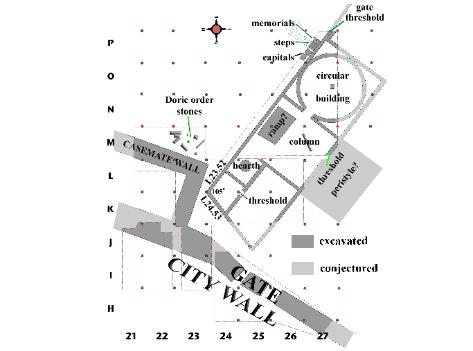
It was a slow process of searching for clues that started at the top of the hill, the Acropolis. Soon, a section of the northern defensive wall was exposed, followed by the discovery of a ramp leading up to the Propylon. Next, a Stoa with Doric columns was identified and dated to the days of Philip V based on a similar gallery built by Attalus II in Athens. 

A long wall and successive rooms were unearthed, making the archaeologists realize they had found the Palace of Philip V and Perseus, the last two kings of Macedonia. 

The first room they explored had all the characteristics of a kitchen, with a fireplace, much pottery, plates, vessels, and amphorae from the 3rd-2nd century BC. The walls were covered with a thick layer of plaster with traces of paint. Followed a room with columns and capitals, which was named Ante-room since it connected to a more important Tholos. For those who visited the Palace of Aegae in Greece, that space is very recognizable. On the other side of this Tholos lies the Entrance Hall, which in turn is connected to the Vestibule. This large room opened onto the Outer Courtyard via a monumental staircase. 

Keeping the layout of the Palace of Aegae in mind, the archaeologists projected the same series of rooms around the Inner Courtyard. The picture seems to fit perfectly. It also matches the Palace of Dimitrias, situated just south of Volos in Greece. The city was built by Demetrios Poliorcetes when he was king of Macedonia, i.e., 294-288 BC. 

Until now, and as opposed to Aegae and Pella, I had no knowledge of the Macedonian Palaces of Bylazora or Dimitrias. The destruction of the Palaces of Aegae and Pella by the Romans is well-documented. Dimitrias, however, was entirely dismantled, and it is assumed that the same happened in Bylazora, although it was never finished. 

Much more pertinent information with clear maps and unique details can be found in this lecture given by Dr.William J. Neidinger of the TFAHR.

[Pictures from TFAHR]

Friday, March 22, 2024

The Bharhut Yavana

Yavana means as much as Greek or could even refer to a foreigner in ancient Indian literature. The word may have a Persian origin and traveled with Cyrus the Great to the Northwestern provinces of India. After the eastern conquests of Alexander the Great, the name Yavana was used more specifically for the Indo-Greeks after approximately 175 BC. 

The Bharhut Yavana refers to the relief of a Greek warrior on a Vedika pillar, discovered near the Stupa of Bharhut in Central India. His role was to guard the entrance to a temple. It is made of reddish-brown sandstone and dated to c. 100-80 BC.

The characteristics of the Yavana warrior are his short curly hair and hairband (the Indians wore a turban), his tunic, and boots. His hair band is well-known from coins minted for King Menander. The sheath of his broadsword is decorated with symbols of Buddhism, such as a srivasta, also known in Hinduism, and a nandipada, the symbol of a bull’s hoof. The inscription at the top of the panel is in Brahmi script and says "Pillar-gift of the lay brother Mahila." Who this Mahila is remains a mystery.

Some sources claim that the Bharhut warrior could represent King Menander of Bactria, who expanded his kingdom to the Punjab as far as Pataliputra. As a great Indo-Greek King, he ruled from 155 to 130 BC.

The Bharhut Yavana is not unique. The Stupa of Sanchi, commissioned by Asoka the Great in the 3rd century BC, displays another 18 of these Greek worshipers. They wear very recognizable Greek tunics, capes, and sandals. Also, they play Greek musical instruments like the aulos (double flute) and the carnyx (a Roman brass horn shaped as a capital G). Here too, the men have short curly hair and many wear a hairband as mentioned above. 

Even in his wildest dreams, Alexander could not have expected this evolution and presence of Greek art for centuries after his death at the other end of his empire.

Wednesday, March 13, 2024

Did Alexander visit Girsu, Iraq?

The ancient site of Girsu is situated some 25 kilometers west of Lagash in Southern Mesopotamia. Today the Iraqi town is called Tello. 

The only time I came across the name of Girsu was at the Louvre-Lens Museum which proudly displayed the diorite statue of Gudea, Prince of Lagash dated from 2120 BC.
 

The Sumerian city currently excavated by archaeologists of the British Museum has yielded a temple from the days of Gudea. The site was abandoned around 1750 BC but tradition still linked the temple to Ningirsu, an ancient Mesopotamian god. It may well be that Alexander was told that Ningirsu was the equivalent of Heracles. Based on his own conviction to be the son of Zeus, that would make him Heracles’ brother. The site would thus honor Zeus and two divine sons, Heracles and Alexander. This speculation would fit the cryptic Greek inscriptions found at Girsu. The text was written in Aramaic and Greek and stated “adad-nadin-ahhe”, meaning “giver of the two brothers”. 

In that context, Alexander could have commissioned the construction of a Greek temple on the same spot where the temple to Ningirsu stood as he intended to honor the ancient gods and his own divine status. 

As he returned to Babylon in 323 BC after his campaign in India, it is not impossible that the king stopped at the city of Girsu which lies only 130 kilometers southeast of Babylon. This theory is confirmed by the discovery on the site of a silver drachm minted around 330 BC and probably left by one of his Macedonians. 

The excavation site yielded other offerings such as terracotta figurines of soldiers and horsemen closely resembling the Companion Cavalry, Alexander’s bodyguard. This would imply that the gifts were left by those close to Alexander or by Alexander himself. 

There may be a lot of speculation involved in the finds at Girsu but if they are confirmed, the construction of this sanctuary would be one of Alexander’s final acts. 

[The Temple of Girsu from ArchaeologyWiki]

The archaeological site of Girsu was first excavated in the 19th century by the French, who noticed that Greek artifacts were mixed with Sumerian elements. The excavations led by Dr Sebastian Rey in 2022 unearthed walls and records of a huge palace as well as the sanctuary that held the Greek temple. This temple is thought to have been used originally for feasts, animal sacrifices, and processions in honor of the god Ningirsu.