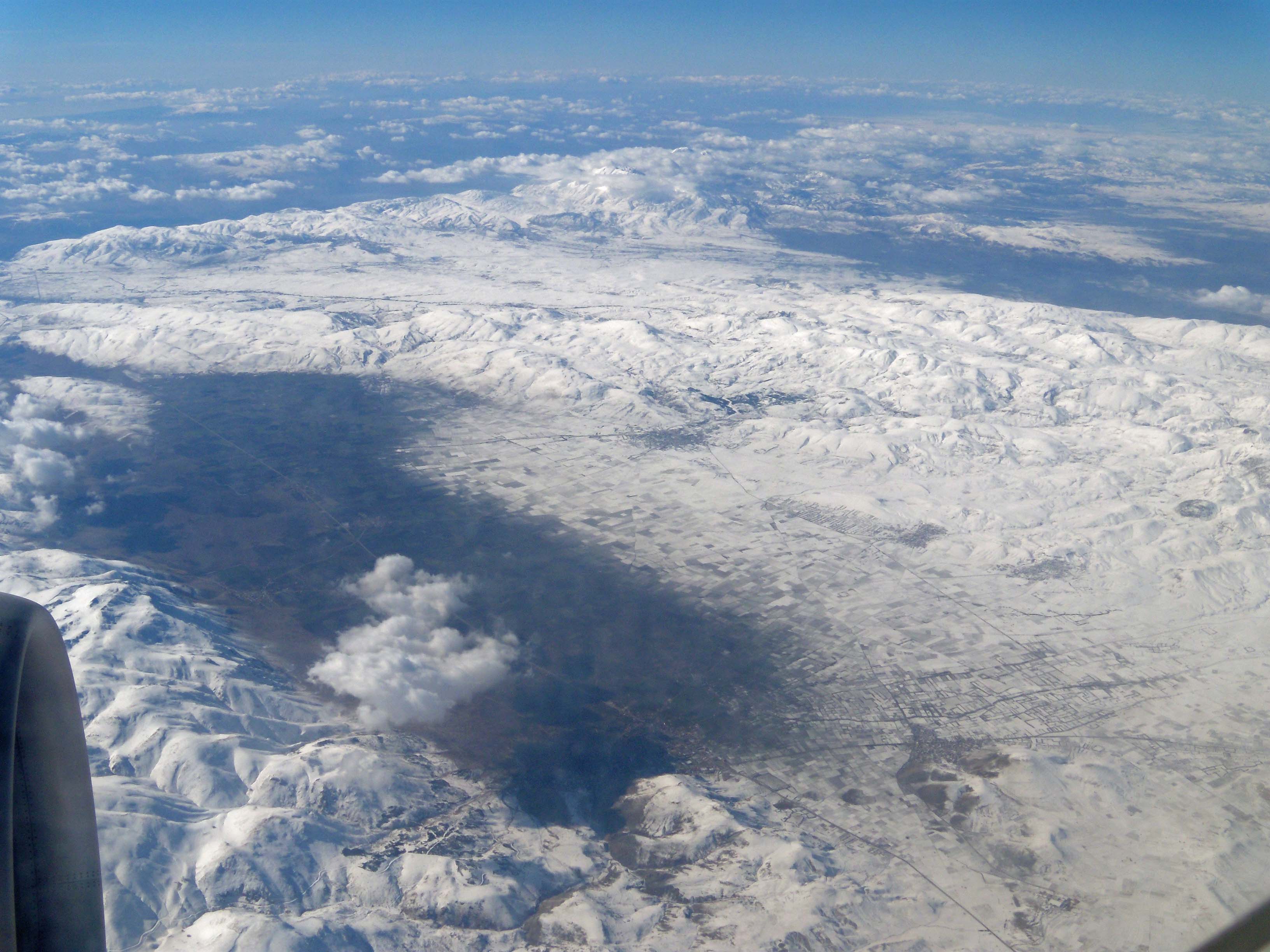
As I so often stated, the weather conditions are not
important for historians. We find only a few examples in Alexander's campaigns,
like the Monsoon in India
and the flash flood in the Gedrosian
Desert. Still, in
reality, the weather did play a vital role in his campaign in the East.
Throughout their march from Greece
to India,
the Macedonians must have been plagued by recurrent earthquakes that disrupted their advance or their camp. Alexander could sacrifice to the
gods, but he could not prevent or control these natural disasters.

Speaking
to one of the locals in Turkey,
I remember him pointing out that he preferred to be “in the open” rather than
inside any building when an earthquake occurred. Being outside, he would
witness boulders rolling downhill and trees being shaken, but none of the
rattlings would be as frightening as when sitting inside a house or shack.
It is easy to imagine
how, in Alexander’s campsites, the army tents would collapse, banging
up the occupants. Frightened horses and pack animals would try to run if they
were not adequately secured by their attendants. When an earthquake hit the
troops on the march, they could immediately react accordingly.
Another natural threat
is the wind, which may not sound so dangerous, but the situation could be
life-threatening when it creates a storm.
This idea occurred to
me during my trip to Iran when
I skirted the Zagros Mountains. In the
winter of 330 BC, Alexander marched south using approximately the same
route I was following a little later in the year, i.e., in April (see: The Zagros Mountains and the Persian Gates in Alexander’s footsteps).
I
was plagued by a severe sandstorm that blew relentlessly during my three-day
journey. Visibility was very low as the sands from the Mesopotamian
Valley in modern Iraq were
carried through the air. My clothes flapped around me as if they were to be
torn away any moment, while the sand was stinging my face and hurting my body.
The wind whistled through the lunch place, and the sand battered against the
windows.
Inevitably, my mind
drifted back to Alexander as he must have known
days like this. Traveling in the comfort of my air-conditioned vehicle was hard
enough. However, when I stepped outside of this protective shell, I had a taste
of what he experienced – if not here, certainly in other locations.
Curtius seems to be the only one to write about Alexander’s expeditions into the interior of Persia some
time in Spring 330 BC, where he was troubled by heavy rain and “almost
intolerable weather.” He even was stopped by heavy snow that had frozen solid;
not for long, though, as he immediately started making his way, breaking the
ice with a mattock, an example that his men promptly followed (see: Alexander amidst the pomp and circumstance of Persepolis).
While we take bad
weather as a mere inconvenience, we cannot underestimate its far-reaching
impact. That became clear after reading The Road to Oxiana by Robert Byron.
Byron traveled to Iran and Afghanistan in
1933, using whatever means of transportation available. The weather conditions
commanded his advance to a degree I did not expect. The Macedonian army must
have faced similar conditions that hampered their progress to the same extent.
Byron is hit by what
he calls a burning dust-storm, a good one hundred miles east of Hamadan,
ancient Ecbatana. Near Bisutun, he witnessed great spirals of dust, “dancing like
demons over the desert,” stopping his car and choking the passengers.
Wind, rain, and ice
are Byron’s main challenges. He attempted to drive south from Tehran to Isfahan in early February but was stopped some ten miles out.
The road turned into a sheet of ice that partly thawed and had frozen again.
The scene must have been spectacular, for he writes, “At this moment the sun
rose, a twinkle of fire lit the snowy plain, the white range of the Elbruz was
suffused with blue and gold.” A beautiful picture, but a horrible travel
condition.
A few days later, it
rained for twenty-four hours. Byron was still stopped in Tehran by a “deluge of rain” in the last days of April. As
he traveled further East via Damghan
to Mashed, a route that approximately matches Alexander’s, “the rain fell like a bath-waste. For miles at a
time the road was a river, the desert a flood, and every mountain a cataract.”
The roads turned into fast-flowing rivers.
 In Spring, Byron eventually reached Herat and continued due East to Kunduz. On his road to Balkh, where Alexander made camp and wintered in 328 BC (see: A view of the Karakum and Kyzylkum Deserts and Afrasiab, ancient Samarkand), Byron describes how “the rain came down in
sheets. … every angle of the mountains was occupied by a cataract. … along that
narrow ledge whence the red pinnacles rose into the clouds above, and whole
ranges could be seen emerging from the clouds below…” A little further, he
continues by saying that “the color of the landscape changed from lead to
aluminum… The clumps of green trees, the fountain-shaped tufts of coarse
cutting grass, stood out almost black against this mortal tint”.
In Spring, Byron eventually reached Herat and continued due East to Kunduz. On his road to Balkh, where Alexander made camp and wintered in 328 BC (see: A view of the Karakum and Kyzylkum Deserts and Afrasiab, ancient Samarkand), Byron describes how “the rain came down in
sheets. … every angle of the mountains was occupied by a cataract. … along that
narrow ledge whence the red pinnacles rose into the clouds above, and whole
ranges could be seen emerging from the clouds below…” A little further, he
continues by saying that “the color of the landscape changed from lead to
aluminum… The clumps of green trees, the fountain-shaped tufts of coarse
cutting grass, stood out almost black against this mortal tint”.
Mazar-i-Sharif fared much better in the last days of May. He
described how the clouds gathered on the mountains each afternoon, although
summer should have set in six weeks before. People said they had never
witnessed such conditions. The weather one hundred years ago was as
unpredictable as today. The rain that fell before Byron’s arrival in the city
was enough to close the road to Kabul for a whole month! An entire village had fallen down
in a nearby gorge. Just picture Alexander having
to cope with such extremes!
After Kunduz, Byron turned West, following the river of the same
name to the plain of Bamyan, crossing the stream nine or ten times over wooden
bridges. I doubt these bridges existed in Alexander’s
days when the army had to find a way through the water. In June, Byron heard
that a landslide had blocked the other side of the Shibar
Pass. In fact, “heaps of
liquid mud and pebbles concealing large rocks.” The travel conditions became
increasingly drastic. “The crops below the road, already half destroyed by the
rivers of mud, were now menaced by a further spate.”
Alexander probably took this same road in the fall of 327 BC
when he left Bactria for India by the Shibar
Pass (see: Alexander crosses the Hindu Kusha second time). Nobody mentions any landslides occurring, but
they were undoubtedly recurrent because further down Byron’s road to Kabul, another dozen landslides prevented him from reaching
the city. Was Alexander just lucky and under the protection of the gods, one
wonders?

The
crossings of the Hindu Kush, in turn, have
been pictured very well by Steven Pressfield in his book The Afghan Campaign.
He describes the pure horror and misery the army endured in their daily lives
of survival (see: From Afghanistan into Bactria across the Hindu Kush). Arrian, of course, gives us the facts, but Pressfield, with
his skills as a military writer, adds the human experience to the expedition.
Picking up Byron
again, we read how on the road from Kabul to Ghazni – which Alexander traveled
in the opposite direction to cross the Hindu Kush into Bactria – “two lorries
were completely wrecked by the stream … the Kunduz ferry has overturned and sunk, drowning five women.”
Reading
our history books, we are far from realizing that traveling or leading an army
was a dangerous enterprise. Not only because of the enemies that had to be
subdued but also because of the terrain and the weather conditions, which, as I
said above, were seldom mentioned or recorded.