Alexandria's founded by Alexander

Alexandria's founded by Alexander the Great (by year BC): 334 Alexandria in Troia (Turkey) - 333 Alexandria at Issus/Alexandrette (Iskenderun, Turkey) - 332 Alexandria of Caria/by the Latmos (Alinda, Turkey) - 331 Alexandria Mygdoniae - 331 Alexandria (Egypt) - 330 Alexandria Ariana (Herat, Afghanistan) - 330 Alexandria of the Prophthasia/in Dragiana/Phrada (Farah, Afghanistan) - 330 Alexandria in Arachosia (Kandahar, Afghanistan) - 330 Alexandria in the Caucasus (Begram, Afghanistan) - 329 Alexandria of the Paropanisades (Ghazni, Afghanistan) - 329 Alexandria Eschate or Ultima (Khodjend, Tajikistan) - 329 Alexandria on the Oxus (Termez, Afghanistan) - 328 Alexandria in Margiana (Merv, Turkmenistan) - 326 Alexandria Nicaea (on the Hydaspes, India) - 326 Alexandria Bucephala (on the Hydaspes, India) - 325 Alexandria Sogdia - 325 Alexandria Oreitide - 325 Alexandria in Opiene / Alexandria on the Indus (confluence of Indus & Acesines, India) - 325 Alexandria Rambacia (Bela, Pakistan) - 325 Alexandria Xylinepolis (Patala, India) - 325 Alexandria in Carminia (Gulashkird, Iran) - 324 Alexandria-on-the-Tigris/Antiochia-in-Susiana/Charax (Spasinou Charax on the Tigris, Iraq) - ?Alexandria of Carmahle? (Kahnu)

Monday, February 27, 2023

About daily life after Alexander the Great

How exciting to read about daily life as it was after the conquests of Alexander! It sounds like a fiction story, but the truth may be closer than we think! 

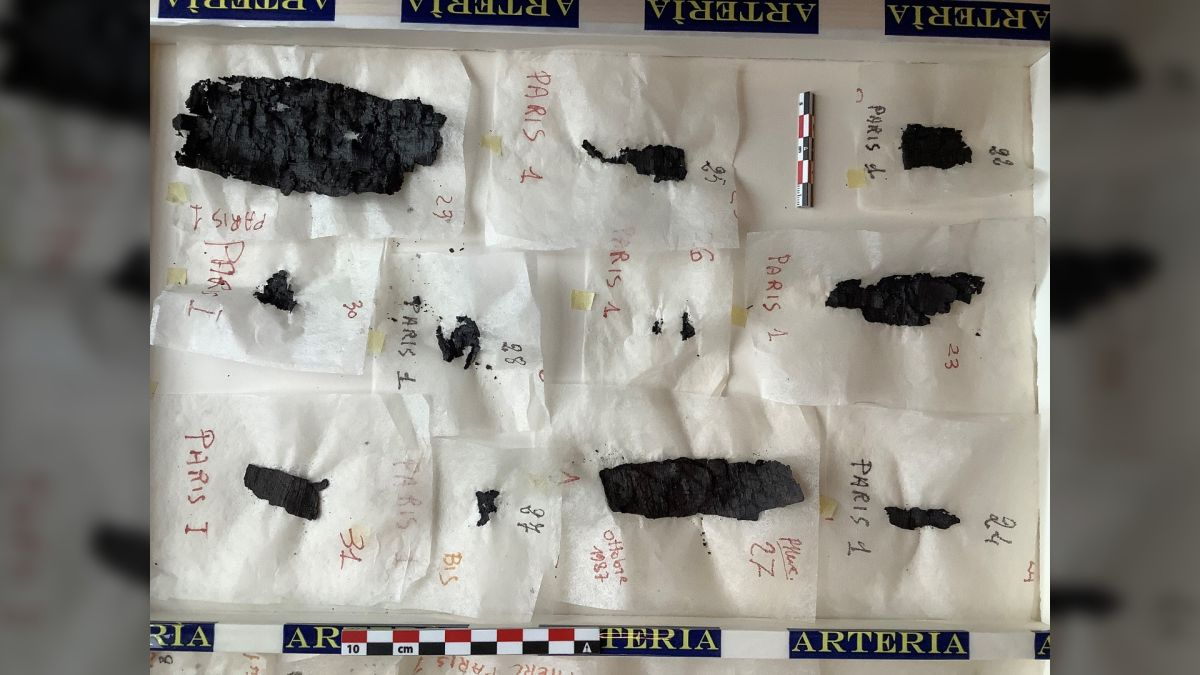
Artificial Intelligence, AI, in short, is a relatively new digital means that offers endless possibilities with unexpected results. Machine learning is a branch of AI researchers use to read faint traces of ink on still rolled-up papyrus scrolls. If successful, this technology opens exciting possibilities to decipher Herculaneum's thousands of carbonized scrolls. 

These latest results have been published in Live Science. The study concentrates on an otherwise “lost book” that supposedly discusses the dynasties that succeeded Alexander. 

Although till now only small fragments can be read, hopes are high to learn more about the Macedonian leaders that followed in the wake of Alexander. So far, the names of Seleucos and Cassander have been recognized together with “several mentions of Alexander himself!” 

[Picture from Live Science, credit Michèle Hannoosh]

The “lost book” is one of the many works discovered at the Villa dei Papiri in Herculaneum. Other books contain writings by Philodemus of Gadara, an Epicurean philosopher who lived from c. 110 until 30 BC and resided in the city. 

The fragile carbonized scrolls ended up at the Institut de France in Paris. Over the years, several attempts were made to unroll the scrolls, but they failed. The papyri crumbled into bits and pieces or volatilized into pure dust. 

Clearly, AI gives us new hope to unravel more about our past.

Friday, February 17, 2023

An introduction to Pyrrhus of Epirus

It was quite a surprise to stand face-to-face with Pyrrhus in Albania. It happened at the entrance to the Skanderberg Museum in Kruje, where his life-sized bust stood right next to the imposing relief figure of Skanderbeg, Albania’s hero. 

Pyrrhus of Epirus was a great-nephew of Olympias and cousin of Alexander the Great – not a small introduction. He was born in c.319 BC – not the right time to be the heir to the Molossian throne of Epirus. He got caught up in the fiery dispute between the sons of Cassander and Thessalonica, and, reigning briefly as a minor, he had to flee his homeland. He joined the court of Demetrios I (Poliorketes) as an exile, and in 301 BC, aged 18, he fought at the Battle of Ipsus. 

As a pawn in the War of the Diadochi, Demetrios, to befriend Ptolemy, gave him Pyrrhus as a hostage. That’s how Pyrrhus arrived in Alexandria. Well, it was not the worst place to grow up, and Pyrrhus most certainly took advantage of the situation, not unlike what Philip II had done at the court of Thebes. He made his way in Egypt and eventually married one of Ptolemy’s daughters, Antigone. 

Four years later, in 297 BC, with Ptolemy’s support, Pyrrhus returned to Epirus and began taking control of his own life. He started expanding his kingdom by annexing Illyria. His ambitions were not small, for when Antigone died, Pyrrhus made three diplomatic marriages to live peacefully with his neighbors. His first wife was Lanassa, the daughter of Agathocles, tyrant of Syracuse. Her dowry was the islands of Leucas and Corcyra (modern Corfu). The next bride was the daughter of King Audoleon of the Paeonians living north of Macedonia. His third marriage was to Bircenna, daughter of the Illyrian King Bardylis II. Demetrios Poliorcetes as king of Macedonia, it should be said, had married Pyrrhus’ sister. 

By 288 BC, Pyrrhus turned against Demetrios and succeeded in getting the Macedonian army on his side. With Lysimachos as his new ally, they jointly ruled over Macedonia. Only for a while, though, since Lysimachos still had his mind set on all of Macedonia and expelled Pyrrhus. 

Once more, Demetrios and Pyrrhus made peace, which was again short-lived. When in 286 BC, Demetrios invaded Asia Minor, ruled by Lysimachos, the latter asked Pyrrhus to invade Thessaly to attack Demetrios from Greece. Pyrrhus soon defeated Antigonus Gonatas, Demetrios’ son, who surrendered Thessaly to him to make peace. 

Pyrrhus’ empire now included half of Macedonia, larger Epirus, and Thessaly. Yet, he still wanted more and eyed Magna Graecia, including the wealth of Sicily. His opportunity arose when Taras (modern Taranto) called for his help to repel an imminent Roman attack. Pyrrhus led his army across the Adriatic Sea, including 20 war elephants. He was victorious at Heraclea (modern Policoro, southwest of Metaponto) in 280 BC and a year later at Ausculum (modern Ascoli Satriano south of Foggia). 

At this point, Pyrrhus decided to stay in Italy, offering his help to Syracuse. He successfully lifted the Carthaginians’ siege in 278 BC and, in return, was proclaimed King of Sicily. The Medagliere, the strongbox room at Syracuse’s Museum, proudly exhibits coins of King Pyrrhus. 

His moment of glory would not last either because of the renewed threat from Carthage, ending Pyrrhus’ siege of Lilybaeum (modern Marsala) in a disaster. The people of Syracuse then decided not to continue the war. The Carthaginians defeated Pyrrhus in 275 BC on his return to Syracuse. 

At the end of that same year, Pyrrhus sailed back to Epirus, which, in his mind, offered new opportunities as his son, Ptolemy, tried to expand the kingdom. The next campaign took Pyrrhus to Argos in the Peloponnesus, where caught in a narrow street, he was killed by a woman who threw a tile from the housetop. 

This was not the death a man like Pyrrhus would have planned. He had fought in so many battles, always leading his men. He had been schooled by Demetrios Poliorketes, who had walked in the footsteps of Alexander and his father, Philip. He was not meant to die such an inglorious death. 

In the 2nd century AD, Pausanias witnessed a memorial to King Pyrrhus at Argos, integrating a panorama ‘carved in relief.’ The king was buried in his capital, Ambracia (a colony of Corinth in Epirus). 

Pyrrhus may have led a glorious life, but the Macedonians resented him because he let his Gauls plunder the tombs of the Macedonian kings at Aegae – an unforgivable crime!

Saturday, February 11, 2023

Wearing silk is immoral in the Roman Empire

With his expansion far into eastern Asia, Alexander had opened a vast section of the Silk Road. In the following centuries, the Graeco-Bactrians, the Indo-Greeks, and the Sogdians played an important role as middlemen in this chain where goods were exchanged between East and West. 

The road between China and the eastern Mediterranean was nearly 6,500 kilometers long. Travel was dangerous, and robberies were frequent. The goods changed hands on the way. In this process, each intermediary increased the price to cover their own expenses and make a profit. 

To reduce the expenses, especially those for the silk from China, the Romans opened a sea route by the 1st century AD. It started near Hanoi in modern Vietnam, with stopovers in harbors on the coasts of India and Sri Lanka, all controlled by China. The shipments eventually reached Roman-controlled ports in Egypt and the northeastern coast of the Red Sea. From there, they could handily be distributed around the Mediterranean. 

Two centuries earlier, from the 1st century BC onward, silk had become the luxury fashion par excellence. In those days, the Romans still thought silk was obtained from tree leaves. Pliny the Elder tells us that the Seres (Chinese) used the woolen substance from the tree leaves, which they soaked in water and then combed off the white down from the leaves. 

Chinese silk was sold at exorbitant prices. It was far more expensive than gold, which caused a colossal outflow of this precious metal. In fact, the acquisition of silk hurt the Roman economy badly. 

In pure despair, the Roman Senate issued several edicts to prohibit wearing silk, more so since they had decided that silk clothes were decadent and immoral. Seneca (c.3 BC - 65 AD) goes as far as declaring: I can see clothes of silk, if materials that do not hide the body or even one's decency, can be called clothes ... Wretched flocks of maids labor so that the adulteress may be visible through her thin dress so that her husband has no more acquaintance than any outsider or foreigner with his wife's body. 

It is surprising to read that in the 1st century AD, women were still (or again) considered a man’s property, although men themselves didn’t shy away from wearing silk outfits!

Saturday, February 4, 2023

Afghanistan, where history keeps repeating itself

The war in Afghanistan is no longer making headline news since the U.S. withdrew its troops in a sudden and short-term operation. What’s new, we might ask. The answer is nothing. 

Alexander spent three years of his life in Central Asia fighting an ever-elusive enemy of tribes that no longer fought each other but joined forces against the invader. In the 5th century, the Huns wreaked havoc; Genghis Khan, at the head of the Mongols, rampaged the region in the 13th century; Tamerlane repeated the operation a century later; and the Mughal dynasty followed suit in the 16th century. Even Islam spreading brotherhood among men could not achieve any result. The more recent invasions by Britain in 1839-1842 and 1870-1880, the Soviet Union in 1979-1989, and the United States in 2001-2021 only repeated their predecessors’ fatal outcomes.  

Who are we to call Alexander’s campaign in Central Asia a failure when later invaders with far more sophisticated means did not fare any better? Alexander was a military genius, and no one has been able to surpass him – certainly not here in Afghanistan. 

Those looking for a complete analysis on the situation in Afghanistan will find useful information in Frank Holt’s book Into the Land of Bones, Alexander the Great in Afghanistan. The author draws an excellent comparison of Alexander’s achievements with those of later invaders. He asserts that the only way to rule the country should imply that the conqueror subdues every warlord because one single exception would erase all previous successes. Isn’t that precisely what Alexander tried to achieve? 

The French archaeologists who worked in Afghanistan early in the last century, upon the invitation of King Mohammed Zahir, were confronted with the double face of the local population. During the day, they gathered around to look and give a helping hand, while at night, they would destroy the statues and steal the precious artifacts. Tribal elderly, generally strong Islamic believers, destroyed many human statues as soon as they were unearthed. Altogether, many unique artifacts were destroyed overnight or disappeared on their way to the Museum in Kabul (see: Le trésor perdu des rois d’Afghanistan by Philippe Flandrin). Typically for Afghanistan, not even the king could overrule the tribe's elders! 

Under these circumstances, it is impressive that the gold treasure from Tillya Tepe, a tomb hill in the northwest corner of Afghanistan, has survived. The content of these six tombs was barely rescued when the Soviet Union entered Afghanistan in 1979 and safely transferred to the Museum in Kabul (see: Bactrian Gold, the Hidden Treasures from the Museum of Kabul). The Museum suffered greatly from the ensuing civil wars and was repeatedly plundered, and artifacts were stolen. The worst, however, was still to come when, in 2001, the Taliban decided not only to destroy the huge Buddha statues at Bamyan but also to annihilate the 2,500 statues and reliefs of the Museum. However, a handful of brave Afghans rescued the Tillya Tepe treasure and locked it away in the vaults of the Presidential Palace. They managed to keep the place a secret. By 2004 the government of Afghanistan decided that the situation was safe enough to bring the gold artifacts out in the open again, but the Museum in Kabul was no longer fit to shelter this precious collection. Based on their earlier collaboration, they contacted the Musée Guimet in Paris and, together, they agreed to send these rich finds on a traveling tour around the world. 

Today, with the ruling Taliban, the country is still dominated by its warlords, who consistently cling to their traditions and mistrust all foreign intrusion.

Sunday, January 22, 2023

Odd hexagonal Dacian mold

It is heartwarming to read that archaeological excavations are still ongoing at the site of Sarmizegetusa Regia in Romania. 

The old capital was a stronghold situated at an elevation of 1200 meters and built over five terraces. It contained a separate ceremonial zone, a residential area, and a fortress serving state and civic matters. 

The largest Dacian sanctuaries occupied the ceremonial quarter with several temples and a circular sanctuary delimited by a set of wooden posts in the shape of the letter D. This was, in turn, surrounded by a circle of wooden posts, which sat inside a line of curb stone used for astronomical observations or perhaps even as a solar calendar. 

In my earlier blog about Dacia (see: Dacia before Alexander), I mentioned the artistry of this country’s artisans. My praise was undoubtedly not exaggerated, considering the highly complex bronze mold unearthed in 2013. When a tree on the site collapsed after a storm, the mold was discovered entangled in its roots. 

It has been established that a Dacian jeweler created this octagonal matrix during the 1st century BC to produce decorative mythological figures made from precious metals. As such, it is the only one of its kind in Europe. 

What makes it so unique is that it contains a whole series of molds of real animals, including a lion, tiger, leopard, rhinoceros, hippopotamus, bear, boar, bull, wolf, antelope, and rabbit. There are also mythological animals, such as a vulture-griffin, a lion-griffin, and a wolf-griffin. 

This eight-kilogram matrix is 5 cm thick and has been described as having eight facets, two of which are hexagonal. Expert analysis has revealed that the images confirm Dacia’s close links with the Mediterranean and Pontic regions. 

Given the importance of this mold, authorities have decided to exhibit it in a separate secured room at the Dacian and Roman Civilization Museum in Deva. Here, visitors can look closely at the animals depicted on the matrix. Deva is some 400 km northwest of Bucharest and roughly 60 km north of Sarmizegetuza. 

Before this find, a sophisticated, more than 2000-year-old calendar was discovered. The Dacian calendar counted 365.242197 days in a year, which beats the ancient Mayan calendar by 12 seconds. Our modern Gregorian calendar counts 365.2425 days in a year. 

Well, so much for the knowledge of people in antiquity!

[Pictures from eutimes.net]

Wednesday, January 11, 2023

Preparations to sail down the Indus

The history of Alexander’s conquests in India usually relates the facts in a succession of events without paying much attention to the king’s thorough planning and preparation ahead. To sail down the Indus was an expedition by itself, which is generally ignored.

Alexander withdrew in style from the Hyphasis. After building twelve altars to thank the gods for having led him so far as conqueror and leaving an impressive memorial to his own accomplishments, he turned around to cross the Hyphasis, Hydraotes, and Acesines once again (see: Alexander erected twelve altars on the banks of the Hyphasis). 

Hence, the army marched to the Hydaspes, where Alexander had founded the cities of Alexandria Nicaea and Alexandria Bucephala (see: The edge of the world was not reached). According to his instructions, many ships had already been assembled, but he needed to build many more before sailing south. Within two months, the entire fleet was ready. It consisted of eighty thirty-oared galleys, troop carriers, flat-bottomed boats for horse transport, circular tubs, local river boats, and enormous grain-lighters for supplies. The latter is a forerunner of the modern LASH ship or Lighter Aboard Ship that loads and unloads barges, as still used on the Indus.  Known locally as zobruks, they have a shallow draught and huge sail, perfectly suitable in strong currents. Each vessel could hold more than two hundred tons of grain to feed the army on their voyage to the Ocean.

This was a massive operation that Alexander had planned meticulously. He selected the Phoenicians, Carians, Cyprians, and Egyptians who served in his army. From them, he chose men with nautical skills for crews and rowers. Other experts were selected from among the islanders (from the Aegean), Ionians from Asia Minor, and people from the Hellespont.

Imagine this armada of up to 2,000 vessels (half the flotilla that crossed the Channel on D-Day!), moving at the shouts of the coxswain (steersman) as his rhythmic call was echoed by the high riverbanks mingled with the noise of splashing oars. 

Another factor worth considering is the number of troops needed to be moved. Back on the Hydaspes, 35,000 fresh soldiers had swollen Alexander’s total manpower to a massive 120,000! His cavalry, at this point, has been estimated to be some 15,000. However, not all the men and horses boarded the ships; neither did the impressive baggage train.

Alexander organized the army in three divisions as he would personally lead the fleet from his Royal galley with the support of his shield-bearers guards, all the archers, and the Companion cavalry – totaling 8,000 men. Hephaistion would march along the east bank of the Hydaspes while Craterus would lead the west bank with part of the infantry and the cavalry. Hephaistion took with him the bulk of the fighting troops and 200 elephants. Their instructions were to march together in advance and wait for the fleet.

The king took command after having performed extensive sacrifices to his ancestral gods and the deities of the river and Ocean. With a golden goblet, he poured a libation into the river from the prow of his ship – entirely in style with the solemn occasion. 

As soon as the trumpets signaled the departure, the voyage started in regular order. It was a hazardous enterprise, but the king had instructed how many baggage vessels were to sail abreast and the place for the boats carrying the horses and the ships of war. All vessels were to keep their distance and stay in formation, adapting their speed accordingly. Given the different sizes of boats ranging from warships and baggage vessels to horse transports, they individually required accurate steering and high alertness of their pilots. The purpose was that the ships would not fall out of each other or sail down randomly. Nearchus of Crete was appointed admiral of the fleet, with Onesicritus of Cos as his second and helmsman of the Royal flagship. 

Even after the monsoon rains had stopped, the annual flow of the Hydaspes was two times faster than that of the Nile or three times that of the Euphrates and the Tigris combined. The current would increase notably as the river narrows, particularly at the confluence with the Acesines. The roaring of the water could be heard miles ahead as the surface roughened.  

At last, the fleet made it across the narrows where the two rivers met, and the banks receded. The stream slackened, and Alexander found a protected spot on the right bank to moor his ships safely. Here, the men could take a break and make the necessary repairs before moving onward. 

Alexander was about to enter the land of the warlike Malians, who had been preparing for the confrontation.

Wednesday, January 4, 2023

Dacia before Alexander

Dacia is a Roman name. When Emperor Trajan conquered the territory of what is now Romania in 106 AD, he called it the province of Dacia Felix. The new capital was Ulpia Traiana Sarmisegetusa, i.e.,  today’s Sarmizegetusa Regia.

The Dacians, however, were known to the Greeks as Getae, the very people Alexander chased across the Danube in 335 BC (see: Crossing the Danube River and The King is dead, long live the King). After the king’s death, Lysimachos, who became king of neighboring Thrace, waged repeated wars against the Getae without success. He was even captured by their king, who forced him to withdraw from the Lower Danube in 292 BC. 

Interestingly, Strabo states that although the language of the Dacians is the same as the Getae's, the name applies to their location. The Getae lived close to the Pontus Euxinus, the Black Sea, and the Dacians, closer to Germany and the sources of the Ister, the Danube River. They somehow managed to co-exist if they did not mingle with earlier settlers. 

In the second half of the 7th century BC, Ionian Greeks had already emigrated to the shores of the Black Sea to escape the expansion of the Persian Empire. The most prominent group of colonies came from Miletus, who, in 630 BC, founded their first town Histria, at the mouth of the Danube (see: The many colonies of Miletus). The Greek colonists remained in Dacia until 46 AD. 

Before them, the nomadic Scythians driving their cattle ever further west from the steppes of Central Asia were in regular contact with the Getae/Dacians from c. 550 to 250 BC. The Scythians left us no writing, but the artifacts found in and around their occasional settlements testify of highly skilled artists. 

Three years ago, in 2020, the Gallo-Roman Museum in Tongeren, Belgium, organized a wonderful exhibition Dacia Felix taking us back in time. The selected objects came from various Romanian museums, particularly the National Museum of Romanian History in Bucharest, which most of us will not readily visit. It offered a unique opportunity to see these unique artifacts brought together. 

Particularly striking are the Getae’s parade helmets with eyes to ward off the evil spirits. One such helmet is made of gold and is decorated with mythological figures. It has been dated to 425-375 BC. Another example from 400-300 BC is made of gilded silver. Although these were ritual helmets, it is easy to imagine how piercing eyes would scare off the enemy if worn in close combat! A silver gilded greave with a tattooed face, dated 340-330 BC, is another example of Getaen art influenced by the Scythians and the Greeks. 

The smaller gold and silver artifacts also call for attention. There are appliques, otherwise known from Scythian art, used to decorate the horses’ bridles and harnesses. Some specimens even show Persian influences (400-300 BC). 

The Getaen men of power, such as high priests and kings, wore finely crafted bracelets. A solid gold spiral specimen with ram heads (500-400 BC) weighs no less than one kilogram! Another eye-catcher is a gold diadem with panthers and flowers (400-200 BC). 

To illustrate that the Getae were not limited to today’s Romania, there are two very similar goblets on display, one silver gilded from neighboring Bulgaria, 400-300 BC, and the other found in Romania, made in silver and dated to 340-330 BC. 

The Celts, in turn, occupied the fertile lands of Dacia roughly from 320 until 175 BC, i.e., after one group of warriors had sacked Rome in 387 BC. These tribes never intended to settle but were constantly hunting for precious goods. Although the Celts shared the same language and religion, they roamed in separate bands along the northern borders of Thracia, Macedonia, and Italy. 

As expected, the Celts left us weapons, helmets, and decorations for horse harnesses, mainly from their grave sites. The most remarkable legacy is an iron helmet holding a falcon on top dated from 250-175 BC. The chief who wore it must have impressed his opponents with his stature, as the bird made him look much taller. Besides, the realistic falcon acted as a symbol of power.

Dacia sometimes stretched beyond Romania, including northern Bulgaria, southwestern Ukraine, and Hungary east of the Danube. The rich testimonies of Scythians, Getae, and Celts are left undocumented, as these peoples did not have any writing. Their heritage is solely based on archaeological excavations, which yielded a wide array of artifacts, including precious jewelry and decorative items.


It should be noted that the battle depicted in Trajan’s Column in Rome reflects the emperor’s sacking of Ulpia Traiana Sarmisegetusa in 106 AD after the Dacians failed to respect the peace conditions of their surrender. Something worth remembering during our next visit to the eternal city!
Thursday, December 22, 2022

Origin of the tin ingots from Uluburun

It largely remains an open question of how much Alexander knew about the lands he set out to conquer. The answer or answers keep amazing me. 

Imagine that Alexander was familiar with the trade routes of the precious minerals like copper and tin that existed nearly one thousand years before he was born. Today, we would say it is rather obvious, but is it? 

Merchants were always very innovative and perseverant in exploring and finding new markets for their goods to be sold at the highest prices. The shipwreck of Uluburun was a true eye-opener, exposing the variety of wares from distant countries that were traded mainly around the Mediterranean. 

In my earlier blog, The flooded remains of Kekova Island and Uluburun, I mentioned that the ship was on its way from Egypt to the Black Sea when it sank off the coast of Uluburun in modern Turkey. It carried, among others, 10 tons of copper ingots from Cyprus and an unspecified number of tin ingots from Persia. 

It was lengthy to bring the cargo from the Uluburun ship to the surface, as it took 22,430 dives. The precious finds are now safely exhibited inside the Museum of Bodrum Castle, surrounded by lively reconstructions of the ship’s haul. I somehow missed spotting the tin ingots as I focused on the copper and glass ingots instead. 

It is common knowledge that copper and tin are needed to make bronze. Since the second millennium BC, bronze has been in high demand to create tools and objects of prestige, but most of all for weapons. It is noteworthy that the Uluburun ship held enough metal to supply swords to 5,000 soldiers! 

A recent study published in The Past established that two-thirds of the 105 tin ingots originated from the Taurus Mountains in Turkey, and one-third were traced back to Tajikistan and Uzbekistan. These two countries are roughly 3000 kilometers east of Uluburun! 

During the Bronze Age, the mines of Central Asia were local operations led by small mobile villagers. Tin from the Musiston mine traveled over rugged and rough terrain to Haifa - a distance of more than 3,000 km – before it was shipped across the Mediterranean.

Saturday, December 10, 2022

Dating Kampyr-Tepe, Alexandria-on-the-Oxus

Kampyr-Tepe, ancient Alexandria-on-the-Oxus, whose foundations go back to the 4th and 3rd century BC, has been continuously excavated by Edvard V. Rtveladze and Alexei N. Gorin. They have concentrated on the citadel and the city proper with its striking Hellenistic entrance gate (see: Alexandria on the Oxus is at Kampyr-Tepe).

Alexander copper coins

By now, the citadel has yielded several Hellenistic coins that shed light on daily life in the city. Altogether, 30 coins of interest have been retrieved, mostly small-denomination copper coins. Two of them belong to King Antiochus I and 28 to the Graeco-Bactrian kings. Among them were rulers like:
 

Antiochus I (281-261 BC)
Only two Seleucid coins were found in Kampyr-Tepe, and both were chalki (χαλκι, meaning copper) of Antiochus I, one minted in Babylonia (Seleucia-on-the-Tigris) and another one in Bactria.
Other examples came to light north of the Oxus River in places such as Afrasiab/Maracanda (see: Afrasiab, ancient Samarkand), Termez, and Bukhara.
 
Diodotus (c. 250-230 BC)
Scholars cannot agree whether Diodotus I or Diodotus II issued the coins. There are four copper coins: two dichalki, one chalkous, and one hemichalkous (half a chalkous). The chalkous was the smallest fraction of a Greek coin; in Athens, one needed eight χαλκι to make one obol. Based on their graphic design, these coins could have been issued by the mint of Bactra or Ai-Khanoum.

Tetradrachm of Euthydemus I

Euthydemus I (c. 230-200 BC)
Ten copper coins of Euthydemus I were found in Kampyr-Tepe, among which seven dichalki and one chalkous. Some of these coins have been extremely useful for dating the city’s buildings. Euthydemus I coins are the most common type found in northern Bactria, and six χαλκι are known from the Oxus Treasure (see: The Oxus Treasure, pieces Alexander must have known).
 
Euthydemus II (c. 190-185 BC)
Coins with the effigy of Euthydemus II are scarce. Some χαλκι, dichalki, and trichalki cuprum-nickel coins were found in Kampyr-Tepe, together with copper dichalki and trichalki.

Demetrius I (c. 200-185 BC)
Kampyr-Tepe has yielded one Demetrius obol and several copper χαλκι, dichalki, hemichalki, and trichalki.
 
Eucratides I (c.171-150 BC)
Eucratides is very much present in Kampyr-Tepe with seven coins, i.e., one drachm, one octuplus (a copper obol), and five obols. The obols belonged to the beginning of Eucratides’ reign when he started using his new title Megas, Great. One of these obols has been important to date when the fortified walls of the acropolis were last used as it was found in its top layer. It is noteworthy that Eucratides’ obols have also been recovered from Afrasiab/Maracanda, Bukhara (see: Alexander in Bactria and Sogdiana), and Ai-Khanoum.


Tetradrachm of Eucratides I

A bonus from Kampyr-Tepe was the find of two hitherto unknown coins of Heliocles and imitations of Demetrius I and Eucratides. Counterfeit is of all times!
 
Heliocles I (c. 139-129 BC) drachm imitation
The exact dates of Heliocles’ reign are not known. This drachm raises questions because of the mistakes in the inscriptions and the sloppy engraving of the letters. It may well be one of the first imitations.
Another drachm of Heliocles has surfaced in Takhti-Sangin, which may have been the source of the Oxus Treasure (see: The Oxus Treasure, pieces Alexander must have known).
 
Heliocles III (1st century BC) imitation
This king is so far unknown among the Seleucid or Graeco-Bactrian coins. Two coins with his bust were made according to Hellenistic traditions, but the shape of the letters on the coin’s inscription is problematic, especially the square omicron. The square version of the omicron first appears on Indo-Greek coins circulating at the end of the 2nd /beginning of the 1st century BC. The tradition continued until the last Indo-Greek King Hippostratus, who ruled over western Punjab.
It is quite possible that these coins were issued locally for Heliocles III, who shortly ruled over (northern) Bactria.
 
Demetrius drachms - imitation
Besides the abovementioned copper coins, two rare imitations of a Demetrius drachm have been unearthed. They were minted using a different die and showed distortion of the prototype. It has been possible to establish that they were issued in Bactria.
 
Eucratides obol - imitation
Among the Eucratides’ coins found at Kampyr-Tepe, one obol is an obvious imitation. The inscription on the obol is distorted and illegible, and the depiction of the ruler’s head is stylized compared to the real thing.
 
It is noteworthy that all the above finds and considerations treat coins from surface finds in Kampyr-Tepe, not from archaeological diggings. As in other Bactrian and Sogdian cities, the problem is that their remains are buried under thick layers of deposits hampering excavations.
 
Hellenistic coins unearthed from the banks of the Oxus River may suggest that the river played a significant role in the transportation and exchange of goods.

[For the above illustrations, I used my own pictures taken at the Numismatic Museum of Athens, because I lost the link to the reference photographs. We always stare at gold and silver coins, and I had no idea that copper Alexander coins ever existed. My pictures of Euthydemus and Eucratides are both tetradrachms, i.e., made of silver in Bactria].