Alexandria's founded by Alexander

Alexandria's founded by Alexander the Great (by year BC): 334 Alexandria in Troia (Turkey) - 333 Alexandria at Issus/Alexandrette (Iskenderun, Turkey) - 332 Alexandria of Caria/by the Latmos (Alinda, Turkey) - 331 Alexandria Mygdoniae - 331 Alexandria (Egypt) - 330 Alexandria Ariana (Herat, Afghanistan) - 330 Alexandria of the Prophthasia/in Dragiana/Phrada (Farah, Afghanistan) - 330 Alexandria in Arachosia (Kandahar, Afghanistan) - 330 Alexandria in the Caucasus (Begram, Afghanistan) - 329 Alexandria of the Paropanisades (Ghazni, Afghanistan) - 329 Alexandria Eschate or Ultima (Khodjend, Tajikistan) - 329 Alexandria on the Oxus (Termez, Afghanistan) - 328 Alexandria in Margiana (Merv, Turkmenistan) - 326 Alexandria Nicaea (on the Hydaspes, India) - 326 Alexandria Bucephala (on the Hydaspes, India) - 325 Alexandria Sogdia - 325 Alexandria Oreitide - 325 Alexandria in Opiene / Alexandria on the Indus (confluence of Indus & Acesines, India) - 325 Alexandria Rambacia (Bela, Pakistan) - 325 Alexandria Xylinepolis (Patala, India) - 325 Alexandria in Carminia (Gulashkird, Iran) - 324 Alexandria-on-the-Tigris/Antiochia-in-Susiana/Charax (Spasinou Charax on the Tigris, Iraq) - ?Alexandria of Carmahle? (Kahnu)

Friday, January 9, 2015

From Agamemnon to Alexander the Great, Exhibition in North America

A brand new exhibition The Greeks – Agamemnon to Alexander the Great has started at the Montreal Archaeology and History Museum at Pointe-à-Callière, Canada (12 December 2014 – 26 April 2015). From here it will move to the Canadian Museum of History in Gatineau, Canada (5 June 2015 – 12 October 2015), followed by the Field Museum in Chicago, U.S.A. (26 November 2015 – 17 April 2016), to end at the National Geographic Museum in Washington DC, U.S.A. (till 9 October 2016).


It is clear that this original exhibition spans over 5,000 years of Greek history, from the cradle of Western civilization up to the fascinating era of Alexander the Great. On display are more than five hundred artifacts, collected from twenty-one different Greek museums.

This exhibition is divided into six specific periods to meet famous men who shaped Greece, like Homer, Leonidas of Sparta, Plato, King Philip II of Macedonia, Aristotle, and, of course, Alexander the Great. Our heritage is still felt in our politics, philosophy, arts, architecture, mathematics, medicine, and sports, and this exhibition just proves it.

Starting as early as 6,000 BC, they quickly moved to the legendary players of the Trojan War, with Agamemnon sailing to Troy to recapture beautiful Helen, who was residing with Prince Paris. A war that lasted for nearly twelve years involved much more than a girl, even a princess. Attention is given to the early discoveries by Heinrich Schliemann of the treasures of Troy and the Royal Tombs of Mycenae.

The visitor is then taken to the days of Alexander the Great, who succeeded his father, King Philip II of Macedonia, at the age of twenty. By conquering most of the world as it was known then, he turned that world into an entirely new one with new ideas and new fashions. His legacy is still being felt today, 2,500 years later.

About twelve centuries separate Agamemnon and Alexander, and in between, Greece knew its Golden Age in which Pericles “invented” democracy, a democracy by the people and for the people. During the 5th and 4th centuries BC, Greece and Athens in particular saw their first great philosophers, while theatre and arts, in general, flourished to an unknown level. The exhibition also makes room for the Olympic Games, which were founded in 776 BC and attracted athletes from all over Greece to compete every four years.

Some exceptional pieces have left Greece for the first time and constitute highlights at this exhibition. Among them are gold offerings from the Tombs of Mycenae, including the famous mask attributed to Agamemnon; a typical figurine from the Cycladic island of Amorgos dated to 3,000 BC; a superb Minoan ritual vase from Crete; bronze helmets and gold funerary masks from Boeotia; and, a very illustrative funerary vase from Delos showing how Achilles avenged the death of his friend Patroclus. The scene would not be complete without a statue of Homer and other famous historical figures, a convincing votive relief of Asclepius with his staff around which a snake is coiled (an emblem still used in medicine today), and finally, a marvelous gold wreath made of lifelike branches of myrtle, the symbol associated with Aphrodite.

The absolute topper, for me, is Alexander himself! Two statues of this great man have left Pella for the occasion: Alexander represented as Pan and the Head of the Young Alexander. 


[Pictures from the Montreal Museum of Archaeology and History]

Tuesday, January 6, 2015

A final call for the Archaeological Museum of Alexandria

Alexander would turn in his grave if he knew how careless his first great city was handling his past!

Agreed, today’s Archaeological Museum of Alexandria is a very far cry from the famous Library/Museum where all the great minds of the ancient world met and exchanged their ideas, but even so: a museum always is a precious center of culture and art.

The recent unrest in Egypt is not a favorable climate for any museum or antique site, but when I hear that this Archaeological Museum contains more than 40,000 artifacts, including some rare and unique books, it certainly hurts my feelings.


The situation in Alexandria is so desperate that private intellectuals and archaeologists have joined hands and are launching a campaign to expand this Graeco-Roman Museum. First of all, the land right next to the museum should be acquired and excavated to recover relics from early times before constructing an extension to the present building from 1892 whose façade copies that of a Greek temple. This museum has been closed since 2005 because it simply is too small to exhibit all its treasures, although I think they could easily rotate their collection if they want to. For now, there is an agreement on the land but the building permit is caught in red tape – to nobody’s surprise.

Yet the stakes are high since the plan is to match the grandeur of the famous Alexandrian Library from antiquity for which UNESCO is willing to help raise the funds.

It will take several years, if you ask me, before this building becomes reality and its relics from the basement going back to the third century BC will find a place so that we can enjoy all these unique treasures.

[Picture from Wikipedia.de]

Saturday, January 3, 2015

News from Mieza

Mieza is known through Homer as one of the cities of lovely Emathia, but to me, it is the place where Alexander the Great received his education from none other than Aristotle himself.

Finally, the ancient theatre of Mieza has undergone thorough works of restoration and conservation to present it in its original form to the visitor. New blocks of travertine marble have been added to blend in the remaining parts that have been cleaned, and the contours of the seating area and the scene have clearly been defined.

It is now ready to receive visitors. A new parking space with a visitor’s entrance has been created since the theater will be used for small venues. The private land on which this theater stood has been expropriated by the State, and the area has been fenced.

So next time you visit Aristotle’s “school”, don’t forget to stop at this wonderful theater, which unfortunately did not exist in Alexander’s day, for it was built in pure Hellenistic style during the second century BC. Its capacity is estimated to be 1,500-2,000 people in antiquity, and I wonder how many could be seated there today.

Thursday, January 1, 2015

Looking for Illyrian remains in Albania

Albania sounds to be the right place to find traces of Illyria, if any are to be found. 

We know that Alexander spent time in Illyria, but not where. There were no cities of importance, but people scattered around in small tribes, fighting among themselves and invading Macedonia on a regular basis in search of fertile land. The borders of Illyria were not clearly drawn. Those of today's Albania are but don't match either with old Illyria, although roughly in its center, nor with Epirus in the south, where it is shared with Greece.

Honestly, I don't know what proof of Illyria I can find or will come across, for they had no alphabet, cities, or art of their own – at least to my knowledge. Albania is not making things easier either, since the country has been locked away for half a century with a totalitarian regime that can only be compared to North Korea. It is now trying to emerge in the hope of meeting Western standards, although the Albanians have only scant notions of what that means, especially those living in the eastern mountains, where time has come to a standstill. I am on a general tour of one week, which is supposed to touch base with the key periods of Albania's history, the Macedonians and Greeks, the Romans and Byzantines, the Ottomans and Skanderberg (National Albanian Awakening), the Slavs, King Zog with WW1, the many foreign rulers during WW2, and the authoritarian communist regime under Enver Hoxha. An extremely long and varied timeline, although I am interested only in the very first centuries. Whatever I'll learn about the Illyrians themselves and the Macedonian occupation is a welcome bonus.

In a previous blog about the Illyrians (see: A closer look at Illyria), I summarized the roles played by King Philip II of Macedonia and his son, Alexander the Great, in putting Illyria on the map. After becoming king of Macedonia, Philip prioritized signing a treaty with the Illyrians, including his marriage to Audata, King Bardylis' granddaughter. This was only a way to win time because one year later, Philip marched north. He met the Illyrian army near Lake Ohrid, where he was victorious, and demanded that the Illyrians pull out of Upper Macedonia north to Lake Lychnitis. Alexander, in turn, sought refuge in Illyria after the brawl during his father's wedding to Cleopatra, Attalus' niece, in 337 BC. Attalus brought a toast to a lawful successor of Macedonia, implying that Alexander was a bastard. We know how Alexander reacted, especially since his father took Attalus' side. This was when Alexander left for Illyria, taking his mother, Olympias, to the safety of her brother's court in Epirus.

Peace with Illyria lasted while it lasted, for as soon as they heard that King Philip was assassinated in 336 BC, they felt free from any obligation towards Macedonia. Alexander could not afford to have these troublesome tribes raiding his northern borders while preparing to cross to Asia. So, as soon as the most urgent matters were settled in Pella, Alexander took his army north and not only defeated the Illyrians but also mopped up all the resistance. Ultimately, the Illyrians became faithful allies and fought at his side throughout his Asian campaign.

I am curious to see the landscape Alexander crossed to understand where he may have been during his self-imposed exile. I will soon be rewarded when we drive over the most horrible road from Pogradec to Gjirokastra through the mountainous region of southeastern Albania.

Pogradec lies on the crossroad linking Tirana, the Albanian capital, to Elbasan and Korce and on the southern bank of Lake Ohrid, where King Philip made history. This was an essential stop along the Via Egnatia in antiquity that connected Byzantium to Rome. Today, Lake Ohrid is shared between Albania and FYROM (meanwhile renamed the Republic of Northern Macedonia). It is one of the three geological wonders in the world, harboring endemic species that cover the entire food chain. As we drive down to the shores of the lake, the views are superb, and I am impressed by the sheer size of the lake; it must have looked like a sea to people in antiquity. Unlike the more inland parts, our stop in Ohrid has a very Mediterranean feeling. But Alexander has been remembered in these parts, for I find restaurants and wine carrying the name Aleksandrija.
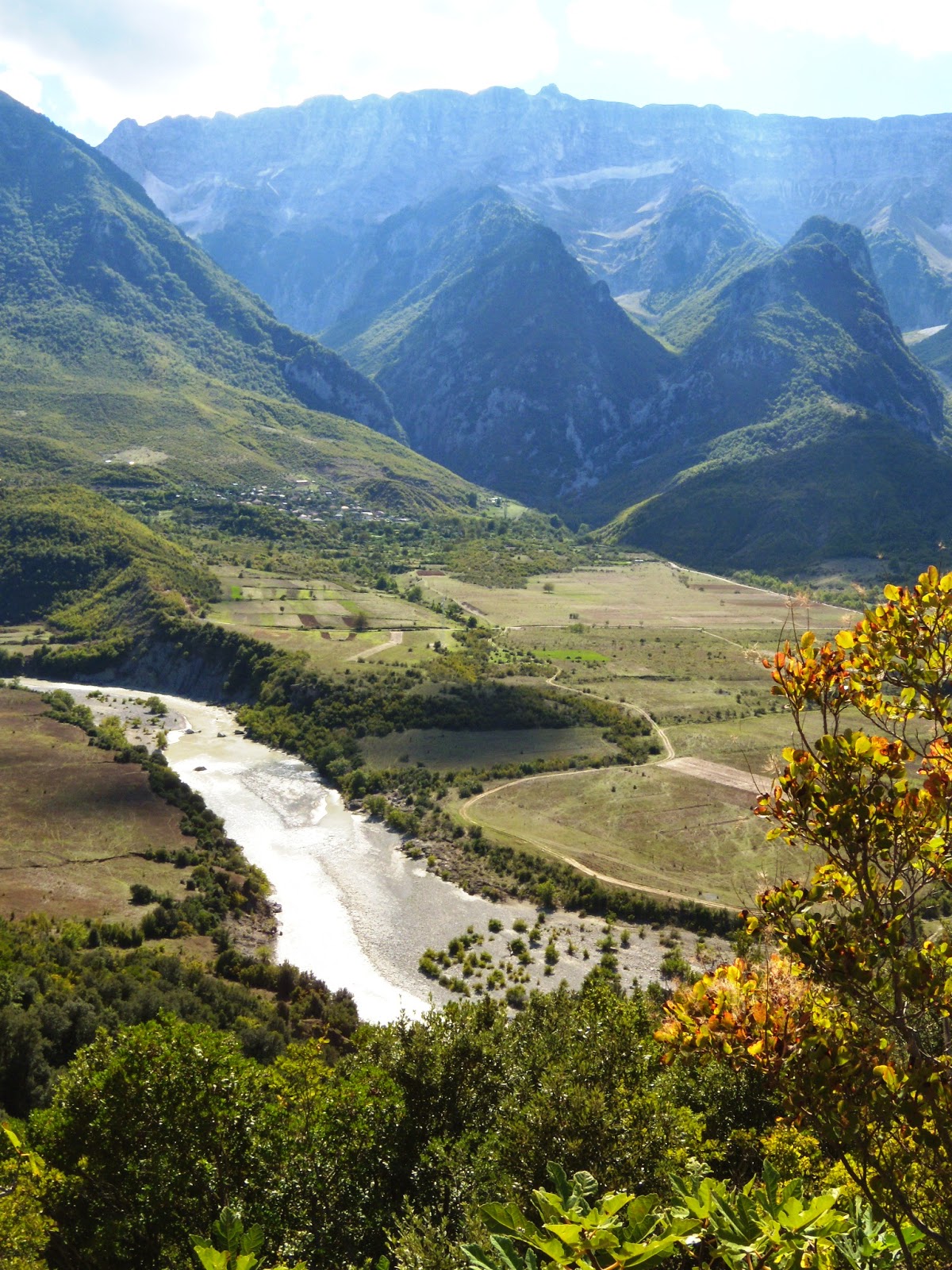
The next day we pick up the main road from Korca south to Gjirokastra, but our maximum speed on this bumpy, degraded, deteriorated, and unmaintained road is 25 km/hour. It takes us all day to get there, but nobody is complaining, for the landscape is absolutely breathtaking! There are no cities or towns, hardly an occasional cluster of houses, recent constructions next to dilapidated shacks that may be stables or housing, who knows. Small gardens, a few fruit trees, a couple of cows, and donkeys are all that people have to live on. I am told that in winter, the snow is two meters deep in these parts, making it impossible for cars or buses to get through. Even today, there is no regular bus service in those parts – how isolated can one live? Was it like this in Alexander's days, I wonder. It cannot have been much better, if any, for the land and weather are still what it was. No wonder the Illyrians were envious of the fertile plains of Lower Macedonia! Overall, the landscape is green with a wide assortment of trees and low bushes between patches of rocky grassland framed with high, barren peaks. Occasionally, a river or stream meanders through the valleys, reflecting the sunlight or threatening clouds. The productive patches of land along those waterways are thriftily cultivated, a pleasant sign in this otherwise austere land.

Then we reach Gjirokastra, whose Greek name is Argyropolis (meaning silver castle), which must have been a fortified place in Epirus (yes, we are in Epirus here!). The oldest finds so far are the city walls from the 3rd century AD. The remains of today's citadel, built between the 6th and 12th centuries, still command the otherwise Ottoman city.
It is funny when I come across a Rruga Antipatrea, which is the old name for Berat, and most probably, this street and city were named after Antipater. A restaurant proudly shows off the name Antigoni. What a shame that there are no written records in Illyria and that the Macedonians or the Greeks didn't bother to write about them.

The most rewarding moments of my tour were those when I faced Illyrian artifacts in the local museums. In Apollonia, I saw my first Illyrian shield from the 4th century BC, which looked so closely like a Macedonian one. I was told that the difference was to be found in its curving; whether that is true or not, I don't know, for it had the same semi-circles and the Medusa head in the center, complete with shiny inlaid eyes that intensified her glance. Another shield was shown at the Skanderberg Museum, with the same semi-circles but carrying the Macedonian star in its center, with an Illyrian helmet and some arrows and spearheads. More helmets were exhibited at the Archaeological Museum of Tirana, where a mold for an Illyrian shield was also displayed.


Yet, the most unexpected highlights are the Royal Tombs of Selca e Poshtme, a place in the middle of nowhere with no decent road leading to it. This is supposedly the ancient city of Pelium, perched high on an acropolis that overlooks the river Shkumbin. In the middle of the 4th century BC, the Illyrian town was protected by a wall, and its life was intensive. They made pottery out of grey clay imitating Greek shapes and decorations, created metal and bronze tools, and traded their goods over the roads along the river, which would later become the Via Egnatia. It was the residence of the Illyrian kings. However, excavations are still in an early stage, and Pelium's role is mainly based on the coins found in cities like Apollonia and Dyrrhachion (modern Dürres). The main discovery is four royal tombs right under the cliff of the Acropolis; definitely Illyrian but, at first glance, very Macedonian. More about these great tombs in my next post, Alexander's psychological warfare in Pelium, Illyria.


Last but not least, I should focus on the route followed by the Via Egnatia, although I have yet to come across any visible pavement like in Philippi, Greece, for instance. From Ohrid, it ran through Elbasan, where it split into two. One arm connected directly to Dyrrhachion (Dürres), and another crossed Apollonia and Antipatrea (Berat) to end at Dyrrhachion on the Adriatic coast. From here, ships ferried people and goods to Brindisi on the Italian side. I regret that I have not seen a remnant of this famous road, but have only been pointed to the line it followed through the cities. Maybe next time?

Sunday, December 28, 2014

Zeugma’s newest mosaics

I have a weak spot for Zeugma, the city that has been nearly entirely flooded following the construction of a dam on the Euphrates River in Turkey – one dam too many if you ask me. I find it inadmissible to flood remains that have survived 2,500 years of history for the simple purpose of cultivating more land. I wrote about Zeugma some time ago under the title Zeugma, Border-town along the Euphrates River.


Zeugma was again in the news at the end of the 2014 excavation season, when it made headlines with three new mosaics that have been unearthed from the House of the Muses, which will join the other rescued floors at the Museum of Gaziantep after restoration and conservation.

The Greek Reporter has added photographs of these gorgeous mosaics: the first one representing the nine Muses framed in elegant medallions gathered around Muse Calliope (see above); the second mosaic is a well-known representation of Oceanus and Tethys (below); and the third mosaic is not shown but is described as the portrait of a young man.


According to the Hurriyet Daily News, it seems that among the 2-3,000 houses of Zeugma, “only” 25 remain under water. If we read the Greek Reporter, the story is however quite different as they state that 80% of old Zeugma is flooded (which corresponds much better to what I heard earlier). No wonder that the Mayor of Gaziantep is so optimistic when stating “I hope we will be able to unearth the whole civilization of Zeugma” – a matter of convincing your audience?

[Pictures from The Greek Reporter, except the one of Oceanus and Tethys which is from the Hurriyet Daily News. The photograph of Oceanus and Tethys in the Greek Reporter is that of an earlier excavated mosaic that is already on display at the Museum of Gaziantep].

Saturday, December 27, 2014

Diodorus Siculus – Books 11-12.37.1 on Xerxes and Sicily

Diodorus Siculus, Books 11-12.37.1 (ISBN 0-292-71277-4) is probably best known as published in the Loeb Classical Library version, but his time I have opted for the alternative version translated and introduced by nobody less than Peter Green.

Diodorus was a Greek historian from Agrigento in Sicily, who lived ca. 100-30 BC and who wrote a world history covering forty books. His history was divided into three parts: the mythical history of peoples, non-Greek, and Greek till the Trojan War; the history till Alexander’s death in 323 BC; and finally the history until 54 BC. Not all books have survived, but we do have Books I to V, where Diodorus writes about the Egyptians, Assyrians, Ethiopians, and Greeks, and Books XI to XX, handling Greek history from 480 till 302 BC. Of the other volumes, we only have fragments.

Book 11 covers the period from 480 BC to 451 BC, meaning from the year King Xerxes of Persia launched his expedition against Greece till Pericles’ citizenship law. Books 12.1.1 to 12.37.1 tell us about the prosperity in mainland Greece, the fight over Cyprus, the internal wars in Sicily, and their peace treaty with Carthage.

It is known that Diodorus used good and reliable sources. He is the only ancient historian covering Greek history from the days of Xerxes’ invasion to the War of the Diadochi following the death of Alexander the Great.

This version, unlike the Loeb book that was translated back in 1946, is set in modern-day English and is enhanced with the most up-to-date historical information and footnotes. Besides the many useful maps, Peter Green has also added a precious Chronological Table of events shown in parallel as happening in Mainland Greece; in the Aegean, Asia and Africa; and in Sicily & the West. In fact, it relates a very comprehensive piece of history. I used this “alternative” translation for my recent trip to Sicily as a most precious travel companion. 

Thursday, December 25, 2014

An update on the Terrace Houses of Ephesos

Truly something for puzzle aficionados! Roll up your sleeves and dig in the bunch of 120,000 shards to recreate an ancient mosaic floor. So far, archaeologists have successfully fitted together 50,000 pieces in four years, an ambitious and challenging project since they don’t know what the ultimate picture is supposed to look like! On average, the team can assemble 50 to 60 pieces a day but on a lucky day, they may assemble as many as 200 pieces. If you don’t fancy investing your energy in this time-consuming guesswork, you still can look over the shoulder of these courageous people while visiting the so-called Terrace Houses when you are in Ephesos (see also my previous article: Ephesos and its terrace houses).


The luxury of these villas has nothing to envy the modern rich and famous. The brilliantly decorated walls and floors are only part of the amenities, for these Romans from the first centuries AD were familiar with floor heating and cooling through cold water channels; the ceilings were decorated with gold leaves, and marbles from fifty different quarries were used.

While at first, the archaeologists were able to distinguish two villas, they now know that one of them belonged to Flavius Furius Aptus, probably a priest at the Temple of Dionysus. His most splendid room was his dining room with a pool in the middle, famous for its floor mosaics and wall paintings where he received his guests. After repeated earthquakes, the building collapsed leaving the 120,000 shards of marble for us to sweep up and put back into place.

Meanwhile, the painted walls of the Terrace Houses are undergoing a thorough cleanup in the hope to give us a glimpse of their original glory. After the initial restoration, archaeologists are now working with a new process using the latest technology. This year alone 120 m2 spread over eight rooms were strengthened and cleaned with these special chemicals. They aim to recreate the decoration with small touches without interfering with the paintings themselves.


I find it most unfortunate that many trips to Ephesos do not include a visit to these Terrace Houses. A separate entrance fee (well worth the hidden beauty) is being charged and tour operators tend to rush their customers down through Curetus Street without stopping at these remarkable rooms. What a shame!

Tuesday, December 23, 2014

First DNA-results from Kasta Hill/Amphipolis tomb

We are all waiting for the results of the DNA test on the bones recovered from the Tomb of Kata Hill/Amphipolis. There are rumors, and apparently rumors only, that the remains could belong to Queen Olympias, Alexander’s mother. From the reports it transpires that the skeleton could be that of a woman, aged approximately 54 years, but the Greek Ministry of Culture does not substantiate this statement.

[Aerial view of the Kasta Mound at Amphipolis. Credit: To Vima]

Good news however is that a geophysical survey of the mound has been carried out revealing additional man-made structures worth investigation. So far, this survey seems to confirm that there may be several other constructions that will require closer examination in a near future. 

Both the Greek Reporter and Archaeology News Network are rather vague, although they base their information on the most recent statement by the Greek Ministry of Culture.

Sunday, December 21, 2014

Alexander’s presence in Ephesos

Picturing Alexander walking through the streets of Ephesos is relatively easy. When he arrived, most cities of Asia Minor were occupied by armed forces and notables loyal to the Great King. The population generally was known to have amicable relations with Macedonia. In Ephesos, they even erected a statue in honor of King Philip II, Alexander’s father.

Three days after leaving Sardes, Alexander arrived in Ephesos and was received with open arms. He immediately expelled the pro-Persian oligarchy and installed a democratic government. Now that the people felt liberated from their political masters, they didn’t waste time putting the collaborators to death. Some victims had sought refuge inside the temples and were now being dragged outside and stoned to death. Alexander reacted immediately, realizing that if he didn’t stop this rage immediately, the vengeance offensive would run out of control, and innocent citizens would be killed. He halted this revolt with a firm hand. The people of Ephesos listened, and Alexander’s popularity never stood higher than after his intervention.

The city probably became a member of the League of Corinth, which meant that it was subject to Macedonian rule and had to pay the tribute previously granted to Persia. In reality, this tribute went to the reconstruction of the famous Temple of Artemis, which was burnt down the night Alexander was born, set afire by a certain Herostratus who wanted his name to be remembered for eternity. A new temple was now under construction, and Alexander initially suggested it should be dedicated to him, but the Ephesians refused. The Artemis cult was old, going back to the worship of Cybele, and probably reached the first Greek settlers around 1000 BC. Artemis was the virgin goddess of nature who assisted women in delivering their babies. She was represented with many breasts (linked to the fertility cult) and a miniature temple on her head as a crown. The three stories of the crown indicated that she protected the cities, while the sickle on her forehead referred to the moon goddess. She also wore the symbol of the bee, i.e., the emblem of Ephesos, indicating that she originated from Anatolia.

The first Temple of Artemis goes back to the 7th century BC, and after its destruction, it was rebuilt on an unheard-of scale. The new temple rested on a plinth of 13 steps, and the sanctuary itself, measuring 115x55 meters, was surrounded by a double row of 18-meter-high Ionic columns, 127 in total. The 36 columns on the front side are said to have been decorated with reliefs by Skopas, while nobody less than Praxiteles built the altar. After its reconstruction, it became one of the Seven Wonders of the Ancient World.

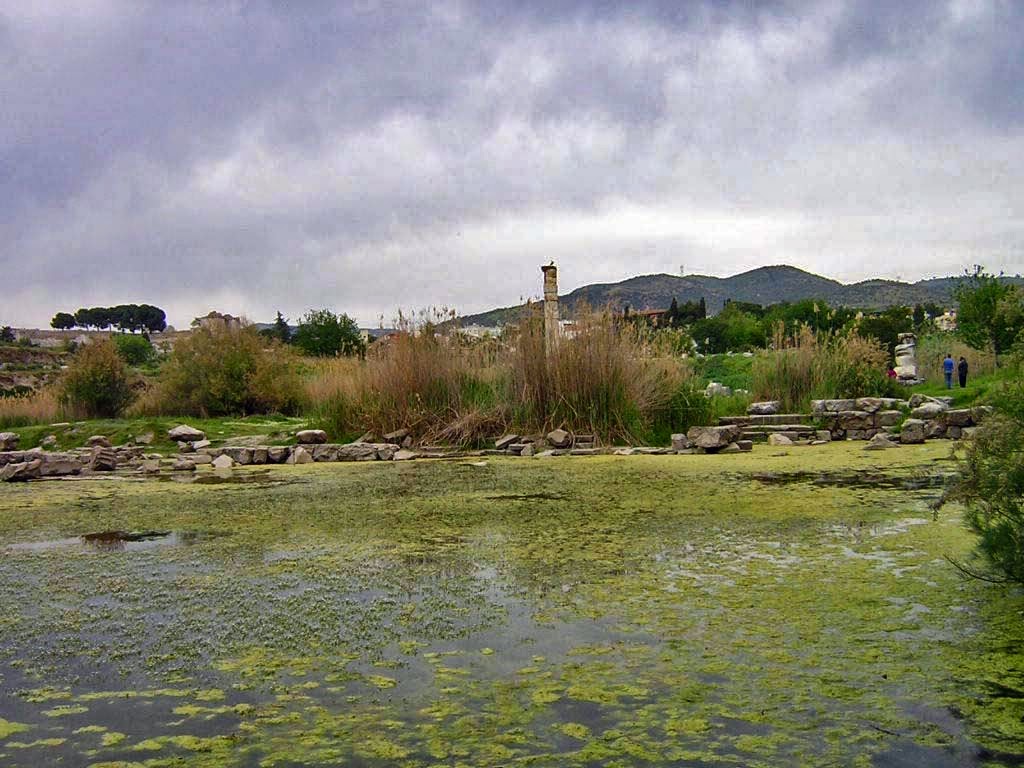
Unfortunately, all that is left today are some flooded foundations and a single not-too-well-reassembled column. The scattered remains go back to the time of Lysimachos, one of the generals and successors of Alexander the Great in the 4th century BC. In Alexander’s days, the city was centered on the Artemision. Lysimachos chose the location for the new town, which he surrounded with defensive walls. The place looks wild and overgrown, an eerie picture accentuated by the cackling chickens and screaming geese on the adjacent farm. At one time, even the gods made sure I heard them. The sky had turned pitch dark, and soon enough, the thunder rumbled while lightning flashes tore the clouds apart. A sign from Zeus, no doubt, but not from Artemis. Strangely enough, I was not surprised by the god’s manifestation.

After twenty years of rest, new excavations started again in 2014 because this year’s drought made the ruins far more accessible. Archaeologists hope to find remains from the Roman era, which may answer whether this famous temple was converted into a Christian church. In its present condition, it is not drawing much interest from tourists, but this may change when enough of the layout is exposed. After all, the sanctuary occupies the size of a football field, something worth considering, right?

Pausing at the edge of the poorly excavated parcel, I wonder about the traders, tourists, craftsmen, and kings who visited this temple over the centuries when it was a market and a religious center. They all came to honor Artemis and to share their profits with her. Excavations have shown that many people came to offer their gifts: gold and ivory statues of Artemis, but also earrings, bracelets, and necklaces from faraway countries like Persia and even India. An excellent collection of these gifts can be seen at the local Museum of Selçuk.

The temple may not have been finished when, in 268 AD, the Goths raided the city, destroying or partly destroying it. In 614, Ephesos was hit by an earthquake, severely damaging the buildings. The town lost its importance as a commercial center, aggravated by the silting up of the Cayster River that constituted its harbor.

While he was in Ephesos, Alexander received representatives from the towns of Magnesia and Tralles offering their submission. Parmenion was dispatched with a force of 5,000 foot soldiers and 200 Companion cavalry to ensure recognition by all Aeolian and Ionian towns in the area. At the same time, Alcimachus, son of Agathocles, set out with an equal force. They established a popular government replacing the existing Persian rule, ensuring that all would keep their own laws and customs and pay their taxes to Alexander instead of to the Persians.

Alexander, meanwhile, stayed in Ephesos and offered sacrifices to Artemis. It is probably at this time that he frequently visited the studio of Apelles, who became the only painter allowed to paint pictures of Alexander. We know of at least one painting made especially for the Temple of Artemis, in which Alexander was represented holding a thunderbolt. Apelles depicted the King using only four colors to create a more wondrous work. Alexander also organized a ceremonial parade of his troops in battle order, wearing their best outfit. He definitely knew how to put up a show!

Leaving the temple area, I drive up the nearby hill where it is said that the Virgin Mary spent her last days. From here, I have an eagle’s view of Roman Ephesos. In 190 BC, the city was included in the Kingdom of Pergamon, which, in turn, was incorporated into the Roman Empire in 133 BC and the later Byzantine Empire. In the early days of Christianity, Ephesos was still significant, if only because Apostle Paul lived here, as well as Apostle John, who is said to have taken care of Mary, who is buried here.

Of course, the Romans turned Ephesos into the largest seaport of the Aegean, which prospered till the harbor silted up, leaving the grand city about 6 miles inland from the coast. The most remarkable monument from those times is the Temple of Hadrian with the Baths behind it, the Fountain of Trajan, the Library of Celsus, and the magnificent villas (see: Ephesos and its terrace houses and The Grandeur of Ephesos).

Thursday, December 18, 2014

The grandeur of Ephesos

It is quite unusual that after so many years and so many visits, I never put anything in writing about beautiful Ephesos, the number one excursion for any tourist to the west coast of Turkey.

The first time I visited the site was during my very first tour of Turkey, and it must be said, with an incompetent guide who claimed he knew it all and treated us as little children. So I gave up listening to his incorrect explanations and drifted off into my own world. He took us to Ephesos in the morning, when huge crowds of visitors were spilling out of the many buses on what seemed like a large parking lot. I remembered my lack of breathing space, the loud talking of the many guides in different languages, and how a solid mass of people pushed me and carried me through the streets of old Ephesos – my greatest apprehension when I visited an antique site. Useless to point out that these circumstances were far from ideal and that my perception of this old city did not match any of the many photographs I had seen over the years with near-empty streets to tempt vast crowds of visitors.

Luckily, this unfortunate experience was soon obliterated by my next visit with Peter Sommer during his tour In the Footsteps of Alexander the Great. To my greatest surprise, the parking lot turned out to be much smaller than what I remembered, hardly filled by a handful of cars and maybe two or three buses. The streets of antique Ephesos seemed deserted this late in the afternoon, and the different buildings now truly showed at their best – the true way to look at the city from Alexander’s point of view. Only now did I see how beautiful this site really was! What a relief!


Ephesos, the Turkish Efes, has a magical ring that may go back to antiquity. I always saw it as the ideal Greek city in Asia Minor, where Alexander and so many other great men from times past had written history. So it was no surprise that my heart was skipping a beat! My first steps over the old pavement were insecure, for my legs were shaking, and my knees felt weak. How many sandals had stridden over these polished stones? How many people through the ages had walked here, all carrying their own burdens and having their own dreams? I ran my hands over the columns and walls, just to make sure they were real – and maybe, just maybe, they had something to tell me? I know this sounds crazy, but I can’t help it. At last, I was face to face with the past; it was so palpable, so very much alive!

Before heading to the main street, I followed the water supply system to a rather large round construction where the water was collected based on Archimedes’ laws. From here, and thanks to an ingenious system of earthen pipes, the water was distributed all over the lower city of Ephesos.

As I stroll down further, my imagination is taking wings! Past the Temple of Domitian lies the Odeon from 150 AD with beautifully preserved arches, originally used as a Bouleuterion with enough seating for 1400 officials. Like so often, the Odeon could be entirely shaded from the sun or the rain if needed. Behind me are the Baths of Varius, now richly decorated with bright red poppies. I marvel at the well-preserved and perfectly connected terracotta water drains all over the city.

At the Gate of Hercules, the passage suddenly narrows to open up again into Curetes Street. It seems that originally this 4th-century gate had an upper floor and was decorated with winged goddesses of victory. Curetus Street runs downhill, straight to the Library of Celsus, and is lined with columns on both sides from where wealthy and powerful citizens once looked down on me. Behind these columns runs a mosaic-paved sidewalk giving access to the cool vaulted shops and some official buildings. These are mere marble skeletons with drafty doorways and gaping windows that once must have created a feeling of safety and a certain complacency. Wooden doors with copper and bronze fittings would have locked out the street noise. The houses had no windows on the street side, only on the inside looking out onto the Atrium or the Peristyle. In summer, these spaces were shaded to keep out the sun and the heat, while in the colder winter months, the rooms were comfortably refurbished and enhanced with floor heating. This luxurious main street, I am told, was lit at night with torches – how I envy those days!

Further down the street, I pass the large Fountain of Trajan, once showing the emperor’s stately statue, and in its shade stands the marble Temple of Hadrian. The friezes from the entrance walls are copies of the originals now visible at the local museum of Selçuk. Yet it is great to have works of art, even copies, back in place to give an idea of what it must have looked like. With nobody walking in my way, I can step back for a better look, and the low sun adds just enough to the atmosphere to drift back in time. Behind this Temple of Hadrian, the Romans built their Baths in the fourth century AD, without forgetting the basic need for latrines, the public toilets in an adjacent room. They are simple cozy seats next to one another, where you sit above your own hole to do what you have to do. The underlying ditch is at least one meter deep and runs downhill like the main street. I just hope the water will run fast enough to keep the air clean. In front of the seats, there is a gutter through which water would be flowing and where you could dip the sponge on a stick to clean yourself.

Across the street from Hadrian’s Temple, I notice two spiraled columns, definitely marking a special entrance. For many years, archaeologists have been working hard to restore two of the seven villas of the rich and famous, generally called the Terrace Houses (see: Ephesos and its Terrace Houses). Two houses may not seem much, but they do total 78 rooms, no small residences dating generally from the first to the third century. The elegant frescos and marble or mosaic floors have nothing to envy to Pompeii or Herculaneum, they are simply superb. Many tourists skip this corner of Ephesos simply because a separate entrance fee is requested, but I think this is entirely unjustified. The glass walkways and stairs lead the visitors through the premises without obstructing the panoramic view. The colors are as fresh as if they were applied just yesterday, unbelievable! If there is one place to get a true feeling of the Roman lifestyle, this is the place!

With or without the stop at the villas, the visitor now reaches the Library of Celsus, which has been beckoning from the onset. It is indeed an impressive building with a carefully reconstructed façade, yet it is consistent with the grandeur and wealth of Ephesos. The high Corinthian columns support richly decorated ceiling caissons and frame the statues of four goddesses on their high pedestal, i.e., Sofia (wisdom), Arete (virtue), Ennoia (intelligence), and Episteme (knowledge). It was Consul Gaius Julius Aquila who built this Library around 105-107 AD for his father, a worthy present, I would say. The inside walls were once covered with colored marble and still vaguely show traces of the niches where the papyrus scrolls were kept. The space is quite grand, measuring 11 x 17 meters, and inevitably, I am reminded of Ptolemy’s library as shown in Oliver Stone’s movie Alexander. How I would have loved to roam here in those days!

Behind me is a strange, round structure that seemed unidentified at the time of my visit, but I recently heard that this could be the tomb of Arsinoe, Queen Cleopatra’s sister.

Through the three arches of the adjacent Gate of Commerce (first century AD), I reach the Agora, the marketplace that was surrounded by an impressive Stoa with Corinthian columns. This huge Agora covers a surface of 110x110 meters – quite incredible. The road from here to the connection with the road to the harbor shows deep ruts in the pavement, testifying to the heavy traffic that must have passed through. Excavations towards the harbor are still underway, and the area is not accessible yet. At the landside end of that street lies the huge theater, originally a Greek construction, masterfully nestled against the slopes of Mount Pion, that was renovated and enlarged by the Romans to offer seating for no less than 25,000 spectators. From one of the top rows, I have a sweeping view over the entire city, all the way to the green marshes now covering the ancient harbor. It is wonderful to sit here for a while to take in the scenery and imagine the hustle and bustle of antiquity.

Alexander saw, of course, a different city with different buildings, but the location and probably the layout of Ephesos were very much the same. For more about this, see Alexander’s presence in Ephesos.