The Paeonians
occupied the land north of ancient Macedonia and functioned as a
buffer zone with the Dardanians on their northern border. Bylazora, in fact, was
situated in a commanding position at the natural pass leading from Dardania
into Macedonia.
Philip V of Macedonia, who
ruled from 221 until 179 BC, captured Bylazora in 217 BC. By blocking the
Dardanian access road to Macedonia,
he freed his country from its repeated menacing raids. Perseus, Philip’s son,
who
succeeded his father, sent mercenaries to Bylazora to confront the Romans, but
he was defeated in 168 BC. He was taken to Rome
to be shown in their victory parade, together with the incredible wealth of Macedonia. The
rich kingdom became a mere Roman province.
Although Bylazora was the largest city of Paeonia
and was mentioned by Livy and Polybius, its location remained a
mystery. It was tentatively identified with (Titov) Veles, but the
results were inconclusive. As so often, the city was discovered by accident in
1994. Road works exposed a buried pool-like building close to modern Sveti Nikole in the Republic of North Macedonia,
some 50 kilometers
southeast of Skopje,
between the Axios and the Strymon
Rivers.
Excavations
started in 2008 after the Museum of Sveti Nikole invited the Texas
Foundation for Archaeological & Historical Research (TFAHR) to a joint cooperation.
It was a slow
process of searching for clues that started at the top of the hill, the
Acropolis. Soon, a section of the northern defensive wall was exposed, followed
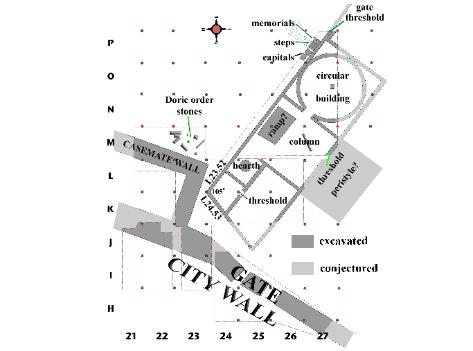
by the discovery of a ramp leading up to the Propylon. Next, a Stoa with Doric
columns was identified and dated to the days of Philip V based on a similar gallery built by Attalus II in Athens.
A long wall and
successive rooms were unearthed, making the archaeologists realize they had
found the Palace of Philip V and
Perseus, the last two kings of Macedonia.
The first room
they explored had all the characteristics of a kitchen, with a fireplace, much
pottery, plates, vessels, and amphorae from the 3rd-2nd century
BC. The walls were covered with a thick layer of plaster with traces of paint.
Followed a room with columns and capitals, which was named Ante-room since it
connected to a more important Tholos. For those who visited the Palace of Aegae in Greece,
that space is very recognizable. On the other side of this Tholos lies the
Entrance Hall, which in turn is connected to the Vestibule. This large room
opened onto the Outer Courtyard via a monumental staircase.
Keeping the
layout of the Palace
of Aegae in
mind, the archaeologists projected the same series of rooms around the Inner Courtyard.
The picture seems to fit perfectly. It also matches the Palace
of Dimitrias, situated
just south of Volos
in Greece.
The city was built by Demetrios Poliorcetes
when he was king of Macedonia,
i.e., 294-288 BC.
Until now, and as
opposed to Aegae and Pella,
I had no knowledge of the Macedonian Palaces of Bylazora or Dimitrias.
The destruction of the Palaces of Aegae and Pella by the Romans is well-documented.
Dimitrias,
however, was entirely dismantled, and it is assumed that the same happened in Bylazora,
although it was never finished.
Much more
pertinent information with clear maps and unique details can be found in this lecture given by Dr.William J. Neidinger of the TFAHR.
[Pictures from TFAHR]



BYLAZORA with location at Knezje, Sveti Nikole is scam, invited by Mr Ivan Mikulcic. Bylazora was not at all even been a capital of Paeonia, it is a lie produced by tWilliam Neidinger!
ReplyDeleteOn what basis? Can you document your statement?
DeleteMy postulation is based on what Polybius said, that Bylazora was located at a pass, of importance for defense of Macedonia from incursion from DARDANIA, and that Philip V took control of at least of two passes. From Veles you are able to pass the Babuna mountain and enter Pelagonia, or if you go along the right side of the river Vardar you are reaching the area of Stobi. Note, if the Bylazora was the capital of Paeonia with location at Knezje, Sveti Nikole, then you can ask you self, what that Dardanian army do at Bylazora at Knezje, and how they managed to attack Macedonia by needs to pass the impassable river Vardar, that is a natural barrier for a such task.
ReplyDeleteSIMPLY, Mr Ivan Mikulcic made the mistake to relocate Bylazora from Veles to Knezje, on bare obsevaston that at Knezje he observed spills of ceramic, by saying that at Knezje must existed the largest Paeonian city, Bylazora. Later, Mr William Neidinger invented that Bylazora was the capital of Paeonia, and the lie that at Knezje was unearthed a palace of PhiliP V. Pure nonsense!!!
97. At about the same time Philip occupied
Bylazora, the largest town in Paeonia and very
favourably situated as regards the pass from Dar-
dania to Macedonia. So that by this conquest he
very nearly freed himself from the fear of the
Dardani, it being no longer easy for them to invade
Macedonia, now that Philip commanded the passes
by holding this city. After securing the place, he
dispatched Chrysogonus with all speed to collect
the levies of upper Macedonia and he himself with
those of Bottia and Amphaxites arrived at Edessa.
The issue is very confusing, indeed. William Neidinger did excavate a section of a larger city in Knezje with walls and rooms (including a Tholos) that remind of the Macedonian Palace of Aegae.
DeletePolybius, as you say, cannot be ignored. He clearly states that Bylazora commanded the pass between Dardania and Macedonia, for which Veles is the best candidate so far.
The problem for archaeologists is to put a label on their finds. This situation is not new. The ruins of the Palace in Aegae, although discovered by Léon Heuzley in 1856, could not be identified as such until a century later by Manolis Andronikos. Until then, it was thought that Aegae was to be found in Edessa.
Thank you for your comment.
What about possibility that the town of "Philippoupolis in Parorbelia" existed on location at Knezje?
ReplyDeleteAs we know Philip II defeated Paeonians and with aim to rule Paeonia, Philip II must have founded the city of "Philippoupolis in Parorbelia", as military and administrative center to keep under control the subdued Paeonians. On the archaeological site of Knezje there already must have existed the prominent Paeonian city of Psaphara, and later the city of Antigonea in Paeonia, when Antigonus Gonatus II rulled with Macedonia and Paeonia, https://www.pollitecon.com/Assets/Ebooks/Philippoupolis-in-Parorbelia.pdf
I am not aware of Philippoupolis in Parorbelia, only of Pilippopoulis, the later Plovdiv in Bulgaria.
DeleteKnezje sounds like a good candidate. Only time will tell.
Yes, lack of information makes things difficult to understand, however if you read Strabo then you must get some clue of the location of Philipopolis in Parorbelia:
ReplyDeleteFull text of "The geography of Strabo"
In the interior, in a valley, which commences at Idomene, are situated Callipolis, Orthopolis, Philipopolis, and Garescus.
As we know Idomene is located on the bank of Vardar, and if proceed upwards along the valley of Vardar, you are at town of Garescus, where also later existed the episcopal town Zapara: https://www.pollitecon.com/Assets/Ebooks/Garescus-and-Zappara.pdf
Orbelus, Orbelia and Parorbelia is a mountain region nearby, and along the left side of the river Vardar which one is identical with the mountain Osogovo, Osogovia, Osogovsko. The identifications about that Orbelus is the same as Osogovo was made by Invan Cvijic, like some others, and even miss placed on on the internet map.
The Geography of Strabo/Fragments -
Near the Agrianes is situated Parorbelia of Macedonia. In the interior, in a valley, which commences at Idomene, are situated Callipolis, Orthopolis, Philipopolis...